Category: Responsible Parenting & Smaller Families

  • The ‘One Billion Americans’ Idea: Are We Missing the Point?

    The ‘One Billion Americans’ Idea: Are We Missing the Point?

    Matthew Yglesias’ new book, “One Billion Americans: The Case for Thinking Bigger,” is the thought experiment the title implies: exploring policies that might increase the population of the country threefold by using incentives to create larger families and increased immigration. The book has been harshly critiqued by most reviewers for its nationalistic admiration of China, confusing quantitative growth with sustainable human development, ignoring and naively dismissing the environmental consequences of its proposal (the sort of thinking that created the climate crisis), reinforcing a patriarchal vision of women as mothers, and more.

    Its title goes far in revealing the fundamental worldview of the author: People are numbers, and babies are economic inputs. But did his reviewers miss a key point in their critiques? Could he have been focused on something other than a target population?

    Obviously, nothing about current trends suggests that a United States of 1 billion of more people will ever happen, and Yglesias admits the same. Quite the opposite, in fact: Smaller families are considered one of the great successes in development, and the trend toward smaller families, which is the most effective long-term way of mitigating the climate crisis, seems likely to accelerate rather than reverse.

    So why write an apocryphal proposal? It’s possible that Ygelsias is doing something more sleight of hand with this book. Despite urging lager families, his book necessarily focuses on one driver for its audacious proposal: immigration. He does so right before an election in which immigration features prominently. And he does so from an economic perspective that many conservatives and fence-riders will appreciate and could be swayed by.

    Beyond Economies, Toward Becoming a Democracy

    But in raising these issues, Yglesias (and almost all of his reviewers) reveal a deep and common conceptual error, the one at the core of his book. He thinks the United States is defined by physical borders. He thinks we are a group of people competing against other groups of people elsewhere in the world, defined by the invisible lines around them, or the historical borders and the militaries that defend them.

    That conception does not capture the essence of the United States. The United States is defined from the inside out by its Constitution, at the center of which is the idea that political authority and legitimacy derive from the people, or more accurately, from each person rather than any collective. This error presents a serious problem for Yglesias.

    How can we invest sufficient resources in each child, while at the same time creating so many, both here and in places from which persons will immigrate? How can we assure equality — or equal opportunities for each child — and follow Ygelsias’ advice that we simply produce more people irrespective of one’s economic birth position? How can 1 billion people have a meaningful say in their federal governance? The United States isn’t about counting people as much as it is about making each person count, first and foremost in terms of their voice in democratic lawmaking.

    If we take seriously the idea of authority and legitimacy as deriving from “We the People,” we might understand that rather than having been constituted in the past by godlike founders, the United States is instead constantly constituting or deconstituting, with each new member, depending on the values at play. And we might understand that which way we go first depends on how the body of people in the United States does or does not reflect the ideal of self-governance. If people are the fundamental source of power, how could we not see our nation in this way?

    This way of thinking could give us a new political border, one very different from lines on a globe and the mind-numbing simplicity of the political left and right.

    A New and Singular Political Border

    Seeing the new and universal political border as defined by the creation of persons exposes very different ways of thinking about who those people should be. One way, reflected in the “baby bust” and “underpopulation”  discourse popular in both left- and right-leaning media today (the message Yglesias favors) pushes for creating more and more people to increase gross domestic product, through new future laborers, instant consumers, and an ever-growing tax base. There is no assurance that each of those children will have a fair start in life; we have to ignore that black families have one-tenth of the wealth of white families in the United States. Impacts on the environment are also ignored, as are impacts on democracy. We cannot ask whether each of the children born will experience the true inclusivity of having a meaningful voice, not lost in the crowd, in their governance.

    A different way, however, would prioritize these values in deriving more cooperative and child-centric policies for the way we should plan our families. The former is about counting people; the latter is more about making people count. The former exudes the greed, masquerading as amoralism, of markets; the latter reflects the inevitable and specific objective values that human rights and political self-determination that require: equal opportunities in life, small political units where power is decentralized, and the freedom from others inherent in nature.  

    Arguably, the latter is closer to any coherent conception of the United States and must prevail. We have to create people capable of participating in town halls, rather than simply populating shopping malls, because in a democracy, the latter is governed by the former. Political freedom precedes economic freedom. And as recent scholarship has pointed out, we will remain in relative states of preconstitutionality and illegitimacy (and will resist reaching the Sustainable Development Goals) until we have those policies. Note that this approach moves us toward the idea of open borders: If freedom of movement requires the absence of blocking borders, it would also requires family planning that produces people — in quantity and quality — capable of maintaining such a system. Travelers would not be “othered,” because they would be born of a family planning norm to which we all agreed, rather than the “nobody else’s business” model we use today.

    Rather than a rally cry for growth as a means of competing with other countries, Ygelsias’ book may reveal a new border within all nations, and a division between preconstitutional people (or “precons”) and those committed to the inescapable and objective values behind the as-yet-unrealized democratic ideal of the United States and many other nations. Rather than more bodies to fuel an economy, the next part of this conversation might focus on more qualitative questions, such as whether every child deserves a socially and ecologically fair start in life. That focus, rather than treating the way we plan our families as “nobody else’s business,” is the key to the future we and our kids deserve and the realistic policies to get us there.
  • Urge Time Magazine to See Falling Fertility As An Opportunity, Not A Crisis

    Urge Time Magazine to See Falling Fertility As An Opportunity, Not A Crisis

    Time recently highlighted the issue of changing fertility rates as a harbinger of a new era for the United States. But the author, Eliana dockterman, errs in thinking changing our old ways, where unsustainable population growth meant free money in the form of new bodies inflating gross domestic product, is a bad thing.

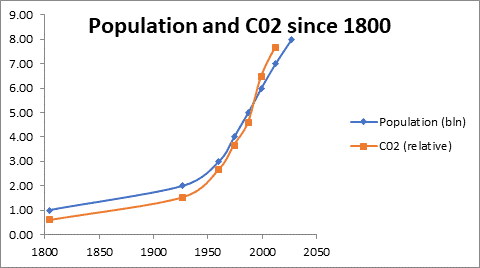
    Falling fertility rates are part of the overall trend towards population stabilization and gender equity, some of the greatest successes of our time. 

    It’s key in this process that we stabilize at a sustainable level – and given the climate crisis (which Docketerman never mentions) – we need smaller families to hit a safe level and we need them now. Delayed fertility and smaller families are one of the greatest ways to mitigate climate emissions. As we change average family sizes  and get over our addiction to growth, we are presented with another opportunity. Can we use new family planning policies to eliminate other crises, like the economic disparity, where the average black family has one tenth the wealth of the average white family in the United States?

    Yes we can, through policies designed to distribute wealth in ways designed to give every child a fair start in life.  Growth had to end sometime – hopefully it’s not too late. 

    Take action: Urge Time’s editor, Edward Felsenthan (@efelsenthal) to talk about better ways of planning our families that can make a brighter future for all.

  • Who’s Pushing Poor Family Planning?

    Who’s Pushing Poor Family Planning?

    Younger generations are responding to the climate and other ecological crises by doing the most effective thing possible: Choosing smaller families. And while that’s great, there is still a lot of work to be done today, like enshrining the change in our laws and policies, and twisting the quantitative trend to make it more qualitatively equitable, by taking the resources necessary to fund cooperative family planning systems that give every kid a Fair Start.

    So who’s pushing back against this change? The obvious culprits are governments and big businesses that built their power on an unsustainable wave of new consumers, cheap future labor, and complaint taxpayers.

    But another category includes older generations – the ones that failed to prevent the population explosion driving the climate crisis – who can’t see beyond their way of doing things. The Independent featured a great example recently, with an author bemoaning how smaller families threaten the bonds of siblinghood. Should we risk the ecological collapse of our planet because we are unable to raise kids capable of bonding beyond their own blood relations? Perhaps we need to think out of the boxes the created the mess we find ourselves in today, and think of bonding and community in more advanced and sustainable ways.

    TAKE ACTION: The media is failing its journalistic obligations to report on what really matters to people: Effective solutions to the world’s greatest problems. Email us at media@fairstartmovement.org for guidance on how to submit op-eds and contact reporters to help news outlets do their job.

  • Worried About Bringing a Child Into the World? Speak out Here.

    Worried About Bringing a Child Into the World? Speak out Here.

    Many young people around the world are rethinking becoming parents, and are deeply concerned about bringing a child into a world beset by a climate crisis, pandemics, and growing inequity and civil strife. Why are we faced with this?

    Almost every crisis before us – from the collapse of our environment to the gap between rich and poor – starts with family planning policies and cultures that do nothing to promote responsible family planning behavior. And in addition to policies and culture, today thoughtful and caring young people have to worry about having one child, even when they are ready to care for that child, because older generations consistently had unsustainably large and unplanned families. Today, would-be parents are in a dilemma because of the family planning systems older generations created, and the “nobody else’s business” approach to having kids that persists today and that is destroying our environment and communities.

    As one Having Kids supporter, who is keen to have one child one day, wrote:

    I am annoyed and dismayed to learn that one of my colleagues in local government is pregnant for the fifth time! How can you bring another child into the world given the state of the planet? This is selfish and irresponsible. Not only for a kid who will not receive the attention they need, but for everyone else. The current population is unsustainable and the planet is dying. Look out the window. We don’t need another mouth to feed, another Costco account, more plane rides, cars, etc. Why are my taxpayer dollars paying for your selfishness? Policies need to change to protect all children and curb this selfish and ignorant behavior. People need to take responsibility for their children, future generations, and the planet. If you want more kids adopt.

    The best solution to the dilemma is to change the way we all plan our families, and to demand laws and policies – and the cultures they shape – that promote parental readiness, a distribution of resources that give all kids a fair start, and smaller and more sustainable families.

    Take action:

    Speak out – send us your story at info@fairstartmovement.org.

    And: Urge key United Nations agencies to use their positions to help usher in the change we need.

  • Factory Farming is Fundamentally the Product of Poor Family Planning Policy. Take Action.

    Factory Farming is Fundamentally the Product of Poor Family Planning Policy. Take Action.

    Cory Booker is spot on in targeting the industrial agriculture complex that is destroying our environment and health.

    But he could go further, and be much more comprehensive and effective.

    That complex was created in response to, and is driven by, ballooning population growth. It also exploits and exacerbates the growing gap between rich and poor, in terms of who consumes and who produces the animal products. Booker should connect the dots, and tie his attack on factory farming to a new version of the guaranteed minimum income for children, or “baby bonds,” proposals he is known for. Specifically, those bonds could be funded by taxes on the biggest factory farming conglomerates, and be modified to incentivize smaller families that cooperatively exchange resources to give all kids a fair start in life. This would cut demand for the products of factory farms, restore our environment, and also restore the middle class – including middle class farmers – that is the antithesis of the toxic corporate structure at the heart of the United States food system. 

    Urge Booker to take a more comprehensive and effective approach. Contact him here.

  • The Most Fundamental and Effective Social Justice Reform Possible

    The Most Fundamental and Effective Social Justice Reform Possible

    The right to have children comes with responsibilities on parents and their communities that protect us all. The United Nations is using a decades-old pro-growth family planning model that ignores those responsibilities and hurts kids. That model is fundamentally driving ecological crises and the climate crisis, child poverty, and growing inequity across the globe. That model exacerbates the risk and impact of pandemics, and prevents our reaching the U.N.’s Sustainable Development Goals. That non-inclusive model exploits children more than it invests in them, thereby driving political illegitimacy.

    But groups and individuals from around the world are signing on to an effort to change the old model, which is focused on what parents want, toward a new model that focuses on what all kids need.

    The new model is called Fair Start family planning, and it is the beginning of real social justice. The reform can begin with the United Nations secretary general simply acknowledging the need for change.

    Sign on, and urge any organization you support or can influence — nonprofit or for profit — to also sign on. Sign here or contact us at info@fairstartmovement.org for more information.

    Help support this effort and you support new family planning policies that can reduce poverty and inequity, and mitigate the climate and other ecological crises, on a scale of 10 to 20 times non-family planning measures.  

  • Ecological Destruction Starts With Poor Family Planning. Take Action.

    Ecological Destruction Starts With Poor Family Planning. Take Action.

    This video was recently shared by a supporter:

    THE FACTS ARE CLEAR:

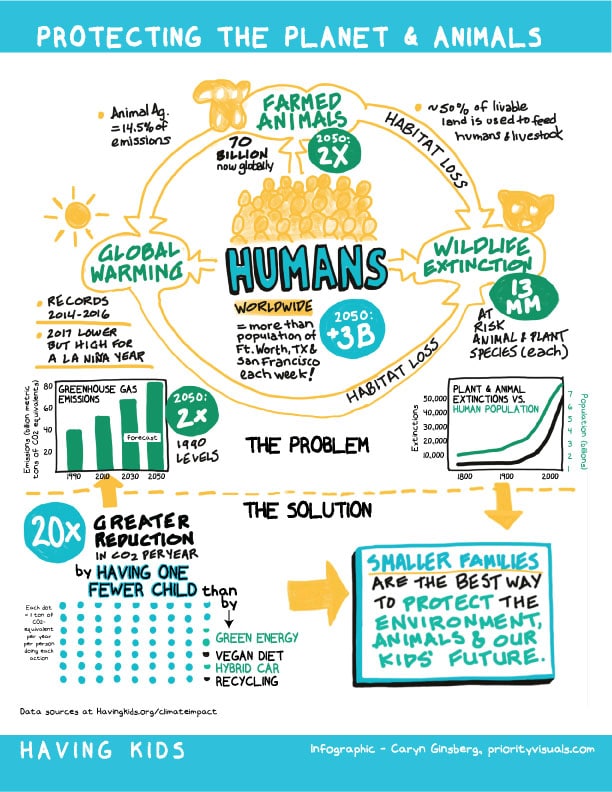
    • The most effective way to address many of the impacts on our environment and other species, such as climate change, is to choose smaller families. In fact, it’s 20 times more effective than changing diet or forms of transportation.  
    • By 2100, world population could vary by billions of people, depending on whether the average woman in the world today has one child more or one child fewer in her lifetime.
    • Child-first family planning provides a clear human rights-based solution and path forward. It’s sustainable and equitable, and it’s reflected in the worldwide trend toward smaller families that can invest more in each child and ensure a safer future.

    TAKE ACTION:

    Urge the United Nations to do what it was created to do: protect all of our futures by adopting Fair Start family planning policies: https://secure.everyaction.com/gZiWOydZ_0m7kxrlfD5OjQ2

    Urge any charities you support to commit to better family planning policies. which are the most effective way to protect kids, animals, the environment, and democracy: https://fairstartmovement.org/organizations-joining-for-world-population-day-at-the-u-n/

  • Pandemic Parenting: How Did We Get Here?

    Pandemic Parenting: How Did We Get Here?

    Parents and their kids are suffering under the weight of the Covid-19 pandemic. A recent study shows significant declines in mental well-being for families with children as the quarantines drag on and other crises loom.

    What went wrong?

    Our family planning policies, cultural attitudes, corporate advertising, and other factors have historically pushed women to have kids, often before they’re ready, in order grow the economy. These forces not only created overcrowded and unhealthy conditions that helped the pandemic spread and created ecological impacts such as the climate crisis that are setting the stage for the next pandemic.

    Who created such policies? Elites at the top of the economic pyramid made these policies to ensure big business a constant stream of cheap labor and hungry consumers. Politicians went along because more taxpayers meant bigger government. The people who pushed population growth, instead of human rights-based policies, are responsible for much the suffering we are experiencing today.

    It’s time to turn the tables.

    We have a right to the wealth and resources being hoarded by companies, rich families, and bloated governments — those with disproportionate power who are blocking real democracy. That money belongs to us. The best way to use this wealth would be to reverse the unsustainable growth paradigm and replace it with policies that move us toward 1) parental readiness, 2) ensuring every child a fair start in life, and 3) smaller and more sustainable families.

    Take action: Urge Congress to reverse the exploitation of families and to instead embrace Fair Start family planning.

  • New Survey: Education on Family Size and Population Growth

    New Survey: Education on Family Size and Population Growth

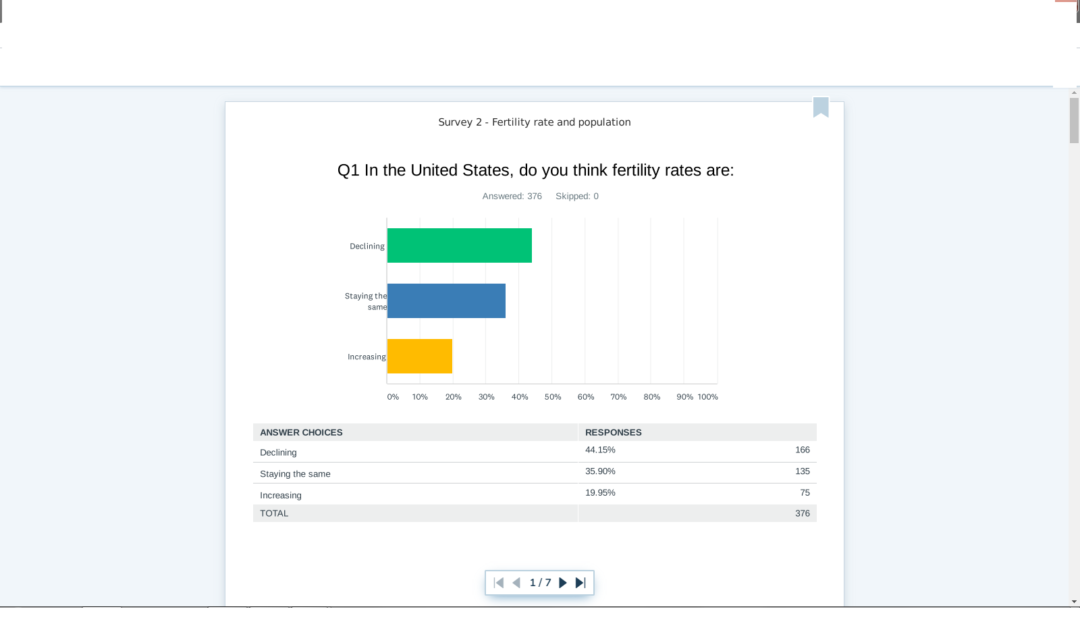
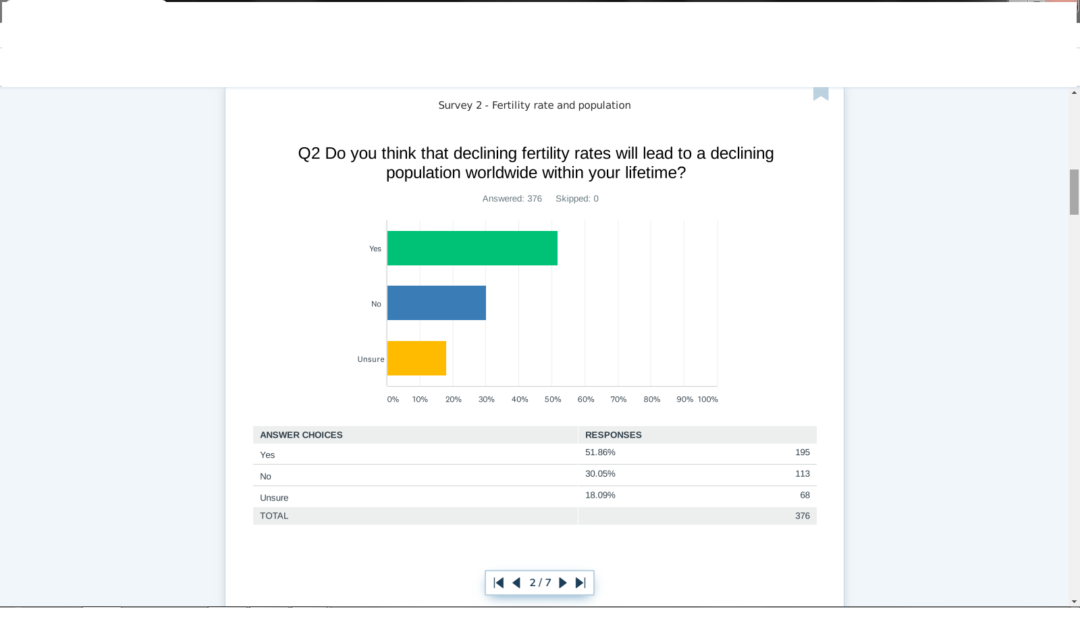
    Having Kids recently surveyed 376 people regarding their understanding of family size and population growth.

    • A significant number of people correctly see a relationship between family size and human population. About 86% of respondents answered affirmatively when asked whether there is a relationship between the number of children a couple decides to have and human population.
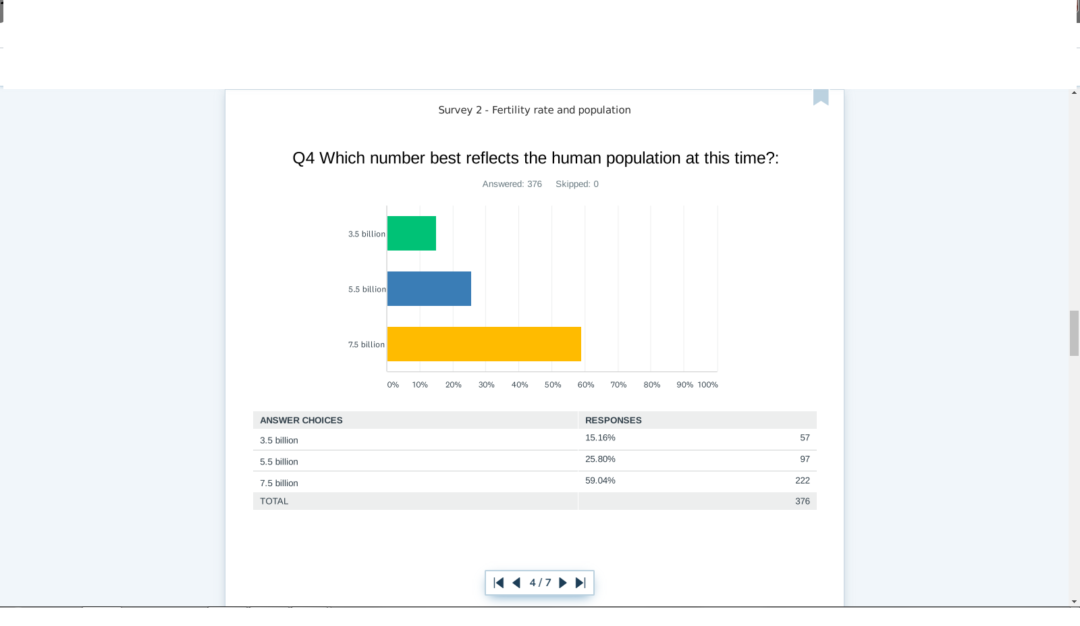
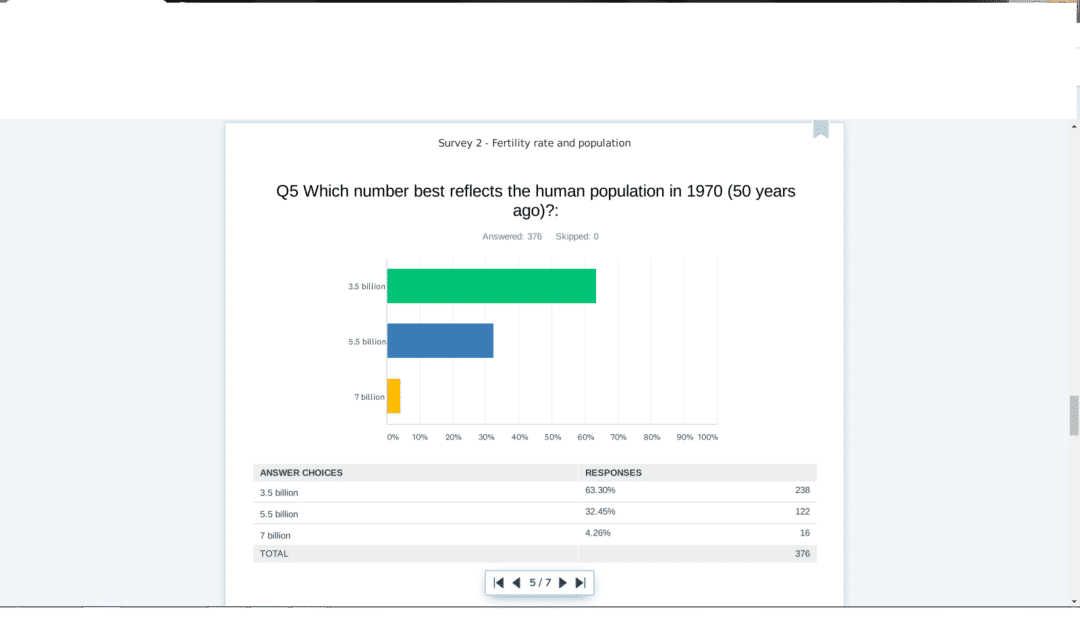
    • Though a majority of respondents have an accurate picture of current population numbers and those 50 years ago, a notable minority do not. Forty-one percent of respondents think the current number of people on the planet is either 3.5 billion (15.25%) or 5.5 billion (25.8%) instead of the correct answer of 7.5 billion and that the population in 1970 was either 7 billion (4.3%) or 5.5 billion (32.6%) instead of the correct answer of 3.5 billion.
    • Support for Having Kids’ mission remains high. Seventy-two percent of respondents indicated they would be supportive (36.3%) or very supportive (35.4%) of an organization pursuing Having Kids’ mission.
    • More education is needed regarding both the current population numbers and the expected growth of these numbers.
    A survey chart shows U.S. opinions on fertility rates: 45.94% think rates are declining, 35.99% say staying the same, and 18.08% say increasing. Bar graph and response table are displayed.
    A survey question asks if declining fertility rates will cause a worldwide population decline within respondents lifetimes. Bar chart: Yes (166), No (53), Unsure (77). Table repeats responses. Total: 296 answered, 0 skipped.
    A survey result screen shows a bar graph and table. The question asks about a relationship between family size and human population. 323 answered Yes, 25 No, and 28 Unsure, out of 376 total responses.
    A survey graph showing responses to Which number best reflects the human population at this time? Most respondents chose 7.5 billion, followed by 6.5 billion and 3.5 billion; results are also shown in a table below the chart.
    A survey question asks about the human population in 1970. A bar graph shows most respondents (62.63%) chose 3.5 billion, 28.29% chose 5.5 billion, and 9.08% chose 7 billion. Total responses: 381.
    A survey results chart shows support levels for an organization promoting cooperation between prospective parents. Most respondents are very supportive or supportive, with fewer neutral or unsupportive responses.