Category: Campaigns & Accountability

  • Thirteen Tortured Kids: Watch the Abuse Continue or Take Action?

    Thirteen Tortured Kids: Watch the Abuse Continue or Take Action?

    David and Louise Turpin beat, choked, starved and shackled their own children, year after year, hidden in the plain view of their own community. The children will suffer permanent physical and cognitive damage, some of whom weigh half of what they should, having been taunted with food as punishment, punishment they would be given no matter what they did.

    What’s the worst part? This will happen again and again, to children around the county, because while we will watch these cases like voyeurs, we will do nothing to stop it. Child abuse and neglect in the United States is everywhere, and it will continue. Why? Our current system tries to prevent mistreatment by waiting for it to happen, punishing the parents and hoping other abusers will take note, and waiting for the next case. Children remain invisible until they are harmed and become visible to the state. That is why we don’t find it insane to talk openly about how citizens can detect if people in their community are torturing their children, when it might be saner to ask why someone who tortures a child has kids at all.

    The Turpin case should remind us of this simple fact: Once the abuse happens we have failed. There is no way to undo that harm, for the kids, and for the community that will absorb its impacts.

    This after-the-fact approach to child protection begins at the source of child-parent relations, with a parent-centered family planning model that treats the act of having and raising kids as a hidden, personal, and private matter left to the parents, irrespective of the impact on the children and the community. The Turpins lived that model, one of using children for self-gratification, and even had plans to use their massive family to launch their own reality show like the Duggar family. The Turpins, like many massive families that have kids out of questionable motives (including religious ones), love their kids the way a factory owner loves its products – for the benefits they bring. For these dysfunctional families, family planning is all about the parents, not the child or the impact of the family on the community.

    The good news is that many are starting to question that model, and focus more on preventing harm than reacting to it. Here’s how:

    Courts around the country have at times issued court orders preventing some parents from having more kids. These orders have often been upheld, against challenge, as constitutional and reasonable limits on the right to have children. These brave courts are pushing a norm change that would move us from the old parent-centered and property family planning model to a child-first model focused on assuring children a minimum level of well-being at birth, and the community all the benefits that assurance would bring. This isn’t requiring parents to have a license to have kids – but it is thinking ahead. What’s a good analogy for what these courts are doing? Imagine the norm of free speech had no limits – if speaking freely included the right to incite riots, use subliminal advertising, create and display child pornography. Court are beginning to build nuance and responsibility into the right to have children where, unlike free speech norms and thanks to parents like the Turpins, it is conspicuously absent.

    These courts are establishing this simple principle: Children should not be born into abusive and neglectful situations. Until we can say that, as our shared belief, we will maintain a system that does not value children and the community, but focuses myopically and senselessly on the parents and their exclusive rights of property and control. We will maintain a right to harm others. People do not like giving up their right to control others, but until we can change family planning norms, cases like the Turpins will continue.

    Changing family planning norms, from one where parents ignore the impact they have on others to one based on shared values, will improve the world in many ways beyond preventing child abuse. Moving towards smaller and sustainable families, because parents have begun to act out of concern for the environment their children will inherit and need, is the most effective way to mitigate climate change and create the smaller and more resilient populace required for people to thrive in a more challenging future. It is also a model built around this simple fact: The fewer children parents have, the more time, resources, and energy they can invest in their child, demonstrating their love through action. And that increased investment creates real outcomes.

    Moving to a child-first model also helps women around the world, because the old parent-centered model – applied in the power dynamic of tyrannical patriarchy – has simply become a husband and male-centered model where women are seen as perpetual mothers. Changing family planning models also carries the promise of revering the massive gap between rich and poor by focusing on its genesis, and using cooperative family planning to peg the commonly accepted principle that everyone deserves equal opportunities in life to the less acceptable process of serious resource reallocation.

    It’s no surprise that this change in norms is facing reactionary pushback. Many, including those that see themselves as progressive, will not want to cede their parental control and will oppose moves like legislation that would authorize courts to prevent child abusers like the Turpins from having more kids. They will think child-centered planning will negatively impact underprivileged families, when in fact establishing and implementing a child’s right to a fair start in life provides the moral basis for cooperative resource reallocation in a way that could eliminate poverty. Moreover, model court orders could be limited to the most egregious cases of abuse and neglect only, exclude any form of coercion including jail time and fines (instead using a form of nudge theory), but instead rely on their expressive force and any appropriate non-coercive interventions, like the appointment of guardians ad litem for future children. These orders could also be designed to account for the principles of affirmative action, and structural inequities of race, class, gender, national origin, etc.

    More commonly, right wing extremists and climate change deniers will resist the change the way they resist all encroachments on that which they few as their private property. Many of them are already defending the child-as property systems that enabled the Turpins.

    But failure to take action, through the state, is a reinforcement of parent-centered thinking, and not an option for those who really want to protect children. How can you act to further this change in family planning norms that will prevent child abuse, improve our environment, and target the massive gap between rich and poor? First, you can use your voice, speak out, and break the taboo: Say openly that the right to have kids comes with responsibilities, to the children, the community and the environment. Second, you can promote and help pass legislation that would authorize courts to prevent abusers like the Turpins from having more kids, and move us towards child-first family planning by changing our child welfare system from being reactive to being proactive. Why take public action? Many progressives think that by going child-free, or having one well-cared for child, they have done their part. But the worst possible result would be for the most thoughtful and caring people, the best parents, to exit the process entirely and reinforce the old model of family planning, the model of isolated decision-making and walled off children.

    Third, you can act locally and urge your community to adopt family planning measures, and support for smaller and sustainable families, as part of their climate action plans. Fourth, you can advocate for a federal tax system that proactively promotes equitable family planning rather than reactively offering measly and pronatal child tax credits that ignore every child’s right to a fair start in life.

    Let’s not gawk at the story of the Turpins. Let’s take action to prevent cases like this from happening again, by starting at the source and reforming our family planning systems. We will not be valuing and protecting the most vulnerable among us – children, animals, and the environment, until we do.

  • Take Action: Thirteen Kids Tortured in Perris House of Horrors

    Take Action: Thirteen Kids Tortured in Perris House of Horrors

    Having Kids is calling on Governor Brown, as well as the California Bureau of Children’s Justice, to investigate the “house of horrors” in Perris, California where parents apparently shackled and tortured up to thirteen children over an untold number of years. Under law, the state was ultimately responsible for the children, and Having Kids is asking the Governor to investigate the responsible agencies in Riverside County for having failed to protect these children.   

    Read the letter here. 

    To prevent this from happening again, Having Kids is also asking the Governor to work with California legislators to pass legislation that authorizes courts, in specialized cases, to issue orders preventing abusive and neglectful parents from having additional children. (For details, please see fairstartmovement.org/theproblem/ and fairstartmovement.org/solution-fair-start-orders/)

    Why would we allow the culture of family planning and familial privacy that caused this disaster to continue?

    Anne Green, Executive Director of Having Kids, had this to say: “Will such a law help the Turpin children? No. But it will mean beginning to take family planning and parenting seriously, so as to prevent more victims like the Turpin children.”

    “It will reflect the simple and irrefutable principle that parents known to abuse and neglect children should not have more. If California takes its responsibility to protect children seriously, it will learn from the disaster of the Turpins and make necessary changes.”

    In just the past year, national statistics estimate 1,670 to 1,740 children died from abuse and neglect, despite underreporting. This means at least four children die every day from child abuse. The recent opioid crisis in the U.S. has only accelerated the problem, with new foster care cases involving parents using drugs hitting the highest point in more than three decades of record-keeping, accounting for 92,000 children entering the system in 2016, according to data by the U.S. Department of Health and Human Services.

    Take action: Write Governor Brown and ask him to act on our letter as soon as possible.

  • The Solution: Fair Start Orders

    The Solution: Fair Start Orders

    [et_pb_section fb_built=”1″ admin_label=”section” _builder_version=”3.22″][et_pb_row admin_label=”row” _builder_version=”3.25″ background_size=”initial” background_position=”top_left” background_repeat=”repeat”][et_pb_column type=”4_4″ _builder_version=”3.25″ custom_padding=”|||” custom_padding__hover=”|||”][et_pb_text admin_label=”Text” _builder_version=”4.7.7″ background_size=”initial” background_position=”top_left” background_repeat=”repeat” hover_enabled=”0″ sticky_enabled=”0″]

    Updated March 25, 2018

    Taking Child Abuse Seriously Through Better Family Planning

    Two parents left their nine-month-old twin daughters, who each weighed about eight pounds when investigators found them, to starve to death in playpens filled with maggots. The couple told authorities they felt overwhelmed taking care of the children while working long hours.

    A parent and others abused a five-year-old boy over the course of several months, beating the boy so severely that he suffered two strokes and had multiple broken bones. He had been locked in a room, bound with duct tape over his eyes, and struck with belts and a hammer.

    Parents tortured and killed their three-year-old, who died from blunt force trauma to the stomach. There was evidence they had previously used torture as punishment, as investigators found whip marks, cigarette burns, and fingernail gouges.

    These are just a few of the endless stories of children, tortured and killed by their own parents in the past year alone.

    ***

    National statistics, despite underreporting, estimate that 1,670 to 1740 children die from parental or caregiver abuse and neglect in the U.S. annually. And many of the perpetrators continue to have and abuse additional children.

    We can prevent these horrors by focusing on the root of the problem: a one-sided, inequitable family planning model that prioritizes a parent’s desire for as many children as he or she pleases, and at any time and place in the parent’s life, over a child’s most basic needs. This model of family planning isolates parents in their decision-making, prevents cooperation that could help close the gap between rich and poor, ignores the massive impacts family planning has on our natural and social environment, and has prevented progressive reforms over the past several decades.

    Recognizing that studies continue to link child abuse to poor family planning, as well as the fact that our after-the-fact public child welfare systems are a failure, Having Kids proposes a new family planning model that balances the interests of parents, future children, and the community in accordance with fundamental human rights and constitutional principles.

    In the process of family planning, future children as well as other species stand out – more than parents – as the most vulnerable entities. We need a family planning model that protects them.

    Such a foundational change in the way we plan families will require a multipronged approached aimed at all levels of government through a diverse coalition of nonprofits and community members who understand and appreciate that family planning is the most effective means of maximizing child welfare, promoting equality, strengthening democracy, halting climate change, and saving endangered species, including our closest biological kin.

    However, it is in the context of serious child abuse and neglect cases that the horrific consequences of the current family planning model become most stark and widely objectionable. And as such, it is in this context that widespread norm change is most likely. Any serious attempt at modifying the underlying norms that continue to spur unsustainable population growth must include proactive child welfare interventions, with measurable changes in our legal regime that actually further children’s interest. Changes here can act as a litmus test to show that we take reform seriously.

    Having Kids has designed such an intervention, called a Fair Start court order. The order is described in detail below, and each would ideally – but not necessarily – be authorized by a complimentary model state statute. Having Kids is also in the process of developing these statutes.

    Fair Star orders are the beginning of changing family planning models, from an old model focused on what parents want in the short term to a new model focused on what children need in the long term. For Having Kids, this is where child-first family planning reform, and fundamental norm change, begins.

    Fair Start orders are not punitive. They are the equivalent of a restraining order meant to protect future children, and allow for the rehabilitation, rather than the setting up for failure, of troubled parents.

    The Fair Start model order is designed to be used in egregious cases of abuse and neglect, and consistent with progressive reforms of criminal justice, should be applied while accounting for historic structural inequities of race, class, gender, and national origin. They should be applied with the recognition that all children deserve a fair start in life, with equitable opportunities in life relative to other children in their generation, and with the recognition that ensuring that start in life would address the disparities of class which may be the most oppressive aspect of our current family planning system. Most importantly, the order discourages the use of coercion of any kind, but instead relies on its expressive legal force and any appropriate non-coercive and collateral interventions, like the appointment of guardians ad litem for future children.


    The Obvious Problem: A Pipeline from Poor Family Planning, to Abusive Homes, to Horrific State Systems

    Rather than focus on interventions before parents have children, the state’s go-to solution in the gruesome stories described above has been to wait until a child has been repeatedly abused before shuffling that child (if he or she is still alive) into (often failing) state child welfare systems. And the state systems themselves are not always an improvement, with many of them being “grossly underfunded, under-resourced and understaffed.”

    The recent opioid crisis in the U.S. has only accelerated the problem. State child protection systems around the country are in crisis, with multiple state systems failing and clear linkages to increased child abuse. Foster care cases involving drug-using parents have hit the highest point in more than three decades of record-keeping, accounting for 92,000 children entering the system in 2016, according to data by the U.S. Department of Health and Human Services.

    And while increased funding to overhaul the child welfare system would help to alleviate some of the strain on welfare agencies that alone would be manifestly insufficient, since it would still require child abuse as a precondition for intervention.

    The current approach is perhaps the worst example of a lose-lose system one could imagine, with parents, children, and the community all being made simultaneously worse off in the process. And this is happening in the context what is perhaps the most important collective interest of all – the creation of future citizens, and through them, the constitution of the future state itself. This must change.


    The Most Effective Solution: Child-first family planning

    The current model of family planning ignores the thoughtful, carefully constructed, and limited right to found a family ensured by the Universal Declaration of Human Rights and instead ensures a would-be parent the unfettered right to have as many children as he or she wishes. The model allows us to exploit future children by eliminating any fair and equitable minimum standard or threshold for their entry into the world, which in turn has allowed states to encourage and harness the resulting explosive population growth (to the detriment and mass-extinction of the nonhuman world) that comes with treating future children as consumers, taxpayers, and cheap future labor. It is easy to externalize the costs on the voiceless, rather than do the hard work of cooperative and equitable family planning.

    What appears to be a beneficent expansion of freedom for parents is a contraction of welfare and freedom for future children, as well as the community they impact and will eventually comprise. By excluding minimum thresholds for future children, it also sets the parents themselves up for failure, as in the many cases of child abuse and recidivist child abuse discussed herein. The current model is also based upon a faulty assumption: That all would-be parents at all times have an equal and compelling interest in having additional children. In fact, parents in the cases described herein have no objective and countervailing interest in having additional children, and instead an objective interest in delaying parenthood as part of their rehabilitation.

    This model, which treats would-be parents and families as isolated unites with no impact on or obligation to each other, is not really a form of family planning at all because it does not include any substantive guides around which plans can be made, and no mechanism around which families and communities can work to actually make such plans. Worse yet, this model limits collective action to improve outcomes, as policymakers incorrectly perceive an impenetrable realm of personal privacy around family planning decisions that prohibit cooperative action.[1]

    In contrast to the current model, child-first family planning would adopt a holistic approach that addresses the rights of parents, prospective children, and their communities, and as such fully integrates the objectives of human rights. In a world where having children is not merely the default option, but accurately recognized as the most important decision of our lives, families may then work together with the support of policymakers to plan a fair start for every child through smaller, sustainable, and truly democratic communities.

    Key steps toward implementing this child-first model include, for example, working to make long-term reversible contraception free and available to teens and those in need, improving local climate change policies by including child-centered family planning measures, and laying the groundwork to urge the United States, European Union, and United Nations to comply with the best construction of the Universal Declaration of Human Rights, and its most fundamental promise of “right to found a family.”


    One Vital Tool: Fair Start Orders That Prevent, Rather Than React To, Child Abuse and Neglect

    In a landmark case, one state supreme court approved as constitutional a court order preventing a recidivist defendant from having more children until he was able to care for them.

    Fair Start judicial orders like these, which prevent abusers and neglecters from having more kids, are a vital part of the process for changing the way we plan families. Such orders are consistent with human rights, constitutionally sound, and morally obligated.

    New York’s highest court has noted that “parental ‘rights’ are not so much ‘rights’, but responsibilities….” a principle that a subsequent court relied upon in concluding that “a parent has the responsibility to rear his or her children, but not an unlimited right to bear children irresponsibly.” In re V.R., 6 Misc. 3d 1003(A) (Fam. Ct. 2004) (quoting Bennett v. Jeffreys, 40 N.Y.2d 543 (1976)). Moreover, in California, Fair Start orders were envisioned and virtually called for in the case of People v. Zaring, 8 Cal. App. 4th 362, 374, 10 Cal. Rptr. 2d 263, 271 (1992)

    In the international human rights context as well, the “right to found a family” is necessarily limited by competing rights and correlative duties. See, e.g., Universal Declaration of Human Rights, arts. 29, 30 (recognizing that rights must necessarily be limited by others’ rights and by the general welfare); Article 5, International Covenant on Civil and Political Rights) (“Covenant”) (“Nothing in the present Covenant may be interpreted as implying for any State, group or person any right to engage in any activity or perform any act aimed at the destruction of any of the rights and freedoms recognized herein or at their limitation to a greater extent than is provided for in the present Covenant.”); see also Article 24(1) of the Covenant (establishing a child’s right “to such measures of protection as are required by his status as a minor on the part of his family, society and the State.”[2] [3]

    And yet, notwithstanding the strong domestic and international law bases for Fair Start orders, the orders are not commonly used or understood, largely because we live under the paradigm of the current family planning model, in which the decision to have kids is focused on what parents want in the short term rather than what each child needs in the long term.

    One way to change this is by developing a model order and advocating for its implementation via legislative enactment,[4] regulation, municipal law, etc., and/or for the order to be applied as new cases arise, with certain guiding principles:

    • These orders should be used in egregious cases of abuse and neglect only.
    • These orders should not include coercion of any kind, but instead rely on their expressive force and any appropriate non-coercive and collateral interventions, like the appointment of guardians ad litem for future children.
    • Use of these orders should account for the historic structural inequities of race, class, gender, national origin, etc. They should be applied with the recognition that all children deserve a fair start in life, with equitable opportunities in life relative to other children in their generation, and with the recognition that ensuring that start in life would address the disparities of class which may be the most oppressive aspect of our current family planning system.
    • These orders should account for the fact that the right to have children is morally and legally satiable and diminishes with each child defendants have. That satiability is a moral fact, and when recognized in law and practice allows for cooperative family planning that simultaneously promotes child welfare, equity, participatory democracy, and protection and restoration of the natural environment.
    • Advocacy for these orders should be accompanied by calls – including by courts – for specific legislation, funding, and resource reallocations that address the underlying problem in family planning, and the need for new modeling.

    Below is one such order, which courts are free to adopt and modify with the requisite level of detail and rationale as new cases of abuse and neglect arise.

    Plaintiff,

    v.

    Defendant.

    Case No. _________________

    Judge ________________

    JUDGMENT ENTRY

    IN THE COURT OF _______________________

    ADDITIONAL CONDITION[S] OF [COMMUNITY CONTROL/PROBATION]

    Adults possess a presumptive right to conceive children. This right diminishes when one has borne one or more children and severely abused or neglected them. The right may be suspended temporarily to fulfill the state’s compelling interest in protecting future children, and to protect defendant’s interest in successful rehabilitation. Defendant’s criminal conviction for child maltreatment is clear evidence of unfitness to parent at this time. To release Defendant into the community now would risk creating a situation in which another child is in danger of similar maltreatment at Defendant’s hands. That risk is sufficient reason for the state to refuse Defendant’s request for [community control/probation]. Thus, this court operates within its proper discretion by granting Defendant’s request only conditionally, contingent upon Defendant’s acting to avoid that risk, as it might do with any other risk posed by a convicted criminal.

    As an additional condition of [community control/probation] this court hereby orders Defendant to avoid [impregnating a woman/becoming pregnant] during the duration of the [community control/probation] period.

    Violation of this order will result in [extension of the [community control/probation] period, an order requiring community service, educational and training requirements, additional actions by this court to ensure the Defendant’s rehabilitation, etc.]

    This order is reasonably related to Defendant’s offense, risk of future re-offense, and necessary rehabilitative efforts, which will require devoting substantial time to counseling and other services targeting Defendant’s demonstrated propensity for maltreating children.

    This order serves the State’s compelling interests in preventing harm to future children. Further, this order in no way requires or condones abortion in the event of a pregnancy during the course of the order’s applicability.

    This condition is effective upon service of a copy of this order upon Defendant.

    IT IS SO ORDERED.

    Dated:                                                                      _____________________________

    These orders may be modified for parole as well. Having Kids can assist state agencies and courts in researching, developing, and using these orders. Furthermore, we can advocate for the associated legislation, regulation, municipal law and funding necessary to make them prevalent and accepted.

    Fair Start orders are a win-win, promoting all of the relevant interests at stake.

    For more information please read this comprehensive report, publication forthcoming.

    —————————–

    [1] The existing flawed model is further entrenched by pronatalist policies whereby wealthy and middle class families in the U.S. are incentivized to have more children via the earned income tax credit and dependency exemptions, whereas as those poor families who need the financial assistance receive neither benefit.

    [2] Unlike other rights contained in the Covenant, the right to found a family can be derogated, see art. 4, and lacks the stipulation common to other rights that it not be unlawfully restricted. See e.g., art. 22 ¶¶ 1-2 (stipulating, in the context of “the right to freedom of association with others,” that “[n]o restrictions may be placed on the exercise of this right other than those which are prescribed by law”)..

    [3] While some nonbinding sources of international law do implicate a broader procreative right, even these nonbinding sources qualify a parent’s right to have as many children as she wishes by specifying the manner in which that right should be exercised. See United Nations: Report of the International Conference on Population and Development, UN Doc No A/CONF.171/13, Cairo, Egypt, 5–13 September 1994 (18 Oct 1994) (“In the exercise of this right, they should take into account the needs of their living and future children and their responsibilities toward the community.”); see also Proclamation of Teheran, Final Act of the International Conference on Human Rights, Teheran, 22 April to 13 May 1968, U.N. Doc. A/CONF. 32/41 at 3 (1968)(“ Parents have a basic human right to determine freely and responsibly the number and spacing of  their children…”) (emphasis added).

    [4] In California, for example, Fair Start orders could be authorized with a simple amendment to Cal. Welf. & Inst. Code § 362(d).

    [/et_pb_text][/et_pb_column][/et_pb_row][/et_pb_section]

  • Hitting Kids Is Wrong, and Increasingly Illegal. Can We Take That Logic Further?

    Hitting Kids Is Wrong, and Increasingly Illegal. Can We Take That Logic Further?

    For many of us growing up it was common to see parents smacking their children. But as the science of better child development has gone mainstream, violence towards children is increasingly unacceptable, and illegal. What changed?

    In addition to knowing more about the impacts of violence on kids, and hence on the rest of us with whom those children will interact, there has been a longer-term erosion of the view  – in morals and law – that parents own their children and can treat them in any way they wish. Of course there are those that push back, much the way some pushed back against the liberation of women from violent husbands, or the liberation of animals from “owners” today, but those people are losing.

    What if we extended the logic of bans on violence towards children to include future children, and rather than violence, we used extreme child inequity and the long-term impact it has on children as the problem we wished to target? There are stark examples of inequity among children, like Robert Mugabe’s kids flaunting their obscene wealth as many children around them starved, but even milder disparities closer to home have lasting impacts on children’s chances of escaping poverty in their lives. What if, rather than treating parents as if they owned their future children and could pluck them out of preexistence whenever and wherever they wished, parents has to cooperate and share resources to constantly improve the conditions into which all children were born?

    That is what the Fair Start model seeks to accomplish. Let’s take the logic of protecting children to where it belongs – to protecting kids before they come into this world.


  • Trump In Violation of Human Rights Treaty

    Trump In Violation of Human Rights Treaty

    [et_pb_section admin_label=”section”]
    [et_pb_row admin_label=”row”]
    [et_pb_column type=”4_4″][et_pb_text admin_label=”Text”]On Universal Children’s Day, Having Kids called on President Trump and Congress to comply with their obligations under international law, and dump their two-pronged population growth policies that limit women’s access to things like contraception while increasing tax incentives to urge them to have more kids. As noted in our press release, the organization sent its open letter to Trump on behalf of Deanna Young, a concerned citizen whose rights Trump is violating.

    Deanna Young, whose rights are at issue, had this to say: “The right to have children can’t be interpreted to hurt kids, or destroy our environment. This isn’t rocket science.”

    Read the letter here.

    Larger and thoughtlessly-planned families are the fastest way to exacerbate climate change and other environmental and social crises. Yet Trump and many in Congress are openly pushing for bigger families. Intentionally endangering our kids and future generations just to meet his shortsighted “more people equal more money” agenda is a violation international law.

    Instead of a cutting off access to reproductive health services and a cash-for-babies scheme, Having Kids is calling for a child-first and truly human-rights based Fair Start family planning system. Recently, Republicans moved to modify tax-advantaged “529” educational savings accounts – used almost exclusively by the well-off – to allow fetuses to become beneficiaries. Instead, Having Kids is urging Trump and Congress to work with states to fully fund those accounts for all prospective parents and children through progressively-scaled contributions. These accounts would also require some cooperative contribution from parents (again, progressively scaled) before they have kids.

    Tweet @RealDonaldTrump, and tell him that pro-natalist policies exacerbate climate change.

    .[/et_pb_text][/et_pb_column]
    [/et_pb_row]
    [/et_pb_section]

  • Tell Trump and Congress to Dump Cash-for-Babies, and Give Us Better Family Planning

    Tell Trump and Congress to Dump Cash-for-Babies, and Give Us Better Family Planning

    Trump and his supporters want taxpayers to pay women to have more kids because it will mean more consumers and demand for big business, cheaper labor in the future as workers compete for jobs, and more taxpayers. What looks like a helping hand to parents is actually an attempt to nudge people towards having larger families to reverse a progressive fertility decline in some populations. That decline has been the greatest success of the last half-century’s concerted efforts around the world for sustainable development, women’s empowerment, and environmental protection.

    The tax proposal, which cut similar credits for adopting a child, is part of a larger Republican move that simultaneously cuts off access to family planning services that would allow for smaller families in a country where half of the pregnancies are unplanned, and which recently included one Republican lawmaker trying to limit access to abortions because doing so would produce a glut of more laborers (thereby disempowering individual workers) to fuel the economy. These moves ignore a trend of economic growth in highly developed places like Japan, despite falling population.

    • Their cash-for-babies scheme, like other child tax credit and pronatalist schemes in general, ignore child welfare. How does encouraging people to have more children ensure that each child will be born in anything approaching optimal conditions? Even with an increased tax credit, more kids inherently means less investment in each child. The average cost per child is about $230,000, which is in no way countered by an increase in the tax credit.
    • Their proposal ignores every child’s right to a fair start in life, which is increasingly important to ensure in a world where one percent of the population owns half the wealth. How do pittance tax credits, which treat families like isolated units, close the gap, massive in some cases, between rich kids and poor kids? Don’t all kids deserve the healthcare, education, and nutrition Trump’s kids got? Why wouldn’t they?
    • Their proposal is pure climate change denial, as our situation only worsens, with over 15,000 scientists recently issuing a dire warning regarding the future of our environment. It would only further destroy the polluted and collapsing natural environment our kids are inheriting. Why ignore the clear evidence that larger families drive the worst impacts on our climate, crowded cities, and other forms of environmental degradation?
    • Their proposal is correct to focus on family planning, but makes a crucial mistake. Instead of growing an economy and intensifying inequality, we need to build democracy. And that means ensuring the intergenerational coming together of free and equal people, through the decentralizing of power, diffusing it instead  among future citizens though a family planning system that builds democratic communities where each person belongs and has a voice.

    The fundamental problem with child tax credits and similar pronatalist schemes is that they divorce the decision to have a baby, the creation of a need, from the resources required to fulfill that need, or the physical and emotional means each child deserves. Human history has shown we get the best results by being proactive and planning ahead, not ignoring needs until they fall in our lap. By raising the conditions of entry for all children, we will continue to reduce family size, increase cooperation, and continue our greatest success in sustainable development, women’s empowerment, and environmental protection.

    Instead of a cash-for-babies scheme, we need a child first and truly human-rights based Fair Start family planning system that incentivizes and also assists would-be parents to have children only in conditions that begin to ensure that child a fair start in life, relative to other kids in their generation. We need to continue the progressive evolution of family planning systems (which have failed to account for things like climate change, inequality, the erosion of democracy, etc.) by now linking them to what kids need, before those kids are born. Family planning determines who we will be in the future, and must further the fundamental values of child welfare, fairness, nature and democracy.

    What would child-first Fair Start family planning look like? Recently, Republicans moved to modify tax-advantaged “529” educational savings accounts to allow fetuses to become beneficiaries. Instead, why not work with states to fully fund those accounts for prospective parents and children, including college tuition, through progressively scaled contributions that also require some cooperative and progressively scaled contribution from parents, before they have kids? Doing so would mean a future world filled with happy and healthy children, equal opportunities for all, smaller and more connected communities, and functional democracies in a healthier environment.

    Please contact President Trump and your representatives and senators today. Please politely tell them to drop the cash-for-babies schemes in favor of proactive, child-first and fair start family planning that incentivizes better and cooperative family planning to give every child a fair start in life.

  • Take Action Now to Protect Your Future: #BetterFamilyPlanning

    Take Action Now to Protect Your Future: #BetterFamilyPlanning

    When you read stories about thousands of scientists urging us to take action now to mitigate disastrous climate change, it’s hard to know exactly what to do. Here are some ideas:

    • Start by focusing on promoting better family planning – meaning smaller and more equitable families – for everyone. It’s the first, and probably most effective, action to take. Not only does it have a huge impact on current emissions and other pollutants, but it will determine the quantity people alive in the future, which in turn will mostly determine our collective quality of life.
    • Choose a smaller family where you can use the resources saved to help invest in your community or another family’s planning. Then please speak out about why you made that choice.
    • Tell our President and Congress to start funding for Fair Start family planning, rather than using taxpayer money to pay people to have kids in the hopes of making more future workers, consumers, and taxpayers to fuel an unsustainable economic model.
    • Tell your city or local government to include family planning in their climate action plan, and to start building more sustainable communities now.
    • If you work with or are a member of an environmental, animal protection, child welfare, human rights /democracy or other comparable civil society nonprofit organization, ask them to include better family planning in their mission and strategic planning. We can’t care about the environment, animals, children, or our democracies without caring about improving how we choose to bring kids into the world.

    Please take action now!

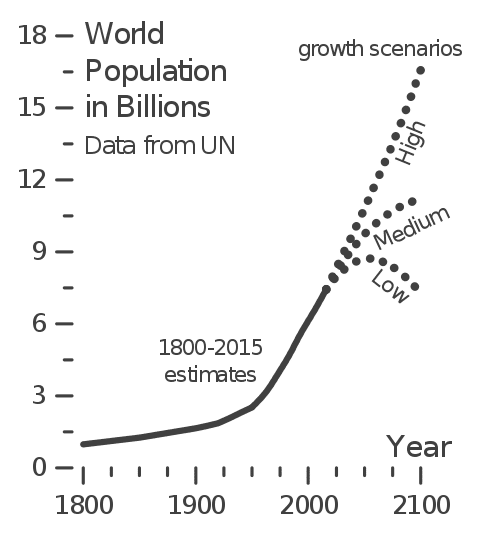
    A line graph shows world population (in billions) from 1800 to 2100, steeply rising after 2000 with three future growth scenarios: high, medium, and low. Data is from the UN, with estimates for 1800-2015.
    By Bdm25 – Own work, CC BY-SA 4.0
  • Protect Your Future from Ivanka Trump and Marco Rubio

    Protect Your Future from Ivanka Trump and Marco Rubio

    Marco Rubio and Ivanka Trump want taxpayers to pay women to have more kids because it will mean more consumers and demand for big business, cheaper labor in the future as workers compete for jobs, and more taxpayers.

    We need better family planning, not a cash-for-babies scheme.

    • Their proposal ignores child welfare. How does encouraging people to have more children ensure that each child will be born in optimal conditions?
    • Their proposal ignores every child’s right to a fair start in life. Don’t all kids deserve the healthcare, education, and nutrition Trump and Rubio’s kids are getting? Don’t you and your kids deserve help getting to that fair start in life? 
    • Their proposal is straight climate change denial. It would further destroy the polluted and collapsing natural environment our kids are inheriting. Why are Trump and Rubio ignoring the clear evidence that larger families have the worst impact on our climate, oceans, other species, etc? Why are they ignoring the way massive overcrowding is destroying our quality of life?

    Instead of Trump and Rubio’s plan to overcrowd America, we want a Fair Start proposal that encourages better family planning: Parents waiting until they are ready to be great parents, having fewer children and investing more in each child, and getting the resources they need to to give every child a fair start in life through a fair division of this country’s wealth.

    Take Action Now

    Contact your Representative and ask them for this simple and better plan: We want tax reform that incentivizes better family planning aimed at giving every child their right to a fair start in life through smaller and more equitable families, not a scheme to create more consumers, workers, and taxpayers for Rubio, Trump, and their corporate sponsors.

  • Trump’s Tax Scam: Here’s a Better Idea

    Trump’s Tax Scam: Here’s a Better Idea

    Most people, even those deeply opposed to President Trump, probably think his plan to expand the child tax credit is a good thing. However, this proposal – long pushed by the religious right – is not so simple. Instead, it has to be viewed within the wider context, including the fact that Republicans are blocking access to family planning and playing politics with children’s health by delaying funding for the Child Health Insurance Program for some nine million needy kids.

    The idea of expanding the child tax credit – the $1000 the government cuts off your taxes for every kid you have – is not new. Increasing that credit been called for by many, perhaps most notoriously Ivanka Trump and Marco Rubio, as another cash incentive meant to encourage certain Americans to have more kids. The credit tries nudge people to reverse a progressive fertility decline in some populations. This decline has been perhaps the greatest success of the last half-century’s concerted efforts around the world for sustainable development, women’s empowerment, and environmental protection.  

    Beyond attempting to undermine women’s empowerment, environmental protection, and sustainable development, this new tax proposal has many other significant problems.

    Even with an increased tax credit, more kids inherently means less investment in each child. The average cost per child is about $230,000, which is in no way countered by an increase in the tax credit. Incentivizing larger families also leads to even greater inequality between rich and poor in a society where some families already buy six-dollar loaves of bread while others can’t afford diapers. Our society’s current approach to family planning continues to widen the gap, and incentivizing more kids will broaden the chasm between the haves and the have-nots. 

    Pushing families to have more kids is also the worst way to exacerbate climate change. Increasing the tax credit to encourage larger families should really be seen as an extreme form of climate change denial. Of course, this hurts an untold number of children in the long run.

    But the tax-credit is also a perfect example of how all of us – Republicans and Democrats alike – claim we care about children but fail to actually help them. Through the child-tax credit, our government is equating a “child” with a few extra dollars for the parent. This divorces the decision to have a baby from the real needs of that helpless and defenseless individual, and all the many physical and emotional resources each child deserves to have. None of those needs can be addressed by simply tossing parents a few more dollars.

    If we really cared about children, we wouldn’t propose minor tax credits in order to disguise massive giveaways to the rich and corporations. We wouldn’t, in a country where half of pregnancies are unplanned, be denying women access to family planning both domestically and abroad, or denying health insurance to our most at-risk children.

    This is what Trump’s tax and budget proposals add up to: Women being prodded to produce more children while society provides fewer resources and programs to care for those children. This creates a pool of resentful future workers with lower education and fewer opportunities – a permanent underclass whose only purpose is to prop up a system built on maximizing profits for the wealthy.

    We need a way to actually help kids, one that recognizes the vital importance of early childhood conditions. Preparation, planning, foresight, and collaboration are how we can truly care about the next child born.  

    We know how this would look: Smaller families making up integrated, cooperative communities that properly fund and support the vital array of resources – healthcare, education, environmental – every child needs to get a fair start in life.

    We could do so much better. If we look at our nation’s founding documents, we all have a fundamental birthright to equal opportunities in life. Instead of tax credits, we need incentives for parents and communities to work together to plan a fair start in life for every child.

    It’s time for a fundamental change in how we care for children. It’s time for Congress to be proactive, not reactive, and help every child have a fair start.

    Please contact your representatives and senators. Please politely tell them to develop a plan that incentivizes parents and communities to work together to plan a fair start in life for every child. 

    Thank you!