Author: Fair Start Movement

  • Worried About Bringing a Child Into the World? Speak out Here.

    Worried About Bringing a Child Into the World? Speak out Here.

    Many young people around the world are rethinking becoming parents, and are deeply concerned about bringing a child into a world beset by a climate crisis, pandemics, and growing inequity and civil strife. Why are we faced with this?

    Almost every crisis before us – from the collapse of our environment to the gap between rich and poor – starts with family planning policies and cultures that do nothing to promote responsible family planning behavior. And in addition to policies and culture, today thoughtful and caring young people have to worry about having one child, even when they are ready to care for that child, because older generations consistently had unsustainably large and unplanned families. Today, would-be parents are in a dilemma because of the family planning systems older generations created, and the “nobody else’s business” approach to having kids that persists today and that is destroying our environment and communities.

    As one Having Kids supporter, who is keen to have one child one day, wrote:

    I am annoyed and dismayed to learn that one of my colleagues in local government is pregnant for the fifth time! How can you bring another child into the world given the state of the planet? This is selfish and irresponsible. Not only for a kid who will not receive the attention they need, but for everyone else. The current population is unsustainable and the planet is dying. Look out the window. We don’t need another mouth to feed, another Costco account, more plane rides, cars, etc. Why are my taxpayer dollars paying for your selfishness? Policies need to change to protect all children and curb this selfish and ignorant behavior. People need to take responsibility for their children, future generations, and the planet. If you want more kids adopt.

    The best solution to the dilemma is to change the way we all plan our families, and to demand laws and policies – and the cultures they shape – that promote parental readiness, a distribution of resources that give all kids a fair start, and smaller and more sustainable families.

    Take action:

    Speak out – send us your story at info@fairstartmovement.org.

    And: Urge key United Nations agencies to use their positions to help usher in the change we need.

  • Why We Can Ensure A Child’s Right to a Fair Start In Life, Ecologically and Socially, By All Means Effective

    Why We Can Ensure A Child’s Right to a Fair Start In Life, Ecologically and Socially, By All Means Effective

    A lot of people have asked the crew here at Having Kids what we mean when we say that we can all further a child’s right to a #FairStart in life, ecologically and socially, by all means effective. What it simply means is that as a peremptory norm, a child’s right to a fair start, enabled through cooperative resource distribution and responsible family planning, overrides things like the property rights of the wealthy, or the right of intending parents to have limitless numbers of children with no cooperative planning to ensure their welfare and equity. #Fairstart comes first.

    Why are the rights and responsibilities that surround having kids peremptory? If power derives from the people, then the norm that accounts for their creation and subsequent empowerment overrides other norms. It is the first necessary condition of legitimacy. It involves literally constituting the political entities that then develop subsequent norms. In other words, nations were not “constituted” at historical points in the past by god-like founders, but are either constituting legitimate systems of governance with every child we have, or they are not, depending on how they do it and the values (like welbeing, consent and nature) at play.

    We say “all means effective” because we refuse to ignore the moral reality of the order of norms, and because the freedom and wellbeing of future generations and nonhumans – the most vulnerable and numerous classes of entities – depend on our using #fairstart to liberate them. Does that mean we promote things like violence? No – we explicitly reject violence and other forms of coercion because we believe they cannot further #fairstart, but by creating cycles of violence, in fact harm kids and their development.

    Learn more about #fairstart, and why we are focused on concentrations of power in icons like Elon Musk.

  • Our Right to a Better Future Does Not Depend on Amy Coney Barrett or the Court

    Our Right to a Better Future Does Not Depend on Amy Coney Barrett or the Court

    The conflict over Amy Coney Barrett’s confirmation, behind which looms abortion rights and the legacy of Ruth Bader Ginsburg, is capturing the focus of the nation. But it will obscure more fundamental matters inextricably tied to debates about the value of human life, abortion, and the nature of future generations: Has the United States reached a place where its centuries-old institutions, like presidency and the Supreme Court, lost enough legitimacy to require revision? Can a handful of people really represent hundreds of millions of deeply diverse people — hundreds of millions more people than existed at the time institutions like the presidency and the Court were designed?

    It seems odd to think that our future must rely upon the decision-making of a handful of individuals, while existential threats like the population-driven climate crisis and the new pandemics it will enable go largely unaddressed. If we care about our kids’ futures, we can’t leave those matters to a few people to decide.

    It may seem fanciful to even raise these questions. It’s unlikely the nation will be convening a constitutional convention for the input of all on a new constitutional structure. Reenter the issues of Amy Coney Barrett’s confirmation and the legality of abortions. The reason a convention seems fanciful is that the nation contains so many people but almost no common core. Much like the population-driven climate crisis, our freedom is limited by one another.

    But what if instead of thinking of the nation as having been constituted top-down by leaders in the past, we thought of the nation as “constituting,” dynamically, with the creation of children? That would be more consistent with the idea that government derives from the people. What if we took “We the People” in a literal and intergenerational sense, so that our being or becoming an inclusive, representative, legitimate, and self-determining people (arguably the cluster of core values behind the idea of the United States) depended on how we have and raise the next generations? How would our thinking change? Would we make lots of people irrespective of their personal development to grow the economy, or would we create fewer people in whom we’ve invested more?

    If we thought in these terms, we could change who we are, as a nation engaged in a true form of federalism that limits and decentralizes power intergenerationally, without convening a constitutional convention at all.

    Thinking in these terms suggests concrete outcomes.

    The abortion debate would change, because we would have to account for abortion as more that just a means of facilitating women’s autonomy. We would have to also ask whether could ever possibly ensure kids a fair start in life without a women’s right to terminate her pregnancy. We would have to ask whether, without abortion, we could feasibly move toward the “smaller family “ ethic that has 20 times the mitigation impact on the climate crisis than other downstream options. We would have to ask whether we could possibly create a future of smaller democracies where each voice matters and whether without abortion we could possibly give kids a fair start in life, eliminating the unearned privileges of one’s birth position and the inequity that is tearing our democracy apart.

    If we realized we were constituting, and not constituted in the past, our thinking would change.

    Should measures like “baby bonds” be enhanced enough and pegged to family planning incentives as a means of leveling the playing field for all kids, perhaps using the privileged children of white families, or more specifically of pronatalists like Mitt Romney, as a benchmark?

    Rather than being divided into left and right, such thinking might lead to a new and singular political border, and a spectrum between those seeking to constitute ourselves as free and equal people, free of the imposition of forms of human power like the climate crisis and possessed of truly equal opportunities in life, and preconstitutionals, and those like Trump and Matthew Yglesias, who sees future generations as fodder to grow the economy, other values aside.

    If we still think we exercise our freedom by doing whatever we want, in terms of having large and unsustainable families and consuming all we can, we are learning nothing from the climate crisis and the way it will limit our and future generations’ freedoms. We will have learned nothing from the pandemic. Like refusal to wear a mask, things that seem freeing and individualized can at times be the opposite and can end by limiting the freedom of all.

    Ruth Bader Ginsburg knew this, as was evident in her appreciation of the role of population growth in the things that threaten our future.

    These are the issues that matter. If the Court’s power derives from the people, our focus must first be on the creation of children as free and equal people, or that which constantly reconstitutes us as a democracy. We have to see that as a process that overrides the Court’s authority — and end any deference to a handful of people who purport to decide the future of hundreds of millions of people to whom they have little, if any, connection. Our right to better family planning is the first human right. It overrides other matters and puts the function of democracy — to free us — above the archaic form of the Court.

  • Factory Farming is Fundamentally the Product of Poor Family Planning Policy. Take Action.

    Factory Farming is Fundamentally the Product of Poor Family Planning Policy. Take Action.

    Cory Booker is spot on in targeting the industrial agriculture complex that is destroying our environment and health.

    But he could go further, and be much more comprehensive and effective.

    That complex was created in response to, and is driven by, ballooning population growth. It also exploits and exacerbates the growing gap between rich and poor, in terms of who consumes and who produces the animal products. Booker should connect the dots, and tie his attack on factory farming to a new version of the guaranteed minimum income for children, or “baby bonds,” proposals he is known for. Specifically, those bonds could be funded by taxes on the biggest factory farming conglomerates, and be modified to incentivize smaller families that cooperatively exchange resources to give all kids a fair start in life. This would cut demand for the products of factory farms, restore our environment, and also restore the middle class – including middle class farmers – that is the antithesis of the toxic corporate structure at the heart of the United States food system. 

    Urge Booker to take a more comprehensive and effective approach. Contact him here.

  • Fair Start Planning Is Essential to the Anti-Oppression Toolkit

    Fair Start Planning Is Essential to the Anti-Oppression Toolkit

    With nearly 40% of all kids in the U.S. living in or near poverty, human rights and democracy under attack, and systemic racism keeping intergenerational inequities alive and well, better policy is long overdue.

    Sadly, it has taken the murders of black citizens in recent years to bring to the forefront the conversation surrounding inequities and oppression. But a deeper look at the intersectional issues is finally making it to the mainstream. Now is the time to develop anti-oppression and anti-racist informed policies to change course effectively. 

    Fortunately, one path forward is clear. Decades of research have shown that family planning is the most effective way to break the cycle of generational poverty and inequality. Early interventions are up to 13 times more effective than reactive approaches. Furthermore, parents who choose to have only one or two kids can invest more time and resources in each child, setting up these children for great success throughout their lifetimes.

    Yet oppression continues because of a lack of equitable resources from birth. The facts are simple:

    • Inequality is inherited. 1
    • Inequality is a welfare issue. Studies have documented examples of rising inequality decreasing child welfare. 2
    • Inequality affects kids for life. Unequal opportunities translate into unequal lifelong outcomes by the time children reach age 5. 3
    • Inequality’s impacts are more damaging the longer it is experienced. The longer a child is poor, the greater his risk of poverty in adulthood and of experiencing lifelong health problems and involvement in the criminal justice system. 4
    • Inequality disproportionately affects children of color in the U.S. 5
    • Affluence plays a role, too. The growing divide between low-income children and their peers reduces opportunities for low-income children throughout their lives. 6

    And that is why anti-oppression policy without Fair Start investments is a nonstarter. If we are truly determined to dismantle systemic racism, we must come together as communities to ensure a fair start for all children. 

    We are already pursuing Fair Start campaigns to improve equity for kids:

    As we plan for 2021, we are working to invite more partners to join our coalition on these intersectional issues. If you would like to join us or share your perspective, please email ashley@fairstartmovement.org.

  • The Most Fundamental and Effective Social Justice Reform Possible

    The Most Fundamental and Effective Social Justice Reform Possible

    The right to have children comes with responsibilities on parents and their communities that protect us all. The United Nations is using a decades-old pro-growth family planning model that ignores those responsibilities and hurts kids. That model is fundamentally driving ecological crises and the climate crisis, child poverty, and growing inequity across the globe. That model exacerbates the risk and impact of pandemics, and prevents our reaching the U.N.’s Sustainable Development Goals. That non-inclusive model exploits children more than it invests in them, thereby driving political illegitimacy.

    But groups and individuals from around the world are signing on to an effort to change the old model, which is focused on what parents want, toward a new model that focuses on what all kids need.

    The new model is called Fair Start family planning, and it is the beginning of real social justice. The reform can begin with the United Nations secretary general simply acknowledging the need for change.

    Sign on, and urge any organization you support or can influence — nonprofit or for profit — to also sign on. Sign here or contact us at info@fairstartmovement.org for more information.

    Help support this effort and you support new family planning policies that can reduce poverty and inequity, and mitigate the climate and other ecological crises, on a scale of 10 to 20 times non-family planning measures.  

  • Ecological Destruction Starts With Poor Family Planning. Take Action.

    Ecological Destruction Starts With Poor Family Planning. Take Action.

    This video was recently shared by a supporter:

    THE FACTS ARE CLEAR:

    • The most effective way to address many of the impacts on our environment and other species, such as climate change, is to choose smaller families. In fact, it’s 20 times more effective than changing diet or forms of transportation.  
    • By 2100, world population could vary by billions of people, depending on whether the average woman in the world today has one child more or one child fewer in her lifetime.
    • Child-first family planning provides a clear human rights-based solution and path forward. It’s sustainable and equitable, and it’s reflected in the worldwide trend toward smaller families that can invest more in each child and ensure a safer future.

    TAKE ACTION:

    Urge the United Nations to do what it was created to do: protect all of our futures by adopting Fair Start family planning policies: https://secure.everyaction.com/gZiWOydZ_0m7kxrlfD5OjQ2

    Urge any charities you support to commit to better family planning policies. which are the most effective way to protect kids, animals, the environment, and democracy: https://fairstartmovement.org/organizations-joining-for-world-population-day-at-the-u-n/

  • Pandemic Parenting: How Did We Get Here?

    Pandemic Parenting: How Did We Get Here?

    Parents and their kids are suffering under the weight of the Covid-19 pandemic. A recent study shows significant declines in mental well-being for families with children as the quarantines drag on and other crises loom.

    What went wrong?

    Our family planning policies, cultural attitudes, corporate advertising, and other factors have historically pushed women to have kids, often before they’re ready, in order grow the economy. These forces not only created overcrowded and unhealthy conditions that helped the pandemic spread and created ecological impacts such as the climate crisis that are setting the stage for the next pandemic.

    Who created such policies? Elites at the top of the economic pyramid made these policies to ensure big business a constant stream of cheap labor and hungry consumers. Politicians went along because more taxpayers meant bigger government. The people who pushed population growth, instead of human rights-based policies, are responsible for much the suffering we are experiencing today.

    It’s time to turn the tables.

    We have a right to the wealth and resources being hoarded by companies, rich families, and bloated governments — those with disproportionate power who are blocking real democracy. That money belongs to us. The best way to use this wealth would be to reverse the unsustainable growth paradigm and replace it with policies that move us toward 1) parental readiness, 2) ensuring every child a fair start in life, and 3) smaller and more sustainable families.

    Take action: Urge Congress to reverse the exploitation of families and to instead embrace Fair Start family planning.

  • New Survey: Education on Family Size and Population Growth

    New Survey: Education on Family Size and Population Growth

    Having Kids recently surveyed 376 people regarding their understanding of family size and population growth.

    • A significant number of people correctly see a relationship between family size and human population. About 86% of respondents answered affirmatively when asked whether there is a relationship between the number of children a couple decides to have and human population.
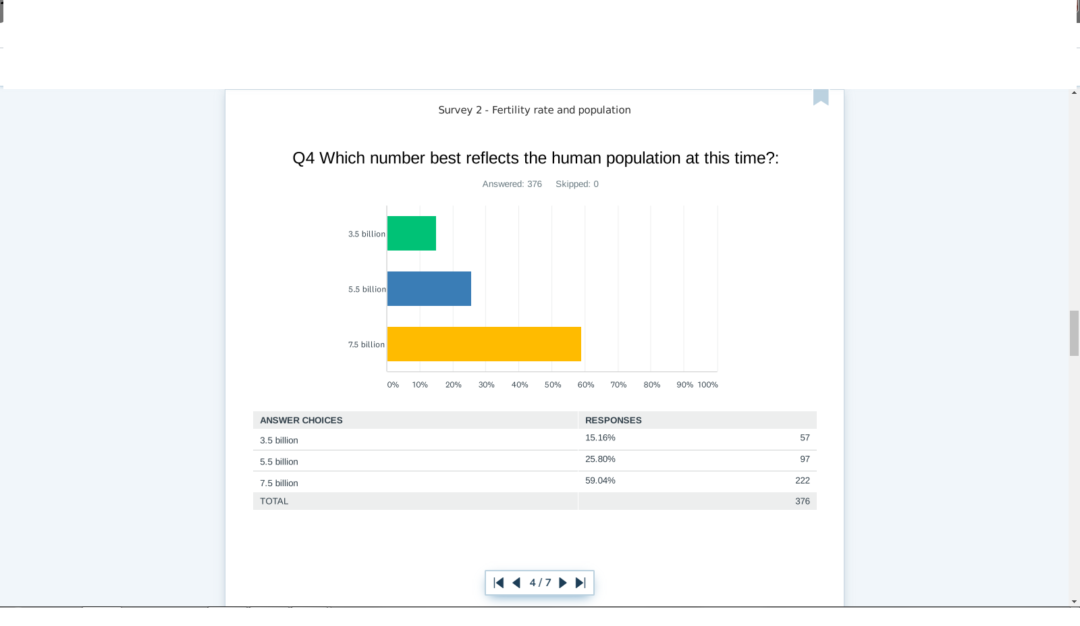
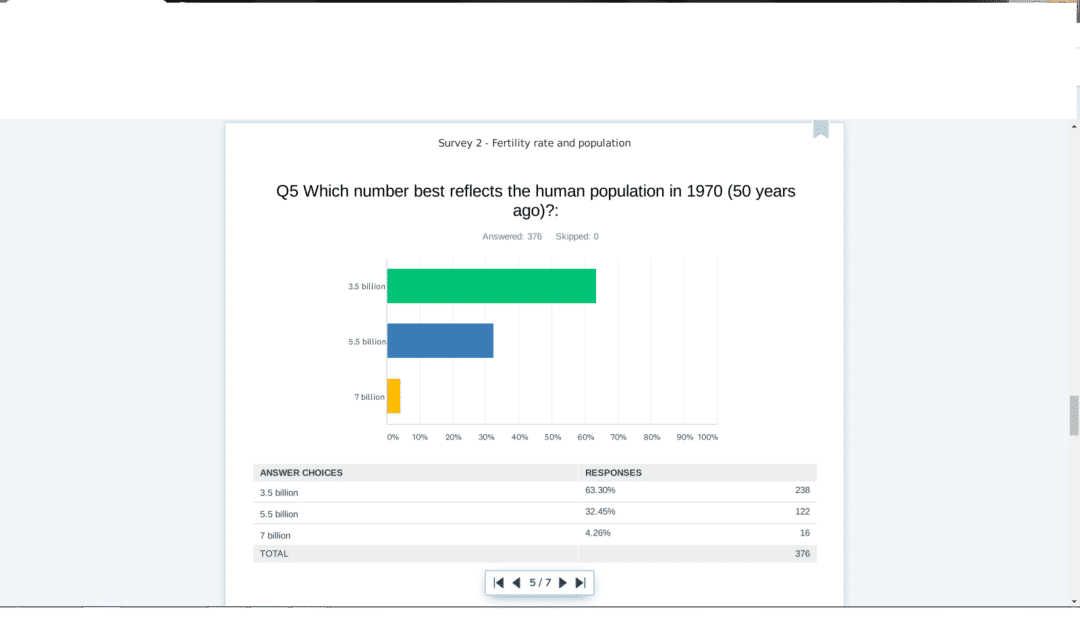
    • Though a majority of respondents have an accurate picture of current population numbers and those 50 years ago, a notable minority do not. Forty-one percent of respondents think the current number of people on the planet is either 3.5 billion (15.25%) or 5.5 billion (25.8%) instead of the correct answer of 7.5 billion and that the population in 1970 was either 7 billion (4.3%) or 5.5 billion (32.6%) instead of the correct answer of 3.5 billion.
    • Support for Having Kids’ mission remains high. Seventy-two percent of respondents indicated they would be supportive (36.3%) or very supportive (35.4%) of an organization pursuing Having Kids’ mission.
    • More education is needed regarding both the current population numbers and the expected growth of these numbers.
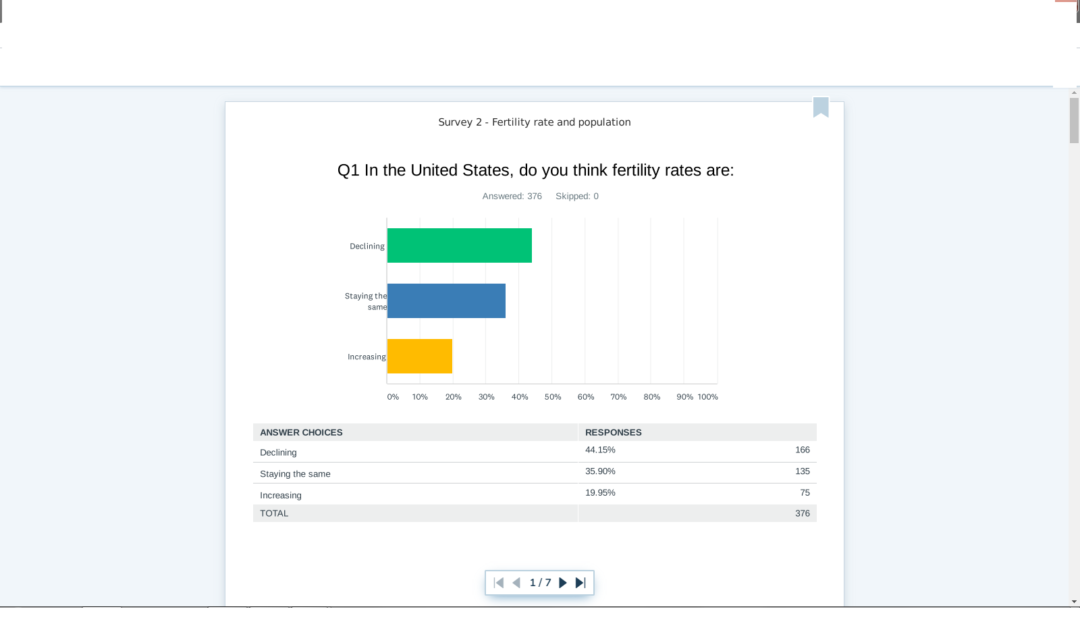
    A survey chart shows U.S. opinions on fertility rates: 45.94% think rates are declining, 35.99% say staying the same, and 18.08% say increasing. Bar graph and response table are displayed.
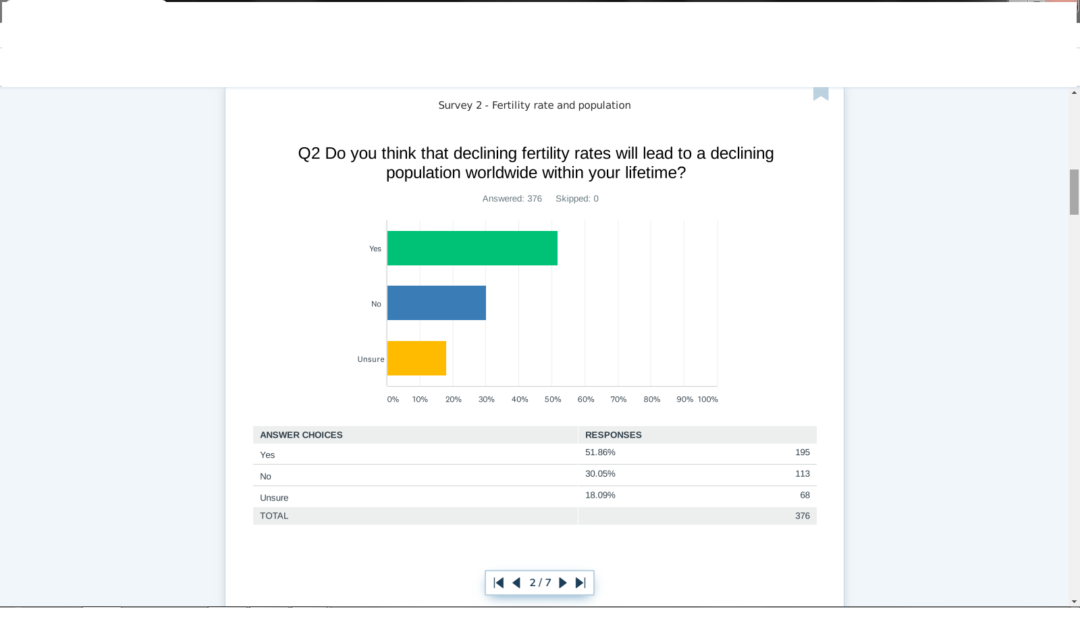
    A survey question asks if declining fertility rates will cause a worldwide population decline within respondents lifetimes. Bar chart: Yes (166), No (53), Unsure (77). Table repeats responses. Total: 296 answered, 0 skipped.
    A survey result screen shows a bar graph and table. The question asks about a relationship between family size and human population. 323 answered Yes, 25 No, and 28 Unsure, out of 376 total responses.
    A survey graph showing responses to Which number best reflects the human population at this time? Most respondents chose 7.5 billion, followed by 6.5 billion and 3.5 billion; results are also shown in a table below the chart.
    A survey question asks about the human population in 1970. A bar graph shows most respondents (62.63%) chose 3.5 billion, 28.29% chose 5.5 billion, and 9.08% chose 7 billion. Total responses: 381.
    A survey results chart shows support levels for an organization promoting cooperation between prospective parents. Most respondents are very supportive or supportive, with fewer neutral or unsupportive responses.