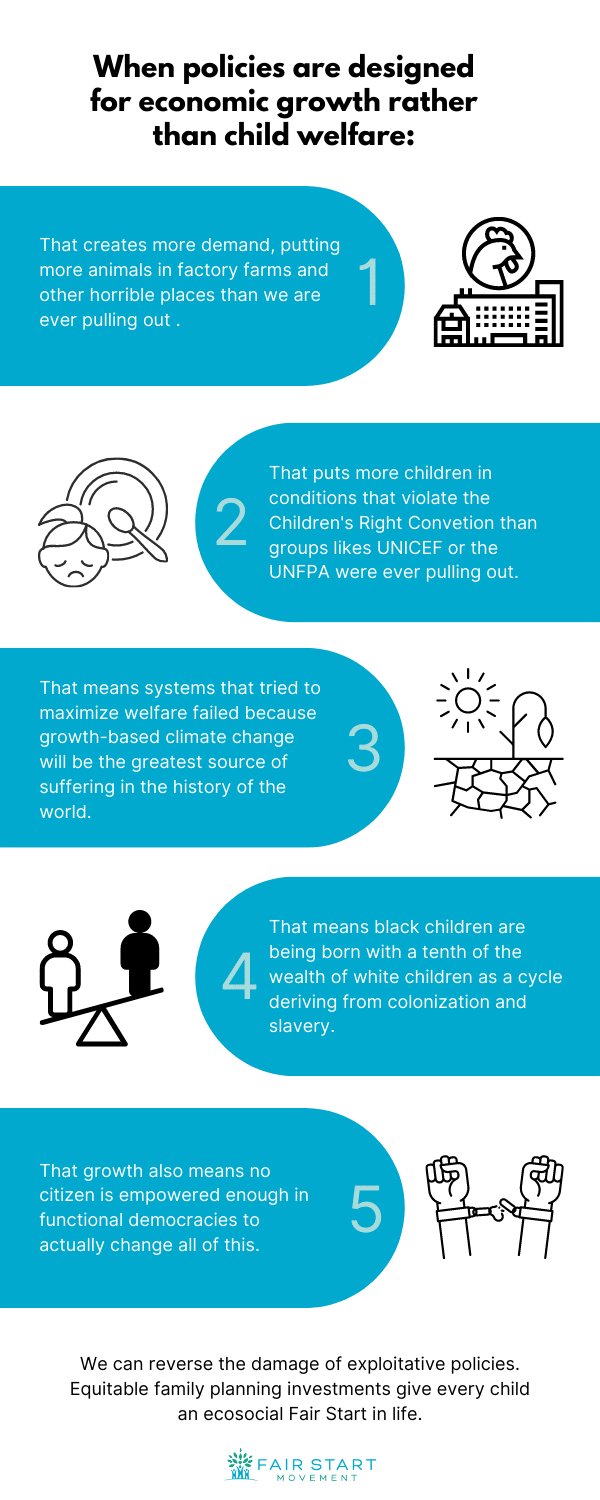
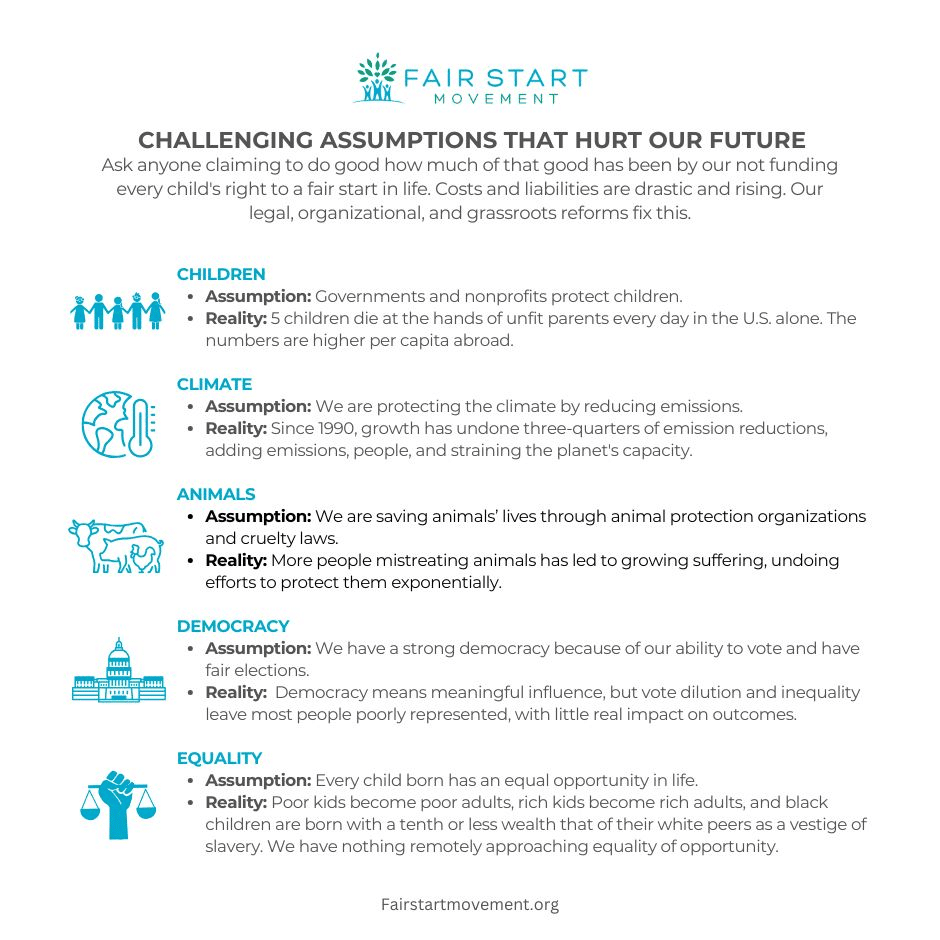
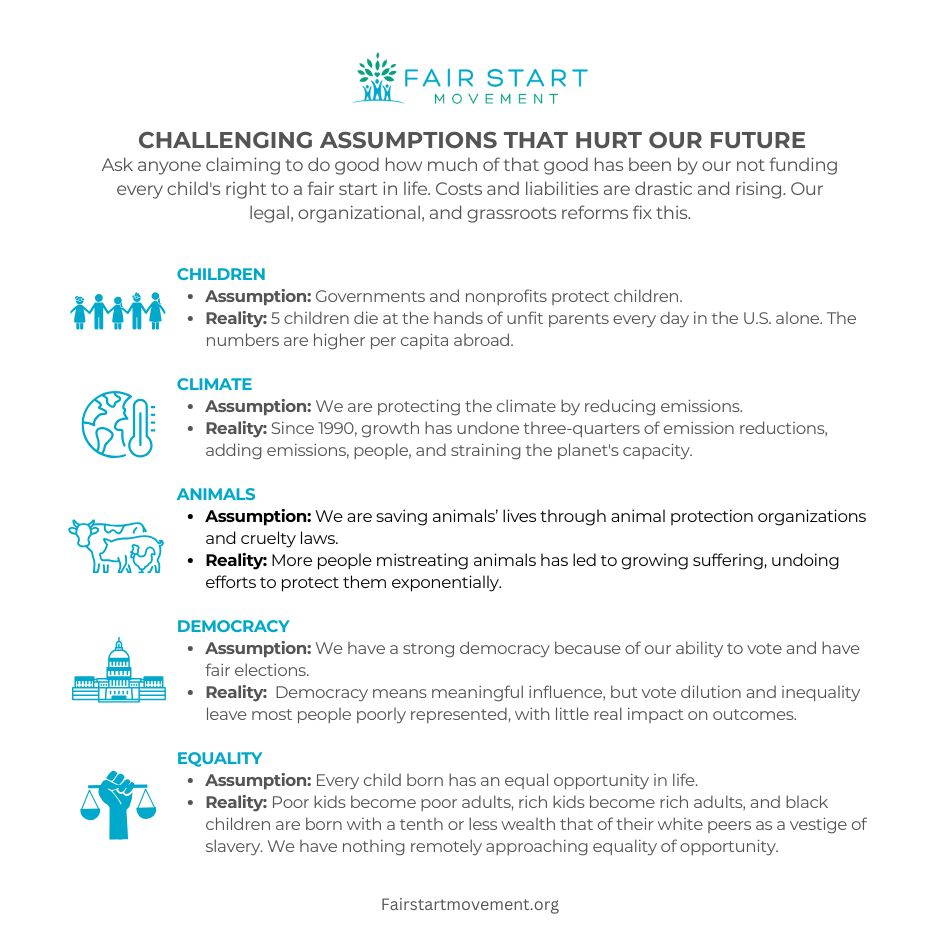
Prominent public interest advocates like Lewis Bollard of Coefficient Giving have for decades made completely inaccurate claims of progress – and in his case, successfully reducing animal suffering – that have hidden the growing political, social, and ecological costs of the polycrisis.
Bollard was never accounting for the way growth and overshoot was always undoing the value he added to the world and the impact he had, growth that was ensuring more demand for animals and more emissions. He was not accounting for children brought into the world without the resources they need to deal with these impacts, and with less political influence to change the system harming them.
Relative to what was he helping animals?
He and those like him benefit from the fantasy world of progress he helped create, and at deadly cost to others. His models preserved the same status quo birth inequity that created and maintained Donald Trump, when animal liberation would have required a total rethink in policy pointed towards total liberation.
Instead the models he used assumed the legitimacy of a random birth lottery, one that uses growth to disenfranchise.
Bollard’s work thus starts by quietly disvaluing the future lives of the animals he claims to protect, and in a way that has ensured benefits for him and cost to the most vulnerable.
When someone makes a value assessment or impact claim we always have to ask, relative to what? Unless the value assessment and impact claims are made first relative to a “one person, one equal and influential vote” standard, they are not made as part of a legitimate (or sufficiently inclusive) system.
Fair Start activists have seen a history of organizations like the Humane World for Animals – where Bollard worked – and the Animal Legal Defense Fund intentionally omitting information from their valuation models and impact claims regarding the largest driver of the outcomes at issue – growing birth-based constitutional inequity – to personally benefit, and in a way that has disenfranchised communities of color.
Micro, downstream victories have hidden the way macro, upstream forces were undoing them every day.
Bollard’s statements are false under preemptive state and federal unfair/unconstitutional competition and civil rights laws because there is no valuation and impact reporting outside of one’s birth positional context, birth-empowerment is inseparable from all other values, and accounting for costs of children entering the world relative to that threshold (constituting) is what justifies the benefits one gets.
There are no legitimate valuation/business models and reporting systems that value others beneath the threshold of their being minimally empowered, because that empowerment is what justifies all of our benefits.
Their discounting the lives of others does more harm than Bollard does good, by his own metrics, like safe temperatures and influence over political systems, and is skewing the baseline for things like climate reparations and voting rights, putting millions at risk.
A revision of the FalseClaimsChecker.org will explore this question and quantify the results:
How much of Lewis Bollard’s wealth-based benefits, including influence, was made by triple dipping? Factoring in his privileged birth positionality in a reproducive rights regime devoid of protections for animals and which treats children of color as deserving less than white kids, 2) the benefits accrued since from that system (growth/inequity-based income, and benefits public interest work and omissive reporting), at illegal cost, including the constitutional disenfranchisement of, or reduction of the voting power, of vulnerable black communities?
The fix?
Governments can’t interpret the constitution or any of their authority – including state and federal unfair/unconstitutional competition and civil rights laws in ways that disenfranchise persons, especially to the point of risking their lives. Birth-positioned constitutional benefits land at the level of individuals – so do liabilities.
Fair Start will be urging California to take action regarding Bollard’s models and claims.
One can’t talk about value out of the context of a system of legitimately empowering others – starting with children entering the world – because governments would have to treat that as fraud by omission in that the claimant would be getting benefits without paying the costs. And if the governance didn’t act, they themselves would slip into illegitimacy and those otherwise subject to their political power would be obligated to take control.
One way to start? We can all tell the truth and admit that legitimacywashing in our valuation models and impact reporting did more harm to our values than we did good. Without reform we triple dip: 1) Benefiting from arbitrary birth positionality, in terms of things like nationality, race and intergenerational positioning, 2) getting the benefits of a growth economy without paying the costs it imposes on others, and then 3) engaging in public interest work that omits the countervailing of impacts of growth so we don’t have to pay the costs.
Right now, across the world, people are beginning to open their eyes and realize something bigger is happening. We are being told humanity is progressing, that justice is advancing, that the world is becoming fairer — yet every day I see people struggling to survive, wildlife losing habitats, children being born into inequality, and entire ecosystems pushed closer to collapse.
People are no longer just looking for hopeful words and polished campaigns. They are looking for truth. Real truth. Because if we truly want to save animals, protect people and give future generations a fighting chance, then we must have the courage to ask whether the systems shaping this world are actually creating meaningful change — or simply becoming better at marketing the appearance of it.
That is the deeper conversation now being raised by the Fair Start Movement in relation to Harvard University and what the organization describes as a “fantasy world of social justice undone daily by birth inequity.”
This is not about attacking good people.
There are countless students, researchers, activists and educators who genuinely want to make the world better. Many dedicate their lives to helping vulnerable communities, challenging injustice and fighting for equality. That work matters. But the wider concern being raised is whether some institutions have become too focused on presenting narratives of progress while failing to fully confront the structural systems continuing to produce inequality underneath the surface.
And that matters more than ever right now.
The Fair Start perspective argues that many social justice institutions focus heavily on downstream solutions — programs, campaigns, reforms, diversity initiatives and public advocacy — while the upstream conditions driving inequality continue growing stronger every year.
In simple terms, we may celebrate individual victories while the larger system producing suffering remains largely untouched.
That is where the idea of “birth inequity” becomes central.
The argument is that children are not entering the world on anything close to equal ground. Some are born into safety, wealth, opportunity and political influence. Others are born into poverty, instability, environmental decline and systems already stacked against them from the beginning.
And as climate instability, economic inequality and ecological collapse intensify globally, those gaps only grow wider.
The concern being raised is that institutions can sometimes unintentionally create the appearance of meaningful progress by measuring outputs rather than genuine net outcomes. A university can point to programs launched, scholarships funded or initiatives promoted, but the deeper question remains: are the structural conditions affecting future generations actually improving overall?
Because that is the truth people are beginning to search for now.
Not branding.
Not polished narratives.
Not carefully managed public relations.
Truth.
The reality is that across the world we are seeing ecosystems pushed to breaking point. Wildlife is disappearing at terrifying speed. Communities are struggling under economic pressure. Young people are growing up with uncertainty about their future, while millions of children are born into conditions where survival itself becomes harder every single year.
And yet many institutions continue presenting narratives that suggest society is steadily moving toward fairness and sustainability.
That disconnect is what people are starting to question.
For those of us working directly with wildlife and vulnerable communities, these realities are impossible to ignore. I see firsthand how deeply connected everything is. When forests disappear, communities suffer. When inequality grows, ecosystems come under pressure. When people are desperate, wildlife suffers too. The survival of humanity and the survival of nature are tied together whether we acknowledge it or not.
That is why transparency matters.
Not to tear institutions down.
Not to shame people trying to help.
But to ensure that the work being done in the name of justice, sustainability and equality is actually capable of creating long-term change in the real world.
The Fair Start discussion ultimately asks a powerful question: are institutions willing to fully examine whether the outcomes they promote publicly still hold true once the wider baseline realities are honestly accounted for?
Because if we truly care about future generations, then we cannot build systems based only on appearances.
We need courage.
The courage to question whether the current path is truly sustainable.
The courage to confront uncomfortable truths about inequality, growth and ecological decline.
And the courage to build a world where justice is not simply something spoken about in lecture halls or campaign slogans, but something reflected in the actual conditions people, animals and future generations are living through every day.
That is the kind of future worth fighting for.
A future built not on illusion, but on truth.
Letter –
May 8, 2026
Attorney General Andrea Joy Campbell Office of the Attorney General Commonwealth of Massachusetts One Ashburton Place, 20th Floor Boston, MA 02108
Re: Request for Attorney General Review of Directional Impact Representations and Baseline Omission in Massachusetts Animal-Welfare Institutional Communications Under Chapter 93A
Dear Attorney General Campbell,
Fair Start Movement and TruthAlliance.global submit this letter to request review and guidance concerning a specific and recurring pattern in Massachusetts-based institutional communications: the creation of a directional impression of progress through public-facing language that does not disclose the baseline conditions necessary to interpret whether that progress is occurring on balance.
This submission is narrow and disclosure-focused. It does not allege improper motive, and it does not dispute that the institutions discussed perform real work, expend real resources, and achieve identifiable outputs. The issue is whether public-facing representations—particularly those that operate in donor-facing, student-facing, or credibility-bearing contexts—are structured in a way that invites reliance on an implied trajectory of improvement without providing the baseline information required to evaluate that implication.
The concern arises from a consistent pattern across multiple Massachusetts institutions. Language is often framed carefully to avoid explicit, measurable outcome claims. Terms such as “committed to,” “working to,” and “seeking to advance” appear frequently in institutional descriptions of animal-law programming and advocacy. At the same time, that language still communicates something to a reasonable reader. It conveys forward motion. It signals that progress is being made, or at minimum that support for the institution contributes to that progress. That signal influences behavior. It shapes donation decisions, student enrollment, partnerships, and policy attention.
The problem is not the use of aspirational language itself. The problem is that the directional impression created by that language is not accompanied by the context needed to determine whether the implied progress is occurring when broader conditions are taken into account. Public-facing materials do not typically disclose the scale of countervailing forces—continued expansion of animal agriculture, growth-driven demand, ecological degradation, and structural conditions that perpetuate harm across generations. Without that context, the impression created by the language may be materially incomplete.
This dynamic becomes more pronounced where institutions move from aspirational phrasing into definitive outcome language. In Massachusetts, MSPCA-Angell provides a clear example. The organization describes itself as “positively impact[ing] the lives of tens of thousands of animals each year” and as driving “meaningful, systemic change.” These are present-tense outcome statements. They communicate that impact is occurring and that systems have changed. At the same time, the organization has publicly disclosed that it no longer tracks the metrics used to measure its results. The combination of definitive outcome language and the absence of outcome measurement creates a gap between the impression conveyed and the substantiation available. That gap is not theoretical. It exists at the point where donors decide whether to contribute, and where the public decides whether progress is being achieved.
A similar issue arises with quantified claims made by Humane World for Animals. Statements that millions of meals have been transitioned or that over a million animals have been improved are specific and concrete. They communicate progress through numbers. But those numbers operate within a broader system that is not disclosed alongside the claim. If the total scale of animal agriculture or confinement grows by more than the improvements cited, the directional impression created by the numbers may not reflect the net trajectory. The claim itself may be accurate in isolation. The impression created by the claim, absent baseline context, may still be incomplete.
Across these examples, the same structural issue appears. Public-facing communications operate at the level of narrative, while the conditions necessary to interpret that narrative—what is counted, what is excluded, what baseline governs the claim, and how competing forces affect the outcome—are not disclosed at the point of reliance. This is the baseline omission problem. It is not a dispute about values. It is a question of whether the information environment in which decisions are made is complete enough to support those decisions.
Massachusetts General Laws Chapter 93A provides a framework for addressing this issue. The statute does not require that a statement be literally false to be actionable. It encompasses conduct that creates a misleading impression through omission of material information. Where a representation invites reliance and the meaning of that representation depends on context that is not disclosed, the omission may be material if it would change the understanding of a reasonable audience.
In this context, baseline conditions are not peripheral details. They are the elements that determine what the claim means. They define whether a statement reflects activity, projected contribution, or demonstrated net outcome. When those elements are absent, the resulting impression may be incomplete in a way that affects decision-making.
This submission therefore requests that the Office consider whether directional impact representations in Massachusetts animal-welfare communications should be evaluated under a material-omission framework when they omit baseline conditions necessary to interpret implied progress. The request is not for punitive action based on isolated statements. It is for a structured review of whether current practices create reliance risks that can be addressed through disclosure.
Specifically, we request that the Office consider initiating a Chapter 93A review of how animal-welfare institutions in Massachusetts communicate impact and progress, with attention to whether those communications distinguish between program outputs and net outcomes once baseline conditions are accounted for. We further request consideration of whether guidance should be issued clarifying that aspirational and outcome-oriented language can create materially incomplete impressions when baseline conditions are omitted.
In addition, we request that the Office review MSPCA-Angell’s use of definitive outcome language in light of its disclosed cessation of outcome measurement, and that it examine whether quantified claims by Humane World for Animals create directional impressions that are supported when evaluated against broader system-level trajectories.
The remedy sought is disclosure-forward and corrective, not punitive. The objective is to ensure that when institutions communicate impact, the public is provided with the information necessary to understand what that impact means and what it does not mean. This can be accomplished through baseline disclosure: clear statements of what is counted, what is excluded, the time horizon used, the presence of uncertainty, and the distinction between outputs and net outcomes.
Fair Start’s Tell the Truth framework provides one model for this approach. It asks institutions to align public claims with the baseline conditions that determine their meaning, so that reliance is based on complete information rather than directional impression alone. The framework is designed to be applied cooperatively, allowing institutions to maintain their advocacy while improving the clarity and integrity of their communications.
We recognize that the institutions discussed are respected and perform meaningful work. This request does not challenge that work. It addresses the structure of the information environment in which that work is presented. Where public trust is involved, clarity is not optional. It is the condition that allows that trust to function as intended.
We respectfully request confirmation of intake and identification of the division or bureau assigned for review.
Respectfully submitted,
Suriya Khan Fair Start Movement / TruthAlliance.global suriya@fairstartmovement.org 516-725-3157
There is a growing conversation happening across the world about justice, inequality and the stories institutions tell about progress.
Not just in climate activism or animal protection, but in universities, nonprofits, philanthropy and social justice movements themselves.
People are beginning to ask a difficult but necessary question:
Are we truly addressing the root causes of suffering and inequality, or are we building narratives of progress while the underlying systems continue producing harm every single day?
That question sits at the heart of the recent Fair Start Movement article discussing Yale and what the organization describes as a “fantasy world of social justice undone daily by birth inequity.” (Fair Start Movement)
Importantly, this conversation should not be framed as an attack on individuals trying to create positive change. Many people working in academia, social justice advocacy and philanthropy genuinely care deeply about equity, human rights and creating a better future. Many dedicate their lives to helping vulnerable communities and challenging injustice.
But the article raises a broader systems-level concern.
It argues that many public-interest institutions may be measuring impact inside incomplete frameworks that fail to fully account for the structural conditions shaping real-world outcomes — particularly inequality at birth, political inequity and the long-term effects of growth-driven systems. (
At the center of Fair Start’s argument is the idea that “downstream” social justice work can be continuously undermined if the “upstream” systems driving inequality remain unchanged.
The article places particular emphasis on what it calls “birth inequity.”
This refers to the reality that children enter the world under vastly unequal conditions depending on wealth, race, geography, political influence and environmental stability. Fair Start argues that these starting conditions profoundly shape health, opportunity, democratic influence and long-term survival itself, especially as climate instability and ecological degradation intensify globally.
The broader concern being raised is that many institutions discuss justice without fully accounting for these baseline inequalities.
From the Fair Start perspective, if systems continue allowing millions of children to enter conditions of severe inequity, then downstream reforms alone may struggle to produce meaningful net progress over time. The movement argues that many public-facing impact claims fail to fully disclose how structural growth, ecological degradation and political inequality may be undoing the very outcomes organizations publicly celebrate. (Fair Start Movement)
Whether one agrees entirely with Fair Start’s framework or not, the deeper questions being raised are significant.
How should institutions measure progress honestly?
How do we distinguish between symbolic progress and systemic transformation?
And how do we ensure that public trust is grounded in transparency rather than carefully managed narratives?
These are questions that are becoming harder for society to ignore.
Across the world, people are watching ecosystems deteriorate, inequality deepen and political trust erode, even while institutions continue presenting optimistic narratives about sustainability, justice and progress. Increasingly, there is public demand for more honest conversations about whether current systems are truly addressing the root causes of the crises humanity now faces. (Fair Start Movement)
For those of us working directly with animals, conservation and vulnerable communities, these realities are impossible not to see.
We see humans and wildlife increasingly competing for shrinking resources. We see communities struggling under economic and environmental pressure. We see ecosystems under stress. And we see how inequality and ecological collapse are deeply connected.
Because when systems fail people, they also fail nature.
The Fair Start article ultimately calls for something larger than political ideology or institutional branding. It calls for a deeper level of honesty about how we measure impact, how we define justice and whether the systems currently shaping the world are truly capable of delivering a fair future for the next generation.
And perhaps that is the most important part of this conversation.
Save the Animals Save The World, was set up by Ryan Parker, a wildlife conservationist, wildlife presenter, safari guide and animal rescuer. With a love of the natural world, and being in the wild making more sense. My idea is that restoring wild areas, letting nature take its course, an ecological balance of evolutionary grand design. But with a growing human population, fighting for resources, human population pushing the climate, more people pushed into poverty.
More and more wildlife is coming into conflict with humans. Animals are not only fighting for wild areas, but also urban areas. We cannot blame the people who are trying to survive, and we cannot blame the animals. They are both the result of social inequalities. And why is this bad?
Once you start removing nature, a species, whether it be plant, fungi, or animal, from birds, to insects, spiders, to large mammals. Every species has an important role to play. Take that away, the ecosystem starts to fail, and this affects us humans. It affects crop growth, flooding, human health, disease control, and even climate, and so much. You just need to check out the benefits of rewilding wolves to Yellowstone national park, or Humpbacks returning in numbers, or the benefits of beavers returning to the U.K. The importance of parrots, or the importance of song birds, to the importance of elephants, or sharks. The list is endless.
So we need to teach people how to live alongside these amazing animals. How to coexistence. As most of the time, the funding from governments, large companies do not reach, the local people. For me conservation is about uniting people. For conservation to work, to help the planet, we need to work together without discrimination. A brotherhood of man.
And me personally how do I do this? Through love! To give hope. My passion and excitement for the natural world! I love it with my heart, and I can get people excited about wildlife. As a safari guide, as wildlife presenter. If I can show what beauty we have on this planet, from wildlife to landscapes. I can make people fall in love with it and fight to save it. This is why I make wildlife films, and take people on safari. I am a conservationist sales man here to save the world. But also prove that people do not have to be a conservationist, know the difference between an alligator or crocodile, or be part of a rich organization. That everyone can make a difference, by simple things, that do not cost money, or spending in the right place if they do. By being kind! This is how! Myself I align myself to work with small grassroots NGO companies working for little money, that is dangerous, hard, with little support. Just like me, I struggle to pay my rent and pay to rescue animals. So I understand them. These are the people that are making a difference! An inspiration. And any company that supports that same ethos, I will be happy to work with them, like I do supporting the Fair Start Movement!
Because if we can work together, to save animals, they will save the world!
What is becoming increasingly clear across the world is that this conversation is no longer limited to animal welfare alone.
The questions now being raised around institutional transparency, impact representation and public accountability are appearing across public health, climate policy, child rights, sustainability and international governance. The deeper we look, the more we find the same structural issue repeating itself: institutions presenting outputs as evidence of meaningful progress, while failing to fully disclose the baseline conditions that continue driving harm underneath the surface.
These concerns were further reinforced through an independent expert letter submitted by Pierrette, a public health and systems governance specialist whose work focuses on child rights, intergenerational accountability, equity policy and institutional integrity, including African Union–aligned work examining long-term social and structural outcomes.
In his letter, Pierrette explains that across multiple sectors there is increasing concern around how institutions communicate public-benefit impact. In particular, the distinction between “program outputs” and genuine “net outcomes” is becoming central to modern standards of accountability and evidence integrity.
And that distinction matters enormously.
Because there is a major difference between reporting actions taken, campaigns launched or services delivered — versus proving that overall conditions genuinely improved once wider structural realities are taken into account.
Pierrette’s letter does not seek to attack advocacy itself, nor undermine the importance of animal protection, social justice or public-interest work. Instead, it raises broader governance questions that institutions across the world are increasingly being forced to confront:
Are public-facing impact claims being communicated with sufficient transparency?
Are baseline assumptions clearly disclosed?
Are modelling limitations openly acknowledged?
And are institutions carefully distinguishing between measurable outputs and actual system-wide outcomes?
These questions sit directly at the center of the current concerns surrounding the University of Denver’s animal law programming and associated public-facing advocacy efforts.
At issue is whether institutional impact language may have implied meaningful net progress in animal protection without sufficiently disclosing the wider structural realities surrounding inequitable growth, systemic harm and the limitations of the underlying models being relied upon.
The concern is not necessarily that individuals involved lacked good intentions. Many people working within these institutions genuinely want to create positive change. But intention alone cannot replace transparency.
Because if suffering expands faster than interventions reduce it, then institutions have a responsibility to communicate those realities honestly.
In his letter, Pierrette explains that across global health, sustainability and governance sectors, there is increasing emphasis on what is known as “evidence integrity” — ensuring that publicly communicated impact claims are analytically grounded, methodologically transparent and properly bounded by clear assumptions.
This is becoming one of the defining issues of institutional trust in the modern world.
From climate policy to child-rights work, systems experts are increasingly warning that when baseline conditions remain hidden or poorly disclosed, even well-intentioned advocacy can unintentionally create overstated narratives of progress. Programs may highlight outputs — cases supported, services delivered, campaigns launched — while larger structural conditions continue worsening overall outcomes in the background.
We see this happening globally every day.
Wildlife disappears while conservation campaigns raise millions. Forests shrink while sustainability reports celebrate incremental targets. Children continue suffering under systems that publicly market themselves as advancing social equity. Communities face hunger and instability while institutions produce carefully managed narratives designed to reassure stakeholders that progress is being made.
Meanwhile, the planet itself continues absorbing the consequences.
That is why this issue matters beyond any one university, campaign or organization.
The deeper question is whether institutions operating in the public-interest space are willing to hold themselves to the same standard of transparency they often demand from governments and corporations.
Because accountability cannot only exist outwardly.
It must also exist inwardly.
Pierrette’s letter ultimately calls for stronger methodological clarity, transparent baseline disclosure and more disciplined communication around institutional impact claims. Not to weaken advocacy, but to strengthen public trust in it.
Because a world facing ecological collapse, inequality and growing social instability cannot afford narratives that outpace reality.
People deserve clarity.
Donors deserve informed understanding.
Students deserve truthful institutional representations.
And the public deserves confidence that organizations claiming to create change are willing to openly disclose both the successes and the limitations of what their programs are actually achieving.
Professors are influential, and when they make public benefit claims, they should do some from clear baselines, and in a way that does not hide inequitable and disenfranchising growth. Not dealing with baselines is evidence to support the Fair Start thesis: That wealth obtained by violating the rights of future children now drives public interest narratives and outcomes to hide and violate those rights.
*This critique is intentionally done outside of customary back and forth academic discourse. A constitutive discourse is more public, and rather than treating values like animal protection as abstract, it assesses the value and impact claims influential people make that fundamentally benefit them, through a system of illegitimate and disentrancing growth and birth positionality, at deadly cost to others and in contravention of academic neutrality.
The Program’s website states it is: “Committed to analyzing and improving the treatment of animals through the legal system.”
That statement is inaccurate. Stilt and the program use an illegal baselining and equity fraud standard that creates a fantasy world of benefit for animals that is undone, upstream, by inequitable and disenfranchising growth.
Stilt’s work on the illusory concept of “rights of nature,” the benefits of which are undone by growth every day, is exemplary of her approach. Claims of using animals benefiting animals are the worst example of the Winners Take Allphenomenon because animals are the most numerous category of vulnerable entities, and because claiming our current political inequity-based system of growth can benefit them are outlandish.
Fact: Inequitable growth that enriched mostly wealthy, white children at deadly cost to countless children of color did exponentially more harm to animals than the program ever did good. Use of that valuation and reporting model hides liability for the deaths of tens of millions as the climate crisis intensifies, and reflects the academic and public interest practice that ensured the polycrisis: Constantly moving goalposts away from the absolute infant-health-as-enfranchisement standard necessary for political legitimacy in order to falsely claim truth, or victories, and to thus raise funds.
The fundamental unit of moral currency is the influence one has over the outcomes of their political system, or what is loosely understood as political equality / equity though common conceptions are incomplete. Other currencies, like welfare, cannot exist outside of systems of political and legal obligation or “oughtness” and the primacy of how people are positioned relative to others and Earth’s ecologies at birth.
This equity is consistent with an objective “one person, one equal and influential vote” (equal offsets of influence relative to zero) standard, empowering persons to limit the influence others have – including ecologically and socially – over them. This is also consistent with more collective systems of family planning in which no child is treated as worth more than another, an outcome ensured through a threshold or level of empowering birth and development conditions and relations outside of which no child should be born.
This physically disembedded persons from any effective role in their political systems. It also allowed those in power, both with political authority and entitlements to wealth defended by that authority, to avoid having to legitimate their power by actually, and measurably empowering those subject to it. Rather than seeing the creation of actual (relative to the legal baseline) empowering relations as the source of political authority, nations treated symbolic or representative instruments like treaties and constitutions as themselves authoritative.
While civil rights movements made headway in areas like housing, employment, and education, the notion of autonomy without equity amounted to the privatization of the creation of power relations, and the totally arbitrary basis for the concentration of extreme levels of generational white wealth – over the span of decades – that drives many of the outcomes we see today. That wealth never had to pay the costs of legitimacy – and the full impacts are now being revealed.
Within less than a few generations the regime caused unsustainable growth, vast political, social, and ecological inequity, the destruction of world ecologies, and the decline of democracy. This inequitable and disenfranchising growth breached political, ecological and social thresholds for objective values we all share like comfortable temperatures, equality of opportunity,
Public interest work and outcomes during these decades and into today have generally oriented from arbitrary, ever-changing and illegal (both because they disenfranchise and otherwise harm children, relative to a host of accepted legal standards usually only applied to existing rather than future children) baselines that violate the “one person, one equal and influential vote” standard. High levels of climate emissions championed by “environmental” organizations that enrich some at deadly cost to others, still permitted and defended by coercive authority of nations, are an example.
Use of these baselines represents an undemocratic, diluted and commercial form of freedom, rather than values consistent with political freedom, that is more akin to “free market” choice” of a shopping mall more than the political influence of a functional town hall.
Public interest interventions to challenge greenwashing and humanewashing have failed because they themselves did not account for the massively countervailing impacts of growth on the interventions themselves – growth that for instance has created more climate emissions than the interventions removed, while bringing children into the world without the resources or political influence to deal with them.
And yet accounting for growth by itself would not account for the inequity of the relations formed by that growth.cIt would not account for how some benefit at deadly cost to others based simply on their birth and developmental positionality, with benefits defended by nations on the false premise that all are empowered equally at birth. One of the false assumptions at work was that some children were magically born poor and others rich, instead of the reality of a policy choice to elevate family autonomy (and not in the sense of being free of the climate crisis, but free in a “free market” sense) over family equity and political legitimacy.
Today women “liberated” by this reproductive rights regime, as well as their children, are dying in growth-based heat waves, living in poverty, with no way to use their political influence to save themselves or their children. They are subject to top-down abstract rules, not rules derived from the inclusive creation of power relations by those subject to them.
Worse yet, wealthy funders benefiting from that inequitable growth – like Tim Midura – have helped conceal this with the downstream charade interventions discussed above, and low standards for defining terms like “green,” “humane,” and “equitable” designed to enrich their own children at deadly cost to others.
For example, Fair Start activists were funded by such funders in their work with prior organizations, and prominent activists turned business owners today benefit from having used assessment and reporting models that each year allowed them to claim progress for vulnerable entities – like animals – that was easily being undone on exponential levels by birth-inequity based growth. The hallmark of equity fraud involves the fraudster omitting from evaluation and reporting the largest driver of the relevant outcome – the birth-based creation of power relations – in order to exploit that process.
The solution?
The FalseClaimsChecker.org accounts for this minimum necessary condition of political equity by replacing those assumptions – and the illegal baselining – with a base assumption that political authority and the entitlement to wealth it can generate must be derived from a “one person, one equal and influential vote” / “no child is worth more than another standard,” thus situating those making the value assessments and impact reporting themselves as part of, or outside of, a discourse legitimacy moving towards a just future. This accounts, at a most fundamental level – at a constitutional or basic system of obligation level, for the driver of the polycrisis.
These claims situate them in their political system, and allow us to assess how they arbitrarily benefit from, or suffer the costs, of the “separate but equal” standard.
When someone makes a value assessment and impact claim, we should ask: Relative to what?
You will find rampant use of shifting baseline – moving goalposts – that allow claimants to appear to create value and beneficial impact with no functional protections for the most vulnerable, infants and animals, as the climate crisis, autocracy, and massive inequity worsens. That means the impact is being undone relative to the minimum legally required threshold, or an illegal baseline – illegal because it does not account for legitimacy, or the need to measurably empower those subject to the legal system, including ensuring minimum levels of health-as-enfranchisement for all infants.
This is called growthwashing, or more accurately equitywashing. Why the latter? Because to treat humans quantitatively as numbers is less accurate than to see them as living in complex qualitative relations, and because past certain ecological, social, and political thresholds, growth has devastating nonlinear impacts – with climate emissions triggering things like ecological feedback loops.
We can use these claims to demonstrate the problem, that the values and impact they claimed would have been undone relative to the legal / preemptive as opposed to arbitrary baselines, and encourage reforms towards the legal baseline and their becoming part of an empowering system of truly self–determining persons by realigning fundamental authority and entitlements around a system of fair birth positionality, consistent with the values that they are signaling in their claims This is a state of autonomy through political equity by rearranging constitutional entitlements, sufficient to ensure Dasgupta’s optimality, but in the qualitative sense of empowering relations.
Given that few if any use the legal “one person, one equal and influential vote” standard, this exercise generally entails their having to admit benefiting from arbitrary birth and developmental positionality (national, racial, intergenerational, etc.) at deadly cost to others, and having disparate influence over others defended by unlegitimated authority, and threat of coercion, of the state.
We admit: Being part of a system of birth inequity that treats children of color as deserving fewer resources and influence, including omitting this as a countervailing factor in our value assessments and impact reporting, by overshooting ecological, political and social thresholds does more harm to our values than we do to further them.
This “Tell the Truth” discourse creates an opportunity for permanent resistance to oppression because it protects, through the use of an intergenerational justice threshold, the most vulnerable, Infants and animals and identifies those who reject that protection, and systems of mutual self-determination with it.
See the fallacious claims by prominent food entrepreneur Paul Shapiro, who ironically started his work as an animal rights activist climbing to a level of national influence on a false advertising campaign against egg producers for humane washing, His claims to have saved animals while explicitly refusing to back equity reforms or qualify his claims, make them inaccurate and out of context because he omits how he chose underlying policies that did vastly more harm to animals than he did good. His omission enables him to exploit financial systems – as lead at a profitable food company with military contracts – that in turn growth exploit animals and elevate his voice above those pursuing on-balance reforms.
Initial attempts, in other scenarios, by Fair Start Movement and Truth Alliance advocates to implement this preemption were met with sabotage by public interest entities hiding liability for decades of inaccurate claims, usually for micro interventions undone – relative to a true system of empowerment – by macro forces that enriched those involved, and their funders, at deadly cost to others.
As a practical matter one can challenge illegal baselining, or political equity and impact fraud, using inexpensive and widely available consumer protection and unfair competition laws to enjoin public and private business valuation, and impact reporting, that don’t comply with the minimum baseline of inclusive legitimacy.
Given that political authority, including to entitle wealth, derives from having to empower those subject to the authority, these cases get to the ultimate question of political freedom: Are we obligated to a political system that does not empower us? And what are the limits of self-defense against such a system?
After 1948 and the inception of universal human rights that limited national authority, nations were obligated to derive their authority and any entitlements protected under it from the equitable empowerment of their subjects. This requirement is widely reflected in the Bill of Human Rights instruments and their references to the right to self-determination – and one person, one equal and influential vote. This requirement should have created an interpretation of the collective pronoun that premises those documents, like the reference to “we the people,” treating a level of influence in one’s political system (“oughtness” or an “influl” that precedes a “util”) as a fundamental currency that precedes utility and welfare.
The textual basis for this interpretive rule is clear – these pronouns are the linguistic premise of the language that follows. Such a currency and universal linguistic rule of interpretation would have entailed a harsh principle: Each person in a system of law and obligation would be owed the level of public protection, or oughtness, they would account to the most vulnerable: Infants, and the animals whom the infants would impact. The value of self, versus other, determination would require it. Again, a racist system of self-determination blocked this change.
Regardless, the principle creates a textual basis to interpret law as requiring the inclusion and empowerment of those subject to it, consistent with standards for intergenerational justice, and ensuring equal offsets of influence relative to a zero baseline and the idea that no child is worth more than another. At a policy level this would have required a fundable, minimum threshold of empowerment beneath which no child should be born, with future children holding entitlements sufficient to create collective family planning systems based on readiness, delay, and the equitable distribution of levels of influence among children. The threshold ensures equal offsets relative to zero, or the preemptive costs of having to measurably empower all children equitably as they enter the world – and at a standard where those children could protect themselves from things like a climate crisis, autocracy, deadly inequity, etc.
Put simply:
If it’s illegal to use a business model that prohibits hiring or housing persons of color, it’s illegal to structure cost/benefit business models to enrich some children at deadly cost to children of color. Use of that model hides liability for the deaths of tens of millions as the climate crisis intensifies, and reflects the academic and public interest practice that ensured the polycrisis: Constantly moving goalposts away from the infant-health-as-enfranchisement standard necessary for political legitimacy in order to falsely claim truth, or victories, and to thus raise funds.
Unless a person or company claiming to add value to the world can show they were evaluating and reporting by accounting for the preemptive costs of having to measurably empower all children equitably as they enter the world – and at a standard where those children could protect themselves from the climate crisis, autocracy deadly inequity, etc. – the person or company making the claims has been using an illegal baseline, a Ponzi/equity-fraud standard that benefits them at deadly cost to others, and mostly children of color.
Those willing to pay the costs of a legitimate political system that avoids arbitrary benefits of birth positionality and conditions authority on empowerment could never compete against those willing to exploit others, and they need not given that any authority to govern or assign wealth derives from first empowering those subject to these things. The other solution to inequity-gained wealth backed by state violence – as the oppression it is – is to treat that violence as illegitimate and triggering the right to self-determinative self-defense against “trolley targets” who benefit themselves at deadly cost to others.
It’s this truthful and obligation-creating discourse, a Tell the Truth campaign, that is most preemptive and legally authoritative over all conflicting obligations, including treaties and constitutions.
Did the University of Denver really spend millions of dollars to create charade of animal liberation, saving a few here and there, while embracing an underlying model of animal propertyhood, birth inequity, and unsustainable growth that kills countless more, and harms vulnerable children?
“Today’s animal rights movement is hindered by an unmet need: While relying heavily on activists and insiders to uncover wrongdoing and urge systemic reform, there has historically been a dearth of available legal support. The Animal Activist Legal Defense Project fundamentally alters this state of affairs, with significant and distinctive benefits for the future of the animal rights movement and for the future of animal well-being.”
Relative to what standard does Marceau, or those like Paul Shapiro, benefit animals? Factor in the inequitable growth that put vastly more animals into suffering than they saved, and you find them moving the goalposts away from on-balance protecting animals in order to to appear to win, and appear so for those who use growth-based wealth to fund the efforts. That well-funded charade drowns out the voices of those who engage in fundamental reforms, and it costs lives as the climate crisis intensifies and women and children go without the resources they need to respond to it.
I co-founded the Animal Activist Legal Defense Project with Justin, in the wake of serious misconduct at the Animal Legal Defense Fund, including illegal baselining skewing how courts evaluate harm to the environment, the Board paying a settlement to the former executive director Stephen Wells to hide this, and continued illegal baselining that hides liability for philanthropists’ and nonprofits’ role in exacerbating the climate crisis. Part of the founding of the clinic at Denver, in records now removed from the school’s website, was a commitment to total liberation that accounted for many forms of justice. That quickly changed – consistent with funders’ growing concern about what the commitments would reveal and require.
When I mentioned to Justin the book “Winners Take All: The Elite Charade of Changing the World,” he responded: “This is a story as old as time. I admire the fact that you think you can solve it.” The work we did, if anything, exacerbated this phenomenon.
Justin’s statement above reflects a fantasy world that hides the liability of those who benefited from decades of anthropocentric, inequitable and disenfranchising growth – those who fund his work.
Fact: Inequitable growth that enriched mostly wealthy, white children at deadly cost to countless children of color did exponentially more harm to animals than we, at the program, ever did good. Use of that valuation and reporting model hides liability for the deaths of tens of millions as the climate crisis intensifies, and reflects the academic and public interest practice that ensured the polycrisis: Constantly moving goalposts away from the absolute infant-health-as-enfranchisement standard necessary for political legitimacy in order to falsely claim truth, or victories, and to thus raise funds.
Marceau’s work is a facade meant to create the impression of animal rights and law, while maintaining an illegal anthropocentric standard from which he benefits. While originally part of Animal Legal Defense Fund litigation that would have reset the baseline around the unity of interests between nonhumans and vulnerable persons, Marceau dropped out after leadership caved to Julia Olson and Our Children’s Trust – an anthropocentric environmental group – pressured the organization to drop the case. His advocacy since derives from illegal baselining that, like the advocacy of Tim Midura at the Brooks Institute for Animal Rights Law and Policy, does more to protect wealth and white privilege than on balance benefit animals.
How could that happen? For decades reproductive rights systems built on “separate but equal” ideology enabled inequitable growth that – absolved from having to pay the costs of equitizing birthrights – created extreme concentrations of wealth. That wealth now funds downstream, micro, and charade-level interventions that hide the macro process and create a fantasy world of progress that hides liability for the polycrisis.
That wealth, not on-balance values like the full measure of protecting animals, accounts for public interest policy and interventions.
Animal liberation can entail the symbolic rescuing a handful of animals and doing a few show trials, while growth drives the harm of trillions of more animals than activists protect.
To protect animals – to practice animal law actually capable of that – requires accounting for the relations they have with humans, relations that start as humans enter the world. But that entails accounting for things like racist child inequity, the countervailing impact of growth, questions of what we owe future children harmed by the climate crisis and whether that debt overrides competing interests, etc.
We, like the Brooks Institute for Animals Rights Law and Policy that funds the animal law program Justin manages as well as his title, chose greater harm to animals than we as animal lawyers could ever do good with our downstream and micro interventions, a choice made we made in order to evade difficult questions around birth inequity, while benefitting ourselves and those funding us, at cost to animals. It was a deliberate choice of macro (human / nonhuman indivisible) animal propertyhood over macro personhood, and in contravention of the wishes of Brooks McCormick Jr. to protect animals – a fact that Fair Start will show in the years to come.
Following the true intent of Brooks McCormick Jr. to protect animals requires the funding of reforms at the level of the creation of power relations between humans and animals. Based on what I saw at the University of Denver, Tim Midura and his daughters – whom he hired to lead the Institute – will have spent more on lavish events than on developing and implementing a norm that could on-balance protect animals by rearranging entitlements at the most fundamental level, accounting for and reversing overshoot and the inequitable and disenfranchising growth that causes it.
Relative to inequitable and disenfranchising growth, Midura’s use of the money had a negligible beneficial impact on animals – and he made that choice, to not even take the first necessary step of altering his conception of animal law and its basic content.
Marceau, instead of dealing with animal rights in the context of the subject-level relations of reproductive rights, intentionally chose to silo the issue away from birth equity in order to triple-dip: 1) benefit from his arbitrary but very privileged national/racial/class birth positionality, 2) benefit from growth-based wealth unimpeded by the rights of future children, and 3) pretend to be an animal savior while ensuring a comfortable life for him and his children at cost to animals. Pushed to do animal law as reforming the express or implied “we” reference that is the premise of all fundamental legal instruments like constitutions and covenants, their concern for animals fades relative to their desire to preserve their children’s unearned privileges.
Macro animal personhood and rights, the sort that accounts for the actual lived experience of all nonhumans, marked from the birth-creation of their relations with humans, is designed to prevent this sort of charade-level work and distractivism.
The lives animals experience cannot be separated from the creation of the humans with whom they will interact. Justin divides the two issues to get the benefit of appearing to be a hero, while using an underlying system – and its funds – that does much more harm to animals than he does good.
The University of Denver, and its funders, now have an opportunity to change the way it assesses value and report impacts – to eventually be able to substantiate its claims of furthering animal rights and liberation, the highest standard of environmental protection one can imagine and something that cannot be separated from the future prospects and lives of all children.
The University has done the micro version of animal liberation and personhood. Now it can do the macro.
If it’s illegal to use a business model that prohibits hiring or housing persons of color, it’s illegal to structure cost/benefit business models to enrich some children at deadly cost to children of color. Use of that model hides liability for the deaths of tens of millions as the climate crisis intensifies, and reflects the academic and public interest practice that ensured the polycrisis: Constantly moving goalposts away from the infant-health-as-enfranchisement standard necessary for political legitimacy in order to falsely claim truth, or victories, and to thus raise funds.
Unless a person or company claiming to add value to the world can show they were evaluating and reporting by accounting for the preemptive costs of having to measurably empower all children equitably as they enter the world – and at a standard where those children could protect themselves from the climate crisis, autocracy deadly inequity, etc. – the person or company making the claims was using an illegal baseline, a Ponzi/equity-fraud standard that benefits them at deadly cost to others, and mostly children of color.
And the just need not be subjected to unfair and unconstitutional competition: Because governments’ authority, including to entitle /incorporate private entities and assign wealth, derives uniquely from the obligation to empower those subject to that authority and those entitlements, governments are under a preemptive obligation to prioritize the elimination, through things like consumer protection actions that can enjoin the underlying business models, of illegal baselining.
“National legitimacy is, and should have always been, contingent on measurable birth equity or
the empowerment of each child to eventually control the outcomes of their political systems. The
Tell the Truth campaign, which is a universal discourse in which all admit wrongly assuming
children legally deserve with the prospects they are born with rather than what racial justice,
their rights, and political equity require, and commit to prioritizing those things, is the best
pathway to that legitimacy. Ensuring this change, especially in post-reconstruction scenarios, is
the first order of business for everyone, and a discourse of our birth-equity obligations – in which
it takes a village to plan for a child – is preemptive.”
Those claiming to prevent such threats – especially lawyers – used a deceptive system of moving goalposts to constantly assess progress and raise funding. But relative to the fixed standard – child/political equity – that was necessary to actually prevent the threats, the progress was being undone daily by inequitable growth – growth that benefited those lawyers and the funders backing them. In the case of those tasked with and claiming to protect animals, their work is the most easily falsifiable – dealing with the most vulnerable class of entities and the legitimacy of the system they use.
A close examination shows a cadre of lawyers creating the illusion of legitimacy for their own benefit at deadly cost to the animals they claimed to benefit, and many vulnerable humans as well.
Those like Trump did not simply win. The progressive systems meant to block him were corrupted.
Fair Start Movement confronts the #illegalbaselining and false claims wealthy funders make about their public interest impacts, claims that hide liability for the climate crisis, decline of democracy, vast inequity, and other horrors facing us today. These claims skew the standard for climate policy and life-saving reparations, enriching white children at deadly cost to children of color.
Hundreds of millions of dollars were left by Brooks McCormick for the protection of animals.
Instead of using the funds to actually protect animals, the lead Tim Midura hired his own daughters and used an anthropocentric growth standard for assessing and reporting value – an illegal baseline that moves the goalposts to allow Midura to claim beneficial impact for animals easily undone by inequitable growth – that did more to benefit himself and those he funded than animals.
What Midura does is not animal law, or obligatory systems determining the actual lives and experiences of animals. It’s human law that refers to animals, a conception that does more to benefit Midura than animals.
Midura and the Institute talk about animals in the current anthrocentric legal system – they do not reform that system to on-balance protect animals, which was the intent of Brooks McCormick. Midura’s omissions, and his misconception of animal law, were deadly. They are the fundamental reason we have billionaire kids like Barron Trump on one hand, and infants dying of dehydration in wealth-driven heat waves on the other.
Midura, instead of dealing with animal rights in the context of the subject-level relations of reproductive rights, chose to silo the issue away from birth equity in order to triple-dip: 1) benefit from his arbitrary but vey privileged national/racial/class birth positionality, 2) benefit from growth-based wealth unimpeded by the rights of future children, and 3) pretend to be an animal savior while living a lavish life at cost to animals.
Why is that so bad? If we are to be free we have to be measurably self-determining, rather than determining of others – through things like wealth-based ecocide killing infants in the Sahel. And that first gets determined in reproductive rights policies that determine who we should be.
Who knew that benefits in a political system should be geared to paying the costs of others being empowered to participate in that system!? This is nutty stuff for those like Midura.
One can easily see this by assessing his quotes on impact in the context of growth, growth that is based on the anthropocentric and “separate but equal” reproductive rights system / baseline that creates commercialized and disenfranchising relations, rather than the legitimate fundamental baseline of “no child is worth more than another / one person, one equal and influential vote” that underlies legitimacy.
More specifically, Midura used the funds to further cement the nonsensical concept of anthropocentric animal law: Animal law as the current legal system’s reference to animals, with no need to fundamentally change how we form human/animal relations to actually / on balance protect animals. But you cannot help animals on balance without accounting for their relations with humans. Helping them requires the same fundamental change children of color need – reforming fundamental illegitimacy – but that’s the last thing those who made their wealth on illegitimacy want to deal with.
Why? Inverting preemptive power from documents like constitutions to collective family planning discourses – to account for the actual creation of power relations and the lives animals will experience – nullifies all of the assumed and unlegitimated authorities and entitlements Midura’s family relies on to live well while others suffer.
This shows a horrible thing: In the middle of the polycrisis, wealth could buy and further false ideologies at top schools – like the idea that freedom is about “free markets” that harm animals rather than measurable political empowerment for humans which helps animals, or the idea that performative public interest work – in which the performer quietly chooses policies that undo the work on balance, and benefit them – are acceptable.
Seeing this does not require inside knowledge – just ask Midura to report impacts in the context of inequitable growth or run the zer-baseline tests with AI described above. The problem is hidden in plain sight. He won’t see the problem because he assumes it’s acceptable that some children benefit at deadly cost to others through inequitable birth positionality, capital growth unimpeded by the rights of future children, and omissive reporting.
The fix? Anyone can challenge illegal baselining – through things like complaints to states attorneys generals under consumer protection law – because it hurts everyone.
Unless a person or company claiming to add value to the world can show they were evaluating and reporting by accounting for the preemptive costs of having to measurably empower all children equitably as they enter the world – and at a standard where those children could protect themselves from the climate crisis, autocracy, inequity, etc. – he person or company making the claims was using an illegal baseline.
Governments are obligated to block illegal baselining, and equity fraud, because their authority derives from having to measurably empower those subject to it.
Take Action: Contact Midura – https://www.linkedin.com/in/timothy-midura-4845a214/ – and ask him to join the Tell the Truth campaign and admit a simple truth and act on it. Inequitable growth and illegal baselining did more to harm animals than he did to protect them, and that he is obligated to change standards.
Background:
What is Fair Start? Legitimate Public Interest Work Can’t Compete Against Illegitimate Charade–Level Work. And It Does Not Have To.
Unless a person or company claiming to add value to the world can show they were evaluating and reporting by accounting for the preemptive costs of having to measurably empower all children equitably as they enter the world—and at a standard where those children could protect themselves from the climate crisis—the person or company making the claims was using an illegal Ponzi/equity-fraud standard and benefiting at deadly cost to others, mostly children of color.
Those willing to account for those costs, to legitimate political systems and engage in the most just and effective reforms possible, cannot compete with those who do not – but they don’t have to. Those benefiting from particular values must pay the costs, and limit their fundamental entitlements, if we are to ensure governance by the people.
In the middle of the Twentieth Century world leaders used the prevailing “separate but equal” standard to treat the act of having children as a matter of parental bodily autonomy, rather than political equity for all. Governments, in the wake of WW2, were supposed to use objective standards to protect the vulnerable. They did the opposite. This blocked the measurable empowerment of each child – the measurable political equity that is a necessary condition of being free – and ensured a privatized, commercialized version of freedom, and unsustainable and inequitable growth that created extreme concentrations of wealth, disenfranchised citizens, and irreparable harm to the environment. It allowed those with authority, wealth and other entitlements to assume them, rather than legitimate them though protective limits on the birth-creation of power relations.
Today women “liberated” by this reproductive rights regime, as well as their children, are dying in growth-based heat waves, with no way to use their political influence to save themselves or their children. Worse yet, wealthy funders benefiting from that inequitable growth masked it for decades with the downstream charade interventions discussed above, and moving goalposts / low standards for defining terms like “green,” “humane,” and “equitable” designed to enrich their own children at deadly cost to others.
Law and justice were meant to eliminate arbitrary measures and outcomes – and yet with equity fraud, these systems start with a random “parental bodily autonomy” birth lottery ensuring inequitable and unsustainable growth that overshot ecological, political, and social thresholds.
Those using the Ponzi/equity-fraud standard are subject to legal and other action to block the use of the standard because all political authority derives from government having to empower those subject to its authority. Documents like constitutions don’t constitute free nations – communications that form empowering relations, including all birth and development, do. Our value assessments and impact reporting constitute such communications and situate us into a system of protective obligation, or they do not.
Illegal baselining assumes children deserve what they are born with, even as growth degrades their prospects, rather than what rights and political legitimacy require. There’s a false assumption behind most public interest work: That our political obligations are constituted by documents like constitutions instead of being constituted, or not, as children come into the world. Public interest work is performative if it is based on this assumption.
And if it’s illegal not to hire persons of color, it’s illegal to systematically enrich white children at deadly and disenfranchising costs to children of color. The largest driver of suffering in the world is the discounting of future life, enabled by a lack of a protective threshold/relations beneath which no child should be born, achieved through “legitimations” – funded collective family planning, entitlements to ensure equal opportunity, and parenting delay and assured readiness.
Will courts go along? Given that their authority derives from the empowerment obligation, they should.
There is a huge class of professionals – lawyers, academics, fundraisers, politicians, reporters/editors, etc. – funded by the wealth created through birth inequity. That wealth, more than the objective values that underlie public interest work, determine outcomes.
They benefit from this high-stakes birth-lottery system, free-ride triple-dipping on birth positionality and omitting the impacts of inequitable growth from the fantasy world of value and impact they create.
The triple-dipping involves the:
– privileges of birth (nationality, race, generational, etc.),
– growth income unimpeded for decades by equity and empowerment-based reproductive rights, and
– charade public-interest heroism that omits countervailing impacts of growth.
Out them with one question: Your value and impact is relative to what? The answer will not be relative to illegitimacy: one person, one equal and influential vote:
Those maintaining and benefitting from the illegitimacy – the lack of a protective check on the birth-creation of power relations. Their lives are worth no more than the infants dying in climate-crisis heat waves caused by the wealth bubble they helped create. They accept a growth arc based on entitlements that contradict their own values, assuming as permissible high levels of harm in a list of variables (this claimant takes credit for “saving animals” for decades), rather than zeroing out the harm – an assumption that quintuple or more discounts the harm caused by birth inequity.
In the context of animal liberation, the macro framework is disfavored by funders because while food law and even criminal law reforms can ensure good media that support existing entitlements and investments, the family law and other reforms that the macro entails pose potential preemptive liability for value assessments and impact reporting around micro, downstream-level interventions undone by macro, upstream-level forces that illegally enriched some at deadly cost to others.
Under our lead counsel, Esther Afolaranmi, the TruthAlliance.org and Fair Start Movement will run a Tell the Truth and Commit (TTTC) campaign backed by legal, grassroots and corporate certification efforts that divides binarily between those who admit use of the standard and commit to changing it, and scammers who do not and instead engage in hypocritical babble and value-signaling devoid of legitimating obligations—many of whom have used the standard for decades. The focus is not on the claims, but the numbers behind the claims.
We admit: We were part of a system of unsustainable birth inequity that did more harm to our own values than we did to further them, and we owe the victims compensation. We admit we omitted key facts, and back universally applicable injunctions against doing so as a matter of ensuring political legitimacy.
The TTTC campaign leverages the costs of tens of millions of deaths from equity fraud to enjoin the use of the standard as unfair competition inside key public and private institutions in the U.S. and Europe. These institutions are using it to assume entitlements rather than legitimate them, and to pursue growth that slowly dilutes and commercializes the average level of political influence. Some of the institutions actually participated in the creation of the standard and constantly framed their public interest work as charity or investment, rather than the obligation of deriving entitlements from the measurable empowerment of others.
The injunction would limit entitlements and other benefits by the true or objective costs to others, based on things we all value—like safe temperatures, equality of opportunity, and limits on who has control over what we experience. TTTC is a truth and reconciliation process involving universal admission of our having benefited deadly costs to others based on equity fraud.
Dr. Michael Greger is a prominent physician promoting plant-based nutrition as a means of health.
He was also paid a significant amount of money by the Humane Society of the United States, years ago, to further their mission of protecting animals.
Instead, over the span of decades he used the equity fraud standard described below and key positions he held in the animal protection movement to focus investors on food choice in growth-based markets as an effective reform, monetizing animal protection into a form of consumption, benefitting himself and investors in the process.
The growth in those markets did exponentially more harm to animals, and to vulnerable populations, than Greger did to help them.
In the past decade, the number of animals on U.S. factory farms has increased significantly, outpacing any reduction from veganism. Factory farm animal numbers rose by 6% (roughly 97 million more animals) between 2017 and 2022, reaching 1.7 billion, while veganism remains low (under 3% of the population) and has not significantly reduced overall consumption.
The Tell the Truth campaign simply asks him to admit that truth and factor in the negative impact of inequitable growth on humans and animals in order to dispel the illusion of his having made the world a better place.
Greger’s version of human health as a matter of food choice – on funded platforms in which he drowns out the voices of the vulnerable – has for decades masked deadly inequity that is now killing tens of millions of persons, and mostly persons of color.
Animal protection requires radical social change – with numbers that track total liberation. Those who have shifted it towards other ends, in the decades that proceeded Trump and the unfolding of the climate crisis, bear some responsibility for the crises we see today.
Contact Greger here, and urge him to Tell the Truth by describing his impacts in context, and to change standards for how he assesses and reports value.
Background:
Why Equity Fraud? Why Tell the Truth?
Fair Start Movement and TruthAlliance.global offer the most just and effective social justice reforms possible today, but one has to ask the right question to understand why. You have to ask, when someone makes a value assessment and/or impact claim, what it’s relative to, or the fundamental baseline the claimant is using. They may be using the same illegal baseline that caused the climate crisis, one that undoes the value they claim by illegally discounting future lives, treating children of color as worth a fraction of the benefits white children enjoy.
If someone claims a beneficial public impact, they should be able to account for how they factor in the variable of children entering the world, relative to what children’s rights and equity require. If they cannot, their assessment of value and reporting of impacts may do more harm than good.
Anyone can identify what’s called illegal baselining, or equity fraud: how is anyone claiming to create public value and impact accounting for children entering the world during the contemporaneous period of time? How were they accounting for a system of empowering children enough so they have a “one person, one influential vote,” enough to stop the harms of the climate crisis? If there was no such accounting or reporting to this standard, the claimant will have benefited at illegal and deadly cost to others and undone their claimed value. The Tell the Truth campaign identifies such people.
History
Fair Start was established by advocates who saw the corrupt use of a fraudulent Ponzi standard in their prior public-interest work. This standard stems from a twentieth-century power grab by wealthy families privatizing family planning to safeguard entitlements and maintain power, in a coercive political system never empowering its subjects. These families, along with political leaders, were legally bound to adhere to an objective, child-rights and equity standard, which asserts that no child is worth more than another, as outlined in the International Covenant on Civil and Political Rights. The fundamental measure of value? Infant health and wellness as self-determination, or the ensuring of equal political influence for each individual.
Instead, they used the prevailing “separate but equal” standard to base reproductive rights on a subjective framework with no functional protection for future generations—a move that disenfranchised others, leading to the exclusion of birth equity from valuation and reporting systems and a commercialized version of freedom missing the necessary condition of empowerment.
The twentieth-century power grab used the “separate but equal” standard to treat the act of having children as a matter of parental bodily autonomy, rather than political equity. This assumed existing entitlements and blocked the empowerment of each child—the measurable political equity that is a necessary condition of freedom—and ensured unsustainable and inequitable growth that created extreme concentration of wealth, disenfranchised citizens, and irreparable harm to the environment.
Today, women “liberated” by this reproductive-rights regime, as well as their children, are dying in growth-based heat waves, with no way to use their political influence to save themselves or their children. Worse yet, wealthy funders benefiting from that inequitable growth masked it for decades with downstream charade interventions and low standards for defining terms like “green,” “humane,” and “equitable,” designed to enrich their own children at deadly cost to others.
The power grab also created a false premise in our legal systems, because there is no protective obligation limiting the birth-creation of power relations. Why should we be obligated to protect the lives of those with great influence if they show no obligation to protect and empower those with the least influence so that political systems are legitimate?
Performative Babble Signaling Value While Benefiting From a System That Undoes It
The illegal standard uses manufactured numbers (using an XYZ analysis, where out-of-context statements about value and impact (X) are assessed against the variable of children entering the world during the relevant timeframe (Y) in a way that overshot and degraded children’s birthright conditions, showing a different outcome (Z) than claimed). The standard encouraged inaccurate claims of micro-level progress that benefited the claimant in order to hide larger losses based on macro-level factors like growth. One can’t benefit from a system that brings children into conditions and relations that violate a host of accepted legal standards, including treating infants of color as entities deserving political equity. Use of the standard means many public interventions did more to subjugate persons of color than further their missions.
These actors engage in hypocritical value signaling and performative babble, doing many seemingly useful things while “triple-dipping”: benefiting from inequitable birth positionality, growth-based wealth, and charade micro- and downstream public-interest work that hides the upstream macro-level harms from which they benefit at deadly cost to others.
Communications without the underlying obligation are hypocritical babble, with the communicator signaling values to others in the hope of improving their position in an illegitimate system, while refusing to legitimate the system by elevating a protective obligation to infants and animals in the formation of power relations above any other obligation, including deference to the state that purports to represent those infants.
For example, Paul Shapiro—a well-known animal-protection advocate—used the equity-fraud standard and a constant flow of inaccurate claims over the span of decades to help shift the movement from on-balance animal protection toward a system of vegan Ponzi-scheme food investments, and then founded his own company in order to cash in.
The power grab thus ensured a public-interest industry built on equity fraud, one that did more to enrich some children (like Barron Trump) at deadly cost to others (infants in the Sahel) than it did to long-run protect animals, the environment, children, and political systems. In this system, the wealth bubble created over decades of never having to pay the cost of children’s birthrights—not values—controls public-interest outcomes. Philanthropists assume entitlements unencumbered by both their professed and object values, when in reality they owe more than they could give as charity or invest.
The Solution: Tell the Truth and Be Part of a System of Protective Obligation—or Not
All Fair Start is is the research conclusion that all facts are relative to values, and value and impact claims either constitute or deconstitute legitimate political systems relative to a legally required ideal of measurable empowerment. It is physically impossible to be free without a preemptive, obligatory, collective discourse that ensures a system of family planning aligning measurable birth and political equity as the preemptive obligation with the coercive authority of the state, bringing all children above a threshold of empowerment.
The Tell the Truth campaign is the closest thing to that discourse because it requires admitting the use of an illegally commissive standard and communicatively reorienting the person in the political system to a preemptive obligation to future children. Like efforts to use non-binary pronouns or land-occupation declarations to change mindsets fixed around binary genders or colonial control of Indigenous land, the Tell the Truth campaign uses admission of benefiting at deadly cost to future generations—especially persons of color—to change how we think about obligation.
The campaign demands admission that we all used a system with an embedded baseline error that dilutes votes and commercializes democratic relations by overshooting and degrading political, social, and ecological thresholds, rather than applying an empowerment and resourcing threshold beneath which no child should be born.
The campaign acts as a “legitimacy lever,” taking the death debt from the use of the “separate but equal” reproductive-rights standard rather than the “no child is worth more than another” standard, and using it to leverage a legal, corporate, and grassroots effort in the United States and Europe to identify and preemptively enjoin key targets using equity fraud. This would, by 2028, not just remove Trump, but the fundamental cause of Trump: the power grab that assumed entitlements rather than legitimating them, and disembedded freedom from empowerment and isolated humans from one another, rather than having them measurably empowered and embedded via birth equity as the overriding human right.
How? Anyone can require their governments to block the use of the equity-fraud standard (usually through an illegal or unfair-competition-law injunction) because governments’ authority—including the authority to entitle wealth and property—derives from a preemptive obligation to measurably empower those subject to that authority. It’s illegal not to hire persons because of their color. It’s also illegal to use a standard in one’s work that enriches some—mostly white children—at deadly climatological and birth-inequity costs to millions of children of color.
Legitimate organizations that empower others cannot compete against those who exploit them. They can’t compete with those who omit facts that would show more harm done through a system that quietly turned claimed values into wealth. They can’t compete with those who want to improve their position in an illegitimate system rather than legitimate it. The Tell the Truth campaign is backed by grassroots, corporate-certification, and legal efforts to block equity fraud through state attorneys general who are obligated to legitimate their governance by actually empowering those subject to it.
Conclusion
To avoid equity fraud—which is an essentially racist Ponzi scheme with moving goalposts for what constitutes social justice in order to allow economic growth that enriches some and kills others—we all must assess value and report impact by accounting for the requirement on all of us to pay the costs of empowering children as they enter the world. The standard for doing so is sufficient entitlements and incentives to bring every child into the world in conditions, and with relations, that ensure one person, one equal and influential vote relative to political-equity metrics.
If one cannot show that—accounting for the costs of future children being empowered enough to use their political system to protect themselves from things like the climate crisis (equal offsets relative to zero, or one person, one equal and influential vote)—those assessing and reporting were using the equity-fraud standard. The Tell the Truth campaign divides the just—who back legal injunctions blocking equity fraud—from the unjust, who exploit birth inequity to triple-dip on their arbitrary benefits at deadly cost to others. The unjust hold wealth and entitlements that they refuse to legitimate with children’s rights, using violence to defend it while women and infants—unaware of their rights, including their rights to self-defense—die.