Summary “From the very beginning, a child’s chances are often shaped by circumstances beyond their control—and The Truth Alliance is calling you to change that early, so every child has a real and fair chance to grow and thrive”
There is a quiet injustice that begins long before a child speaks their first word or takes their first step. It starts at birth sometimes even before and it quietly shapes who gets a chance to thrive and who is left struggling to survive. The Truth Alliance brings this reality into the open with a simple but powerful truth: no child is worth more than another. And yet, the world we live in does not reflect this.
The Hidden Weight of Birth Inequality
From the very beginning, children are placed into different worlds. Some are born into safety and opportunity, while others arrive into hardship and uncertainty.
Where a child is born, who they are born to, and how society labels them can determine their access to education, healthcare, and even basic dignity. These invisible labels quietly decide how far a child can go before they even have a chance to try.
For many children, it’s not about lacking potential, it’s about being denied a fair chance to realize it.
Illegitimacy and the Denial of Dignity
In too many communities, children are still judged based on circumstances they had no control over. Being labeled “illegitimate” can mean exclusion from family support, from education, and from a sense of belonging.
This is more than unfair. It is deeply unjust. No child chooses the conditions of their birth. Yet some are made to carry that burden for life. Over time, these labels shape not just how others see them, but how systems treat them and how they come to see themselves.
Wealth, Borders, and Unequal Chances
The gap between the privileged and the vulnerable continues to grow, and children feel it most.
Access to food, healthcare, and education often depends on the wealth of a family or the country a child is born into. A border line on a map can mean the difference between life and death, between opportunity and struggle.
These differences are not inevitable; they are the result of human choices, policies, and priorities. And they can be changed.
The Cost of an Unfair Start
Every day, children lose their lives not because we lack solutions, but because those solutions do not reach them. A lack of basic needs, nutritious food, clean water, healthcare, and protection continues to claim lives that could have been saved. This is the cost of an unfair start. No child’s survival should depend on chance or circumstance.
Rethinking Family Planning: More than Numbers
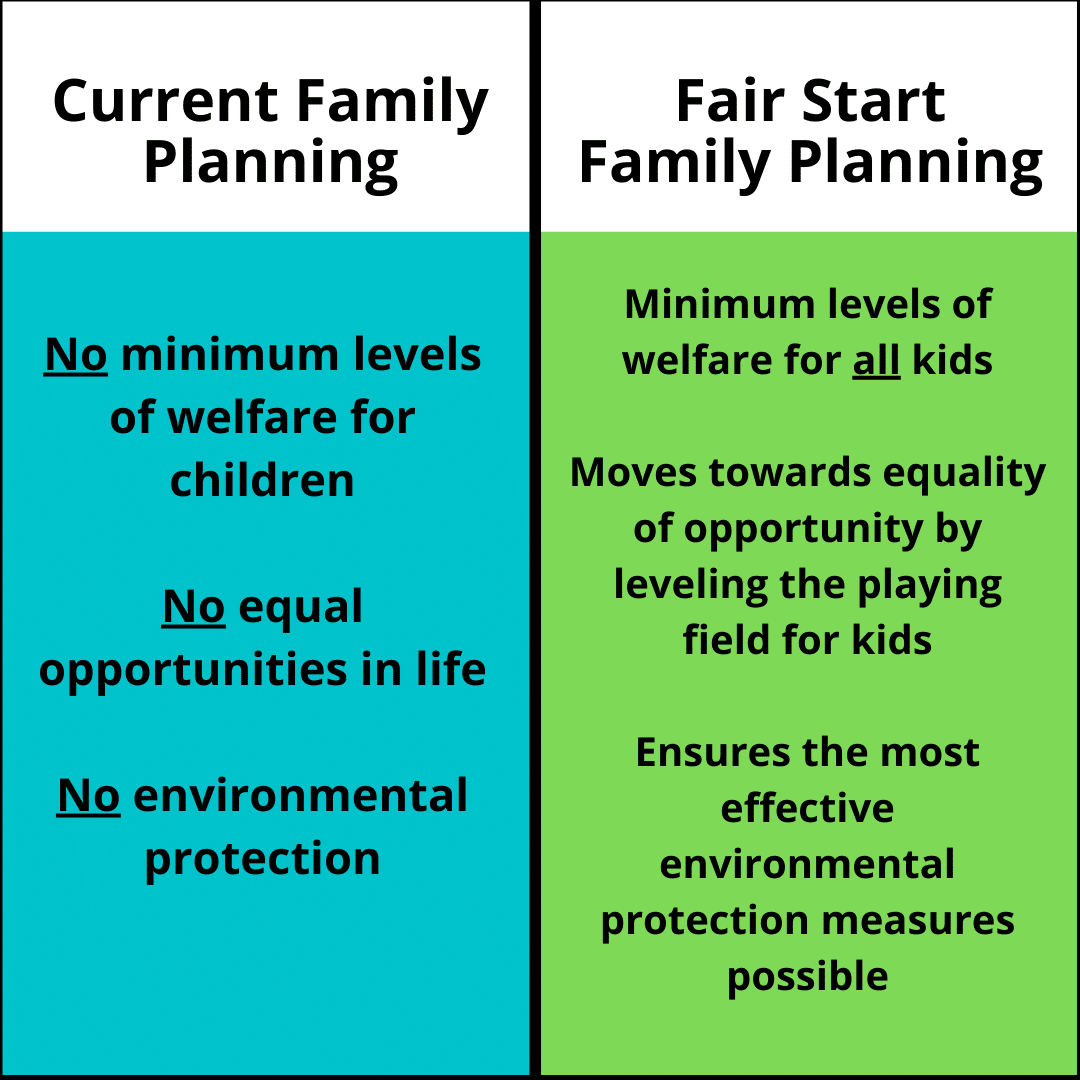
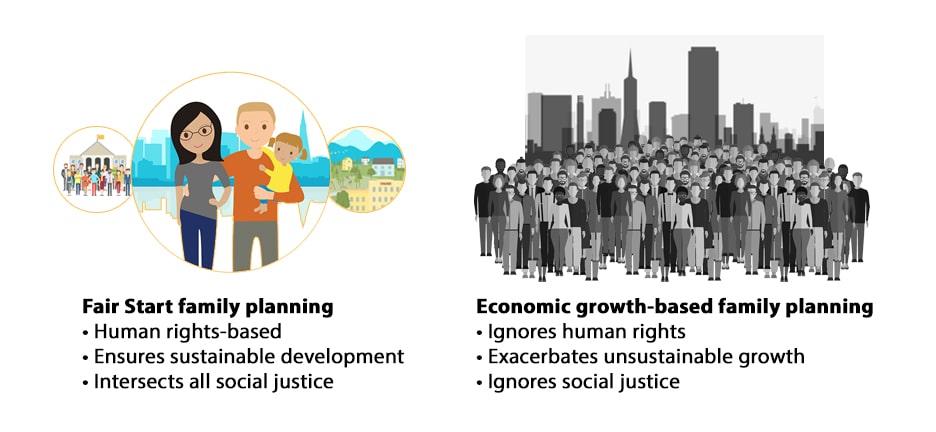
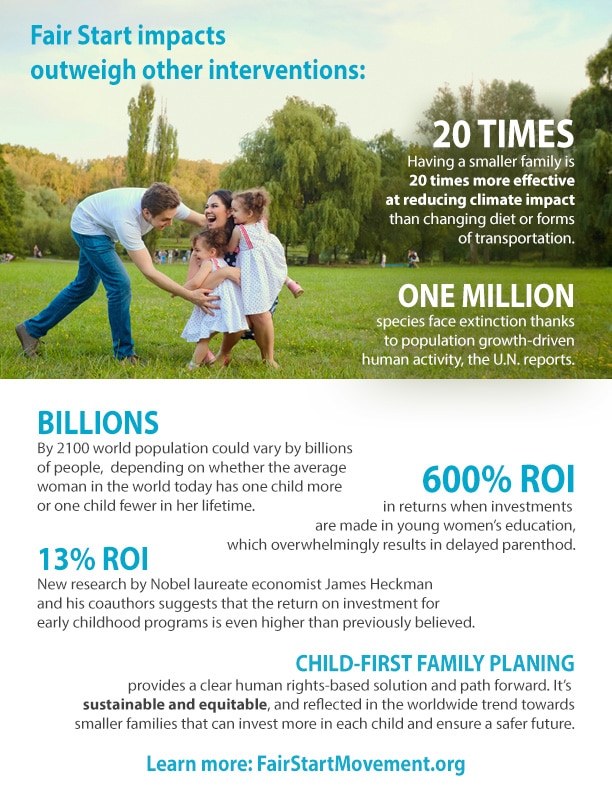
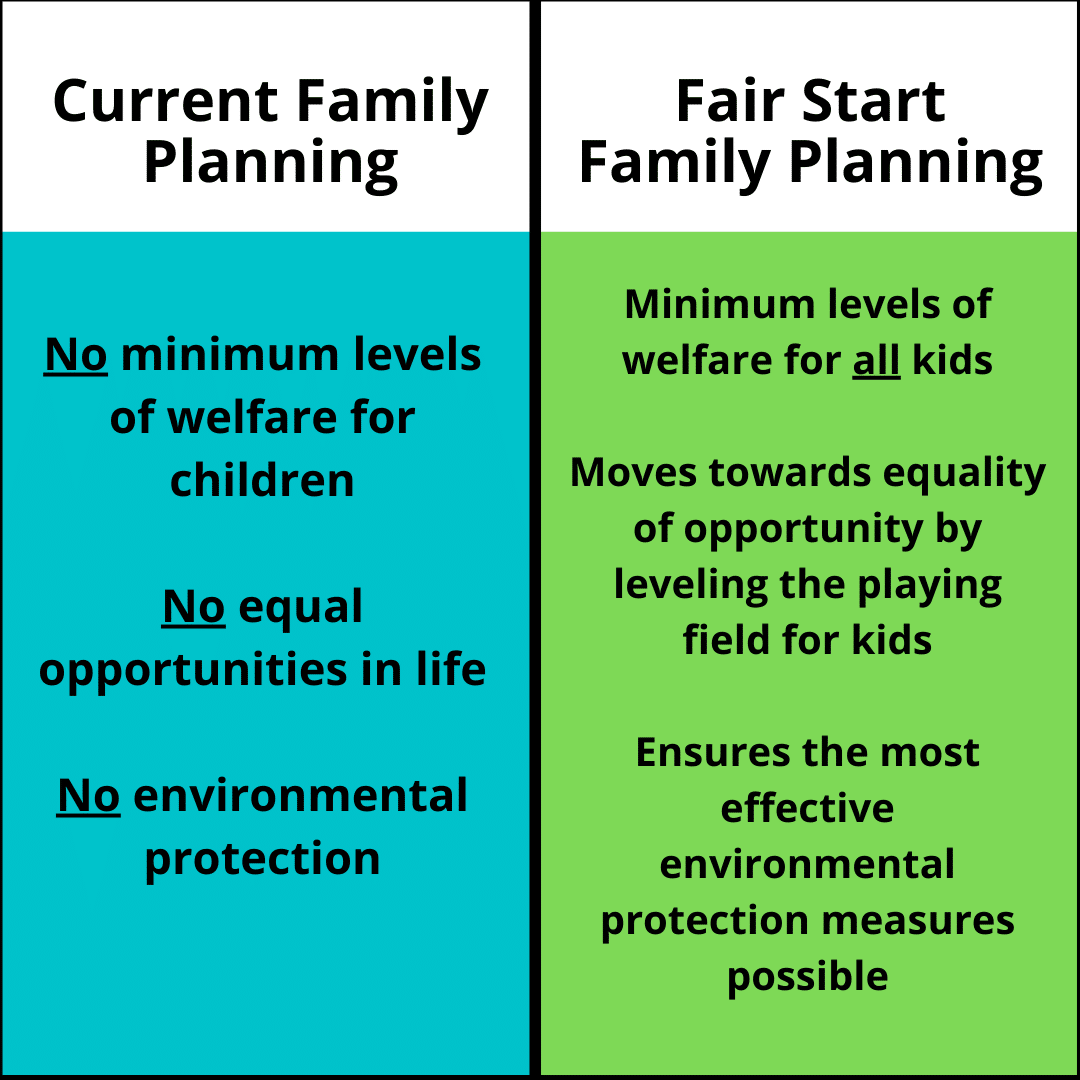
Family planning is too often reduced to a conversation about controlling population growth. But at its heart, it should be about something much deeper ensuring that every child is born into conditions where they can grow, thrive, and be supported. It is not just about preventing births; it is about preparing for them. When families are supported and systems are strengthened, children are given a better start. But when this issue is sidelined or misunderstood, the cycle of inequality continues.
An Unjust Starting Point
What we are seeing is a system that begins from an unfair starting point that can be called an “illegal baseline.” When some children are born with access to everything they need, while others are born without even the basics, the system itself is broken from the start. And no amount of effort later in life can fully erase that gap.
Why Preemption Matters
If we truly believe that every child matters equally, then fairness must begin at the very start. This means acting early before inequality takes hold. It means investing in mothers, supporting families, and removing harmful labels and barriers. It means ensuring that every child has access to the essentials from day one. Preemption is not just a strategy, it is a commitment to justice.
A Call to Reset
The Truth Alliance is calling for a shift in how we see and value children. A shift away from systems that quietly rank human worth, and toward a world where every child is given the same foundation to stand on. This is not an unrealistic dream. It is a necessary step toward a more just and humane future. Because if we do not address inequality at the beginning, we will always be trying to fix it too late. The question is no longer whether change is possible. It is whether we are willing to make it happen.
Professors are influential, and when they make public benefit claims, they should do some from clear baselines, and in a way that does not hide inequitable and disenfranchising growth. Not dealing with baselines is evidence to support the Fair Start thesis: That wealth obtained by violating the rights of future children now drives public interest narratives and outcomes to hide and violate those rights.
*This critique is intentionally done outside of customary back and forth academic discourse. A constitutive discourse is more public, and rather than treating values like animal protection as abstract, it assesses the value and impact claims influential people make that fundamentally benefit them, through a system of illegitimate and disentrancing growth and birth positionality, at deadly cost to others and in contravention of academic neutrality.
The Program’s website states it is: “Committed to analyzing and improving the treatment of animals through the legal system.”
That statement is inaccurate. Stilt and the program use an illegal baselining and equity fraud standard that creates a fantasy world of benefit for animals that is undone, upstream, by inequitable and disenfranchising growth.
Stilt’s work on the illusory concept of “rights of nature,” the benefits of which are undone by growth every day, is exemplary of her approach. Claims of using animals benefiting animals are the worst example of the Winners Take Allphenomenon because animals are the most numerous category of vulnerable entities, and because claiming our current political inequity-based system of growth can benefit them are outlandish.
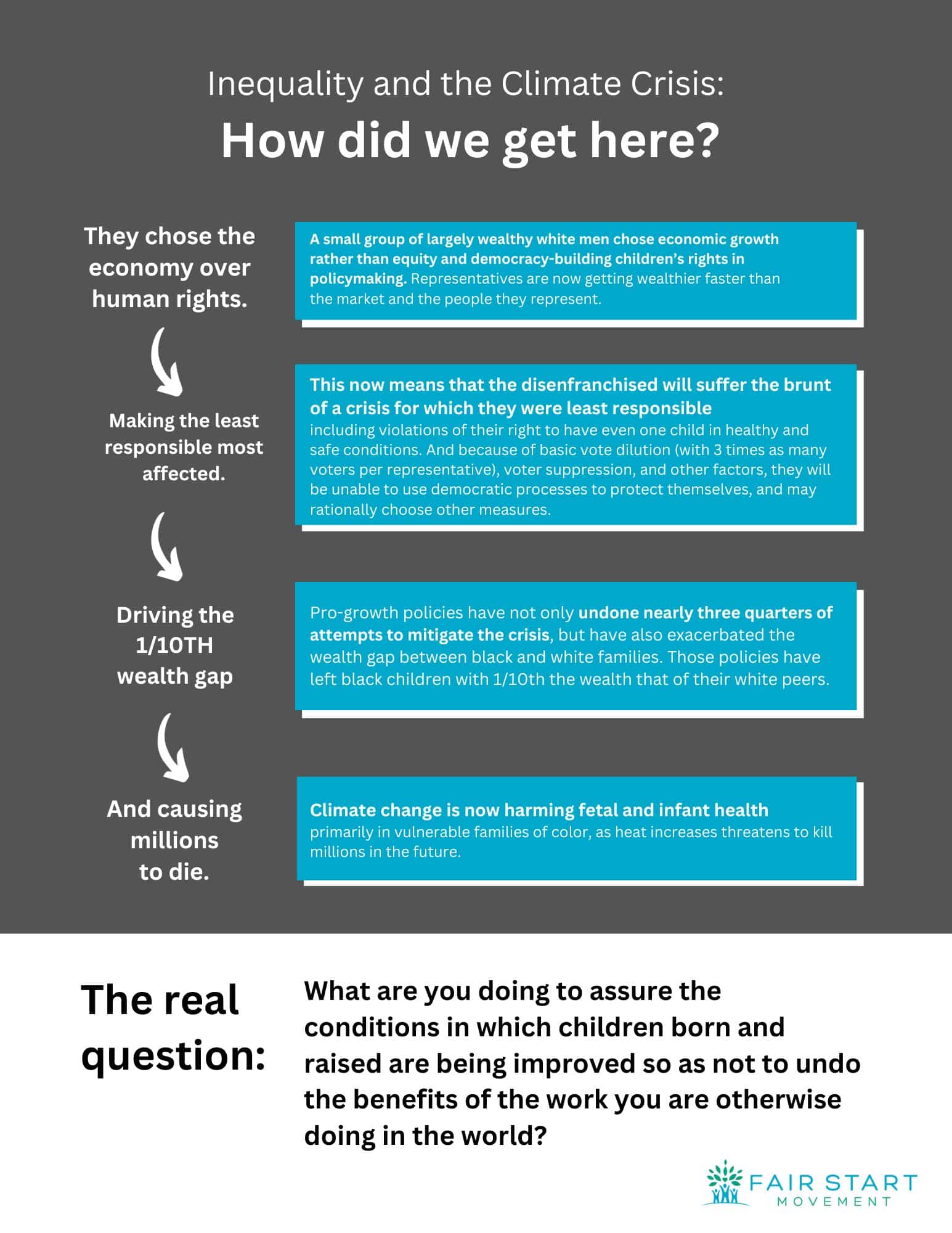
Fact: Inequitable growth that enriched mostly wealthy, white children at deadly cost to countless children of color did exponentially more harm to animals than the program ever did good. Use of that valuation and reporting model hides liability for the deaths of tens of millions as the climate crisis intensifies, and reflects the academic and public interest practice that ensured the polycrisis: Constantly moving goalposts away from the absolute infant-health-as-enfranchisement standard necessary for political legitimacy in order to falsely claim truth, or victories, and to thus raise funds.
The fundamental unit of moral currency is the influence one has over the outcomes of their political system, or what is loosely understood as political equality / equity though common conceptions are incomplete. Other currencies, like welfare, cannot exist outside of systems of political and legal obligation or “oughtness” and the primacy of how people are positioned relative to others and Earth’s ecologies at birth.
This equity is consistent with an objective “one person, one equal and influential vote” (equal offsets of influence relative to zero) standard, empowering persons to limit the influence others have – including ecologically and socially – over them. This is also consistent with more collective systems of family planning in which no child is treated as worth more than another, an outcome ensured through a threshold or level of empowering birth and development conditions and relations outside of which no child should be born.
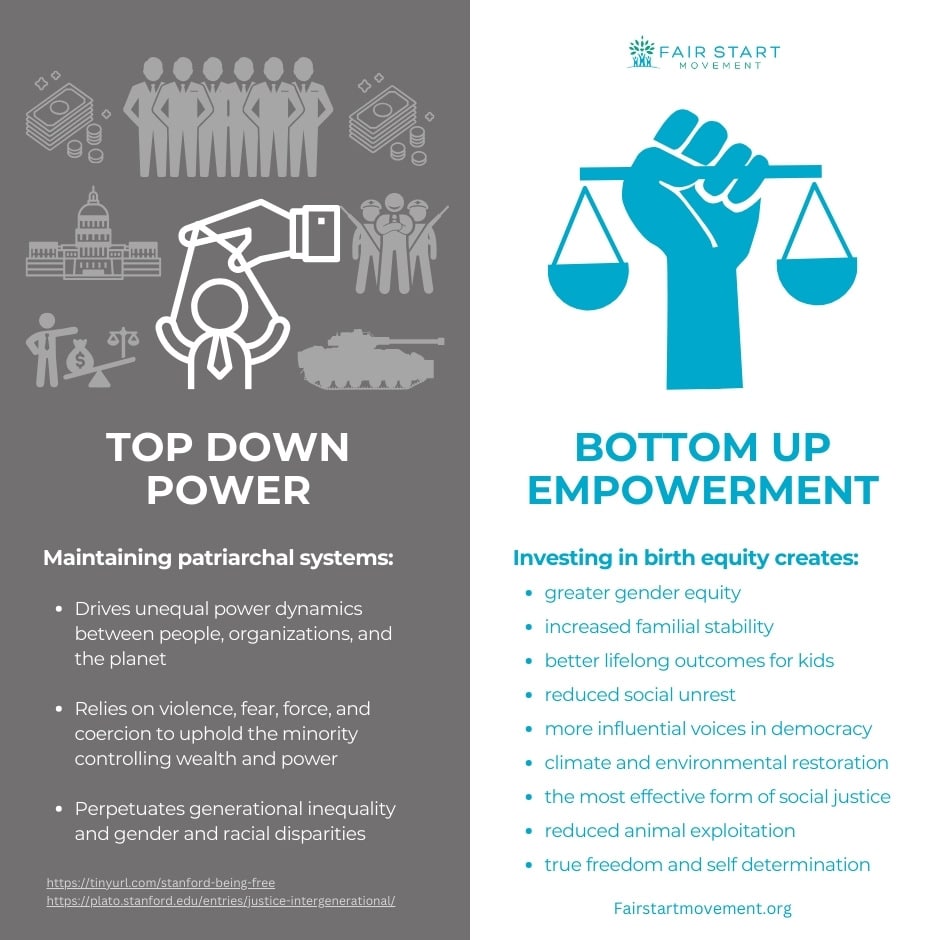
This physically disembedded persons from any effective role in their political systems. It also allowed those in power, both with political authority and entitlements to wealth defended by that authority, to avoid having to legitimate their power by actually, and measurably empowering those subject to it. Rather than seeing the creation of actual (relative to the legal baseline) empowering relations as the source of political authority, nations treated symbolic or representative instruments like treaties and constitutions as themselves authoritative.
While civil rights movements made headway in areas like housing, employment, and education, the notion of autonomy without equity amounted to the privatization of the creation of power relations, and the totally arbitrary basis for the concentration of extreme levels of generational white wealth – over the span of decades – that drives many of the outcomes we see today. That wealth never had to pay the costs of legitimacy – and the full impacts are now being revealed.
Within less than a few generations the regime caused unsustainable growth, vast political, social, and ecological inequity, the destruction of world ecologies, and the decline of democracy. This inequitable and disenfranchising growth breached political, ecological and social thresholds for objective values we all share like comfortable temperatures, equality of opportunity,
Public interest work and outcomes during these decades and into today have generally oriented from arbitrary, ever-changing and illegal (both because they disenfranchise and otherwise harm children, relative to a host of accepted legal standards usually only applied to existing rather than future children) baselines that violate the “one person, one equal and influential vote” standard. High levels of climate emissions championed by “environmental” organizations that enrich some at deadly cost to others, still permitted and defended by coercive authority of nations, are an example.
Use of these baselines represents an undemocratic, diluted and commercial form of freedom, rather than values consistent with political freedom, that is more akin to “free market” choice” of a shopping mall more than the political influence of a functional town hall.
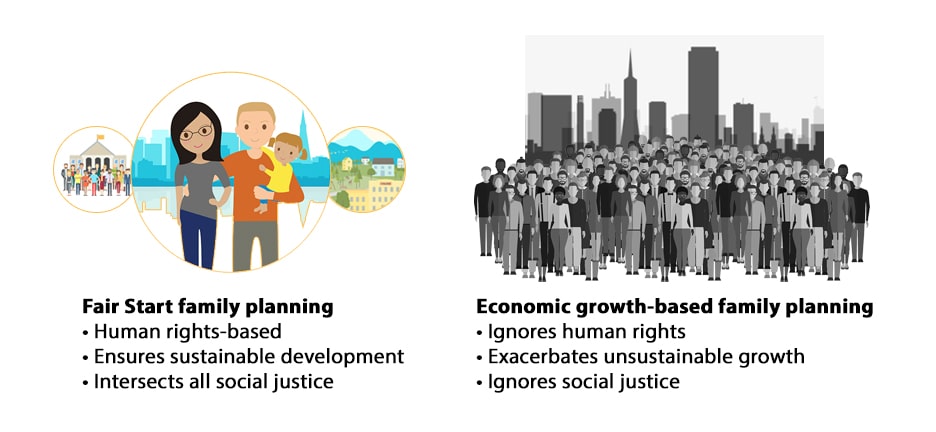
Public interest interventions to challenge greenwashing and humanewashing have failed because they themselves did not account for the massively countervailing impacts of growth on the interventions themselves – growth that for instance has created more climate emissions than the interventions removed, while bringing children into the world without the resources or political influence to deal with them.
And yet accounting for growth by itself would not account for the inequity of the relations formed by that growth.cIt would not account for how some benefit at deadly cost to others based simply on their birth and developmental positionality, with benefits defended by nations on the false premise that all are empowered equally at birth. One of the false assumptions at work was that some children were magically born poor and others rich, instead of the reality of a policy choice to elevate family autonomy (and not in the sense of being free of the climate crisis, but free in a “free market” sense) over family equity and political legitimacy.
Today women “liberated” by this reproductive rights regime, as well as their children, are dying in growth-based heat waves, living in poverty, with no way to use their political influence to save themselves or their children. They are subject to top-down abstract rules, not rules derived from the inclusive creation of power relations by those subject to them.
Worse yet, wealthy funders benefiting from that inequitable growth – like Tim Midura – have helped conceal this with the downstream charade interventions discussed above, and low standards for defining terms like “green,” “humane,” and “equitable” designed to enrich their own children at deadly cost to others.
For example, Fair Start activists were funded by such funders in their work with prior organizations, and prominent activists turned business owners today benefit from having used assessment and reporting models that each year allowed them to claim progress for vulnerable entities – like animals – that was easily being undone on exponential levels by birth-inequity based growth. The hallmark of equity fraud involves the fraudster omitting from evaluation and reporting the largest driver of the relevant outcome – the birth-based creation of power relations – in order to exploit that process.
The solution?
The FalseClaimsChecker.org accounts for this minimum necessary condition of political equity by replacing those assumptions – and the illegal baselining – with a base assumption that political authority and the entitlement to wealth it can generate must be derived from a “one person, one equal and influential vote” / “no child is worth more than another standard,” thus situating those making the value assessments and impact reporting themselves as part of, or outside of, a discourse legitimacy moving towards a just future. This accounts, at a most fundamental level – at a constitutional or basic system of obligation level, for the driver of the polycrisis.
These claims situate them in their political system, and allow us to assess how they arbitrarily benefit from, or suffer the costs, of the “separate but equal” standard.
When someone makes a value assessment and impact claim, we should ask: Relative to what?
You will find rampant use of shifting baseline – moving goalposts – that allow claimants to appear to create value and beneficial impact with no functional protections for the most vulnerable, infants and animals, as the climate crisis, autocracy, and massive inequity worsens. That means the impact is being undone relative to the minimum legally required threshold, or an illegal baseline – illegal because it does not account for legitimacy, or the need to measurably empower those subject to the legal system, including ensuring minimum levels of health-as-enfranchisement for all infants.
This is called growthwashing, or more accurately equitywashing. Why the latter? Because to treat humans quantitatively as numbers is less accurate than to see them as living in complex qualitative relations, and because past certain ecological, social, and political thresholds, growth has devastating nonlinear impacts – with climate emissions triggering things like ecological feedback loops.
We can use these claims to demonstrate the problem, that the values and impact they claimed would have been undone relative to the legal / preemptive as opposed to arbitrary baselines, and encourage reforms towards the legal baseline and their becoming part of an empowering system of truly self–determining persons by realigning fundamental authority and entitlements around a system of fair birth positionality, consistent with the values that they are signaling in their claims This is a state of autonomy through political equity by rearranging constitutional entitlements, sufficient to ensure Dasgupta’s optimality, but in the qualitative sense of empowering relations.
Given that few if any use the legal “one person, one equal and influential vote” standard, this exercise generally entails their having to admit benefiting from arbitrary birth and developmental positionality (national, racial, intergenerational, etc.) at deadly cost to others, and having disparate influence over others defended by unlegitimated authority, and threat of coercion, of the state.
We admit: Being part of a system of birth inequity that treats children of color as deserving fewer resources and influence, including omitting this as a countervailing factor in our value assessments and impact reporting, by overshooting ecological, political and social thresholds does more harm to our values than we do to further them.
This “Tell the Truth” discourse creates an opportunity for permanent resistance to oppression because it protects, through the use of an intergenerational justice threshold, the most vulnerable, Infants and animals and identifies those who reject that protection, and systems of mutual self-determination with it.
See the fallacious claims by prominent food entrepreneur Paul Shapiro, who ironically started his work as an animal rights activist climbing to a level of national influence on a false advertising campaign against egg producers for humane washing, His claims to have saved animals while explicitly refusing to back equity reforms or qualify his claims, make them inaccurate and out of context because he omits how he chose underlying policies that did vastly more harm to animals than he did good. His omission enables him to exploit financial systems – as lead at a profitable food company with military contracts – that in turn growth exploit animals and elevate his voice above those pursuing on-balance reforms.
Initial attempts, in other scenarios, by Fair Start Movement and Truth Alliance advocates to implement this preemption were met with sabotage by public interest entities hiding liability for decades of inaccurate claims, usually for micro interventions undone – relative to a true system of empowerment – by macro forces that enriched those involved, and their funders, at deadly cost to others.
As a practical matter one can challenge illegal baselining, or political equity and impact fraud, using inexpensive and widely available consumer protection and unfair competition laws to enjoin public and private business valuation, and impact reporting, that don’t comply with the minimum baseline of inclusive legitimacy.
Given that political authority, including to entitle wealth, derives from having to empower those subject to the authority, these cases get to the ultimate question of political freedom: Are we obligated to a political system that does not empower us? And what are the limits of self-defense against such a system?
After 1948 and the inception of universal human rights that limited national authority, nations were obligated to derive their authority and any entitlements protected under it from the equitable empowerment of their subjects. This requirement is widely reflected in the Bill of Human Rights instruments and their references to the right to self-determination – and one person, one equal and influential vote. This requirement should have created an interpretation of the collective pronoun that premises those documents, like the reference to “we the people,” treating a level of influence in one’s political system (“oughtness” or an “influl” that precedes a “util”) as a fundamental currency that precedes utility and welfare.
The textual basis for this interpretive rule is clear – these pronouns are the linguistic premise of the language that follows. Such a currency and universal linguistic rule of interpretation would have entailed a harsh principle: Each person in a system of law and obligation would be owed the level of public protection, or oughtness, they would account to the most vulnerable: Infants, and the animals whom the infants would impact. The value of self, versus other, determination would require it. Again, a racist system of self-determination blocked this change.
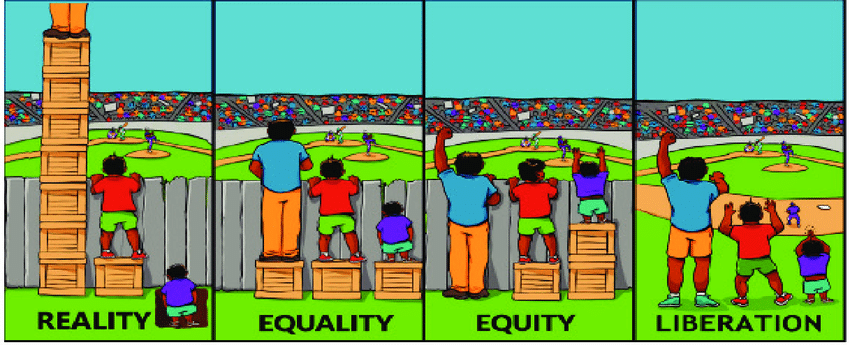
Regardless, the principle creates a textual basis to interpret law as requiring the inclusion and empowerment of those subject to it, consistent with standards for intergenerational justice, and ensuring equal offsets of influence relative to a zero baseline and the idea that no child is worth more than another. At a policy level this would have required a fundable, minimum threshold of empowerment beneath which no child should be born, with future children holding entitlements sufficient to create collective family planning systems based on readiness, delay, and the equitable distribution of levels of influence among children. The threshold ensures equal offsets relative to zero, or the preemptive costs of having to measurably empower all children equitably as they enter the world – and at a standard where those children could protect themselves from things like a climate crisis, autocracy, deadly inequity, etc.
Put simply:
If it’s illegal to use a business model that prohibits hiring or housing persons of color, it’s illegal to structure cost/benefit business models to enrich some children at deadly cost to children of color. Use of that model hides liability for the deaths of tens of millions as the climate crisis intensifies, and reflects the academic and public interest practice that ensured the polycrisis: Constantly moving goalposts away from the infant-health-as-enfranchisement standard necessary for political legitimacy in order to falsely claim truth, or victories, and to thus raise funds.
Unless a person or company claiming to add value to the world can show they were evaluating and reporting by accounting for the preemptive costs of having to measurably empower all children equitably as they enter the world – and at a standard where those children could protect themselves from the climate crisis, autocracy deadly inequity, etc. – the person or company making the claims has been using an illegal baseline, a Ponzi/equity-fraud standard that benefits them at deadly cost to others, and mostly children of color.
Those willing to pay the costs of a legitimate political system that avoids arbitrary benefits of birth positionality and conditions authority on empowerment could never compete against those willing to exploit others, and they need not given that any authority to govern or assign wealth derives from first empowering those subject to these things. The other solution to inequity-gained wealth backed by state violence – as the oppression it is – is to treat that violence as illegitimate and triggering the right to self-determinative self-defense against “trolley targets” who benefit themselves at deadly cost to others.
It’s this truthful and obligation-creating discourse, a Tell the Truth campaign, that is most preemptive and legally authoritative over all conflicting obligations, including treaties and constitutions.
Across public-interest work — from animal advocacy to climate to social policy — institutions regularly claim progress.
They report impact.
They describe success.
They ask for trust.
But far too often, they do not answer a simple threshold question: relative to what baseline?
Without a clear baseline, a claim of “impact” cannot be independently verified. It becomes a statement without a measurable standard, and in that gap, perception can replace reality. An organization can appear to succeed while underlying conditions remain unchanged — or even worsen.
This is not always intentional. But it is systemic. And it matters.
At its core, this is a question of legitimacy. Public-interest institutions operate with authority and influence, often shaping outcomes that affect animals, children, and vulnerable communities. When claims of progress are made without clear, equitable, and measurable standards, that authority rests on perception rather than demonstrated outcomes.
These claims influence where money flows, which strategies scale, and ultimately which lives are affected — including animals, children, and vulnerable communities. When baselines are unclear or absent, it becomes difficult to distinguish between meaningful progress and performative success.
The problem is not limited to one issue area or one kind of institution. It extends across domains where public-facing claims are used to attract trust, justify strategy, secure funding, shape policy, and signal legitimacy. In that environment, the absence of a disclosed baseline is not a minor technical omission. It is often the difference between a claim that can be evaluated and one that cannot.
These gaps are not confined to a single domain. They extend into areas such as climate policy, where decisions are often evaluated against incomplete or shifting baselines. As a result, actions may be presented as progress while long-term consequences — including projected loss of life, environmental degradation, and disproportionate impacts on vulnerable populations — are not fully reflected in how success is measured or reported.
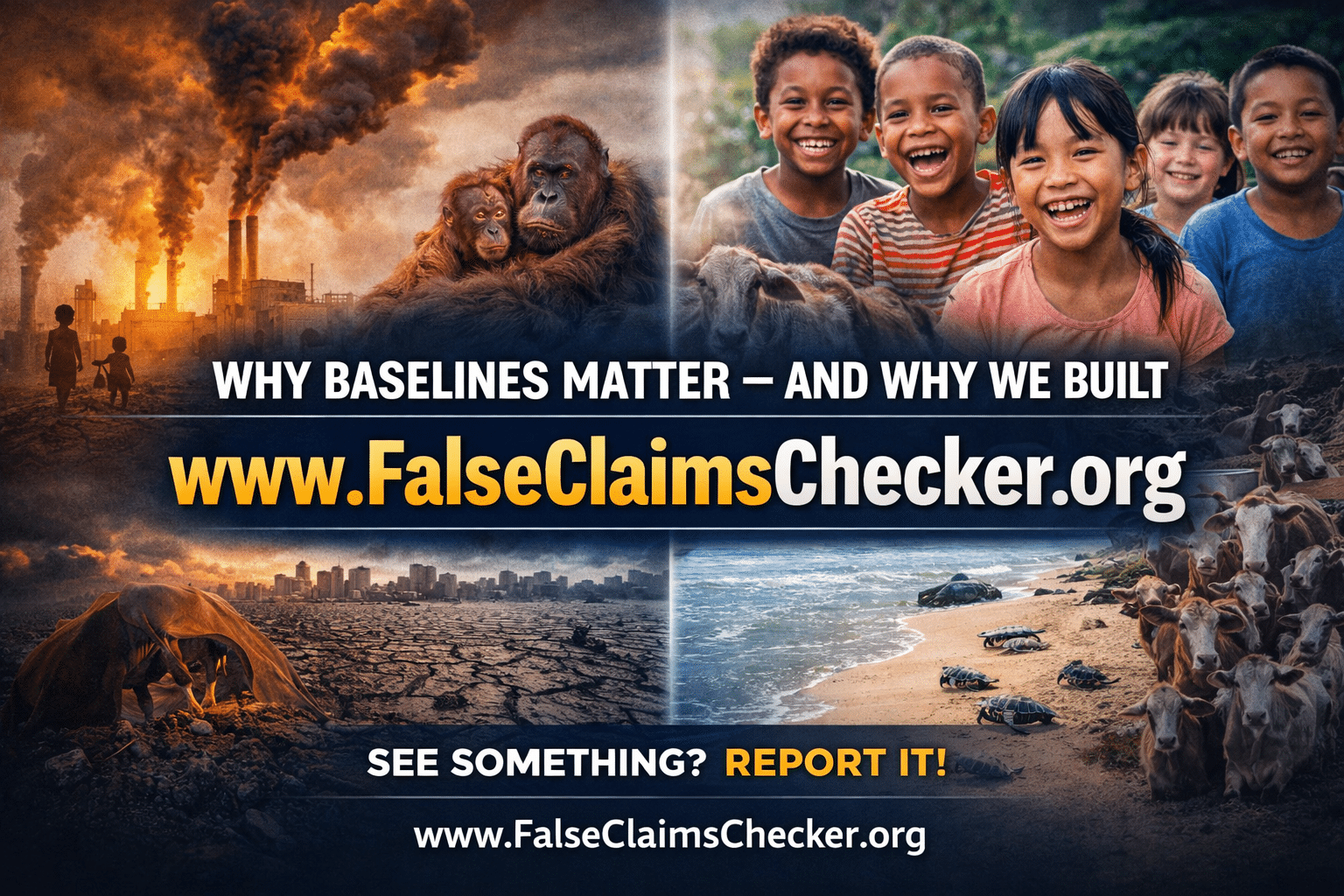
That is why we built the False Claims Checker.
www.FalseClaimsChecker.org is not a commercial product or a marketing exercise. It is a public-interest intake and triage mechanism designed to help structure the review of public-facing claims. It exists to identify whether a claim can actually be understood and assessed based on what has been disclosed. In that sense, its role is straightforward: to bring structure, clarity, and accountability to claims of impact before those claims are accepted at face value.
FCC evaluates publicly available claims using a structured standard:
What is being claimed?
What baseline is being used?
What outcomes can be independently verified?
It does not assume bad intent.
It does not require inside information.
It simply asks:
Can this claim be understood and validated based on what has been disclosed?
That question matters because public-interest claims do real work in the world. They shape reputations. They influence donors, regulators, journalists, institutions, and the public. They affect which interventions are replicated, which narratives dominate, and which harms remain obscured. If the baseline is missing, unstable, or selectively framed, the claim may still sound persuasive while remaining impossible to verify in any meaningful way.
This is especially important where the people, animals, or communities affected by a policy or institution are not positioned to control how success is defined on their behalf. In those settings, baseline selection is not neutral. It determines what counts, what disappears, and what can be publicly celebrated despite unresolved or worsening underlying conditions.
The broader concern behind FCC is that claims of progress are often made without the level of transparency necessary to evaluate them fully. That concern reaches across domains affecting animals, children, climate, race, and other vulnerable or publicly affected populations. Where appropriate, the issue is not merely whether a claim sounds reasonable. It is whether the claim discloses enough to permit independent understanding, meaningful comparison, and honest scrutiny.
Without that, “impact” can become a matter of presentation rather than proof.
FCC was built to address that problem.
Because without a baseline, there is no way to know whether progress is real.
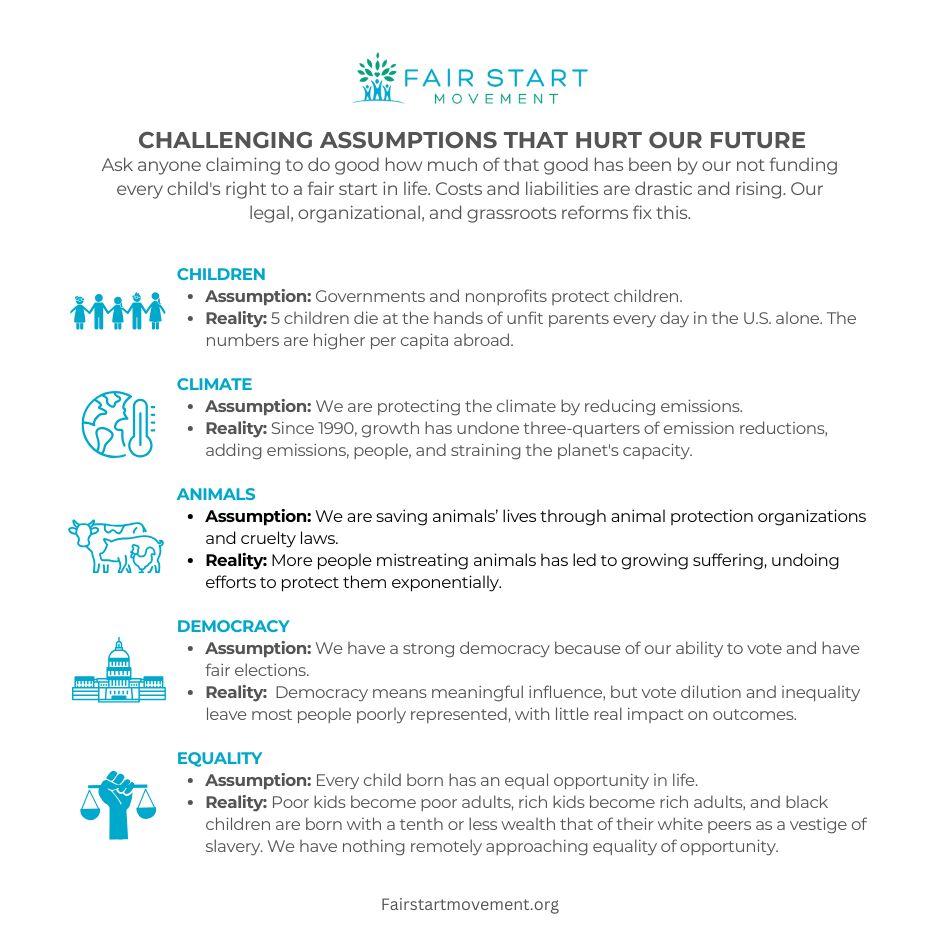
Micro, downstream interventions in public interest crises are being undone by macro, upstream growth and birth-based political inequity that involves illegally discounting future lives and hiding liability for the deaths of millions. Illegal baselining enriches some children at the illegal and deadly cost of others. The Tell the Truth Campaign can end it.
1.
Fair Start was established by advocates who identified a fraudulent Ponzi standard embedded in their prior public-interest work. This standard stems from a twentieth-century power grab by wealthy families who privatized family planning to safeguard entitlements and maintain power within a coercive political system that never empowered its subjects. These families, along with political leaders, were legally bound to adhere to a child-rights and equity standard asserting that no child is worth more than another, as outlined in the International Covenant on Civil and Political Rights.
The fundamental measure of value is infant health, wellness, and self-determination—ensuring equal political influence for each individual. Instead, they relied on a prevailing “separate but equal” standard to define reproductive rights and disenfranchise others, leading to the exclusion of birth equity from valuation and reporting systems.
Equity fraud—and the illegal baselining it entails—was embedded decades ago as a “separate but equal” standard in reproductive-rights systems, ensuring inequitable and unsustainable growth. This has resulted in the deaths of millions and is a fundamental cause of the polycrisis. The legitimate standard, which should have been used as early as 1948, treats no child as worth more than another and centers on collective family planning that ensures no child is born beneath a threshold of empowerment.
After World War II, governments and wealthy families were obliged by human-rights regimes to use an objective and protective standard to limit the power humans have over one another. Instead, they chose a subjective and illegitimate standard that allowed exploitation of birth positionality, with no functional protection for the most vulnerable: infants and animals.
Today, women “liberated” by this reproductive-rights regime—and their children—are dying in growth-based heat waves, with no way to use their political influence to save themselves or their children. Worse still, wealthy funders benefiting from that inequitable growth masked it for decades with downstream charade interventions and low standards for defining terms like “green,” “humane,” and “equitable,” designed to enrich their own children at the deadly expense of others.
This was existentially subversive to racial-justice and decolonization efforts, because it constituted wealth and power segregation at the very creation of power relations. What appears to be simple growth is, relative to the correct baseline, qualitative disenfranchisement.
Equity fraud involves using a discounted version of freedom: Measuring levels of harm to vulnerable infants and animals as permissible (as opposed to impermissible, or requiring a zero baseline) because the user wrongly redefines self-determination so that economic growth (benefitting some at illegal and deadly cost to others) offsets the requisite political disenfranchisement to achieve that growth, skewing the baseline for climate damage and other life-saving evaluations in the process.
2.
If an entity claims beneficial public impact, it must be able to account for how it factors in the variable of children entering the world relative to what children’s rights and equity require. If it cannot, its assessment of value and reported impacts may do more harm than good. If one cannot show—after accounting for the costs of ensuring future children are empowered enough to use their political systems to protect themselves from threats like the climate crisis (equal offsets relative to zero, or one person, one equal and influential vote)—then the equity-fraud standard is being used.
The illegal standard relies on manufactured numbers through an XYZ analysis, in which out-of-context claims about value and impact (X) are assessed against the variable of children entering the world during the relevant timeframe (Y) in a way that overshoots and degrades children’s birthright conditions, producing an outcome (Z) different from what is claimed. This standard encourages inaccurate claims of micro-level progress that benefit the claimant while hiding larger macro-level losses driven by growth.
One cannot benefit from a system that brings children into conditions and relations that violate a host of accepted legal standards, including the obligation to treat infants of color as persons deserving political equity. Use of this standard means many public interventions have done more to subjugate people of color than to advance their stated missions.
3.
Fair Start activists have encountered many actors intentionally concealing information that would reveal this fraud—literally skewing the baseline that protects infants and animals—to improve their position within an illegitimate system rather than to legitimate it. These actors engage in value signaling and performative babble, doing many seemingly useful things while “triple-dipping”: benefiting from inequitable birth positionality, growth-based wealth, and charade micro- and downstream public-interest work that hides the upstream macro-level harms from which they benefit at deadly cost to others.
The Tell the Truth (TTT) Campaign is a yes-or-no, fact-checking effort that requires admission of the use of the illegal standard and a commitment to replacing it with the equity standard necessary to legitimate national governance. The campaign operates with full transparency, including querying those who once worked with Fair Start but later chose to use the equity-fraud standard to benefit at deadly cost to others.
One can either tell the truth and participate in a discourse of true constitutional—or empowering—obligation, or fall outside its scope and face legal action for subverting racial-justice movements to enrich white children at the deadly expense of children of color.
4.
A legion of professionals refusing to Tell the Truth ensure the white wealth bubble:
Lawyers, who refuse to derive authority from empowerment because they benefit from not doing so.
Academics, many of whom do not account for birth positionality and thus lose neutrality in their work.
Reporters/editors who omit the countervailing impacts of child inequity on the facts/values they report, and cave to incentives to write ad-worthy sensationalism that omits relevant facts around birth equity.
Campaigners, who focus on micro interventions undone by the macro.
Paid fundraisers, who take a cut from working downstream on a problem, rather than solving it.
They create a fantasy world of legitimacy and social justice progress with performative, micro-level and downstream interventions easily undone by inequitable, disenfranchising, and upstream growth.
5.
Our thesis is that:
A. Admitting use of a system in which wealth created through decades of violating children’s birthrights determines public-interest outcomes instead of objective values, and
B. Through the admissive language itself
C. Inverts obligations away from those in governance and toward future generations.
6.
TTT is supported by legal, certification, and grassroots efforts within Fair Start and Truth Alliance. Legitimacy is about obligation, and all work either reflects or fails to reflect that basic value.
Entities that address birth inequity and truly—on balance—benefit animals cannot compete with entities that use a birth-inequity-based growth standard to quietly convert the values they claim to promote (such as wildlife protection) into wealth—wealth that elevates their voices above others. But because this practice is illegal, it can be blocked.
Anyone can require governments to block use of the equity-fraud standard—often through an unfair-competition-law and legitimacy injunction—because governmental authority, including the power to entitle wealth and property, derives from a preemptive obligation to measurably empower those subject to that authority. It is illegal to refuse to hire people based on race. Yet it has been treated as legal to use a standard that enriches some—mostly white children—at deadly climatological and birth-inequity costs to millions of children of color.
Fair Start reforms offer the most just and effective way to address many of today’s overlapping crises—but only if public-interest claims are evaluated using the right standard. Anyone claiming positive impact should be asked a basic question: How did your cost-benefit model account for children entering the world, and did it meet what those children’s legal rights, political equity, and national legitimacy require? In most cases, the answer is that it did not. Children are typically treated as economic inputs driving growth, while the ecological, political, and human costs of that growth are ignored or illegally discounted. This produces “free” wealth that depends on worsening conditions – especially for children of color – and contradicts the values advocates claim to hold, such as safety, equality, and sustainability. The result is continued overshoot of ecological and social thresholds that both humans and nonhumans need to survive.
The standard treated children, and thus future generations, as means rather than ends, and it ignored that persons not documents constitute nations, and almost inevitably through collective family planning efforts that ensure a minimum threshold of empowerment for all children. That threshold – a real border to replace the fictitious ones nations use today – enables consensual governance, avoiding each person’s loss of self-determination to the billions of others occupying and changing the planet. The real border makes consent possible.
In what the judge called “one of the most horrific examples of child abuse that I’ve ever seen,” a Tullytown couple were sentenced this afternoon to 10 to 21 years in state prison for violently abusing their twin, infant daughters. Melissa Shales, 26, inflicted multiple broken bones on both infants by the time they were 2 months old. Now 17 months, the girls only recently began to walk, and still need physical therapy. Michael Shales, 31, failed to seek medical care for those injuries and badly tore the throat of one girl with a pair of pliers when he was high on heroin. That girl remains on a feeding tube. “Their two months of life with their parents was torture,” Deputy District Attorney Chelsey D. Jackman said. “Nothing short of torture.” Bucks County Common Pleas Court Judge Raymond F. McHugh concurred with that assessment. “I believe that both of these parents tortured their children,” McHugh said. “I don’t know which is worse: to injure a child, or to fail to get a child treatment.” Both defendants pleaded guilty on May 22 to charges of aggravated assault and endangering the welfare of children.
McHugh sentenced each to serve seven to 14 years for the assault charges, plus a consecutive three to seven years for child endangerment. Police were called to the Shales’ squalid, trash-strewn apartment on March 21, 2016, where officers found the infants malnourished and injured. Melissa Shales told police that one of the twins was having trouble breathing. The child had a throat injury inflicted earlier in the day when Michael Shales had used pliers to retrieve a piece of gauze lodged there. Police found the baby pale and gurgling, her breathing shallow. The apartment, meanwhile, was strewn with dirty clothes, toys, sharp tools, soiled diapers and dirty dishes, along with drug paraphernalia and unspent bullets left within the reach of the babies and their 2-year-old brother. Michael Shales had begun the day by purchasing $120 worth of heroin in the Kensington section of Philadelphia. When he returned, Melissa Shales became so enraged that she threw the baby she had been bottle-feeding into the aluminum rails of a nearby daybed and stormed out. Michael Shales then injected the heroin he had bought before trying to wipe the inside of the injured baby’s mouth with a piece of gauze. When the gauze became lodged in her throat, he tried to retrieve it with his fingers before using a pair of pliers, puncturing the back of her throat and esophagus in the process. Police were not summoned to help the infant until after 10 o’clock that night. The baby’s injuries required her to be intubated to breathe and for a feeding tube to be inserted for nourishment. The child also was found to have a fractured femur, rib and tibia, neck injuries consistent with shaken-baby syndrome, and cuts and bruises to her vagina.
The couple admitted having left her in soiled diapers for hours at a time. About one week before police intervened, Melissa Shales had grabbed the same baby’s leg while bathing her and heard a pop. Over several days, both parents tried repeatedly to pop and twist the leg back into place, possibly worsening the injury, Jackman said. Neither parent called or visited a doctor, and by the time police were summoned the child’s leg had swollen to the size of a 1-year-old’s leg. Melissa Shales also admitted to having thrown the same baby forcefully into her swing after becoming angry with her husband on March 20, 2016. The baby landed hard on her left side, and appeared to be favoring that side afterward. Michael Shales witnessed the assault but, again, neither parent sought medical attention. The baby’s twin sister also was found to have two fractures to her leg, and was hospitalized on March 22, 2016. Experts at St. Christopher’s Hospital attributed the breaks to non-accidental trauma, likely caused by pulling, shaking or twisting the child. Melissa Shales admitted to police that she had picked up the infant by her onesie and placed her down hard in the past. Both children were malnourished, having gained only two pounds each in their first two months of life, Jackman said. In a statement to police, Melissa Shales said she had injured the babies “to get back at Michael, to show him how mad he makes her.”
In court today, Melissa Shales said had she worked 40 hours per week for minimum wage while her husband stayed home and spent their money on guns and drugs. She accused him of abusive, threatening behavior toward her. Melissa Shales also blamed her behavior on her use of methamphetamine. She said she began using the drug after the twins were born at the behest of her husband, who “told me that sex would be better” on meth. She said she “was too afraid of him” to challenge Michael Shales’ own drug abuse. “What I did to my kids was and is unacceptable,” she said. “From here on out, I wouldn’t blame my kids if they never wanted to see or hear from me again.” Michael Shales told a much different story. Addicted to opioids since 17, when he suffered severe spleen and back injuries in a criminal assault, he said the injuries and his addiction limited his ability to work. His attorney, Paul Lang, told McHugh that Melissa Shales had been physically abusive to her husband, and was trying to “deflect” blame for her violence onto him. “Words cannot express the pain and sorrow that I have built up in my heart,” Michael Shales said. “I regret my actions, and long for the opportunity to rectify my actions.” The girl who suffered the most broken bones and the punctured throat “was treated as a rag doll by the two people who are supposed to protect her against any kind of harm,” Jackman argued.
Michael Shales, she said, “sat there and watched” his wife abuse the child, failing to intervene each time the baby cried out in pain. “Those cries went unanswered,” she told McHugh. “I’m asking Your Honor to answer those cries today, and to see that justice is served.” Family members of both defendants testified that both were brought up in good homes, a fact that McHugh said made their crimes even worse. The judge added that heroin addiction may explain theft and other property crimes, but not violence inflicted on one’s own children. “It’s horrific,” the judge said. “It shakes my faith in human beings.” The case was investigated by Tullytown Police Sgt. Phillip D. Kulan and Bucks County Detective Jack Slattery, and prosecuted by Deputy District Attorneys Chelsey D. Jackman and Monica W. Furber. Contact: Chelsey D. Jackman, 215.348.6016, cdjackman@buckscounty.org Approved for release by Gregg D. Shore, First Assistant District Attorney.
Sourced via CRIMEWATCH®: https://bucks.crimewatchpa.com/da/29567/post/couple-get-10-21-years-torture-twin-infant-daughters
Across justice and equity movements like Fair Start and the Truth Alliance, young people are often praised as the future yet too frequently sidelined in the present. While these movements exist to challenge injustice, equity fraud, and exclusionary power structures still limit genuine youth participation. Youth are not just participants; they are leaders, innovators, and truth-tellers. They bring lived experience, courage, creativity, and the ability to challenge systems that no longer serve communities fairly. However, many encounter barriers such as symbolic inclusion without decision-making power, unpaid labor and selective listening.
True equity demands more than good intentions. It requires sharing power, embedding youth in leadership with real authority, creating transparent accountability systems, investing in youth capacity, and honoring the diversity of youth identities. It also calls for intergenerational collaboration, where experience and energy work together not in hierarchy, but in partnership. Young people around the world are already proving what possible exposing discrimination is, leading grassroots solutions, and holding institutions accountable. Their success shows a simple truth: when youth voices are trusted and supported, justice becomes real.
Here is the summary of the interview of Carter Dillard and Youth Advocate Domonick D’Angelo
The Fair Start Movement argues that current political and economic systems shaped by investors who prioritized unsustainable growth have created large inequalities and allowed significant harm to future generations. This has produced extreme wealth concentration and driven many of today’s social justice efforts. The movement proposes a fundamental fix: redesigning these systems so that future generations are protected from inequity and environmental harm from the start. It invites people to join in addressing what it calls “equity fraud” and to help build fairer foundations for the future.
Recently we interviewed Domonick D’Angelo, a young man from South Florida, about his thoughts on all of this: He often discusses major societal issues with his friends, especially money and the national debt. He’s worried about how cryptocurrency might worsen financial instability and harm elderly retirees. He opposes abortion bans because he believes they force parents into raising children they don’t want or can’t afford, which can negatively affect kids.
He’s deeply concerned about global warming particularly shrinking glaciers and disappearing Arctic wildlife and fears for the future. He’s also uneasy about AI, seeing how it has already made classmates less engaged and worries it will replace human thinking and jobs, especially with population growth.
He loves nature and believes spending time in it is essential for feeling connected to God’s creation, noting that growth and development destroy wildlife and natural spaces. He distrusts the government due to perceived corruption and worries about misinformation and deep fakes further eroding trust.
The message is clear:
Youth voices matter. Youth leadership is essential. And equity cannot exist without accountability. The future of fair, inclusive movements depends on unleashing youth power now, not later.
When Promises Spoke Loudly but Care Was Left Behind. Between 1948 and 1968, the world spoke boldly about justice. Leaders gathered to declare human rights, equality, and freedom. The Universal Declaration of Human Rights promised dignity for all. Independence movements filled the air with hope. Civil rights were debated in grand halls. But while these words traveled the globe, everyday life told a different story especially for families across Africa and the Global South.
Behind the speeches, white supremacy, racial hierarchy, and economic extraction were tightening their grip. Wealth continued to flow outward. Power remained concentrated elsewhere. And quietly, without ceremony, the ways families cared for one another were disrupted. This contradiction between what was promised and what was lived reshaped homes, gender roles, and care itself.
When One Family Model Was Declared “Modern”
During this period, a single idea of family was promoted as the future: the Western nuclear family. A man earning wages. A woman caring alone, unpaid. A household separated from the community.
This model was presented as progress. But for African societies, it meant loss.
Extended families where aunties, grandmothers, neighbors, and older children shared responsibility were pushed aside. Communal childcare, women-led food systems, and collective protection of elders were labeled outdated. Care that had sustained life for generations was erased from policy and planning. While Western nations built wealth through industry, land control, and racialized labor, African families were told to abandon systems that worked without being given resources to replace them.
Families were not failing.
They were being forced to change under unequal power.
What Women Never Stopped Doing
Even as systems shifted, women did not stop caring.
Mothers shared food when money was gone. Grandmothers raised children whose parents were lost to migration, illness, or conflict. Women organized survival quietly through shared labor, farming, caregiving, and conflict resolution.
This is where Women Care Modeling begins.
It does not invent care.
It recognizes what women were already doing, even when it was invisible, unpaid, and unsupported.
Women Care Modeling understands care as real power, economic, social, and political. It is not charity. It is not instinct alone. It is skilled labor and collective leadership.
Unlike the imposed nuclear family, Women Care Modeling is collective, intergenerational, and resilient because it was built to survive reality, not ideology.
Rights on Paper, Care in Real Life
From 1948 to 1968, governments debated rights in meeting rooms. Meanwhile, women in marginalized communities practiced justice daily without funding, without recognition, and often without rest. That gap has not disappeared. Today, institutions can mobilize millions of dollars for abstract priorities, while women-led family care systems holding children, responding to climate stress, feeding communities, and protecting the vulnerable are expected to survive on fragments. The question is not capacity. It is whose lives are valued.
Following the Money, Naming the Contradiction
Women Care Modeling makes the contradiction impossible to ignore. If families especially across Africa had controlled serious resources decades ago, the priorities would have been clear: Children cared for together, not left behind, Mothers supported in health and wellbeing, Food grown and shared locally, Elders protected and respected, Women leading with accountability to their communities
Instead, wealth was centralized in white institutions, and African families were blamed for “underdevelopment” after being stripped of land, labor, and decision-making power. Women Care Modeling names this not as an accident, but as racial injustice.
What this work reveals is a deeper truth about both Trump-era politics and the suffering experienced across Africa: for decades, much of what was labeled ‘public interest’ work left out crucial facts while claiming to serve the common good. At its core was a quiet but powerful assumption that some children mattered more than others.
These approaches were shaped by political and economic systems marked by inequality, often influenced by wealthy white families with outsized power in global institutions like the United Nations. In exporting a narrow vision of freedom and the patriarchal nuclear family, communitarian planning systems were weakened or dismantled.
The consequences have been devastating: wealth accumulated in some communities while children in others died. Enormous sums of money were used to avoid accountability through omission and misrepresentation, benefiting a privileged few at the direct expense of marginalized children. This is why every claim presented as ‘fact’ must be examined in context including whose values are centered and what baselines are being used. The most dangerous form of distortion is not always a lie, but the quiet erasure of the baseline itself.
Listening as Evidence
One of the strongest tools in Women Care Modeling is listening.
It asks families a simple but radical question:
How would you have used resources to care for life?
Across communities, the answers repeat themselves. These collective voices challenge the story that extraction builds progress. They show, again and again, that care builds societies. Real numbers are not only found in budgets. They live in shared wisdom, lived experience, and community accountability.
Care as Justice, Not Nostalgia
Women Care Modeling is not about returning to the past. It is about repairing what was deliberately dismantled. It stands as a justice-based family reform movement calling out the hypocrisy of a world that preached equality while sustaining white supremacy.
The call is clear:
Repair the harm through reparative funding.
Recognize African care systems as valid and powerful.
Move away from isolated family models toward women-led, community care power
Africa does not suffer because it lacks families. It suffers because its care systems were broken to enrich others. Women Care Modeling insists on remembering this truth and building forward from it, with care at the center.
Women Care Modelling starts from a simple truth: the people carrying the heaviest weight of climate change, poverty, and injustice already know what needs to change. Women, especially caregivers, farmers, and community organizers are not on the sidelines of this crisis. They are living it every day. This model places them where they belong: at the center of decisions, resources, and accountability. It recognizes that real solutions do not come from distant offices or short-term projects, but from those who protect families, stretch scarce resources, and hold communities together when systems fail.
Centralized Power, Rooted in Real Life
In Women Care Modelling, power is not scattered across layers of bureaucracy or captured by elites. It is centered within women-led care groups, the same groups that manage food, water, health, education, and daily survival. Because these women know which child missed a meal, which household lost crops, and which family is at risk, decisions are grounded in reality. Centralizing power here builds trust, strengthens coordination, and closes the space where corruption and “elite capture” often thrive. Money and support are harder to misuse when communities can see, feel, and track their impact.
Facing the Climate Crisis as a Daily Reality
For women, climate change is not a theory it is empty granaries, longer walks for water, and children falling sick more often. Women Care Modelling treats climate action as a matter of survival.
Women lead practical solutions:
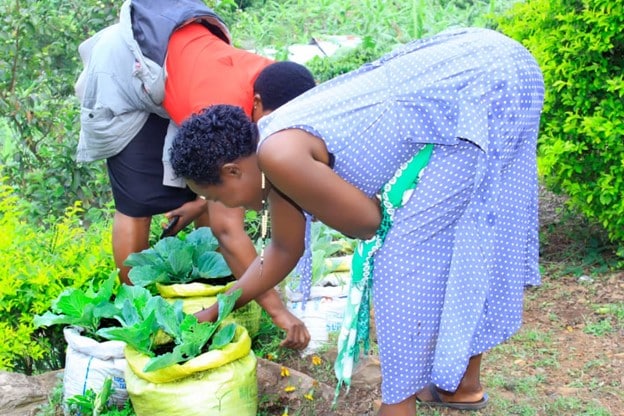
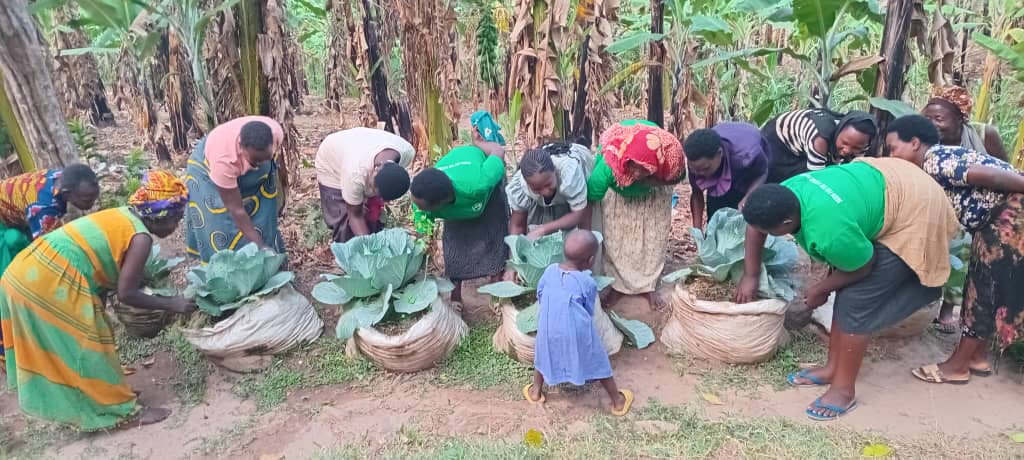
Kitchen gardens that feed families even during drought
Water-saving practices that protect health and dignity
Seed preservation that keeps food systems alive
Knowledge shared between mothers, daughters, and grandmothers
Because women manage households and care systems, the impact is immediate. Food appears on the table. Children eat better. Families become more resilient, not in reports, but in real life.
Naming and Stopping Equity Fraud
Equity fraud happens when systems talk about fairness but deliver benefits upward to the wealthy, the connected, and the powerful while leaving women and children behind. Women Care Modelling exposes and interrupts this pattern.
It does so by:
Putting oversight directly in women’s hands
Measuring impact at the level of the home and the child
Demanding transparency in climate finance and aid
Prioritizing those most at risk, not those with the loudest voices
This is not about being invited to the table. It is about owning the table, the budget, and the decisions.
“No Child Is Worth More than Another”
At the heart of Women Care Modelling is a moral line that cannot be crossed: no child’s life is more valuable than another’s. When care guides decision-making, children are no longer sorted by wealth, geography, or politics. Nutrition, health, safety, and education become non-negotiable not privileges reserved for a few. Under women-led care systems, children are not numbers in future plans. They are here, now, and their lives matter today.
A Shift in Power and in Values
Women Care Modelling is not charity, and it is not a soft approach. It is a transfer of power away from extractive systems that profit from crisis, and toward care-centered leadership that protects life. In a world facing climate breakdown and deepening inequality, this model offers something rare and necessary: a way to govern that values care as strength, accountability as justice, and survival as a shared responsibility.
We may all feel like we create value and beneficial impacts in the world – but relative to what standard? Few talk about how inequitable birth positionality and the growth it has enabled for decades illegally harms the most vulnerable children, and undoes the good work for the public interest many do. We don’t talk about it because inequity and growth benefit those at the top, often those funding us. This is not about population. It’s about political equity, or having an effective voice in ones’ political system. Not the word “population” in the phrase “we should reduce population to reduce climate emissions” but the word obligation-creating “we” in that phrase. Wealthy entities never had to pay the cost of a legitimate legal system. We should be fundamentally determined by the constituents with whom I share the nation, not their representatives
Facts:
Most public policy and private business models today are based on a twentieth century sleight of hand standard by world leaders, called political equity and impact fraud (or equifraud), that created a massive bubble of mostly white wealth that is today driving most interventions and policies, and is being guarded by widespread equitywashing, a form of fraud that goes beyond greenwashing and ensures a fantasy world of social justice and beneficial public interest impact. The sleight of hand involved defining things like “power” and “freedom” in terms of the coercive power of the state, and outside of the context of having to measurably empower children at birth by accounting for unjust birth positionality – intergenerationally, racially, in terms of class etc. This allowed elites at the time to assume authority and entitlements rather than birth-legitimate them – a problem that continues today. It relies on the mistaking of isolation for empowerment.
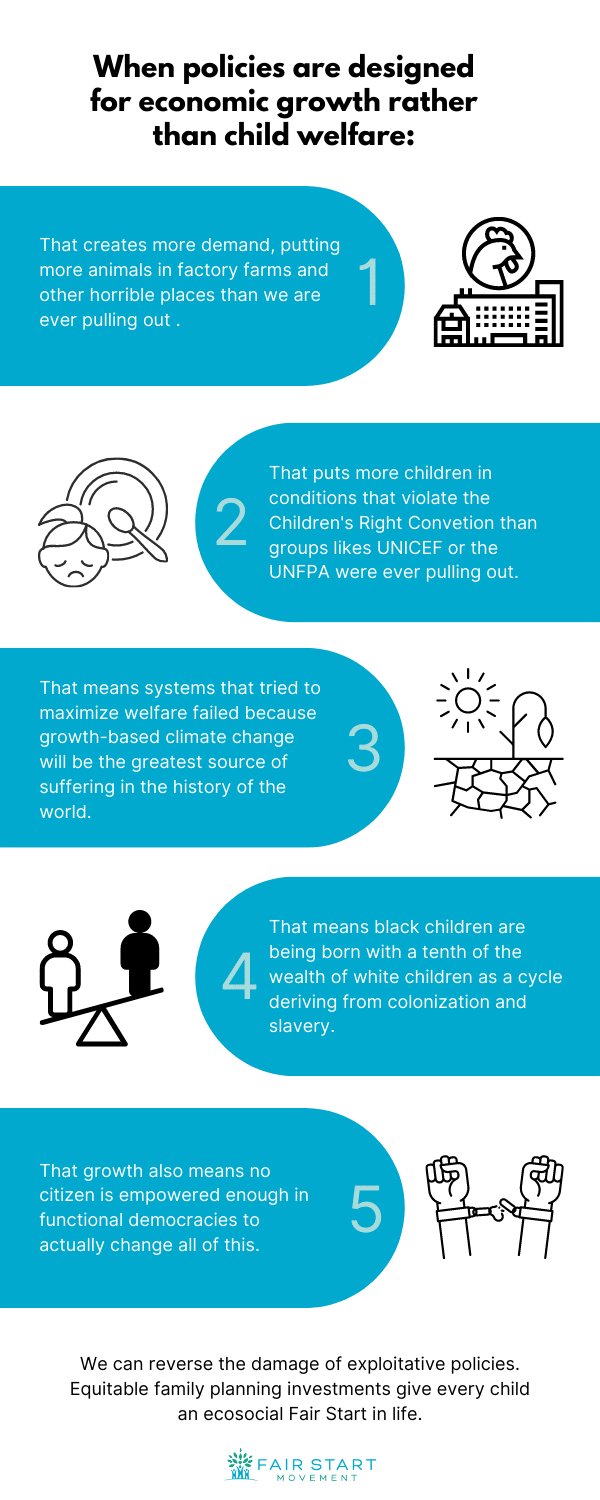
The equifraud standard removed children’s rights and measurable political equity for all as a check on universal reproductive rights, allowing unsustainable growth that enriched some at deadly cost to mostly women and children of color. Use of the standard amounted to an arbitrary, inequitable and unsustainable birth lottery rule. By the conditions of our birth and development, we are part of what one Nobel laureate called a Ponzi scheme system, one that did more to harm our most basic values than any of us have possibly done to further them. The standard undoes the good we do, by our own metrics, because all objective value is relative to real world thresholds – like comfortable temperatures, participatory democracy, equal opportunities in life, etc. – that the standard ensures we overshoot and alter. Our work and value adds must be measured relative not to what others are doing, but who we should be, and that standard is defined by children’s rights, and the necessarily collective endeavor of political equity those rights seek to achieve. We are not accounting for or explaining something if we do not start from that standard of fundamental causation, and nothing is more fundamental than accounts of how we are created. Not accounting for the benefits of our birth positionality means not being part of a system of justifiable obligation.
Our lives depends on the people around us. And that state of affairs depends on their birth and development. Our primary obligation is to children, not any document, like a treaty or constitution. At the key moment these issues were being considered, between1948 and 1968, world leaders chose to rely on a false premise (there there is national legitimacy without enough individual empowerment for humans to have avoided the crises we now experience) to make what is a collective action problem exponentially worse by isolating decision-making .
The standard treats the average child of color as deserving fewer resources and deserving more risk. This, over the span of decades, has subverted the racial justice movements of the Twentieth Century. The historic use of the standard, which privatizes the creation of power relations by isolating women in systems of family planning and thereby guts environmental and other protections, has led to the deaths of tens of millions, but as described below those who received the benefits it created are now being asked to pay the full costs – measured at an on-balance assessment, or zero baseline, for value – of those benefits. Between 1948 and 1968 human and reproductive rights organizations were supposed to use an objective standard to limit power relations between humans, and between humans and nonhumans. They did the opposite. And if political authority is based on our inclusion of all as equals, the standard used blocked that process. Worsening political inequity was hidden behind the veil of family and reproductive autonomy, a move that undid most of the benefits of the racial justice movements, and today enable value assessments and impact claims that rely on manufactured numbers and a sleight-of-hand that takes freedom out of the context of political equity.
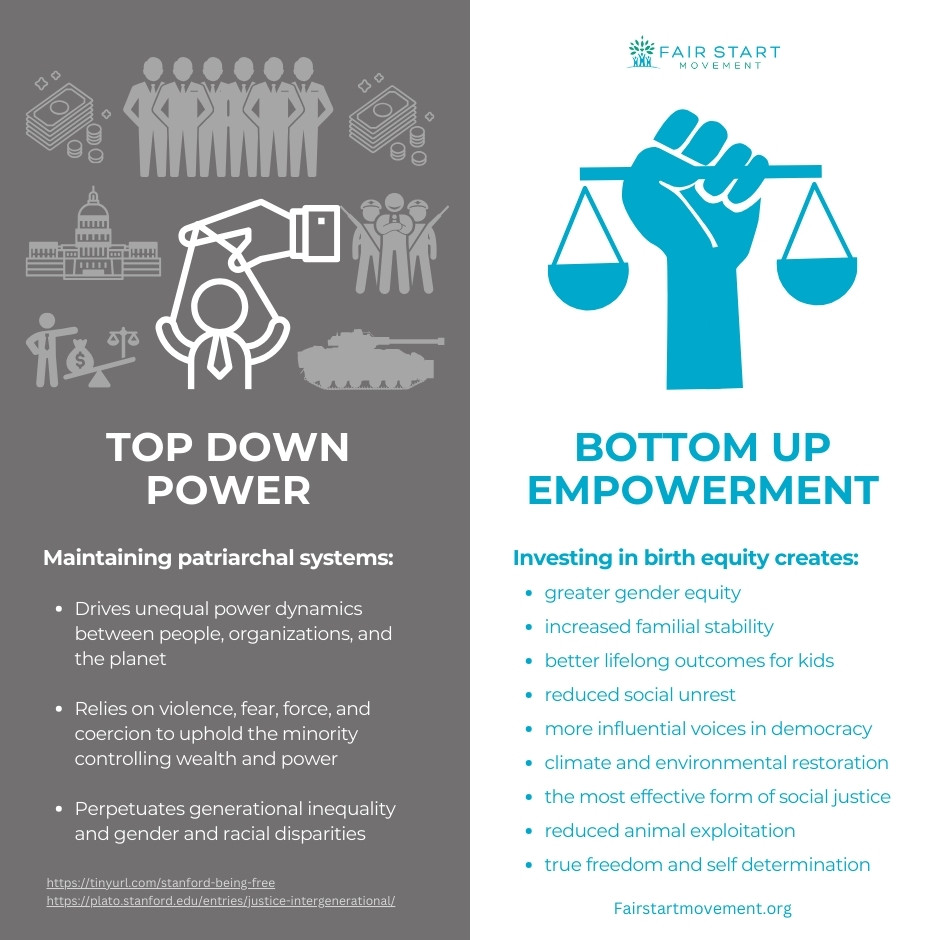
The sleight of hand framed reproductive rights around the autonomy of parents rather than the political equity of parents, children and their communities. It also defined power as the threat of coercion from the state rather than any form of human influence, a move which evaded world leaders having to fundamentally legitimate benefits and entitlements that derive from birth inequity and unjust positionality. It also allowed influential entities at the top of economic systems to divide those subject to that authority and wealth into left versus right, hiding the top down power dynamic. This was the fundamental corruption of social justice – starting with the illegal privatization of power relations.
A necessary condition of being free is being empowered, with measurable political equity for each person, but because of the sleight of hand our political and legal systems block that condition from being fulfilled as we are created. Humans living in democracy are supposed to offset each other’s influence equally (to be self-determining rather than other-determining), but that’s impossible if there’s no threshold of empowerment for children as they enter the world, and there’s no threshold if the act of having a child is treated by the law as more exclusively an act of self determination of the parents than determination of a child’s, and a community’s, future. The standard works by discounting the freedom that future people deserve in order comprise legitimate societies. Use of the standard thus involves wealth made at cost to objective values used to drown out the voices of those who are trying to prevent that very thing.
The basic obligation to follow the law in a political system derives from being empowered. Again, the standard blocks that because birth inequity makes it impossible to empower children, relative to the thresholds required for intergenerational justice. It is physically impossible to constitute obligatory relations – to control who has power over you – without reforming this. Where else would legally empowering relations come from? The rule of law begins by meaningfully including those subject to it through the language we use, not in ancient documents like treaties and constitutions. The value and impact claims we make situate and orient us in our political system and they indicate our choice to omit or to include the correct accounting for how we benefit and cost others relative to our draw in the exclusionary birth lottery.
If it’s taboo to talk about the right to have children, that taboo has a lot more to do with those at the top avoiding political equity as a primary and an overriding value that with protecting the vulnerable. The equifraud that taboo prevents our addressing has slowly, over decades, commercialized democracies. The power disparity that every would-be parent has had over their future children and future generations for decades is now being reflected in macro level inequity, and the continued inversion of justice. Measurable political equity is a necessary condition of being free, but the privatization of reproductive rights in the Twentieth Century made assuring that equity impossible. The fix, as described below, is to require it as preemptive standard today, implemented through fundable birth equity standards.
Much of the violence in the world today can be logically traced to the illegitimate use of violence by the state, illegitimate because without actual or on balance empowerment governments cannot be representative. Those using the standard often do not see their position as furthering violence because that violence is indirect, often used to defend the privileged positions rather than proactively by the state.
There is a preemptive legal claim against use of the standard, for fraud by omission (political equity and impact fraud). Humans constitute nations through the accurate language of obligation. The claim assesses that X said Y, while in fact when factoring in children entering the world relative to their rights and equity, Z is true. Run that test – using ChatGPT for example – on the average public interest impact claim today and you will see a fantasy world where hidden and daily maternal/infant deaths drive wealth to a few.
For years Fair Start activists have seen nonprofits that use the equifraud standard and the wealthy funders driving them take extreme measures to evade liability, including retaliating against whistleblowers in their organizations. For many, if they can get the benefit of their birth positionality, the systems that use that ongoing injustice to make money, and the appearance of doing good, they will do it until forced not to. They will evade fundamental causation to hide liability. But again, because use of the equifraud standard, for decades, has led to the deaths of millions as the climate crisis and decline of democracy accelerates there are strong reasons to use our legal systems to end equifraud. Many have argued that if a social justice challenge to elites arises, they will devise a fake version of it – a decoy. The idea of parents being liberated to harm their future children is exemplary.
The most glaring examples involved the animal law and liberation movement of recent decades, which largely failed because it embraced a macro form of human and animal propertyhood while raising funding on micro examples of liberation, not even trying to account for animals’ lived experience in the birth-creation of their actual relations with humans, micro-successes that were easily being undone by the upstream macro growth. Many who used veganism to monetize animal rights assume the authorities and entitlements that drive – at the most fundamental and effective level – the oppression of animals, and assume and benefit from arcs of population growth and decline that will kill many outside of their immediate circles and echo chambers.
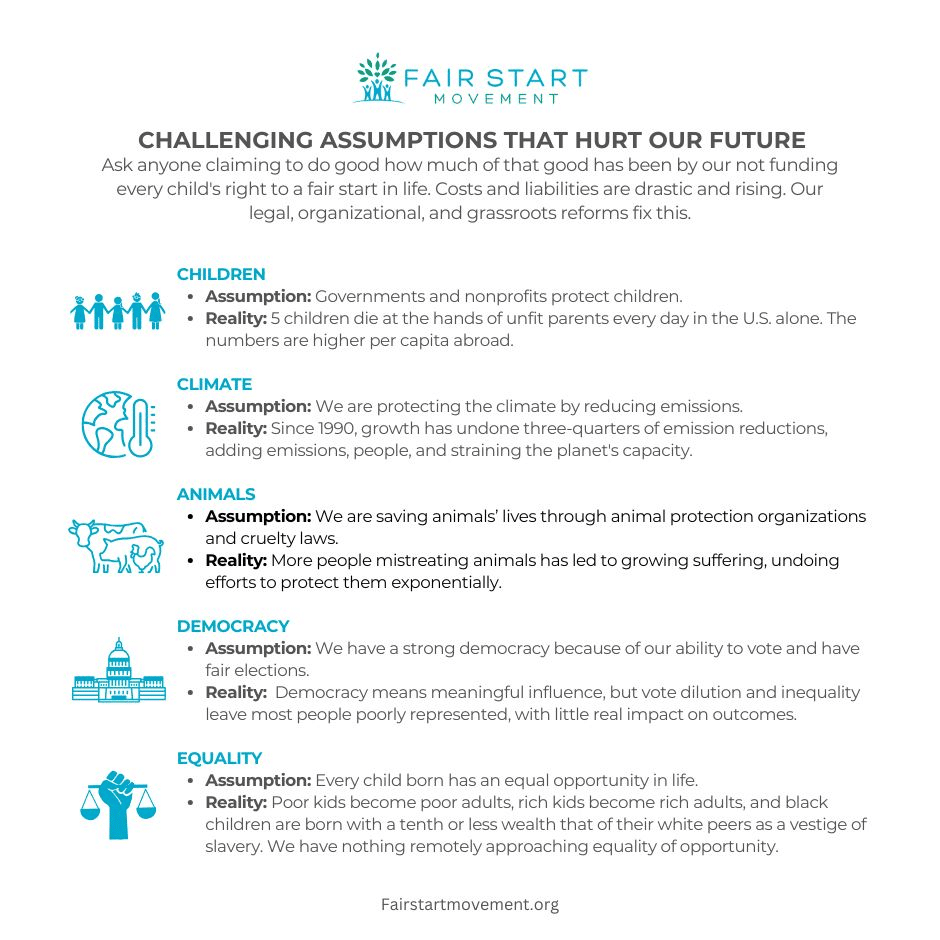
Inequitable growth has put more animals and children in conditions of abuse, neglect and suffering than any organization has been able to save, and that’s before we factor in compounding factors like the climate crisis, and the decline of democracy.
There are those doing better and avoiding equifraud, organizations that account for the way growth undoes social justice, especially because of birth inequity. But they can’t really compete with organizations that ignore or exploit that factor and improve their position in an illegitimate system (by their own values) rather than legitimate that system. Organizations trying to legitimize the system through the fundamental truth and reconciliation of prioritizing birth equity thus have legal claims, often in the area of unfair competition, civil rights and constitutional law, to block the use of the equifraud standard by those organizations that use it to compete unfairly. Preemptively fair competition is how the vulnerable give their kids a chance, rather than using the existing legal system to dilute and disenfranchise.
There is a preemptive right to be measurably empowered, and our laws cannot be interpreted in a way that excludes persons from that process through birth and development. In this case, if we’re interpreting a consumer protection or unfair competition statute for what people have to disclose about their value assessments and impacts, courts can’t interpret those laws in a way that disenfranchises the people that are subject to them because courts’ basic authority relies on empowering those persons. That argument isn’t new, but it was never applied in the context of ” it takes a village to plan for a child” as a preemptive standard, because it was blocked by a colonial and patriarchal system where men (aided by corrupt lawyers) generally see autonomy as disconnected from the social relations that actually enable it. That system is the basis of equity/ legitimacywashing.
Organizations like Truthalliance.global have claims for civil rights violations of the most basic right – the right to be empowered – or the active and deadly disembedding of a person from their political system and efficacy in it. This action is derived from the preemptive meaning of the word “we” in the preamble of the Constitution and any other use of collective references to obligation in legal instruments. Those collective references have to mean “one person, one effective vote: – which means measurable political equity. There is no such thing as freedom out of the context if political equity, and governments can’t hide what it means to empower their subjects to avoid liability for the polycrisis they caused.
Fair Start recently received light finding to bring the first action for this against Coca-Cola for its illegal discounting and concealment with fraudulent omissions related to sale of its products. The equifraud involves measuring a variety of harms, to our ecologies, democracies and legal systems, economic communities premised on equal opportunity, etc. from high and arbitrary numbers rather than the only fair and just measure: from zero. of We all have a choice to be part of a movement ending equifraud, or the system that is continuing it. We all have a choice to be primarily obligated to the most vulnerable, infants and animals, who we protect with the thresholds described above which ensure we all become free or self-determining, or primarily obligated to those at the top who are enriched when we don’t use the thresholds.
This is the most just and effective work one can do, assuming one asks the right questions, based on the facts above. As the death toll from climate/inequity grows, those entities that want to legitimately account for full costs of their benefits cannot compete against those who do not, and governments must enjoin the use of a standard that allows the latter to externalize at the most fundamental level – reproductive rights regimes and systems of intergenerational justice, really as a form of comprehensive civil rights and physical “constitutionalism” that goes well beyond topical, divisive, and downstream DEIJ, ESG, etc. interventions. The first constitutional cause of action is to enjoin the use of a standard that disenfranchises. In that split, one is either part of a system of obligation, or not, and we deserve as much protection as we extend to the most vulnerable.
In the book “Winners Take All: The Elite Charade of Changing the World,” the author described a similar phenomenon, but did not account for birth inequity, the physical constitution of nations, or nonhuman liberation, and did not provide a practical test and method for solving the problem.
The core discourse to engage in the solution: “_______’s claimed value add does not account for political inequity, which is caused by our all treating children of color as deserving of less than white children, something that has for decades slowly disenfranchised at risk communities. That’s illegal, and a mistake that caused horrible outcomes that are undoing our claimed value add to the world, including allowing our governments to never actually empower the people they claim to represent. Use of any standard that ignores political equity means actively harming others, while slowly disenfranchising persons of color. Choose the Equity/Fair Start standard instead. Freedom is universal democratic empowerment, not exploiting arbitrary but massive differences in birth positionality and empowerment.” One is either part of a system of mutual obligation, or not, and asking these questions helps determine where others stand.
Justice means not benefiting at deadly cost to others and not doing so starts by accounting for birth positionality. It would be physically impossible to be self-determining in any literal sense without the reforms above, and the discourse of getting all children over the line that enables them.