Category: News & Fair Start Headlines

  • Fair Starts in Life Mean Telling the Truth, and Finding Common Ground with Others

    Fair Starts in Life Mean Telling the Truth, and Finding Common Ground with Others

    Deal with the cause not the symptom. 
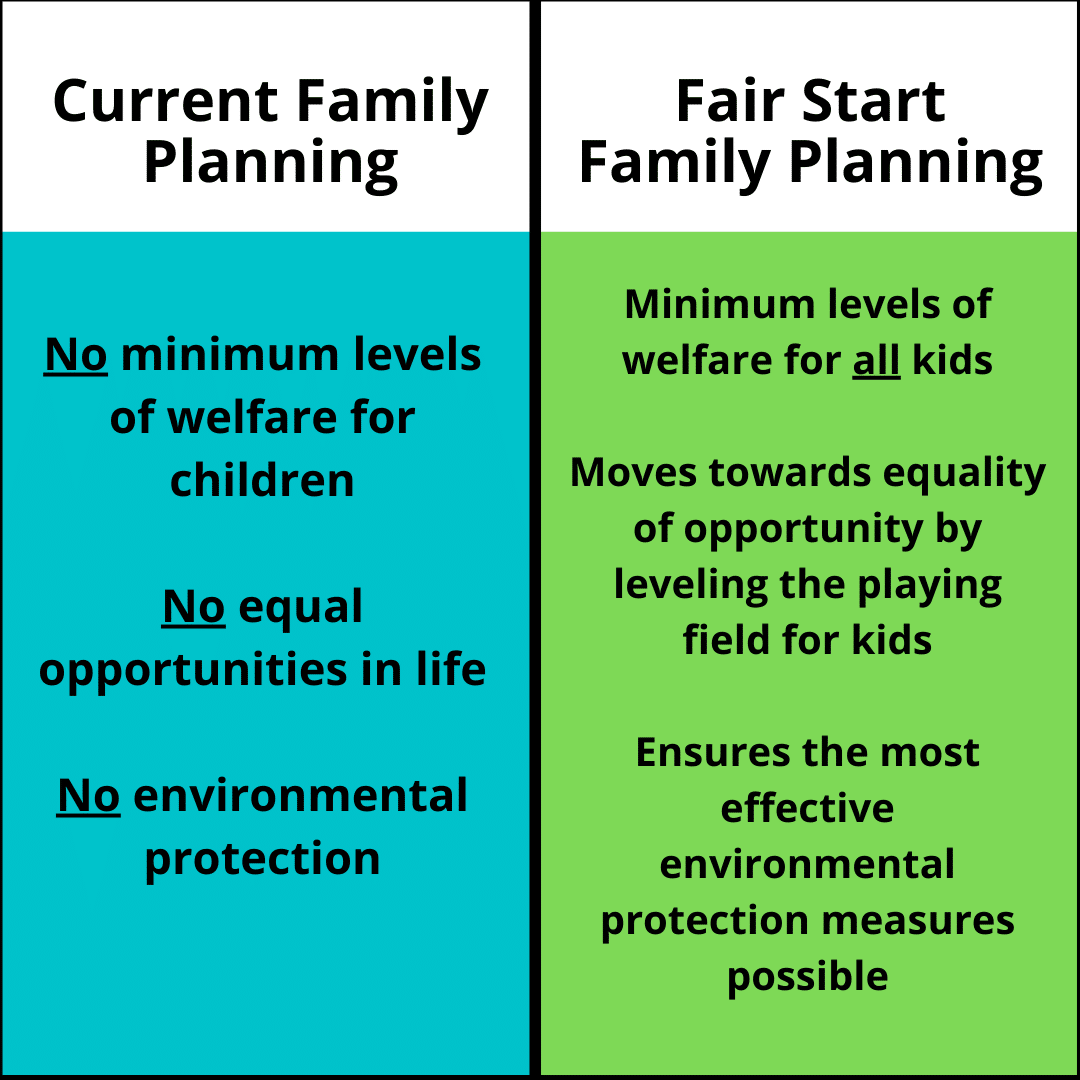
     

    A comparison chart of Current Family Planning vs. Fair Start Family Planning. The left side lists negatives of current planning; the right side highlights positive outcomes of fair start planning for welfare, equality, and environmental protection.


    The one question to move towards justice: If one were claiming to create market value, public interest impact, or to exercise authority as government officials or those entitled to their wealth, please ask that person how they were accounting for children entering the world relative to their rights (and especially to political equity) as they made their claims?

    Just the same way we have equity in a company, we have equity in our democracies. Our share depends on how many others are in it, the varying levels of influence we and they have, the impact on the environment around the democracy and how it makes us each less self-determining, etc.

    How does that variable impact the accuracy of our value claims?
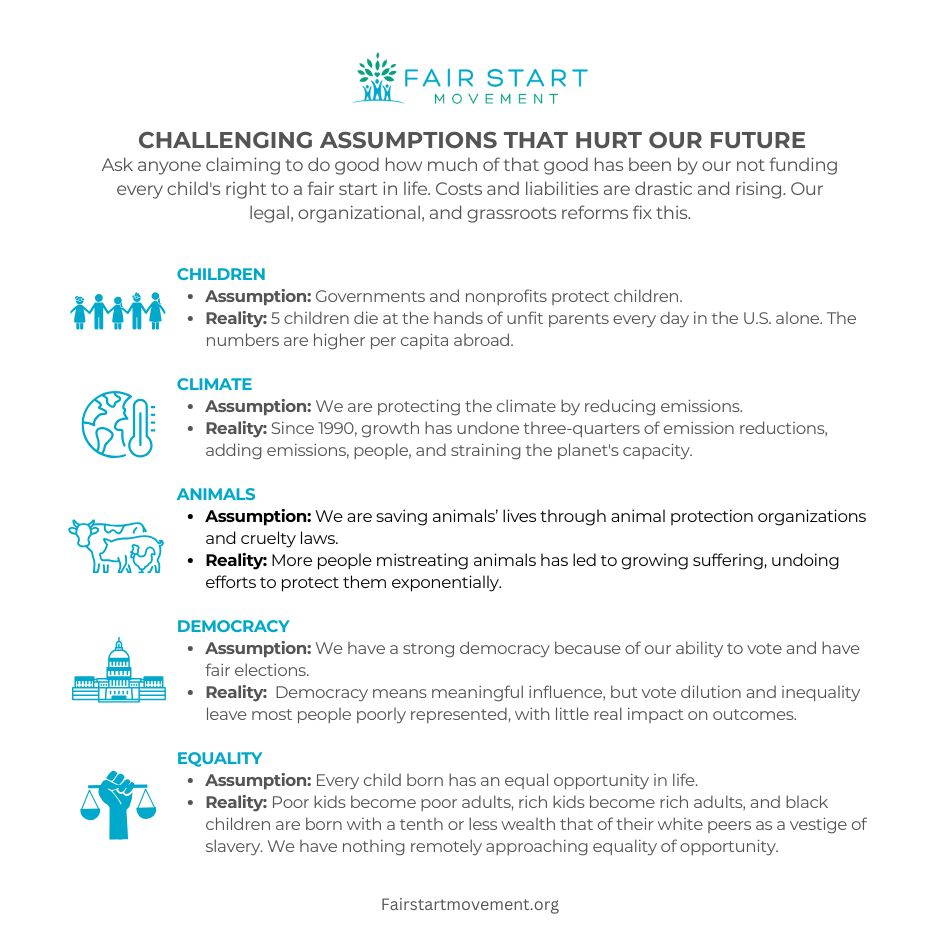
     

    Challenging assumptions that hurt our future infographic

    The answer is that few of us were accounting for such things, because no one ever told us that how we measure value and impact, and derive governmental authority and entitlement to wealth, is actually conditional on empowering people and not harming them.

    Instead world leaders in the Twentieth Century assumed entitlements and authority they should not have, which fundamentally led to the crisis. 

    Leading thinkers like Cass Sunstein and Martha Nussbaum have assumed the same, for decades.

    Instead free persons who whish to make choices for themselves, rather than making choices for others, will admit they were not accounting for this, and that they operated based on the false assumptions noted above.

    Those who do not  admit the error choose to free ride on unjust systems of birth positionality, and they threaten us all. It is physically impossible to be free, as in self-determining, if we cannot ask and then assure that persons are created, developed and emaciated in ways that offset equally their capacity to influence political systems equally, relative to a neutral position or objective standard for evaluation. Those entering the world are either not empowered, or we all have no choice but to be subjected to their power and influence – including in the degradation of the environment around us

    Fact: Our benefitting from growth economics built on violations of children’s birth rights did more harm than any of us did good. We don’t get to legitimate nations by having zero functional protections for children as they enter the world, and thus for the nonhuman world they will impact. The growth those violations enabled has degraded the capacity of the Earth to support infant health, the only true measure of value.

    We can’t get to justice from injustice and constitute a just future without actual or measurable equity in birth and development. How do you constitute a just nation? Through language – by admitting and Telling the Truth about justice undone daily by birth inequity – which is language that accurately captures our first obligations, deriving back and conditioning wealth and authority on our actually being obligated to empower people.

    Fair Start is a permanent, universal method for just resistance to and freedom from illegal power, which is any power that is not derived from the people.
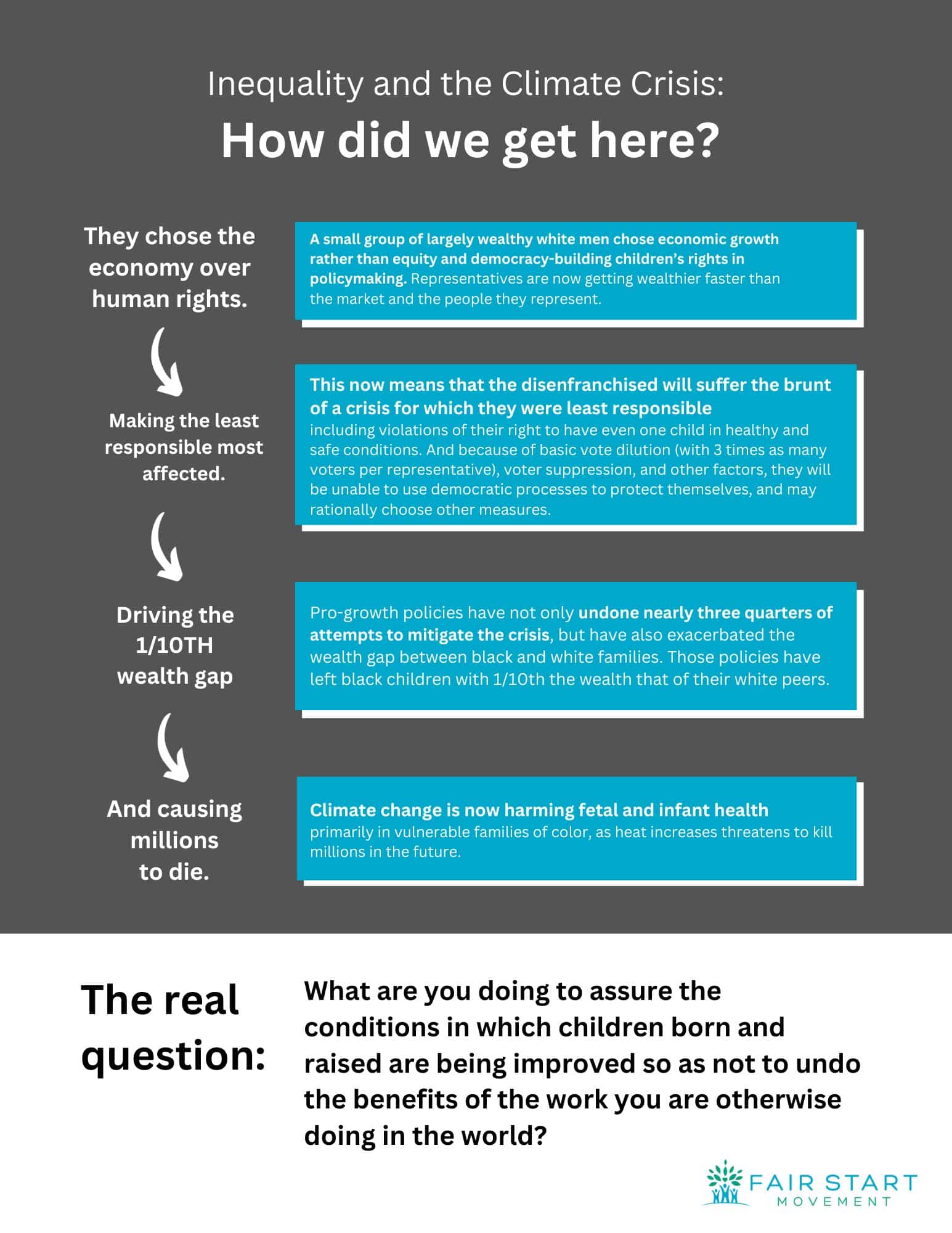
    Inequality info graphic


    Why Fair Start? 

    The Fair Start Movement was formed to engage in fundamental fact checking and reparations recovery, rooting out reparations fraud enabled by the assumptions above. We identify those who use of the same fundamentally illegal standard of entitlements that caused the crisis, often because they are avoiding liability for the crisis, and for the life-saving and legitimating reparations they owe. Abstracting from the creation of power relations, from the birth and development of kids, ignoring the undoing of our work, makes justice performative.

    Fact: Decades ago, world leaders collectively violated children’s right to a fair start in life, by using unsustainable growth and loss of political equity to degrade eco-social birth and development conditions beneath a key threshold, all based on separate but equal family planning policies that assuming children of color deserved much fewer resources and much more risk.

    So we can ask anyone claiming to add value to the world: How were you accounting for your work being undone by violations of children’s birthrights? Would you be willing to derive wealth and authority back, and condition it on, ensuring such birthrights? If you could go back and make that change in our  base systems decades ago to save millions of lives, would you? If you claimed to create value that was being undone by basic inequity, would you not be eager to reform that system and align with your claimed values? 

    Facts:

    • The concentrations of generational wealth funding and driving public interest claims omit the daily undoing because that would show the liability of those funding the work to first fund birth equity.
    • To be obligated, if we assume all are political equals in the sense of each person having one vote, would begin with our being born, raised and enabled to be measurably self-determining, which means our vote offset others equally, relative to zero.
    • No one has to follow laws in a system that doesn’t actually empower them. All legal obligation derives from language, and ours should mutually empower – not disempower – at the base. Language that accurately reflects and forms obligations has to be accessible to the people who are engaged in the discourse – meaning it definitely is not reflected in traditional national constitutions which do not communicate well to the average person.
    • People, not documents like written constitutions, constitute nations by ensuring rights-based conditions and equitable relations in the birth and development of each child. But in the Twentieth Century world leaders evaded their obligation to reconstitute nations as such under human rights regimes, ignoring child welfare until after children had been born, and the conditions and relations were largely fixed.
    • This is not capitalism or socialism, or any left v. right ideology. It’s about inclusive legitimacy, versus  illegitimacy.
    • Violence, fundamentally, flows from the use of it by nations that do not represent their constituents because they did not empower them as such, including them into the social contract. Instead, almost all have, for decades, used children as economic inputs rather than empowered constituents.
    • Because Fair Start is an overriding form of justice, the adult children of wealthy families that do not pay the costs of their benefits inherit their parents death debts.


    The Fair Start Tell the Truth campaign just asks the questions above.
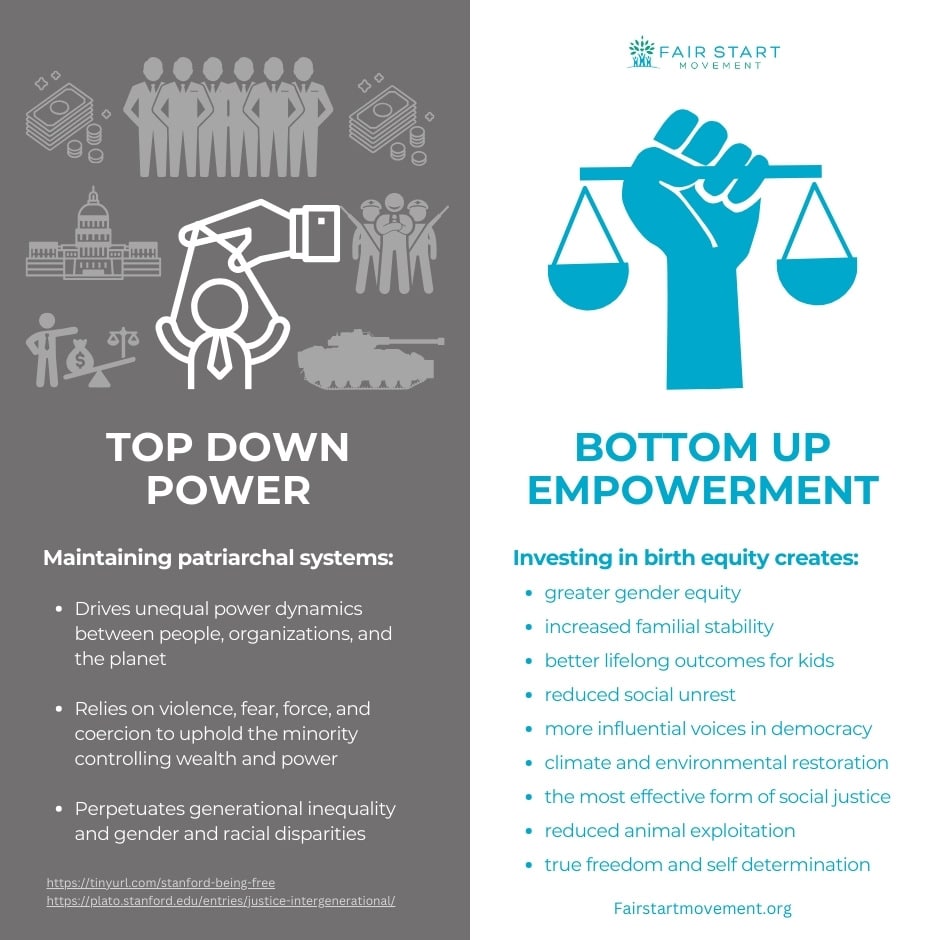
     

    Top Down Power and Bottom Up Empowerment infographic


    The growth those violations enabled has degraded the capacity of the Earth to support infant health, the only true measure of value. This is exacerbated by vast inequity and political disenfranchisement that inhibits the ability of the average constituent to change our current trajectory, using a shell/ponzi scheme that slowly degrades democratic influence in favor of economic growth, identified as such by Nobel laureates, which has caused the deaths of millions of innocent persons around the world. All of this loss of freedom and welfare is measurable by widely accepted metrics used for assessing sustainable development

    Fair Start activists in prior employment used wealth, and false assessment and reporting standards, to create a fantasy world of social justice impacts based on entitlements that made our claimed mission impossible, drowning out the truth that hid the drivers causing the world we are experiencing today. Many others did the same.
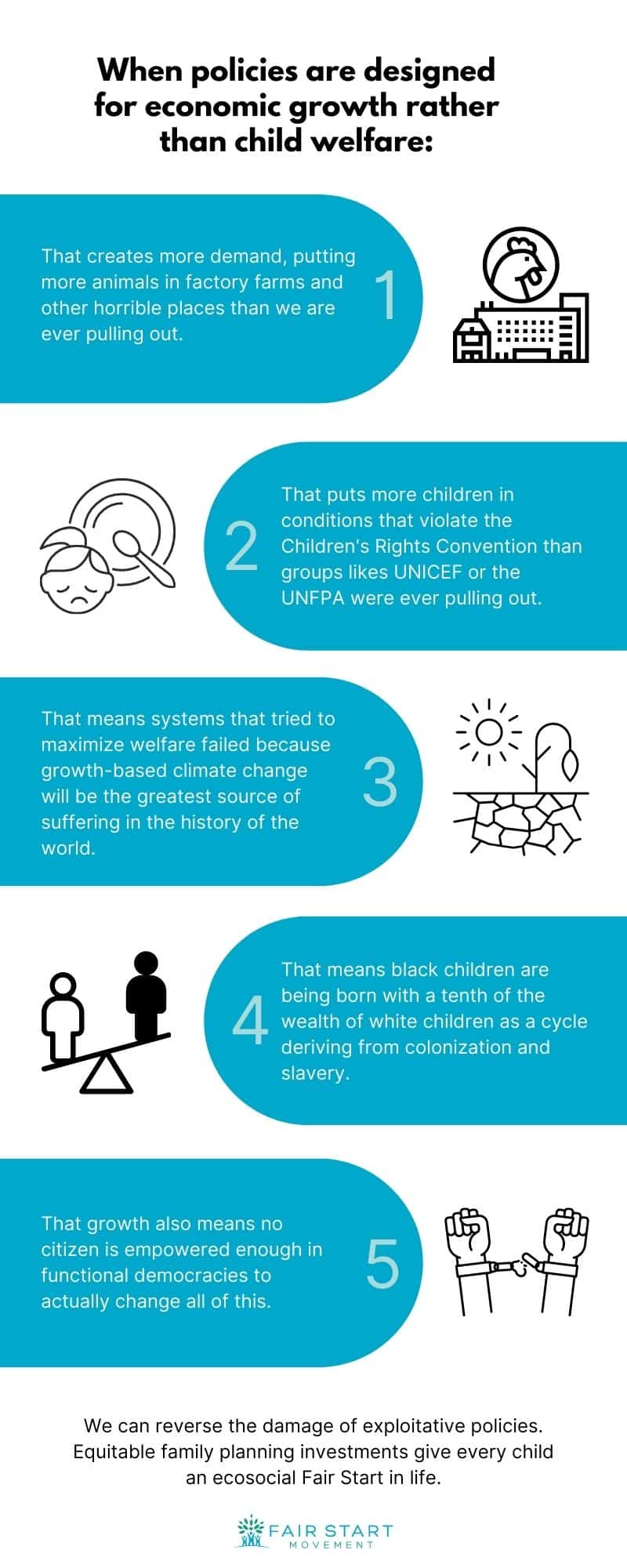
    How Do You Destroy a Planet's Atmosphere? Tell Lies. Fair Start Certification Tells the Truth Infographic

    Reporting public benefit impacts out of context is harmful because it allows some kids to benefit at deadly cost to others, hiding violations of children’s rights that cost millions of lives and trillions of dollars, harming families and businesses throughout places like Uganda.

    Total Liberation 

    Much of the work of Fair Start was inspired the animal liberation work of Direct Action Everywhere, which treated animal personhood a serious matter of social justice, relative to more performative work of other animal protection efforts. But if we assess animal protection work in the context of the most vulnerable, animals impacted by children born into the world who deprived of their birthright development conditions, the impacts at a macro level are infinitesimal, undone every day by inequitable growth.

    Instead we can orient from a more macro level that treats humans as they animals they are unifies justice at the base, through Fair Start reforms that treat measurable inclusion and empowerment as the first obligation. This is better than using racist and unsustainable assumptions justifying birth inequity, assumptions that undo the work we do for animals, every day.

    Do you believe all kids deserve a fair start in life, yes or no? If yes you will back this reform. We can either confront those lying to protect wealth made illegally and at deadly cost to others, and use that money to ensure justice and save lives, or not. The choice is easy.

    Please consider making a contribution through Donate. Together, we can create lasting change to save next generation
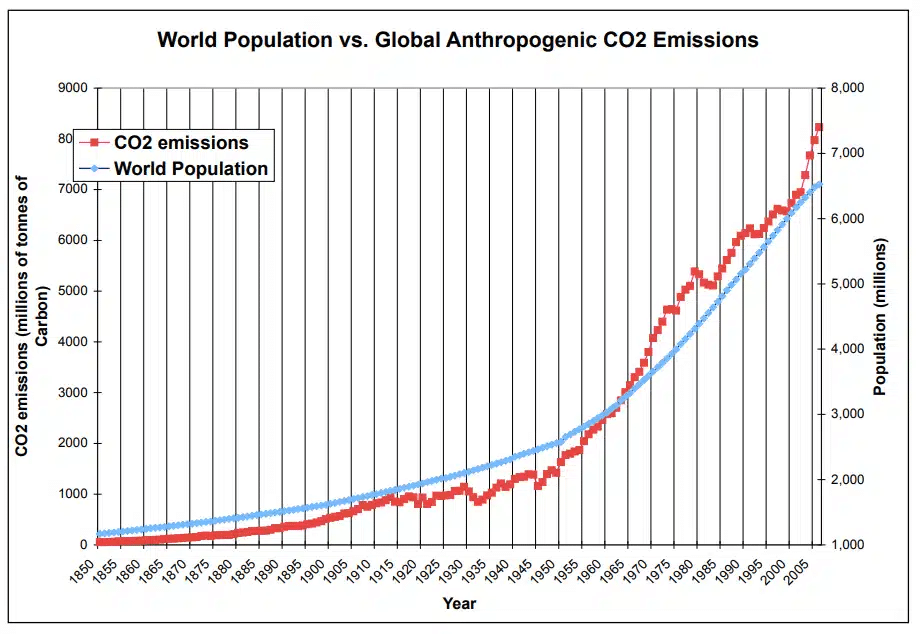
  • Inception of Seeds for the Future Project

    1. Seeds for the Future began in 2023 under RAFUG as kitchen gardens tied to child reparations accounts. The idea was an Afrocentric view of decentralizing power into women using women care groups for future generations.

    2. It moved to Nigeria, Tanzania, and Kenya in the forms of school supplies, agroforestry, and school fees, respectively, all tied to a birth and developmental equity reparations under Esther Afolaranmi’s work at the UN: https://fairstartmovement.org/fair-start-file-update-to-un-human-rights-council-petition-our-overriding-right-to-nature-and-equity/

    3. Next month RAFUG will launch a policy effort in India, showing how it could save countless lives.

    Seeds For the future began in early 2023 under Rejoice Africa Foundation as kitchen gardens, agroforestry, women sensitization on family planning and doing child saving in responding to wealthy redistribution, signs of climate crisis and family planning policies. We used Afrocentric model of Women Care groups with decentralization system.

    Rejoice Africa Foundation got passion not to let others out in doing seeds for the future and we formed a unique coalition of organizations from Nigeria, Kenya and Tanzania and now initiating in India which share one common goal: To change family planning systems to prioritize a just distribution of resources to ensure all children are born and raised in conditions that reflect the ideals of the Children’s Rights Convention, both ecologically and socially. This has become especially challenging given the horrific impact of the climate crisis on children, even before they are born. However, the climate crisis is also an opportunity to pivot towards just and equitable family planning, given the move towards reparations from wealthy nations to the Global South, the

    Growing number of studies that show the efficacy of investing in young women as a means of

    Reaching sustainable development goals, and the impact of ensuring direct funding to young

    Women as a means of building their communities. Investing directly in children works, and is

    Increasingly part of regenerative planning.

    Unlike most other nongovernmental organizations, our coalition believes the Cairo Consensus on population and development is outdated and does not adequately address the two greatest threats to our future: The climate crisis, and massive economic inequality driven by family policies, both in the United States and abroad. Rejoice Africa and its partners have developed specific baselines for the compensation required to address these issues.


    Fundamental justice means changing the way we plan our families and raise our children.

    Our response is to introduce seeds for the future and equitable family model, which better reflects the International human rights regime and its commitment to self-determination. This model is now the subject of several successful peer-reviews, and dozens of positive articles in news outlets around the world. It is consistent with the calls by leadership at the United Nations for changes to population and development policies so that rather than counting people, we are working to make each child count. The formula for child-centric families is simple: Parental delay and readiness, a fair distribution of opportunities for all children, and a universal ethic of smaller families. Reparations and focus them on the birthright entitlements of the majority of people: Those who will live in the future.

    The Cairo Consensus helped create the climate crisis and massive inequity and heaps the costs of climate change on those who are least responsible for it. Improving upon it will result in balanced ecosystems, and equal opportunities in life. The crises we face today could have been avoided with a more ecocentric family planning system, one truly compliant with the Children’s Convention.

    Please consider making a contribution through Donate. Together, we can create lasting change to save next generation
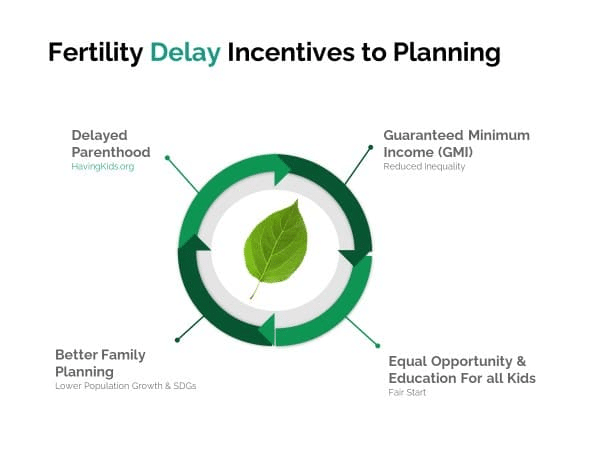
     

  • Variations in Doing Charity

    More charities are coming out without validation of how they give charity and so far DBL is identified as culprit of this error because of the following which makes it out of standard.

    First P – Prevention, DBL does not have a formula and matrix on how they intend to prevent unborn children from the climate crisis where they have not included birth entitlement. This has increased death in the vulnerable communities and left Judith dead in the same situation. Because parents of Judith did not have capacity to prevent her from dying of malaria and instead Judith died in error of Symptom-like measures on the ground which rooted in charity based giving in preventing harm.

    Second P – Protection, DBL has come up with inequality in protection of the generation from climate crisis and their charity giving doesn’t meet bottom-top protection, instead its following top-bottom protection in addressing the climate crisis and this has been errors for many nonprofits that ignore decentralized system in family planning reforms.

    Third P – Promotion, DBL is not doing first P and second P in meeting third P in improving life for all human and nonhuman beings on this planet earth instead is promoting wellbeing of people only who deserve a right to food, shelter, education and basic healthcare which are not meeting UN standards and Fair start standards and doesn’t meet family planning reforms. Not promoting birth entitlement, equal wealth redistribution, not promoting admit the truth and pay reparation.

    DBL doesn’t want to use decentralization in executing Their work and doesn’t have a clear formula and method of giving charity to people in need. In short, DBL doesn’t meet eight metrics and doesn’t clear accountability for growth and climate crisis.

    this has caused lack of access to fund for the real cause of the indigenous people and resulting into increased climate crisis symptoms witnessed by the increase of death of people due to diseases caused by variation in climate change

    A story of the death Mbabazi Judith

    “Mbabazi Judith a three year old, a daughter to kansiime Rovina and mushabe Joseph from

    Rutoma village in isingiro district western Uganda. Mbabazi Judith was the seventh child in the family, and second last bone.

    Rovina the mother said on 8/April/2024 , Mbabazi Judith started vomiting, fever and diarrhea and immediately I took her to the st Theresa clinic for treatment , when I reached their , mbabazi Judith was very weak and dehydrated clinic removed Malaria blood sample and it was positive .

    On examination Judith had pallor of mucous membrane in the eyes. Clinic also tested

    Hemoglobin level and the results came that Mbabazi Judith also had anemia in Malaria.

    I did not have enough money for all the treatment and the clinic in charge referred me to the government hospital for treatment. I didn’t have money for transport and decided to borrow shillings ten thousand shillings for transport and it was not enough. I started walking for 5 kilometers until I reached the main road to board a car to the government hospital.

    As I was in the journey half way, Mbabazi Judith started convulsing and gasping in five minutes, Mbabazi Judith breathed last breath. The car stopped and removed me with a dead body and I did not have money to go home. I started walking and walked for 15 kilometers to reach home and reached late in the evening. Started organizing for the burial of Mbabazi Judith. Judith died because I was poor and did not have money”  

    While Women Care Group modeling standards are based on the 3Ps (prevention, protection and promotion) and Rejoice Africa Foundation urges DBL to use 3 Ps in doing work.

    Please consider making a contribution through Donate. Together, we can create lasting change to save next generation

  • A Unique Coalition for the Seeds for the Future Project

    The Seeds for the Future initiative began in early 2023 under the Rejoice Africa Foundation’s guidance, encompassing endeavors such as kitchen gardens, agroforestry, women’s sensitization on family planning, and child savings, all in response to signals of climate crisis and evolving family planning policies. Employing an Afrocentric model of Women Care groups within a decentralized system, our foundation laid the groundwork for transformative change.

    Driven by a fervent determination to ensure no one is left behind in sowing the seeds for the future, we forged a distinctive coalition comprising organizations from Nigeria, Kenya, Tanzania, and now India. This coalition shares a singular mission: to revolutionize family planning systems, prioritizing the equitable distribution of resources to ensure every child is born and nurtured in conditions that uphold the ideals of the Children’s Rights Convention, both ecologically and socially.

    Esther’s UN work and Esther’s ICCR research underscores the urgency of our mission, particularly in light of the dire impacts of the climate crisis on children, even before their birth.

    However, amidst the challenges lies an opportunity for transformative change. As momentum builds for reparations from wealthy nations to the Global South and evidence mounts regarding the efficacy of investing in young women for sustainable development, our coalition stands at the vanguard of progress. Unlike conventional non-governmental organizations, we reject the outdated Cairo Consensus on population and development, recognizing its inadequacy in addressing the twin perils of the climate crisis and economic inequality.

    Fundamental justice means changing the way we plan our families and raise our children in the News letter

    Our response is anchored in the introduction of a seeds for the future and equitable family model, aligning with the principles of the International human rights regime and its commitment to self-determination. This model has garnered acclaim through successful peer-reviews and extensive coverage in global news outlets. It resonates with calls from UN leadership for a paradigm shift in population and development policies, emphasizing the value of each child’s life.

    Dickson from Kenya Amboseli love organization echoes the plight of marginalized communities like the Maasai in Kenya, underscoring the historical injustices that have stripped them of their land and livelihoods. The failures of the Cairo Consensus to address such injustices only exacerbate the climate crisis and inequity, burdening the most vulnerable. He said and I quote “Kenya recognizes over fifty tribes of native people. The Maasai were the dominating tribe at the beginning of 20th century. They are one of the very few tribes who have retained most of their traditions, lifestyle and lore. In common with the wildlife with which they co-exist, the Maasai need a lot of land. Unlike many other tribes in Kenya, the Maasai are semi-nomadic and pastoral: they live by herding cattle and goats.

    Ashoka from India said ….” The move follows on two letters to Prime Minister Modi urging him to take action to ensure the nation complies with human rights requirements, as detailed in a recent filing before the United Nations Human Rights Council.

    The new organization argues that India is out of compliance with human rights requirements, and in a way that risks countless lives.

    ●India faces unprecedented future deaths, in the millions of those least responsible, due to a combination of the climate crisis and current family planning policy.

    ●A new NGO is challenging the status quo family planning policy, urging India to get ahead of the curve and comply with human rights systems that correctly base political legitimacy on birth equity-based family reforms using the Children’s Convention as a guide.

    ●The reforms would entitle massive family planning entitlements to make sure children are only born in safe conditions and use climate loss and damage liability to start the process which could save countless lives.

    The organization further argued that given calls for population policy reforms, recent attempts to reform family planning systems, the call for family reforms made by the Supreme Court, as well as the import of its rulings on access to family planning, this is an issue that should not be ignored. India should consider itself bound by international human rights and obligations to future generations when devising a new policy, which it needs desperately. The best human-rights based guidelines for that policy are described in filings now before the United Nations, and which treat Article 16 of the International Bill of Human Rights as the most basic norm – or Grund norm – around which all family and population policy must orient.” 

    Ayubu from Tanzania said…….” Women and children are considered to be among the most vulnerable groups of people in the

    World, especially in the developing countries. The challenges faced by women and children are unprecedented and often worsened by extreme situations such as climate change. Climate change is one of the leading causes of food insecurity. Food-insecure areas are often drought-stricken and hard to live in because of the shortage of food and water. For women in

    Tanzania most especially, this is a big challenge because they are often left in charge of feeding their families. This means that the absence of water or food makes their lives more complicated as they have to travel long distances or spend more to purchase foodstuffs and water. For the children, this affects their health and nutrition needs. It also puts them at risk of missing classes due to hunger or because they have to fetch water from far places.

     Sometimes food insecurity leads families to move to other food secure places which is often cumbersome for children who have to leave during school times. Therefore, food insecurity brings about a lot of uncertainty and affects the lives of women and children who are already affected by climate change results.

    Esther from Nigeria said “…….in a slum, where many children live below the poverty line, education takes the back seat. Poverty, underdevelopment, mass illiteracy, ignorance, urban backwardness and conservatism has caused many in slums to be deprived of their basic right to education and limited access to education means many children will be stuck in a cycle of poverty.

    In many slums around the world, children are unable to attend school regularly due to a lack of resources, including school supplies. Without these resources, children are unable to participate in classes and may fall behind their peers. Additionally, a lack of access to education can perpetuate the cycle of poverty in these communities.

    in conclusion, in rewriting the narrative, we envision a future where balanced ecosystems and equal opportunities prevail. By embracing an ecocentric family planning system aligned with the Children’s Convention, we can mitigate the crises we face today and cultivate a more just and Sustainable tomorrow. Through our coalition’s collective efforts, we sow women care group in the seeds for the future project of hope and equity for next generations.

    Please consider making a contribution through Donate. Together, we can create lasting change to save next generation


  • Women Care Groups Leading Afrocentric Model in Saving the Next Generation

    Care group model helped Seed for the future project to identify and sensitize the real voiceless young women from the grassroots communities in Africa and pilots done in Uganda, Nigeria, Kenya and Tanzania as Coalition and its growth to other countries and regions that were harmed over the years of wealth distribution injustices.

    This work has roots in the first forms of democracy and can drive decolonization of wealth to liberate many in measurable ways. The United Nations failed to ensure sustainable and equitable family systems, which is now killing millions as the climate crisis unfolds.

    The United Nations in 1968 finalized a paradigm of privacy isolating us from each other in the act of trying to constitute – through having children – equitable future relationships. This was done because a few wealthy families had a disproportionate impact on the standard and wanted to avoid covering the cost to children’s rights, and to benefit from the growth-based investments not having to invest in kids would ensure. This was done even though the act of having kids is more interpersonal than personal, and by ensuring isolation and subjectivity, the UN set in lace the collective action problem of inequity as not having an equal and influential share in determining the rules one lives under, and thus halting the unwanted influence others have over you.

    The UN not telling this truth is killing innocent persons, skewing the baseline for live-saving climate loss and damage funding, including the preemptive nature of birth and developmental equity, the prioritization of certain claims, the amounts owed, and how the funds must be used.

    What should have been done and can still be done today to fix this? One can create social contexts that overcome the collective action problem and break the veil of subjectivity, ones that invert entitlements (as was done to address famine), so that mothers and would-be mothers can all see how having kids and creating new members of the community will impact all and the future. In short, the use of a social context leads to the discerning of objective values we all share and are hidden by the UN process, and as such delay, the moving of resources from the wealthy to impoverished, relocating in some cases, smaller families, etc. – and this can all be expedited with child and future child savings accounts around which collective action can be based.

    Small and less consumptive white families in wealthy nations will model and assist in funding the change. Delay, readiness, redistribution, share equity to get to autonomy, nature, etc. – these are the terms of a truly universal and intergenerational social contract.

    Humans can only constitute the future through the language of obligation and the linguistic creation of power relations, and the fundamental mistake we all seem to be making is that our obligation is inverted: It would be physically impossible to be free unless we see ourselves as first obligated to persons who will parent, rather than first ruled by those at the top of the influence pyramid, e.g. officials, the wealthy, CEOs, celebs, etc., because all entitlement to influence – and ensure criteria other uses to assess what is true and valuable – derives from the governed and their primary equitable positioning. The latter should only have influence to the extent the creation of others ensures measurable (eight metrics as least) equity.

    Whereas the United Nations and its members exploited isolation and birth and developmental positionality to fill factories and shopping centers with workers and consumers, this collective process will fill town falls, surrounded by nature, as the life of self-determination – not exploitation as economic units by in an economy that first requires democracies defined by measurable equity to be regulated – that justifies governance.

    For example, the United Nations has recently recognized the right to a healthy environment, but on the day the General Assembly did so it was quickly undoing the right with subtle family policies that did more harm to the environment and the humans and nonhumans that comprise it than the UN was doing good. 

    The family policies work by giving would-be parents a sense of autonomy that ignores all the interpersonal impacts of having kids, one that ensures inequity and growth.

    What the UN did is common. Most claims of public benefit are inaccurate because the key values/variables claimed (whether it is protecting animals, children, democracy, etc.) are actually hidden in/ absent from the premise (who we should be, which precedes what we should do) and being undone, but in ways humans have trouble perceiving because the changes move so slowly. The recognition of a right is a charade unless the UN enables crowd-sourced implementation of a right to the creation of power relations consistent with the right to a healthy environment.

    These are facts, ones which enriched some at deadly and impoverishing cost to many, as the hiding/absence infects our thinking and conversations, making us unable to connect situations like redlining and urban heat in the U.S. to deforestation and poverty in Africa. In both situations the aligned values of nature and equity are absent from the first necessary premise of who we should be, and even the most ardent activists cannot see it.

    Donations or reparations that are instead treated as one of many forms of influence (use of contact networks, prestige, civil disobedience, one’s skills, etc.) that logically are first obligated towards creating and maintaining the system that physically creates and maintains just power relations, which can be measured. Prioritizing our various forms of influence – above taxes or recognizing any entitlements to own wealth – makes us part of a system where we constitute or treat others as we would like to be treated – one which mimics the sort of entitlement change that has significantly reduced famines. Doing so includes the key values/variables in the premise of who we should be. One is either moving in the direction of being part of such a system or a threat to it – there is no middle ground. Those who choose to use their influence to back a system that does not include others as empowered equals, whatever they say, are harming equity.

    It seems care groups are doing from below what written constitutions could not do from above – actually empower people with self-determination in a measurable way. The situation of women lacking basic needs in their lives causes physiological torture and force them to get early married, teenage pregnancy and gave birth too many children in the act of looking for the basic needs. Women cannot stay with basic needs; they are vulnerable if a younger woman lacks basic needs might end up doing negative things.

    Global north wealth people, foundations and companies harmed women from the global south and her child’s future. Would it be wrong for a young woman with little wealth or income intending to become a mother to demand birth equity resources – resources that simply ensure a level playing field for her child and thus offset the harm from a wealthy family that externalized the deadly environmental and social costs of its wealth upon the child she wished to have?

    What if that family exploited that birth inequality and growth to not only harm her future child, but ensure that child would be likely to work for little money for the wealthy family and their children? What if the young woman were black, and whose child would have 9/10th less wealth than white kids because they would be black, and the white family she asked could afford to share by choosing to have fewer children?

    Start by stopping the harm and demanding climate restoration though birth equity as human right. Then start paying them back in the most effective through Care group model in the spirit of doing these reparations in decentralized form in transparency and accountability in responding to climate crisis and human rights and provide quick results in a short period of time. In paying to plan to keep the children’s women will have a safe environment.

    The Care Group model, with its emphasis on identifying and sensitizing the marginalized and voiceless young women in grassroots communities, has been instrumental in addressing the long-standing injustices caused by wealth distribution disparities. These disparities have pushed women in these communities into a cycle of deprivation, leading to early marriages, teenage pregnancies, and excessive childbirth as they seek to fulfill their basic needs. This situation not only inflicts physiological torment on these women but also makes them susceptible to engaging in negative activities in their quest for survival.

    It’s crucial to recognize that global wealth imbalances have often harmed women in the global south and jeopardized the future prospects of their children. In light of this, is it unjust for a young woman with limited wealth or income who aspires to become a mother to demand birth equity resources? Birth equity resources seek to level the playing field for her child and redress the harm caused by externalizing the environmental and social costs of wealth accumulation onto her child.

    What if a wealthy family, responsible for this externalization, not only perpetuates birth inequity but also ensures that her child is likely to work for minimal wages for their family and heirs? Moreover, what if this young woman is black, knowing that her child will inherit significantly less wealth than white children due to racial disparities, and the white family she approaches could easily alleviate this disparity by choosing to have fewer children?

    The path towards rectifying these injustices begins with halting the harm and advocating for climate restoration as a fundamental human right through birth equity. Simultaneously, it entails repaying the debt owed to these marginalized communities effectively, and the Care Group model provides a promising avenue for achieving this. By implementing reparations through this decentralized approach, we ensure transparency and accountability in responding to both the climate crisis and human rights violations. This method also delivers rapid results in a short timeframe, creating a safe and conducive environment for the children these women wish to raise.

    In essence, urging wealthy individuals, foundations, and corporations from the global north to adopt the Care Group model in their family reforms. Reparations efforts are a means of addressing historical injustices, restoring dignity and opportunity to marginalized women, and fostering a more equitable and sustainable future for all. It’s a call for collective responsibility and action to rectify the imbalances that have perpetuated suffering for generations.

    The care group model directly promotes decentralization with decolonization of collective action to problems through talking to each other in democratic system unlike the nuclear families in the global north, and also demoralizes non-human decolonization Animals to have freedoms.

    How will the Care group model help future families?

    • The Global North countries model on family planning endorsed by the United Nations simply isolates parents and parents-centered decision making resulting in errors in the global south model and Care group emerged to fix this error.
    •  The isolation has caused a terrible climate crisis and inequality in today’s generations.
    •  Care group modeling will allow Parents- children discussing and prioritizing when producing children based on their family planning reformation of policies that allow children all rights according to children’s UN convention.
    •  Will enkindle in all families with the sense of socialization and promoting working together in nuclear families.
    • Care groups use rules that protect vulnerable voiceless women and children through investing in them and conserving animal freedoms in protecting nature to prevent crises present.

    Why the Care group model?

    1. A Community-Based Approach: The Care Group model is fundamentally community-based. It involves the formation of small, local groups of women who share similar life experiences and challenges. These groups serve as a support network for one another and work collectively to address common issues. In the context of reparations and family reforms, these groups would be a vital resource for affected women. They provide a platform for women to share their stories, access information, and collectively advocate for their rights.

    2. Education and Awareness: The Care Group model places a strong emphasis on education and awareness. Trained community health workers or facilitators play a crucial role in disseminating information on a range of topics, including reproductive health, childcare, nutrition, and financial literacy. In the context of reparations, these facilitators can help women understand their rights and the resources available to them, empowering them to demand equity and justice.

    3. Skill-building and Empowerment: Beyond education, the Care Group model focuses on skill-building and empowerment. Women in these groups can learn practical skills such as income generation, which can help them become financially independent. Reparations efforts can incorporate skill-building programs to equip women with the tools they need to secure a better future for themselves and their children.

    4. Advocacy and Collective Action: The Care Group model encourages collective advocacy and action. Women in these groups can come together to voice their concerns and demands. In the context of reparations, these groups can be powerful advocates for justice, demanding accountability from those responsible for historical injustices and seeking restitution for the harm caused.

    5. Monitoring and Evaluation: The Care Group model also includes a robust system for monitoring and evaluation. This ensures that the programs and initiatives being implemented are effective and responsive to the needs of the community. In the context of reparations, this means that the impact of reparations efforts can be closely tracked, and adjustments can be made as needed to ensure they are achieving their intended goals.

    6. Sustainability: One of the strengths of the Care Group model is its focus on sustainability. By building the capacity of women within communities, it creates a lasting impact that extends beyond the duration of any specific program. In the context of reparations, this means that the benefits and support provided to women can have a lasting and positive effect on their lives and the lives of their children.

    7. Partnership and Collaboration: The success of the Care Group model often relies on collaboration with local organizations, governments, and NGOs. When applied to reparations, partnerships can help ensure that resources are mobilized effectively, and a coordinated effort is made to address climate injustices and promote birth equity.

    Coalition is aware of how environmental leaders are responding to the climate crisis and one of them suggested that their birth benefited them at the cost of others and working together to bring children into the world and avoid the problem that is arising from their errors.

    None of the leaders want to participate in this conversation of saving the next generation, they are just ignoring because of supremacy.

    Care groups can fix these crises, if environmental leaders can adopt and participate in the Care group model in responding to climate crises in a decentralized system of operation.

    the Care Group model offers a comprehensive and community-centered approach to addressing the needs of marginalized women and their children in the context of family reforms and reparations for future socialization in families working together in addressing the climate crisis. It leverages education, empowerment, advocacy, and sustainability to create lasting change and promote birth equity and climate justice. Care groups focus on the vulnerable and how entrants impact the entire group to children above threshold therefore reversing the exploitation into growth to save the next generation.

    Please consider making a contribution through Donate. Together, we can create lasting change to save next generation

  • Women Leading in Climate Restoration and Family Planning

    Women care groups are responding to the climate crisis present today and using the Fair Start model at grassroots level following the norms of different cultures. Women care groups model was initiated in Uganda by the Rejoice Africa Foundation as the only tactic in responding to the climate crisis, family planning policies and reformation of children rights to help in birth equity and reparations to reach the most beneficial frontline indigenous women in remote areas. Africa is a continent with many ethnicities and different cultures and care groups work as a model to help in upholding cultures in different ethnicities. Our partner, Rejoice Africa Foundation is using women care groups on our joint project, Seeds for the Future.

    Please consider making a contribution through Donate. Together, we can create lasting change to save next generation.

  • Urging Rich People to Use Care Group Model in Reforms and Paying Reparations

    From our partner, Rejoice Africa Foundation:

    1. Organizations that solely focus on reducing family size and population through contraceptives can overlook why parents choose to use them. Encouraging people to join care groups where they can learn about the benefits of planning and see how others have. benefited can be more effective. These groups can offer resources such as childcare, kitchen garden materials, school fees, school materials, etc., all under the premise of providing a fair eco-social start in life for all children.

    2. Many large organizations and foundations use a centralized system to respond to climate crisis and family reforms, which often yields insufficient results. However, the Fair Start Movement (FSM) and Rejoice Africa Foundation Uganda (RAFUG) have developed a decentralized implementation system that generates transparent and trustworthy results for real beneficiaries affected by parent-centric family planning and climate crisis.

    3. How can we increase funding for such groups? Wealthy nations can also adopt this collective approach to family planning, linking with less wealthy nations to share resources and promote birth equity, parental readiness, and smaller, more eco-centric families.

    how care groups operate, and testimonials.

    Rejoice Africa Foundation has established twenty care groups, each comprising 20 women led by a designated leader (women Care Group Leader) These leaders are responsible for monitoring various initiatives, including kitchen gardens, saving for children, family planning policy, and agroforestry.

    Check out the YouTube videos here: link 1, link 2

    Immaculate, a care group leader from Bugashe in Rwampara district, has overseen initiatives to enhance kitchen gardens, agroforestry, smart cooking, and family reforms. Anonymous donor provided $640 for child savings accounts, and RAFUG established 62 accounts and grants for kitchen gardens. Despite this, wealthy individuals from the global north have yet to contribute funds to support children in the global south.

    Jessica Blome partnered with Fair Start to support care groups and children affected by the global north. The Parent centric family planning model in Rwampara, western Uganda, has failed due to the side effects of contraceptives and myths surrounding their usage.

    Komugisha Ruth ……. “ member of the care group, shared her experience of getting pregnant while using a family planning contraceptive, Implanon. She gave birth to Joan and is now struggling to provide for her basic needs. Joan is not in school, and they do not have land for agriculture or a permanent home. As a result, Ruth has developed a negative perception of parent centric family planning model. She hopes to start a Child-Centrism family planning approach to delay having another child until they are better able to provide for their family”

    Kabugho Jemima story …….” growing up in a poor family of 10 children in Kabarole, Western Uganda. She dropped out of school after primary seven and was forced to marry an older man at the age of 16 to support her younger siblings. She eventually divorced and became a maid for priests, which led to a priest sponsoring her to go back to school for nursing. After witnessing the struggles of refugees in a settlement, Jemima began her activism at age 27, focusing on areas such as agroforestry, sexual reproductive health for adolescent girls, water accessibility, and women and children’s rights”

    Kabugho Jemima co-founded the Rejoice Africa Foundation and encourages people to take responsibility for their actions through a human rewarding system to fight climate change. Despite challenges, Jemima remains focused on her goal of saving the next generation. Sixty women in three care groups have found success in kitchen gardening, allowing them to produce vegetables for personal consumption and sale. Through sack farming, even those without access to land have been able to grow their produce. Members of the care groups report earning $10USD per week from their harvests, providing a source of income and reducing their dependence on others.

    The success of these kitchen gardens has helped women like Paskazia, who previously struggled to provide for her family and resorted to exchanging sex for basic needs. Now, Paskazia no longer engages in such activities and can provide for her family through the income generated by the kitchen garden. Joy, a care group member and mother of three, shared her story with younger women without children. She advised them to delay having children and plan for their future first, citing her own struggles in providing for her children during prolonged drought and poverty. She encouraged other women to do the same and advise younger women in their communities to delay childbirth and plan for their children’s well-being.

    According to Jessica, Fair Start will advocate for defining terms such as “green,” “eco,” and “sustainable” to include full biodiversity restoration and climate action via birth equity as the first human right. This includes equalizing resources between wealthy and poor children, delaying parenting readiness, and promoting smaller families.

    Rejoice Africa Foundation uses of Care Groups for the following reasons:

    Community-Based Approach: The Care Group model involves creating small groups of women with similar experiences and challenges, providing them with a platform to share stories, access information, and advocate for their rights.

    This community-based approach can be valuable for affected women in the context of reparations and family reforms.

    Education and Awareness: The Care Group model prioritizes education and awareness on topics like reproductive health, childcare, nutrition, and financial literacy, promoting equity and empowerment. Facilitators can use this approach to help women understand their rights and available resources, particularly in the context of reparations.

    Skill-building and Empowerment: The Care Group model emphasizes skill-building and empowerment, enabling women to learn practical skills like income generation, leading to greater financial independence. Reparations efforts can include skill-building programs to help women secure a better future for themselves and their children.

    Advocacy and Collective Action: The Care Group model promotes collective advocacy and action, allowing women to voice their concerns and demand justice, seeking restitution for historical injustices.

    Monitoring and Evaluation: The Care Group model has a strong monitoring and evaluation system to ensure program effectiveness and community responsiveness. This can be useful in tracking the impact of reparations efforts and making adjustments to achieve intended goals.

    Sustainability: The Care Group model prioritizes sustainability by empowering women within communities to create a lasting impact that extends beyond specific programs, potentially. resulting in positive and long-lasting effects on the lives of women and their children in the context of reparations.

    in conclusion, if the wealthy can emulate the spirit of Jessica Blome and Enkindle women Care Groups in doing Reparation in this generation, there will be more transparent and accountable for their giving and the next generation will be saved.

    Please consider making a contribution through Donate. Together, we can create lasting change to save next generation

  • Mwesigye Robert and Carter Dillard on Climate Liability

    Between 2000-2020 attorney Carter Dillard admitted omitting facts regarding how insufficient child welfare policy reversed the claimed impacts of many governments and organizations, exacerbating harm to many children and women in western Uganda.

    This harm can be measured by at least eight metrics that comprise self-determination, the value wealthy used to evade environmental regulation, taxes, birth and development conditions, and all else that caused the climate crisis and growing #deathdebt.

    The metrics are detailed here, but discussed more below.

    These are metrics.

    1. Minimum level of Welfare: Deliberately violating the children’s welfare from Uganda, resulting in climate crisis conditions that created conditions supporting Malaria transmission and causing the deaths of more children. Many in high emission and wealthy nations pushed for more babies there, to “expand labor markets” as many have said and to increase demand for resources already at the brink of deadly elimination. 
    2. Equity: Inequality in the U.S. and here increased the risk of children suffering from the climate crisis differently, it was driven by millionaires and billionaires in USA who are making more money on investments based on green washing and growthwashing that contributed more greenhouse and carbon emission and these impacted the climate change differently where alteration in the climate that favored malaria and Judith a vulnerable to this error end up suffering from malaria and eventually dies from Malaria.
    3. Environment: Climate conditions in Uganda favors communicable diseases like Malaria. And there’s inadequate protection from those communicable diseases and therefore causing more deaths among children, as many in the U.S. drove policies that created more growth and more harm so they could benefit from it. 
    4. Human rights and Democracy: Global North policy makers undermined because they were growth in rich people as civilization and controlling a lot of more people and hence the concentration of power under global north policy makers and later degrading voice of voiceless people from global south and avoiding the democratic/decentralization system in approaching the climate crisis and not prioritizing human rights in responding to the crisis.
    5. Right to Continuity: Parents’ right to continue their lives through their children is being harmed. Children from the global south have suffered disruption in health care systems – and a failure in addressing climate crisis harms. Instead, many in the U.S. are born rich and never having to work, because of the cost externalization that killed Judith.
    6. Efficiency: Not admitting that accumulating wealth on the losing the wealth of the global south hence not serving human needs by using resources most productively and sustainably throughout their life cycles, generally minimizing the funds involved in efficiency. Carter has said he was told by many wealthy they would not be here in the future and their kids would have money, as a reason for these things.
    7. Trust: Degrading trust during the climate crisis. The wealthy are affected differently, and poor people have been less valued in bringing positive change in climate change. Wealthy worlds have mistrust and thinking there are the only one to save next generation using centralized system and modified technology in restoring climate crisis and negative climate crisis are seen in global south. Seeds work asks – Why should we trust others if we never ensured their development? Why should they treat us well if we did not treat them well? Investment in children and women is the primary obligation in responding to climate crisis and Frontline communities under more climate crisis and its impacts. Decentralization system the only form of freedom and self-determination.
    8. Self-determination: The global north showed themselves as supremacy in deciding how climate crisis can be responded to, leading to the denial of equity and accessibility to full determination (the right of every people to choose the sovereign under which they live) of parents of Judith to make decision when to produce children.

    This destabilized the standard of climate restoration civilization. Then Rejoice Africa Foundation emerged as savior of next generation and determined to use Afrocentric model (women Care groups) this is tempting to use decentralization in investing in women and children and giving all rights to marginalized communities. It’s based on economic and climate apartheid because of the actions of the richest from the global north and connects the global power divide with economics, highlighting another key aspect of elf–determination.

    Carter Dillard failed to observe this in his work and remained depending on causing harm to marginalized population, contributing death of Judith and others from Malaria and other climate driven caused. More recently he and others have tried to create reform but they still benefit at harm to others, and many organizations do the same – ignoring metrics of self-determination, even against their own mission. 

    Parents of Judith should have given all eight metrics of life in responding to climate restoration and should have opened a savings account to saving for Judith. Judith would have money for health and their continuity of her life.

    Please consider making a contribution through Donate. Together, we can create lasting change to save next generation

  • Are Philanthropists Conditioning Funding on Not Talking About Their Full Climate Liability?

    Are Philanthropists Conditioning Funding on Not Talking About Their Full Climate Liability?

    As liability overtakes charity as the paradigm for life-saving wealth transfers, here is what matters. We have to admit the philanthroscam, in which funders got to be saviors while enjoying inequitable growth that enriched their kids at deadly cost to others. In that scam nonprofit leaders would be saviors too, and in their assessment and reporting they omitted the way that growth undid their progress.

    That hid the largest variable driving the climate crisis, and it was all based on violating children’s legal rights. 

    Read more: How the World Hides Liability for Climate Deaths – CounterPunch.org

    Wealthy families in those nations most responsible for the climate crisis are funding a fantasy world to evade liability arising from use of what amounts to an equity fraud standard, including liability for climate reparations. This is a charade of environmental sustainability and social justice that is being vastly undone every day as children enter the world without the resources they need. These families fund decoy nonprofits that silo social justice into various downstream issues, to hide upstream entitlement and reparations fraud, using a false premise to benefit from a system that undoes the good they seem to do. This does more to benefit the rich, white children of the funders backing their programs, and at deadly cost to countless children of color, than it does to accomplish the missions.


    A comparison chart of Current Family Planning vs. Fair Start Family Planning. The left side lists negatives of current planning; the right side highlights positive outcomes of fair start planning for welfare, equality, and environmental protection.


    In most cases the wealthy families that funded the field known as sexual health and reproductive rights benefited more from consumer demand created by growth, than they spent on creating demand for contraceptives and other health interventions. It was a scam, undermining inclusive and representative democracies with growth, just to avoid birth equity and likely to avoid its preemptive effect on conflicting norms like entitlements to generational wealth.


    Inequality info graphic

    Many funders in the population space refuse to question the UN’s contradictory notion of reproductive autonomy because that would require also looking at the generations of nepotism at the heart of their foundations. Or it might require changing the frame away from “population” and towards the correct framing of an individual’s choice to be free, or self rather than other-determining, in the creation of power relations through birth, development, and emancipation.

    Activists now with the Fair Start Movement, in prior employment, had to omit facts that would have shown public interest information and interventions being vastly undone by growth and inequity. This was a charade of environmental sustainability and social justice that is still today being vastly undone every day as children enter the world without the resources they need. These families routinely funded decoy nonprofits that silo social justice into various downstream issues in order to hide upstream entitlement and reparations fraud, using a false premise to benefit from a system that undoes the good they seem to do. This does more to benefit the rich, white children of the funders backing their programs, and at deadly cost to countless children of color, than it does to accomplish the missions.


    Top Down Power and Bottom Up Empowerment infographic


    Practically we ensure true change and children’s rights by entitling would-be parents to parenting delay payments, inverse to wealth and income. Given the first point above, the rights to the wealth needed for the entitlements override the rights of those currently claiming to own the wealth, in part because the owners made the wealth through unsustainable growth and loss of political equity, or the externalizing of costs that required violating children’s birthrights.


    An Open Letter to ReproAction and the Center for Reproductive Rights: Abortion Rights Can Override Governmental Authority


    There is an analogy for the shift that is needed: All work is done on a floor that is falling apart, and some want to keep going by relying on the arbitrary privilege of their draw in the birth lottery, while others fall through and clutch at those around them, taking many down. By delaying the replacement of the floor, these free riders threaten us all. It is physically impossible to be free, as in self-determining, if we cannot ask how our communications account for and then assure that persons are created, developed and emaciated in ways that offset equally their capacity to influence political systems, relative to a neutral position or objective standard for evaluation. Without that those entering the world are either not empowered, or we all have no choice but to be subjected to their power and influence – including the degradation of the environment around us.

    Please consider making a contribution through Donate. Together, we can create lasting change to save next generation