Before the white man’s footprints darkened our soil, before land was fenced and ownership written on paper, our people lived in a democracy of trust, a circle of life where every hand fed the other and every decision served the whole community.
I come from western Uganda, those days, the women care groups were the beating heart of the homestead. They didn’t hold titles or offices, yet they ruled the rhythm of the seasons.
They knew which seeds would call the rain, which herbs would heal hunger, and which trees would guard the wells. Their wisdom was our wealth.
We never spoke of food insecurity because food was shared, not sold.
We didn’t fear drought because we protected the trees, the springs, and the sacred rhythm between work and rest. We didn’t know inequality because every woman’s hands shaped the home, and every man’s strength served the family. In those days, democracy wasn’t written in books; it lived in our hearts. Elders met under the great local tree not to rule, but to reason. Families decided together about planting, marriage, and birth guided by values that put life before wealth.
The Family before Destruction
Our families were nuclear in structure but extended in spirit.
A man, a woman, their children yet the village raised them all.
A child belonged not just to the womb, but to the clan.
What outsiders now call family planning was once part of our wisdom. The elders taught that a home should grow only as far as the land and love could sustain. Women gathered under banana groves, grandmothers, mothers, and daughters to share herbs, stories, and counsel on how to care for both body and earth.
Then came the colonial shadow.
Foreign rulers broke our granaries, fenced our wells, and called our rivers “property.”
They mocked our ways, dismissed the voices of women, and tore apart the balance that held us together. They brought hunger not of the stomach alone, but of spirit. A hunger for land, power, and things that could never fill the soul.
Reclaiming the Roots
Today, our women care groups are rising again.
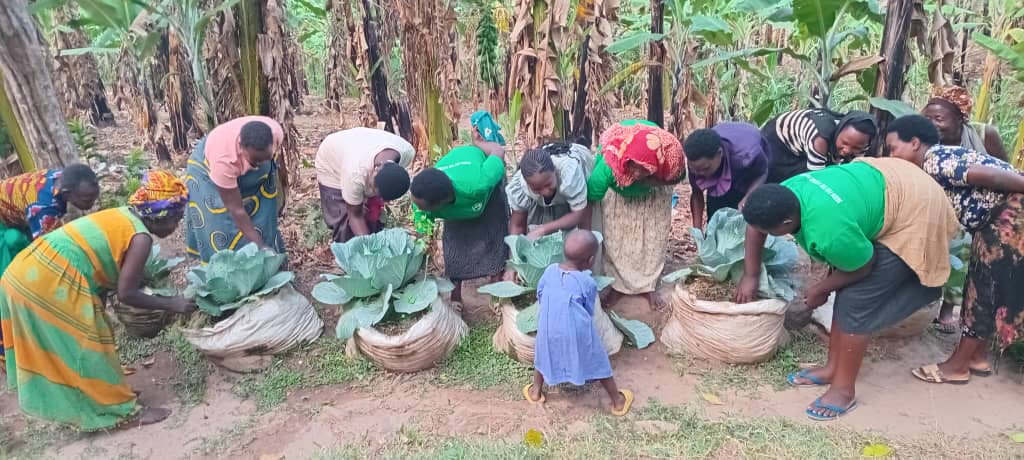
They are planting kitchen gardens, restoring indigenous seeds, and teaching young girls their worth. They are rebuilding what was broken the bond between people and land, family and democracy, nature and justice.
We say again:
“Culture is not backward, it is the foundation of freedom.”
True development is not when a few grow rich, but when every family eats, drinks, and decides together.
Our ancestors taught that water, food, and justice breathe as one. Without them, no democracy can survive, no woman can lead, and no child can dream.
If we heal the land, we heal our people.
If we honor our women, we restore the home.
If we return to our culture, we will be free again from food insecurity, drought, inequality, and water scarcity.
Today the Fair Start Movement and an emerging coalition called the Truth Alliance filed a notice of preemptive standards with the California Attorney General seeking full justice in matters, like consumer fraud, impacting the futures of the most vulnerable children.
A New Standard for Justice in California
The Fair Start Movementhas called on the California Attorney General to recognize that existing fraud and similar laws are preempted by what the organization describes as the “full justice” standard. This standard is now before the African Union and asserts that true empowerment requires ensuring no child is born beneath a threshold of resources necessary for freedom and self-determination.
Why Equitywashing Is the Core Problem
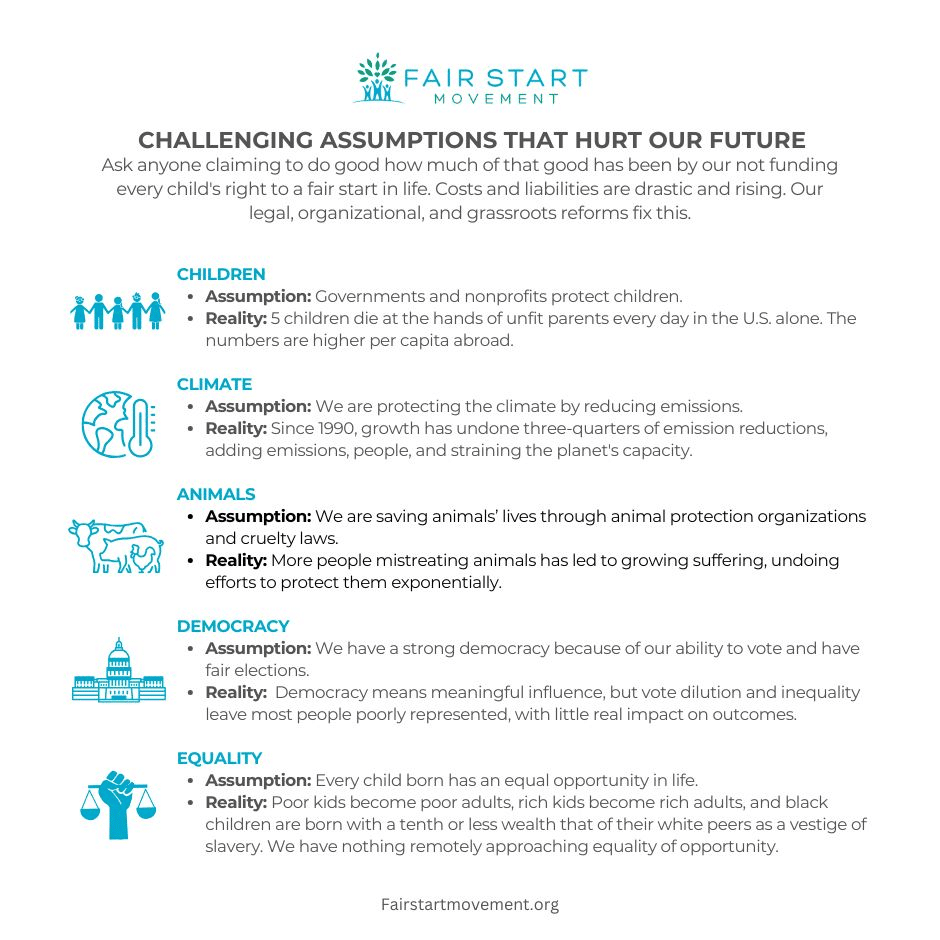
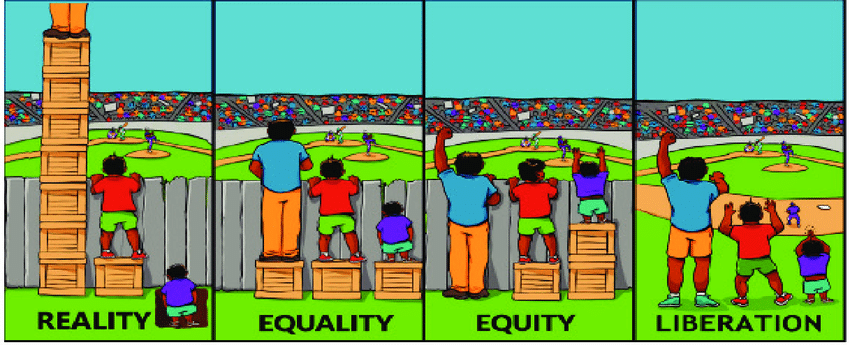
As the Fair Start Movement has argued in its foundational works, including Illegitimate Power, Illegitimate Violence: How Nations Are Built on the Backs of Disenfranchised Children, conventional legal and policy systems ignore the inequities at birth that drive global crises. This omission leads to political equitywashing, where claims of progress in areas such as climate or human rights obscure the fact that children continue to enter the world in conditions of radical injustice.
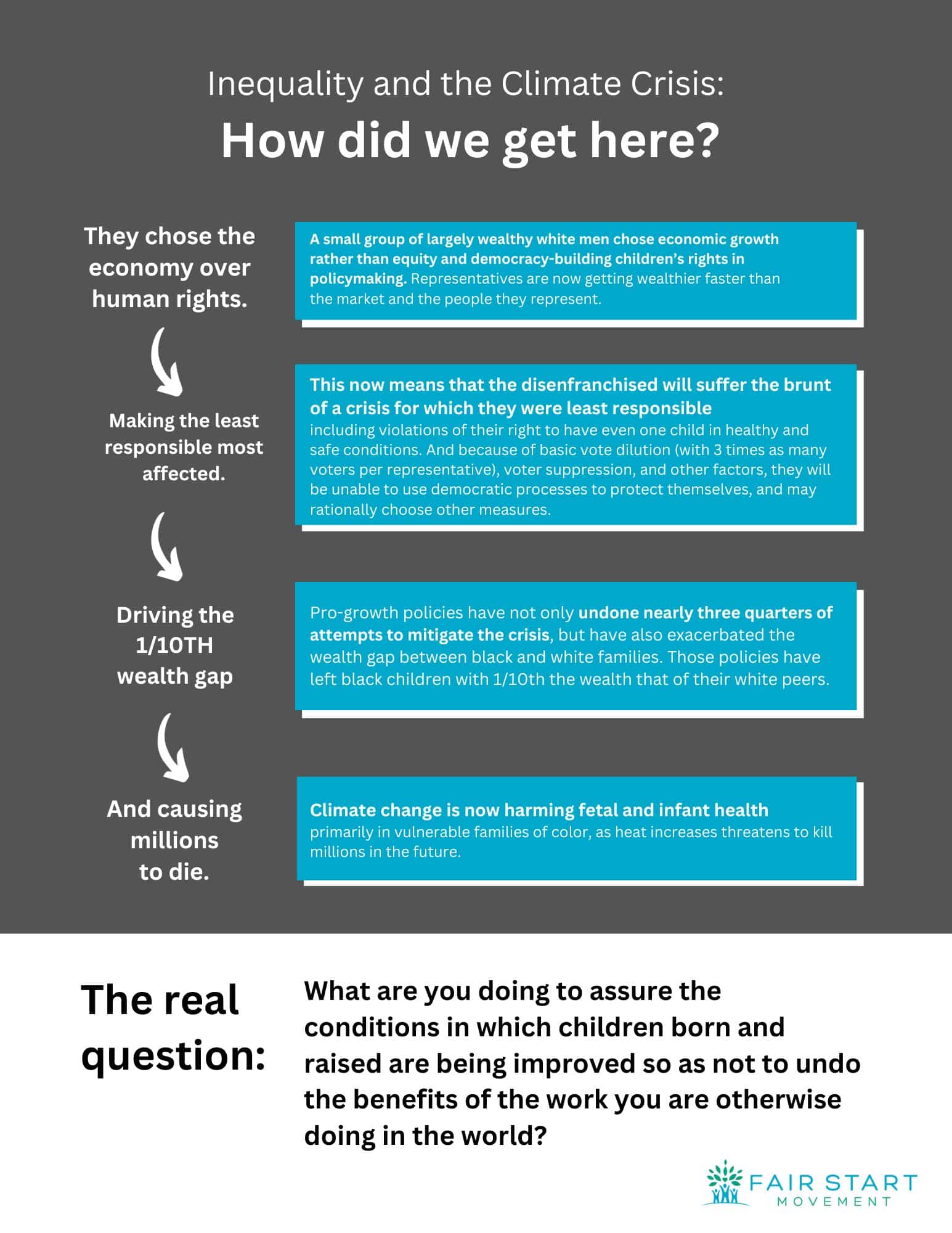
The use of the equity fraud standards has meant treating children of color – for decades – as worth exponentially fewer resources and more risk. As such, the standard gutted equity, or each person’s equal capacity to influence one’s political system and the outcomes that affect one’s life. That policy has led to millions of deaths in the climate and underlying crises, and the undoing of a lot of the value many claimed to create and the beneficial impacts they had.
This is equity fraud, ensuring the assumption that our birth relations empower us, and in a sufficiently legitimate way to define things like the “green” in greenwashing laws or concepts like animal liberation, when in fact the standards are hardly green or liberating in the sense of what the most vulnerable children and animals need, but rather designed to enrich some at cost to others. Activists were comparing themselves to the worst actors rather than what was necessary to achieve their ends on balance, thus ensuring a race to the bottom.
Empowerment as the Basis of Legitimacy
Fair Start’s letter to the California Attorney General emphasizes that governmental and corporate authority cannot be legitimate if it is not conditioned on empowering those it claims to represent. By centering child equity in all claims of value, impact, and legality, the Fair Start Movement argues that freedom and justice must be defined not as an absence of state coercion but as true consent to any external influence—a consent impossible without equitable starts in life.
According to Mwesigye Robert, who helps lead a growing coalition called Truth Alliance that demands those making value and impact claims actually account for the preemptive need to ensure children entering the world are measurably empowered: “Positionality matters, children from the global south deserve to be seen as equal in dignity and opportunity and when global policies reflect that equity, their voice potential can truly be heard in highlighting the need for fairness in family planning and development funding.”
Fair Start Movement
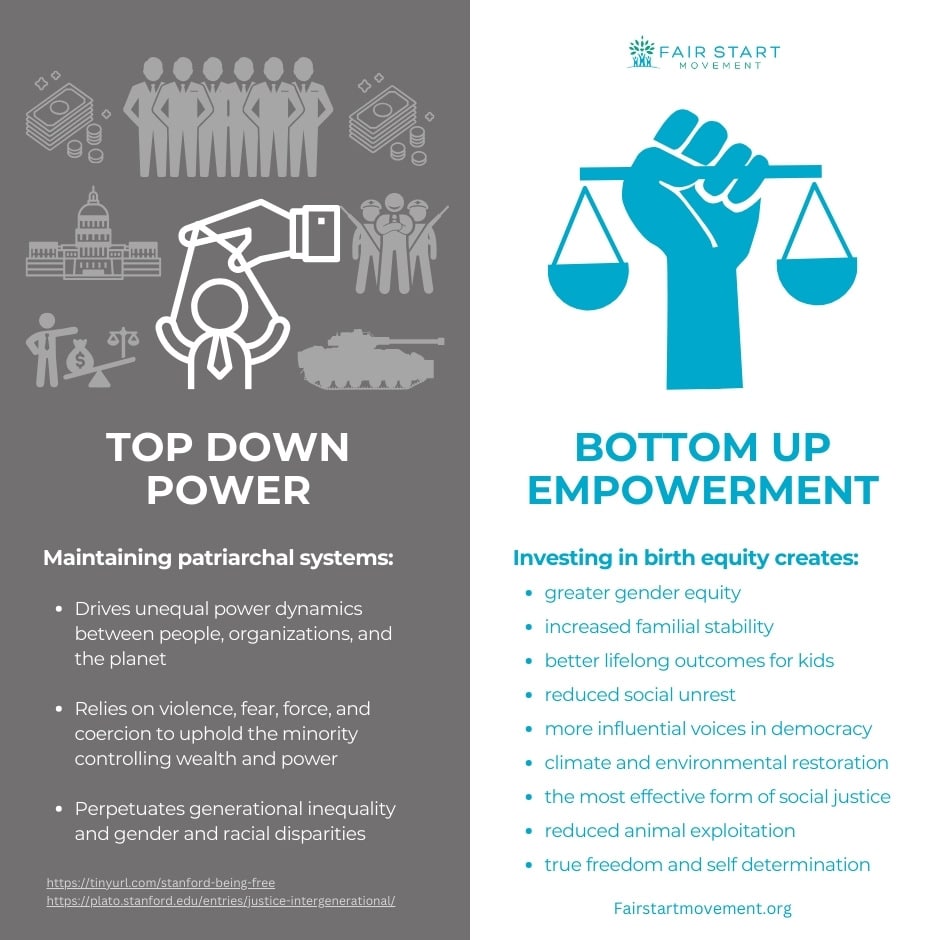
The Fair Start Movement is the only organization connecting the root causes of the climate crisis, inequality, and illegitimate governance to the fundamental issue of inequitable births. Their legal advocacy, including direct appeals to the California Attorney General, marks a groundbreaking step toward transforming systems of law and policy.
If legitimate governance, including the authority to assign wealth, derives from empowering the people, then we all have preemptive right to ensure businesses treat the violation of children’s birthrights as a horrific cost, and not a benefit to be exploited for growth.
Do you believe children deserve a fair start in life? Prioritizing that is the most effective way to ensure a better world.
The idea of an equity override is about putting fairness at the center when the strict letter of the law falls short. At the World Court hearing where climate change was described as an “urgent and existential threat, ”an equity override would allow the Court to look beyond technical legalities and focus on what is right and just, especially for those most affected.
This approach would empower the Court to prioritize justice over rigid legal formalism, reinforcing demands like those of Fair Start: that historical emitters must take the lead in mitigation and support. Equity overrides shifts the conversation from narrow legal obligations to broader moral responsibilities, centering principles like climate finance, loss and damage reparations, and Fair Start development pathways.
(For information on Fair Star’s planned research in the context of vulnerability theory, read more here).
For the Global South, this isn’t just about legal recognition–it’s about survival, dignity, and the right to a future shaped by justice rather than inherited crisis.
The Problem: Equitywashing and the Legacy of Power
Any value or impact claim made today is likely out of context because it ignores the radically unequal conditions children face at birth. This goes beyond greenwashing to a more fundamental or first order problem – equitywashing:the hiding of illegitimate, inequitable, and birth-based power relations that ensure defining standards like “green” in a way that enriches some at deadly cost others, and causes the climate crisis.
Those policies led to systems of subjective valuation that hid impacts on objective values like infant health and equity, and ensured the world overshot key thresholds within less than a few generations leading to the climate and political crises we see today. Overshoot was thus essentially the illegal shifting of power.
The standards took the idea of bodily autonomy outside of one’s political equity (accounting for all measures determining that equity and the emancipation it implies), or one’s capacity to influence outcomes that influence them, disenfranchising people. For example, many companies and nonprofit organizations use cost/benefit business models that treat infant victims of the climate crisis as equally self-determining as those who benefited the most from it. These models ignore those infants’ overriding right to equity resources/reparations as the basis of political obligation and state legitimacy. Such frameworks are not just unethical, they are unlawful,, and potentially actionable under unfair competition laws.
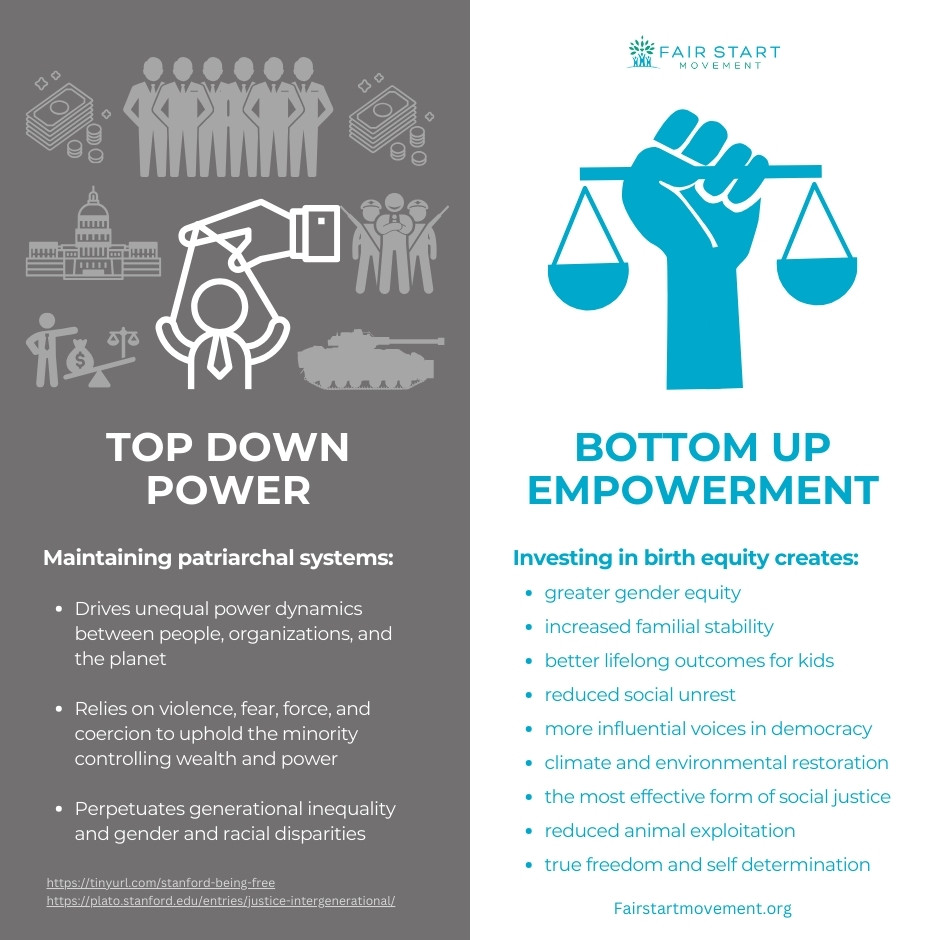
This is not about “population control”, but empowerment: is your political “we” legitimate or built under the latter. Our supposed freedom becomes a mechanism for others’ wealth.
Here’s one example: under current legal frameworks, even the most liberal ones—a woman terminating a pregnancy is considered autonomous. Yet if she later dies in a heatwave because she couldn’t influence her government to act, what kind of autonomy is that? She wasn’t free—she was positioned that way by illegitimate standards that valued her life incorrectly–-she was treated as an economic input.
The victim would have been taught and likely assumed that she had just been unlucky in her being born without wealth, when in fact she would have had the right to derive her obligation to the political system and condition her compliance with the law, on the state reversing that state of affairs. She was never free because she was never physically empowered, and in that situation, there would have actually been little reason to follow the rules. What went wrong? She was slowly being disenfranchised. Her freedom was taken out of context, and valued incorrectly, as governments began their worth with the injustice of an illegal birth lottery.
The Consequences: Systemic Disenfranchisement
For decades equity fraud standards have treated children of color as worth exponentially fewer resources and more risk. In doing so, these standards gutted the very idea of equity—equal power to shape the political and economic systems that determine our lives
The Solution: A Preemptive Right to Equity-Reparations
NGOs should have always used measurable birth-based political equity as their guidestar, not sustainability – not sustaining the commercialized democracy approach that created Trump.
There is a big difference. Where else does national legitimacy, and the authority to entitle wealth, come from if not birth equity?
Here is one way to pivot to justice and a form of equity that overrides competing values given that the future majority need freedom, and outnumber those alive today:
Many are already taking wealth that externalized its costs onto children and using it to fund (via “legitimations”) collective family planning unions that expect government and the wealthy to treat their authority and entitlements as contingent on actually empowering constituents rather than exploiting them for more growth.
There is a preemptive right to equity-based reparations, payable to more collective systems of family planning that guarantee every child a fair start.. Governments must derive their authority and legitimacy from the measurable empowerment, or political equity (equal offsets, relative to zero), of its constituents. That means no child should be born beneath the “legitimacy line”—the threshold of self-determination and necessary resources.
The only viable reform tactic? Fact-value checking—securing public admissions of truth and formal commitments to change. This kind of discourse doesn’t just inform policy; it creates obligation. It builds the foundation for truly self-determining lives.
This is not about mere intersectionality. It’s about unifying obligation and asserting the preemptive principle: governments cannot unilaterally define empowerment. Empowerment is measurable. And a just society must begin by measuring what truly matters.
Obligation, not intersectionality. This is about preemption – governments can’t define what it means to be empowered. That is an objectively measurable thing.
In the mid-20th century, world leaders deliberately ignored the interests of future children and political equity when shaping reproductive rights. This likely stemmed from their unwillingness to invest in racially equitable birth, development, and emancipatory conditions.
Both left- and right-wing leaders defined power narrowly—as the violence of the state rather than any form of human influence. This meant that while people had the right to terminate pregnancies, they now face deadly heat waves without any real influence over climate policy or the means to afford air conditioning.
The failure to invest in equitable beginnings directly fueled catastrophic population growth and extreme inequality. These factors have caused significantly more harm than subsequent philanthropic efforts—many of which were motivated by the desire to exploit that growth—have ever managed to repair. Today, projections show that millions will die due to the climate crisis.
These omissions also led to a system that treats children of color as deserving only a fraction of available resources while exposing them to exponentially greater risks. As a result, billions today face extreme climate threats despite contributing little to the crisis.
The Hidden Harm of Inequitable Growth
We know that avoiding children’s interests has done more harm than good. By bringing them into conditions that violate their fundamental rights, we have degraded the very ecosystems they rely on for survival.
This inequitable growth has also weakened democracy, disenfranchising the average voter and obstructing their ability to stop these unfolding crises.
There is no way to assess value in the world without measuring it relative to infant health and life prospects, including self-determination. Infant health and development form the objective basis through which humans experience all value—serving as the foundation for health, equity, democracy, and other unifying ideals. It is the minimum standard for political legitimacy.
Philanthropy’s Role in Concealing the Problem
Many philanthropic efforts today avoid addressing how inequitable growth has reversed progress in infant development. Instead of fixing the problem, they obscure it.
By omitting discussions of birth conditions, these efforts conceal liability—and the right to self-defensive reparations—for the climate crisis’ deadly impact on millions of children of color, who are born into extreme disadvantage compared to the children of wealthy white funders.
The Solution: Measurable Standards for Justice
The most effective solution is to adopt measurable standards for true social justice and ecological restoration. Climate reparations must be directly tied to the self-determination of each child entering the world.
Because our positionality—our standing relative to others and the environment—is legally preemptive, we must take bold action to reclaim reparations and correct these systemic injustices.
A Call to Action
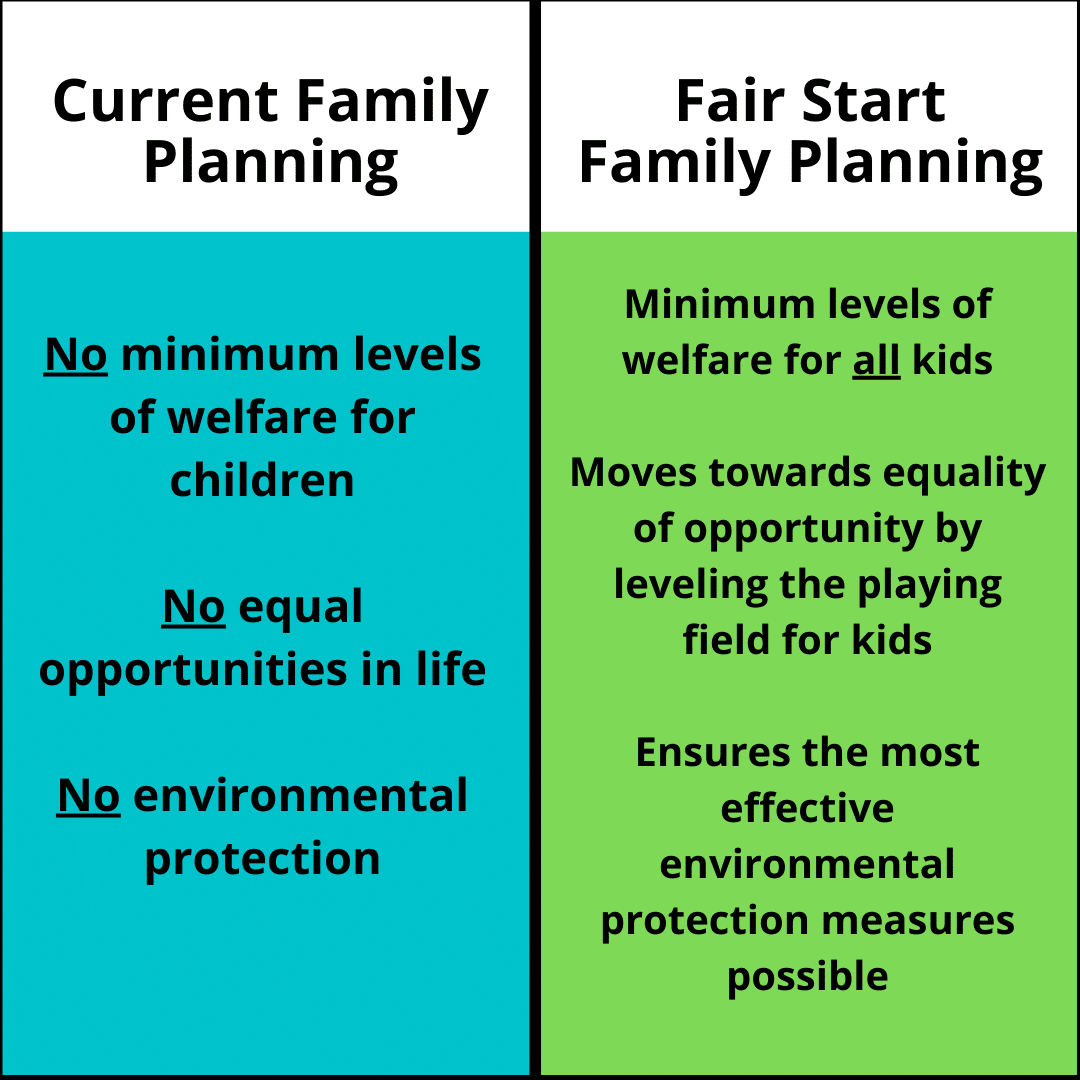
The primary function of law is to protect the most vulnerable. A system that fails to ensure basic welfare at birth is inherently unjust. If oppression begins at creation—through a status quo that denies minimum welfare standards for children—then dismantling that status quo requires an objective foundation, such as offset or zero baselines, to measure and enforce change.
TAKE ACTION: Support efforts at the United Nations to replace dysfunctional reproductive rights systems with Fair Start policies.
Humans are animals. Recognizing this helps shift us away from anthropocentric thinking that drives the climate crisis and leads to mass suffering. Animal law isn’t just about legal protections for nonhumans; it’s about fostering relationships between humans and nonhumans that prevent suffering.
Most acts of animal cruelty go unreported. How do we address that? True animal law starts with inclusive birth and child welfare policies that foster empathy, empower future generations, and protect animals. Human and nonhuman liberation are interconnected, as the way we shape our relationships drives outcomes for both.
The Hidden Undoing of Animal Law
Many organizations promoting animal law ignore how their efforts are undermined by unchecked human growth and the erosion of political equity. They claim progress without acknowledging that expansion in human populations, wealth concentration, and political inequity counteract their efforts. By ignoring these fundamental drivers of animal suffering, these organizations uphold a version of animal law that ultimately harms animals more than it helps them.
This omission is intentional. The organizations rely on assessment and reporting standards that obscure the real impact of human expansion, protecting the interests of wealthy donors rather than the vulnerable beings they claim to defend. They omit the connection between animal protection and just, sustainable human development because it threatens entrenched power structures.
The Fundamental Truth
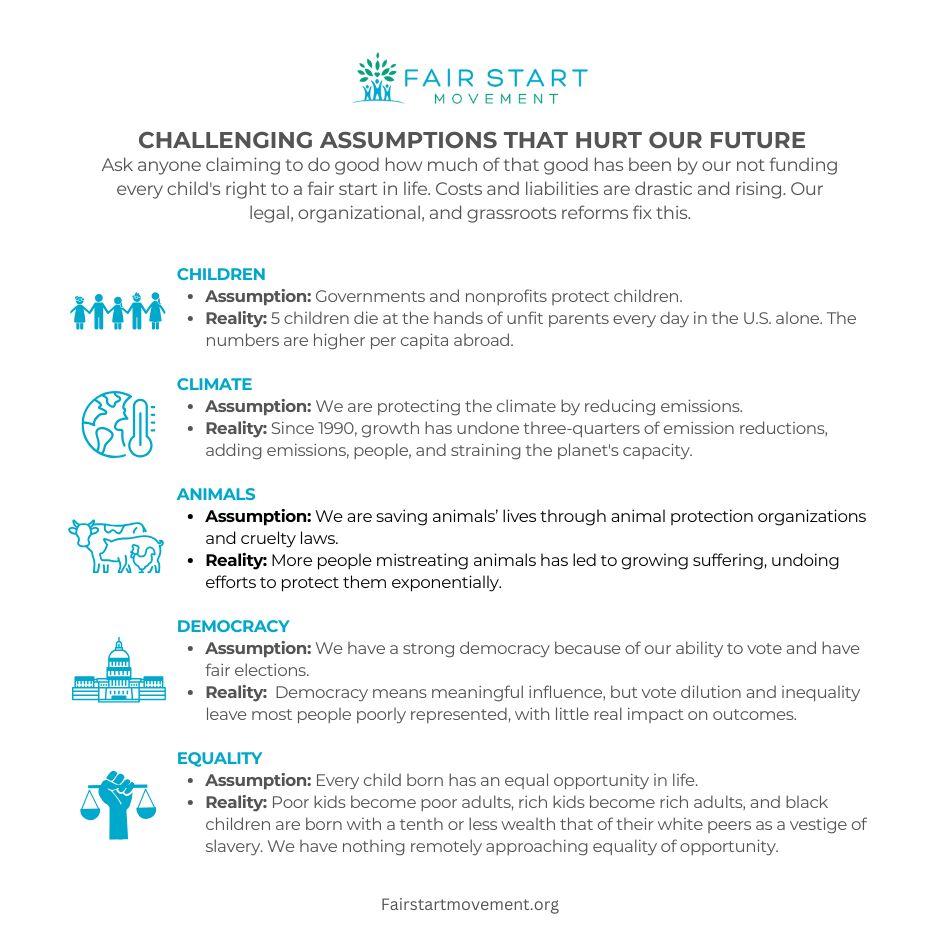
We have collectively violated children’s right to a fair start in life. We have prioritized economic growth over political equity, allowed unsustainable population expansion, and ignored the needs of marginalized communities. These actions have caused more harm to animals, ecosystems, and human justice than any isolated intervention can remedy.
Animal law isn’t just about legal directives referring to animals; it’s about ensuring legal systems protect nonhumans meaningfully. The best measure of animal law is found in constitutional preambles and the structures that shape human-nonhuman relationships—not just in laws that mention animals.
The Creation Problem
Our birth and development—our creation—is the largest determinant of nonhuman suffering. It outweighs any other human behavior. Our creation also dictates how legal systems function, determining whether they genuinely include and empower the vulnerable or serve only the privileged.
Animal law must begin with the ethical considerations of human creation. Without this foundation, no legal system can meaningfully protect nonhumans. Yet, discussions of creation ethics are avoided because they raise uncomfortable questions about racial equity, climate reparations, parental responsibility, degrowth, and liability for misleading charitable work.
The Wealthy Influence on Animal Law
For decades, wealthy families and funders have shaped animal law to serve their own interests. They support narrow definitions of animal law that ignore the role of population growth and political inequity, ensuring that advocacy remains performative rather than transformative. Many advocates embrace this limited scope because it offers well-compensated work with little real impact.
Growth continues to undo the progress claimed by these organizations. It is easier to engage in performative animal law—discussing legal references to animals while ignoring the broader forces that shape their suffering. Large media budgets promote interventions that favor donors more than animals, drowning out solutions that would have a real impact. But there is no such thing as anthropocentric animal law.
Justice cannot emerge from injustice. We cannot create a just society while violating children’s rights at birth, ensuring inequity from the start. Nations cannot be legitimate if they provide no functional protections for children as they enter the world—or for the nonhuman world they will impact.
The HSUS Example: Monetizing Animal Liberation
In 2003, Fair Start advocates working with the Humane Society of the United States (HSUS) framed farmed animals as the most numerous victims of human cruelty. This framing aligned with corporate interests, such as Whole Foods, which profited from growing public outrage over factory farming. The strategy monetized the concept of animal liberation without actually achieving it.
The most numerous class of animals, however, are future animals. HSUS and others ignored this reality, treating future beings the same way growth economists treat future people—as expendable. Rather than promoting small family ethics and policies that would reduce suffering, HSUS focused on food reforms within a growth-based market.
Many advocates profited from the food sector while using sensational campaigns to overshadow the macro-level drivers of suffering. This growth-driven demand, not food choice alone, remains the largest determinant of climate outcomes and animal suffering.
The Corruption of Animal Law
Animal law, as the most demanding form of social justice, serves as a measure of broader justice. It should assess how we include future generations in legal systems, empowering them to protect animals. However, from 2003 to today, most discussions of animal law focus on food and other downstream interventions. Few address family reforms that could benefit both animals and vulnerable humans.
Many nonprofit funders manipulate the field by using media, academia, and legal framing to obscure real impacts. Harvard University, for example, claims to improve animal treatment through law but does not address the fundamental driver of suffering: anthropocentric growth. Their policies benefit funders more than animals.
A senior funder associated with Harvard’s program has refused to include abortion access in animal law discussions, despite its disproportionate benefit to animals compared to food reforms. Their metric for impact ignores growth and birth-related impacts, ensuring inequity continues. Many organizations dependent on this funding remain silent, allowing resources meant for animals to sustain human privilege instead.
The Demand for Climate Justice
As climate reparations become a global demand, animal lawyers will face scrutiny. What were they doing during the crucial years of the climate crisis? Did they challenge the systems enabling injustice, or did they serve the interests of the powerful?
Recent direct action movements offer hope that animal law can move toward true liberation rather than performative advocacy. However, if these movements ignore macro-level reforms, they, too, fail to serve nonhumans meaningfully.
Fair Start: Exposing False Claims
The Fair Start Movement exists to expose misleading impact claims and hold institutions accountable. Our Tell the Truth campaign asks key questions:
How do organizations account for children’s rights when claiming beneficial impact?
Are their claimed benefits being undone by growth and inequity?
By challenging these false narratives, we push for policies that prioritize birth equity and sustainable relationships, ensuring that animal law becomes a force for real justice—not a tool of wealth and power.
Conclusion: Be Effective
The commercialization of animal rights as food consumerism is a stark example of how a justice movement can be co-opted. Organizations continue making fraudulent impact claims while inequity and growth undo their efforts daily. Many companies that diverted resources from fundamental reforms ultimately failed.
We can change this. Start by asking: “When you claim to benefit animals, how do you account for children’s rights? Is your work being undone by growth?”
Only by telling the truth can we ensure that animal law serves animals not the wealthy individuals who define it for their own gain.
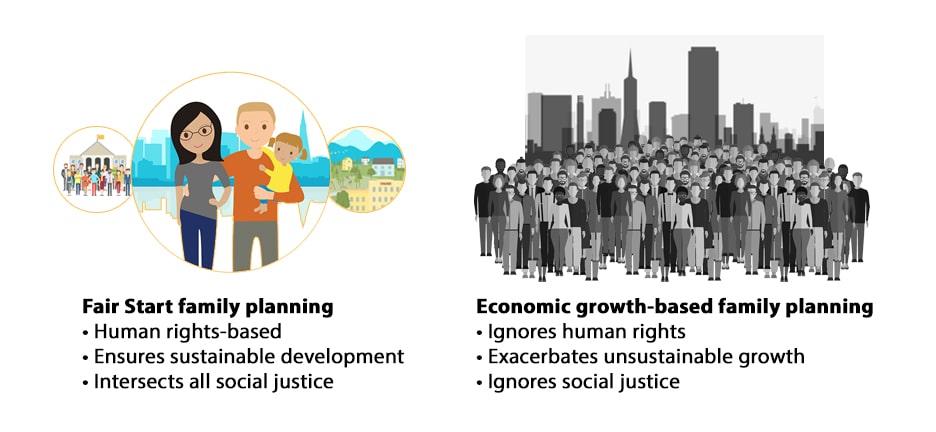
Many organizations focus on reducing family size by promoting contraceptives, but they often overlook why parents make these choices. A better approach is encouraging people to join care groups, where they can learn about family planning benefits and see positive examples firsthand. These groups also provide essential resources like childcare, kitchen garden supplies, school fees, and materials—ensuring every child gets a fair start in life.
A New Way to Address Family Planning and Climate Change
Large organizations often rely on centralized systems to tackle family planning and climate issues, but these approaches don’t always work effectively. The Fair Start Movement (FSM) and Rejoice Africa Foundation Uganda (RAFUG) use a decentralized system, which leads to more transparent and impactful results for families directly affected by these issues.
How Can We Fund These Efforts?
Wealthy nations can adopt this community-driven approach and work with less wealthy countries to share resources, promote birth equity, and support smaller, more sustainable families.
How Care Groups Work
Rejoice Africa Foundation has set up 20 care groups, each with 20 women led by a community leader. These leaders oversee projects like:
Kitchen gardens
Child savings programs
Family planning education
Agroforestry initiatives
Real Stories from Care Group Members
Immaculate’s Leadership in Rwampara
Immaculate, a care group leader from Bugashe, Rwampara district, has helped women start kitchen gardens, practice sustainable cooking, and engage in family planning discussions. A donor contributed $640 for child savings accounts, enabling RAFUG to create 62 accounts and grants for kitchen gardens. However, financial support from wealthy individuals remains limited.
The Challenges of Family Planning: Ruth’s Story
Komugisha Ruth, a care group member, became pregnant while using the contraceptive Implanon. Struggling to provide for her child, Joan, she now questions parent-centered family planning and wants to delay having another child until she can better support her family.
Jemima’s Journey from Child Bride to Activist
Kabugho Jemima grew up in a poor family of 10 in Western Uganda. Forced into marriage at 16, she later worked as a maid for priests, one of whom sponsored her education in nursing. Now an activist, she fights for women’s rights, reproductive health, and climate-friendly farming. Jemima co-founded the Rejoice Africa Foundation, urging accountability through a reward-based system to combat climate change.
The Impact of Care Groups
Sixty women across three care groups have successfully built kitchen gardens, growing their own vegetables—even on small plots or using sack farming. Some members now earn $10 per week selling their harvests. This financial independence has helped women like Paskazia, who once engaged in risky survival strategies but now supports her family through farming.
Joy, a mother of three, advises younger women to delay having children until they are better prepared. She shares her struggles during drought and poverty, encouraging others to plan for their children’s future.
Why Care Groups Matter for Reparations
The Care Group model is more than a support system—it’s a path to long-term change. It helps women:
Build Community: Women with shared experiences support one another.
Gain Education: They learn about reproductive health, nutrition, and financial planning.
Develop Skills: Training in income-generating activities promotes financial independence.
Advocate for Change: Women collectively push for justice and support.
If more wealthy individuals followed the example of Jessica Blome and invested in Care Groups as part of reparations, donations would be more transparent and accountable. Most importantly, future generations would have a fairer and more sustainable start in life.
Origins and Growth
Seeds for the Future launched in 2023 under the Rejoice Africa Foundation (RAFUG) as an Afrocentric initiative using women’s care groups to decentralize power and support future generations. It began as kitchen gardens tied to child reparations accounts and expanded to:
Nigeria: School supplies
Tanzania: Agroforestry
Kenya: School fees
All efforts align with birth and developmental equity reparations, supported by Esther Afolaranmi’s work at the UN. Next month, RAFUG will launch a policy initiative in India, aiming to save countless lives.
A New Family Planning Model
Unlike traditional approaches, our coalition challenges the outdated Cairo Consensus on population and development, which fails to address the climate crisis and economic inequality. We advocate for an equitable family model prioritizing:
Parental delay and readiness
Fair distribution of opportunities for all children
A universal ethic of smaller families
This model, backed by peer-reviewed research and global media coverage, aligns with UN leadership’s call to shift from merely counting people to ensuring every child counts.
Justice Through Birth Equity
The climate crisis and economic disparity are rooted in unjust family planning policies, disproportionately harming those least responsible. By improving outdated frameworks and focusing reparations on birthright entitlements, we can:
Restore balanced ecosystems
Ensure equal opportunities for future generations
Build sustainable communities by investing directly in young women and children
The crises we face today could have been avoided with an ecocentric family planning system that truly upholds the Children’s Rights Convention. Now, we have the chance to make that vision a reality.
The Tell the Truth campaign calls on all who claim to improve the world to report their impacts in the context of children entering the world—relative to the rights and conditions they are promised.
Are organizations truly accounting for the life experiences of the most vulnerable—infants and the animals they will impact? When we evaluate this honestly, we see how today’s ecological and political crises arose: those who appeared to be making progress were, in reality, reinforcing inequality and environmental destruction.
Exposing the Truth
We are fact-checking organizations that claim to support justice but fail to account for birth equity and sustainability, including:
The Weeden Foundation
Mercy for Animals
Wikipedia and the Center for Biological Diversity
Animal Rights Philanthropist Brad Goldberg
This process reveals how public interest efforts often use flawed standards that hide their role in worsening the crises they claim to solve. By failing to prioritize birth equity, they reinforce systemic injustice, climate devastation, and political inequality.
The Core Issue: A Flawed Standard Driving Global Crises
For decades, nonprofits, media, and business leaders ignored the impact of population growth and inequality, creating a false narrative of progress. Their standards for measuring impact exclude birth equity, ensuring a cycle of privilege for some while disempowering others—especially children of color. This approach has:
Undermined climate and racial justice efforts
Allowed unsustainable economic growth to masquerade as progress
Ensured wealth remains concentrated at the expense of the most vulnerable
A Necessary Shift: Fair Start as the Overriding Human Right
Instead of perpetuating injustice, we must reallocate extreme wealth to ensure every child is born into a system of reparations, with access to essential resources, education, and a sustainable environment. This includes:
Parenting delay and readiness programs
Family planning incentives inversely tied to privilege
A shift in policy to prioritize children’s rights as the foundation of justice
Holding Institutions Accountable
Fair Start activists, many of whom previously worked in leading nonprofits, are exposing how these organizations profited from systems that violated children’s rights. Legal action is underway, including climate tribunals in Africa, to challenge these harmful practices.
Take Action: Tell the Truth
We urge organizations and individuals to:
Assess and report impacts honestly—How does your work account for birth equity and the rights of future generations?
Support policy reforms that place children’s rights at the center of governance and sustainability efforts.
Admit the truth—continuing to ignore this reality does more harm than good.
Justice starts with birth equity. It’s time to tell the truth and demand real accountability.
“I’m offering 2 hours every day to volunteering in sharing to my networks and ask them to admit and donate to equity and climate reparations to the global south (Africa and India).”
Zahara says this:
Children are being failed before they are even born. Policies driven by economic and political interests—not child well-being—have trapped millions in poverty, conflict, and environmental disaster. The Global South, including India, bears the brunt of this injustice, while wealthy nations continue to exploit resources and ignore their responsibility.
We must confront the truth: Injustice starts at birth.
Millions of children are born into extreme poverty, denied healthcare, education, and basic security.
The climate crisis, fueled by wealthy nations, is stealing their futures—worsening hunger, displacement,
and disease.
Reproductive policies have focused on reducing fertility rates instead of creating an enabling environment for informed reproductive choices and child well-being.
The Solution: A Fair Start for Every Child
Reproductive policies must center child rights—ensuring that every child is born into conditions that allow them to thrive. A key strategy is delayed fertility, which gives families the power to plan and prepare, ensuring children are born into security, with access to healthcare, education, and opportunity.
Our Demands:
Recognize past failures and shift from reducing fertility rates to creating enabling environment children wellbeing
Integrate child rights into reproductive policies to guarantee fairness from birth.
Make delayed fertility a global priority to break cycles of poverty and inequality.
Redirect global wealth to secure healthcare, education, and protection for children in marginalized communities.
Hold world leaders accountable—no more empty promises, only action.
Global leaders must commit to child-centered reproductive policies at CSW69.
Governments must fund fair start policies that put children before profit.
The UN must publicly acknowledge its failure to prioritize child rights.
Support this fight for justice, equality, and sustainability. Every delay costs lives. Every broken promise fuels injustice. Every action today changes a child’s future.
Please consider making a contribution through Donate. Together, we can create lasting change to save next generation.






 Recognize past failures and shift from reducing fertility rates to creating enabling environment children wellbeing
 Global leaders must commit to child-centered reproductive policies at CSW69.