Category: Opinions, Essays & Perspectives

  • Why Is Congress Making the Climate Crisis Worse, and Reinforcing Economic Inequity?

    Why Is Congress Making the Climate Crisis Worse, and Reinforcing Economic Inequity?

    Congress Could Have Recognized Children’s Right to a Fair Start in Life. Instead It’s Treating Them as Cheap Future Labor.

    The Senate’s debate of stimulus legislation that includes significant child-care and tax changes is an opportunity for the United States to recognize every child’s right to a Fair Start in life, ecologically and socially, and radically transform the way we plan families. 

    Instead, per the New York Times and Forbes, the Senate is pushing what one Nobel Laureate called a population growth Ponzi scheme. The legislation does not eliminate the massive wealth gap between black and white families or encourage sustainable family planning that does not severely exacerbate the climate and other ecological crises. Smaller families can have 20 times the impact on the climate crisis as other measures. 
     
    Fair Start, the better approach, would pivot to:
    • Cut all benefits for wealthy families and dramatically expand them for poor families, making the rich pay to offset the unearned privileges their children enjoy in life.
    • Incentivize better family planning, and smaller and more sustainable families for everyone, through things like delaying childbirth until parents are really ready.
    • This is key: These moves can make the legislation antiracist and regenerative and can lay the groundwork to eliminate child abuse and recognize our fundamental human right to nature.
     
    We can do better than pushing women to have kids. Let’s restore nature and level the playing field at birth for all kids. That’s how we create a legitimate society. It’s called Fair Start. It’s the first and overriding human right, and as such, we may achieve it by all means effective. Here is an example of that type of better approach, one that Sen. Cory Booker can easily promote as the Senate debates. We should use funding to fundamentally change the way we plan families to maximize investments in future generations and to compensate them for the harm we have caused. 
     
    Sen. Mitt Romney, a Mormon with five wealthy children, is using the excuse of child poverty to push population growth as means of creating cheap future labor, increased consumption, and a bigger tax base that will benefit his privileged kids.  It’s similar to the Ivanka Trump approach to families and the future. 
     
    The current proposals do nothing to ensure all children some minimum level of well-being, equal opportunities in life, a safe and natural environment, and an effective voice in democracies or systems of self-rule. The proposals further the exclusion of people from their own governance, rather than inclusion, and are setting the stage for further political violence in the future as the gap between rich and poor, in a degraded environment, worsens.  

    What You Can Do Today

    Call Kamala Harris and these four key senators today, and make your case for every child’s right to a Fair Start in life: 

    ·       Cory Booker
    ·       Elizabeth Warren
    ·       Amy Klobuchar
    ·       Bernie Sanders

    And donate here to promote every child’s right to a Fair Start in life, the most effective way to protect our shared future. 

  • Guest Opinion: Practical Solutions to Common Concerns of Parents Working From Home

    Guest Opinion: Practical Solutions to Common Concerns of Parents Working From Home

    Guest author: Emily Graham, MightyMoms.net

    Emily is mother to two daughters, cares about their future, and supports the Having Kids approach. Neither she nor Having Kids received any compensation for this piece.

    Having a baby or toddler as a coworker may sound pretty cute. If you’re a parent who is currently trying to perform this juggling act, though, you know just how stressful things can get. You may have even found yourself in situations where you felt overwhelmed, including the examples below. This is why we are giving you some practical tips for overcoming them, courtesy of Having Kids. 

    “My home is a mess!”

    Chaos and toddlers seem to go hand-in-hand. The first thing you should do to tame the clutter and mess is to cut yourself some slack. If you’re caring for a younger child while working from home, you’re basically working overtime at two full-time jobs. 

    Now, if things have gotten out of control, you can also use some free tips to get your home organized, fast. When you have a few minutes, go around one room and pick up clutter. Also, try to spend a little time cleaning each day so your house stays fresh and doesn’t overwhelm you. Last but not least, open a window for some fresh air. Then, take a deep breath and relax after all of that hard work.

    “I’m working in pajamas” 

    Look we get it — wearing your pajamas is convenient and seemingly smart when you’re chasing after a toddler in-between work and chores. You may feel comfortable working in the same clothes you wore to bed, but as it turns out, spending a few minutes on getting yourself ready for the day will actually help you be more productive. Essentially, you’re letting your brain know it’s time for work. 

    That isn’t to say that you should wear a three-piece suit and fancy heels to work from home. How would you ever keep up with a constantly exploring child in that getup? Instead, put together a few casual looks that can take you from Zoom meetings to zooming after kids. Need to shop for new clothes? Look for promo codes and coupons from stores like Belk to find functional and fashionable outfits for a lot less. 

    “I’m constantly interrupted!”

    There are only two things that will help in this emergency situation: realistic expectations and boundaries. We’ll get to boundaries in just a moment, but first, let’s go over some ways you can create better schedules and routines for your family. You need to plan your work week ahead of time and talk your schedule over with your kids, if possible. If you have a partner or spouse, come up with expectations for how you will split parenting duties. 

    Next, enforce your schedule and routine with boundaries. That may look like working during naptime with toddlers and babies since you can’t very well explain boundaries to them. It could also include setting up your very own office space to create some physical separation. 

    “Sleep is non-existent for me.”

    Not getting enough sleep is a common concern for parents of younger children. But you really do need quality sleep to thrive and avoid burnout. In fact, one trick you can use is to focus on quality rather than quantity. Johns Hopkins recommends trying to rest in cycles of two to four hours, which will hopefully coincide with your kids’ naptimes. Even if you can’t sleep, resting helps! 

    Another important tip for working parents is shutting off electronics before you try to fall asleep. This goes for your work phone and laptop, too, since the light from screens can make it more difficult for your eyes and brain to relax. If you have a habit of checking emails or social media while in bed, stopping now will help you get the quality sleep you need. 

    Working at home with a baby or young child in the mix shouldn’t make you feel burned out or overwhelmed. Having a plan and sticking to consistent routines can help you maximize your productivity. It’s also extremely important that you set boundaries to maintain some order. 

    Donate to Having Kids, a non-profit dedicated to giving every kid a fair start. 

  • Having Kids Statement on Ohio Supreme Court Opinion: Parents Need Not Support Their Kids?

    Having Kids Statement on Ohio Supreme Court Opinion: Parents Need Not Support Their Kids?

    The Ohio Supreme Court has ruled unconstitutional a probate judge’s order that an Ohio man who has 13 kids by nine mothers to avoid procreating further because he owes hundreds of thousands of dollars in child support. Polls in Ohio show that many people would have supported the Lorain County judge’s original decision and that people believe the right to have kids is contingent on parents being able to support them.

    The court seemed sympathetic to the idea that having kids comes with responsibilities but ultimately found that the order did not sufficiently relate to the legal authority under which the judge issued it. In other words, it would be up to the Ohio legislature to step in and broaden courts’ authority to address poor family planning.

    Having Kids has developed model legislation, based on some of the leading research in the field, that would authorize courts nationwide to do this. We have also developed federal legislation that would facilitate funding to improve the way our system protects kids and our communities from poor family planning. Of course, the right to have kids comes with responsibilities. And our failure to ensure those responsibilities through better policy has fundamentally created the social and ecological crises we are experiencing today.

    We can do better, and Having Kids is leading the way.

    Take action: Urge Ohio Gov. Mike DeWine @GovMikeDeWine to prioritize Fair Start order legislation.

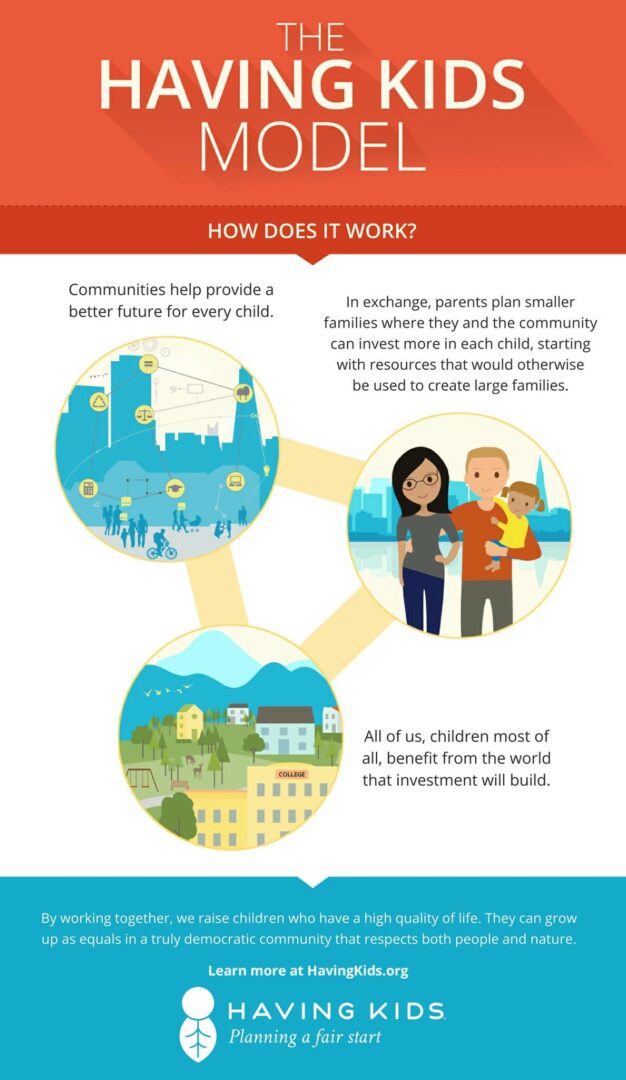
    Infographic explaining the Having Kids Model with three illustrated sections showing how communities invest in children, parents plan smaller families, and all children benefit from these shared resources.

  • Video: Sustainable and Responsible Family Planning – The Law Needs to Change.

    Video: Sustainable and Responsible Family Planning – The Law Needs to Change.

    [et_pb_section admin_label=”section”] [et_pb_row admin_label=”row”] [et_pb_column type=”4_4″][et_pb_text admin_label=”Text”]

    The most effective way to protect children, animals, our environment, and equality is by changing from family planning policies that focus on what parents want to policies that ensure future children what they need, both ecologically and socially.

    The sooner you speak out, the better our and our kids’ future will be.

    There are massive advantages to planning smaller and more equitable families.

    It enables greater empowerment for women, more individual attention and more resources invested in each child, greater achievement in school, and more engaged, less crowded communities. But most importantly, research indicated that smaller families are better for kids. Smaller families also leave time, energy and resources for parents to invest in their community, and to ensure that the world their children will inherit is better and more equitable than the one we experience today. This list is by no means exhaustive. The bigger picture is that families and communities benefit. Read more reasons to have a small and more equitable family.

    Have you chosen to have just one or two kids? Send us a video and tell us why. Email info@fairstartmovement.org

    [/et_pb_text][/et_pb_column] [/et_pb_row] [/et_pb_section]
  • Why We Can Ensure A Child’s Right to a Fair Start In Life, Ecologically and Socially, By All Means Effective

    Why We Can Ensure A Child’s Right to a Fair Start In Life, Ecologically and Socially, By All Means Effective

    A lot of people have asked the crew here at Having Kids what we mean when we say that we can all further a child’s right to a #FairStart in life, ecologically and socially, by all means effective. What it simply means is that as a peremptory norm, a child’s right to a fair start, enabled through cooperative resource distribution and responsible family planning, overrides things like the property rights of the wealthy, or the right of intending parents to have limitless numbers of children with no cooperative planning to ensure their welfare and equity. #Fairstart comes first.

    Why are the rights and responsibilities that surround having kids peremptory? If power derives from the people, then the norm that accounts for their creation and subsequent empowerment overrides other norms. It is the first necessary condition of legitimacy. It involves literally constituting the political entities that then develop subsequent norms. In other words, nations were not “constituted” at historical points in the past by god-like founders, but are either constituting legitimate systems of governance with every child we have, or they are not, depending on how they do it and the values (like welbeing, consent and nature) at play.

    We say “all means effective” because we refuse to ignore the moral reality of the order of norms, and because the freedom and wellbeing of future generations and nonhumans – the most vulnerable and numerous classes of entities – depend on our using #fairstart to liberate them. Does that mean we promote things like violence? No – we explicitly reject violence and other forms of coercion because we believe they cannot further #fairstart, but by creating cycles of violence, in fact harm kids and their development.

    Learn more about #fairstart, and why we are focused on concentrations of power in icons like Elon Musk.

  • The CDC Responds and We Reply: Address Overcrowding as a Fundamental Factor in Pandemics

    The CDC Responds and We Reply: Address Overcrowding as a Fundamental Factor in Pandemics

    On Earth Day this year, Having Kids wrote to the Centers for Disease Control and Prevention asking it to consider supporting new family planning policies that would address overcrowding and other factors that impact the spread and impact of Covid-19 and that threaten to help create new pandemics.

    On May 27, the U.S. Department of Health and Human Services and the CDC kindly responded, noting that 1) United States birth rates are at an all-time low, and 2) the CDC is doing much to protect families and children from Covid-19.

    We appreciate the response and applaud these efforts, but we have responded with the following ask:

    Given that the CDC in its letter recognizes the connection between low birth rates, overcrowding, and pandemics, would it support our call for new legislation promoting smaller families? Forthcoming legislation on Covid-19 could be linked to forthcoming legislation on childcare and subsidized “baby bonds” in a way that starts to change the underlying model that drives family planning outcomes and transitions the country to smaller families who can invest more in each child.

    We are also asking the CDC (and World Health Organization) to include in the policy change the other three inevitable factors present in all family planning regimes: 1) the impact on prenatal, birth, and early development conditions on qualitative outcomes like health, education, and the development of empathy, 2) the impact of equity and prospects for equality of opportunities in life, and 3) the impact on the environment and prospects for the restoration of nature as a buffer against future pandemics. The CDC and WHO can support policy transitions to better family planning and can codify the human rights-based child-centered model in a variety of ways.

    The facts are clear:

    • Population growth and the large families that cause it have worsened the impact of Covid-19.
    • The impact of Covid-19 depends on the civic qualities of the populace, including empathy and the willingness to engage in measures that protect others. These qualities, and related factors like the effective dissemination and internalization of simple public health information, depend in part on family planning regimes.  
    • Equity and the massive disparity in health outcomes during Covid-19 largely depend on family planning and birth conditions.
    • The underlying driver of future pandemics is the degradation of nature. We need policies that restore it.
      In other words, the historic spike in population growth over the past century has been a public health problem.

    TAKE ACTION: Urge leadership to move from parent-focused to a human rights-based child-focused family planning model.

  • Why Conservatives Should Support Family Planning Reform

    Why Conservatives Should Support Family Planning Reform

    David Brooks recently made an argument in The New York Times that should resonate with conservatives: Inequity, and many other related crises, stem from the family and the way we raise our kids. His argument speaks to the sense among most conservatives that deep changes in our culture, and the decline of the family as a preparative institution, is the root of many evils from debilitating loneliness to widespread drug addiction.

    But Brooks stopped short of offering a truly effective solution to the problem. Why? Any solution would have to start with an obvious but controversial truism: If we want to ensure families prepare children to succeed, we need to start before those children are born and actually ensure that parents are ready to raise and develop children responsibly. That process does not happen magically.

    How Family Planning Should Be Reformed

    It requires reforming the way we plan families. How, exactly? As a recent Having Kids research paper published in the Loyola Chicago Law Review pointed out, one step forward would be to successfully incentivize prospective parents to wait to have kids until those would-be parents have met certain milestones. The cost savings of taking these steps to ensure responsible parenting are unparalleled, especially when we factor in the huge impact on pressing crises like climate change and extreme child poverty.

    In other words, it’s good to make sure the state will not have to pay the costs of parents failing to actually raise the kids they have, rather than our paying taxes to make sure the state continues to do a horrible job of post-hoc parenting. Moreover, this process can reduce population growth and the big government, centralization of power, and mind-numbing bureaucracy that comes with it. All this moves us toward governance that’s actually representative of the people themselves. That vision of freedom is the opposite of Mao’s policy of pushing women to have more kids, which made China, now with well over 1 billion people, the greatest threat to freedom in the world today.

    In short, ensuring every kid a fair start in life, in part by paying would-be parents to prepare, is a policy that works. Conservatives should support family planning reform because it embodies these fundamental conservative values:
    • Promoting responsible parenting and families
    • Ensuring our promotion of responsible parenting is efficient by acting before problems arise, and
    • Guaranteeing the American idea of freedom, or personal autonomy, that is possible only in a democracy of well-prepared citizens capable of self-rule and with true access to equal opportunities in life.

    Where Personal Freedom Really Begins

    There is, of course, a push among conservatives to ignore values like responsible parenting, fair starts in life, and participatory democracy in favor of policies that create kids as consumers, future workers, and compliant taxpayers because promoting a high birth rate will inflate the economy. That is simply selling out our values and foisting on our kids the costs of bad parenting in what Nobel Laureate Steven Chu called a pyramid Ponzi scheme. We are a democracy before we are an economy, and there is no reasonable conception of personal freedom that does not start with accounting for and developing the people who actually constitute our political systems and, as such, have power over us. And accounting for future citizens of our democracy means ensuring responsible parenting.

    The many who gave their lives to protect what they perceived to be a unique form of freedom did not die so that the United States could become a threat to itself, ecologically through the climate and other environmental crises, and socially through the decline of the family as an institution that prepares kids for functional society. Better family planning is our best solution to both the environmental and social problems we face.

    Learn more here.

  • Why Good Family Planning Is the First Human Right and Responsibility

    Why Good Family Planning Is the First Human Right and Responsibility

    Do the family planning policies in your country ensure all children receive what they need to succeed and a fair start in life relative to other kids? Do they ensure that the child will have a meaningful democratic role in making the rules under which they live, and the freedom and security of the natural world around them? If not, then those policies and the governments that push them are fundamentally illegitimate, or “preconstitutional,” and the people may reverse the violations by all means effective.

    This is the claim Having Kids researchers recently published the Willamette Law Review, and the article is now suggested reading on the influential Legal Theory Blog administered by Georgetown law professor Larry Solum. In short? For people to be free, their governments have to be legitimate; to be legitimate, governments have to be inclusive of the people they claim to represent; and to be inclusive, they first have to comprehensively account (from a logical baseline) for each child, as well as the conditions in which that child is born, develops, and becomes able to meaningfully participate in democracy. In other words, family planning policies have to limit and intergenerationally decentralize the power each of us exerts over one another. Those policies have to free us from one another.

    TAKE ACTION: The United Nations was designed to protect international peace and security, in part by protecting human rights. Instead, leadership there has promoted the interests of illegitimate governments that exploit, rather than invest in, future generations. Urge them to reverse course and do the right thing: https://fairstartmovement.org/uncandobetter/

  • Family Planning After Coronavirus: Why We Need Male Contraception

    Family Planning After Coronavirus: Why We Need Male Contraception

    By Sarah Johnson

    I can’t help but admire the strength and resilience I see on display every day in my nursing colleagues with whom I’ve served for the past 22 years. Like many Americans, we confront this next phase of the epidemic with a mix of worry and hope. 

    However, as medical practitioners on the front lines battling the coronavirus, it is impossible for us to ignore a feature of American life that the virus has made all too clear: the deep inequality facing communities of color, who are dealing with disproportionate infection and death rates from COVID-19, as well as longer-term health challenges like lack of access to birth control. In these communities, the epidemic will cast a long shadow — not only as families struggle to recover spiritually and economically, but as young women navigate critical moments of their lives with limited or nonexistent support from medical experts. 

    For our society to rebound, we must understand and address the root causes of the inequality that the virus has laid bare. Family planning has played a significant role in improving the lives of women and people of color since it was declared a human right, but we still have a ways to go. As we imagine a world after the arrival of this pandemic, we must ensure that the U.S.’ outdated family planning model is replaced in order to address lingering inequality and to prioritize children and communities over corporations and profits. A common-sense set of solutions is the “male pill” and long-acting, reversible male contraceptives such as Contraline and the RISUG. If fully tested and approved in the U.S., such options could empower men to share more equally in family planning, leveraging their own bodies. And studies indicate that men may be open to the idea.

    This is why Having Kids calls upon the United States Congress and the National Institute of Health to prioritize the development and deployment of male contraceptives. 

    Why Male Contraception Is Essential

    Why is male contraception important? Research shows that smaller families benefit children. It also indicates that the economic disadvantage correlated with larger families tends to perpetuate economic inequality that undermines democracy by leaving undue influence in the hands of the few. Yet in the name of economic growth, we see corporations targeting moms with costly ad campaigns to have more children for the purpose of growing the consumer base. We see sexual stimulants prioritized over birth control, and we see the U.S. tax system incentivizing larger families when incentivizing delays in pregnancy may better position women and children for equality. Economic growth-based family planning not only puts in question the planet that we’ll be able to pass down to our children, but it also leaves us more susceptible to future pandemics due to population overcrowding and decreased distance between humans and animals.

    Today in the United States, nearly half of pregnancies unintended, costing us about $15 billion each year. I remember several years ago telling one of my patients, a 37-year-old African American woman in Oakland, Calif., that her pregnancy test had come back positive. She instantly froze and began to cry. She wanted the baby, but she did not have the financial resources to take care of the child. She was then faced with a very difficult decision. Scenes like this play out every day across America and the world. 

    In a few short months, the pandemic has made family planning even more difficult. Condom shortages and lack of access to birth control during this social distancing period can lead to serious socioeconomic consequences for young couples. Going forward, we must empower men with equal opportunity to safely participate in their right to family planning using their own bodies. 

    Male Birth Control and Modern Family Planning

    What options are already on the table? Aside from the “pullout” method and abstinence, there are more than 12 options for pregnancy prevention available to women. Meanwhile, two options are available to men on the U.S. market: condoms or vasectomy. While there have been several attempts over the past several decades at developing viable options for males, critics say that sexism may be the largest barrier, in part evidenced by the early termination of clinical trials on a male version of “the pill,” due to side effects these critics say women have been experiencing for decades.

    The obstacles in front of us are not insurmountable, and we cannot afford to decelerate on the road to scientific breakthrough. In today’s politically polarized America, any solution that pushes us forward while side-stepping traditional political divides should be a no-brainer. Falling squarely within the pre-fertilization category of birth control options, male contraceptives are less politically contentious, in part thanks to the current pope’s less stringent stance on contraceptives. Abortion tends to dominate the family planning public discourse, but the real conversation should be about modernizing family planning, so that women and their partners can have equal access to resources and information to plan better lives for themselves and their families. 

    Downstream approaches to improving children’s welfare are failing kids and endangering our future. The most effective way to eliminate the greatest threats to children, the environment, and our democracies is to ensure better conditions for every child from the moment they are born. Let’s start at the source. When communities and parents cooperatively embrace better family planning, we can invest more in every child and create the future we all deserve.

    For these reasons, we at Having Kids call upon the National Institute of Health and U.S. Sen. Rand Paul and U.S. Rep. Anna Eshoo, who lead the congressional committees on health that oversee family planning matters, to increase funding for the development of male contraceptives. 

    As we salute nurses for their work on the front lines of the pandemic, we should also think about the long-term resilience of our healthcare system and our communities, and how state-of-the-art family planning drives better patient outcomes for a healthier, better-functioning society.

    Sarah Johnson, a family nurse practitioner with 15 years serving patients in critical care and 22 years in allopathic medicine, graduated with an M.S. in Nursing with high honors from Georgetown University and currently lives and works in the San Francisco Bay Area. She is a founding board member of Having Kids, a U.S.-based nonprofit organization dedicated to raising awareness for The Fair Start Model, a human rights-based, child-focused approach to family planning.