Category: Featured Families & Personal Profiles

  • Pierrette Kengela’s Letter To Dean Smith – Letter Included

    Pierrette Kengela’s Letter To Dean Smith – Letter Included

    What is happening right now is bigger than one university, one legal program, or one public dispute.

    Across the world, people are beginning to ask deeper questions about institutional accountability, transparency and truth. Whether in conservation, climate policy, social justice, public health or animal protection, the same concern keeps appearing: are institutions presenting real impact, or carefully managed narratives of impact?

    UN Warns Earth 'firmly on track toward an unlivable world'

    That question now sits at the center of growing concerns surrounding the University of Denver Sturm College of Law’s animal-law programming.

    And importantly, these concerns are no longer coming only from activists or campaigners.

    On February 18, 2026, public health and systems governance specialist Pierrette Kengela submitted an expert perspective letter to Dean Smith of the University of Denver Sturm College of Law. Writing in his independent expert capacity, Kengela outlined growing cross-sector concerns regarding what he describes as “baseline transparency” and “impact integrity” in public-interest programming.
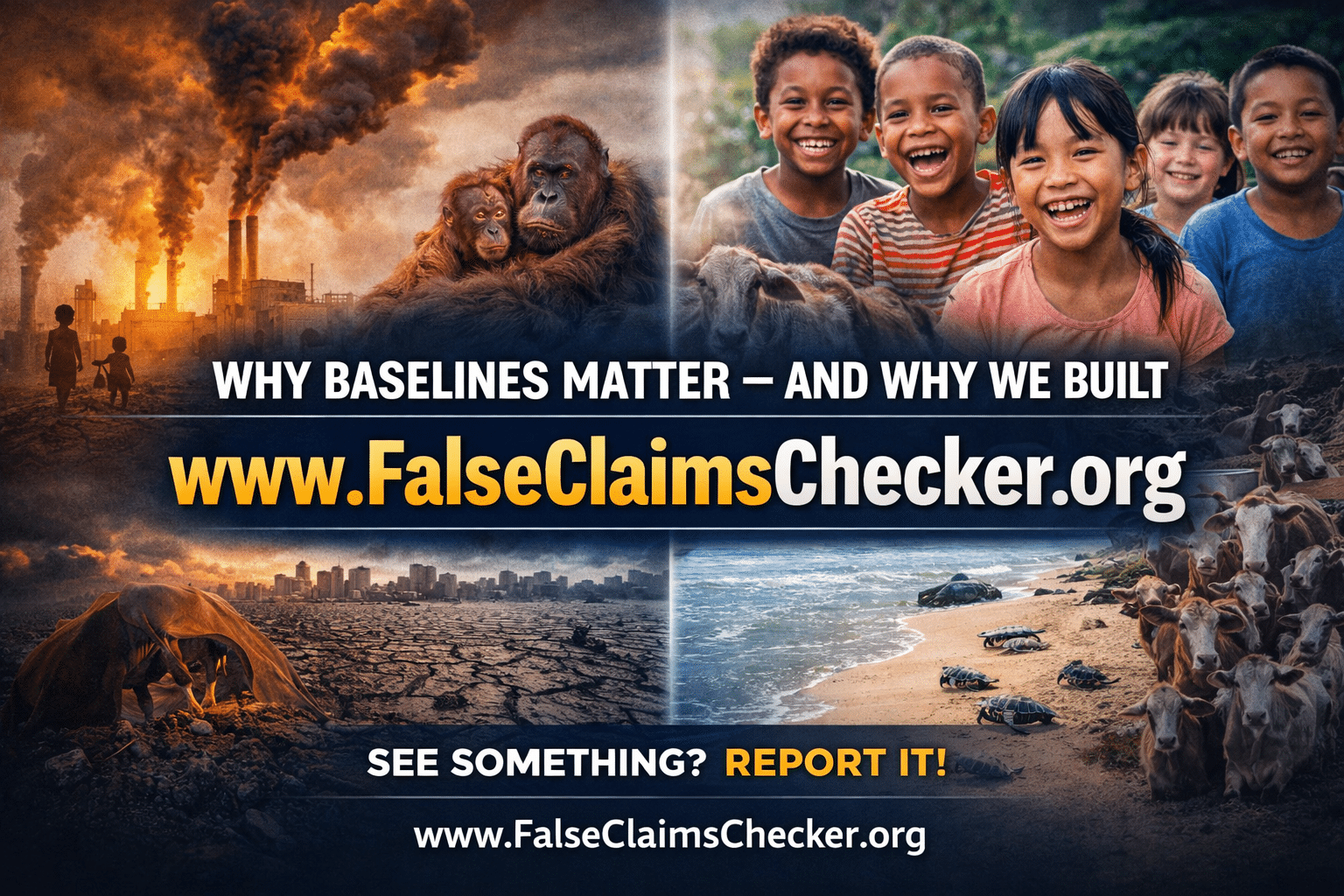
    Fales Claims Check.org

    His letter matters because it places this issue into a much wider global context.

    Kengela’s work focuses on child rights, intergenerational accountability, institutional integrity and African Union–aligned policy work examining long-term social and structural outcomes. In his letter, he explains that across multiple sectors there is increasing technical concern about how institutions communicate public-benefit impact to donors, students, stakeholders and the wider public.

    At the center of that concern is one enormously important distinction:

    The difference between “program outputs” and genuine “net outcomes.”

    In simple terms, institutions may report actions taken, services delivered, advocacy campaigns launched or legal cases supported. Those are outputs. But the deeper question is whether overall conditions genuinely improved once the surrounding baseline realities and structural drivers are fully accounted for.

    And that distinction changes everything.

    Because if underlying systems continue expanding suffering faster than interventions reduce it, then institutions have a responsibility to communicate that reality honestly.

    Kengela’s letter explains that this issue is now increasingly recognized across public health, climate accountability and governance sectors as a matter of evidence integrity and informed public reliance. Public-facing impact claims, he argues, should be clearly bounded by transparent assumptions, modelling limits and honest disclosure of baseline conditions.
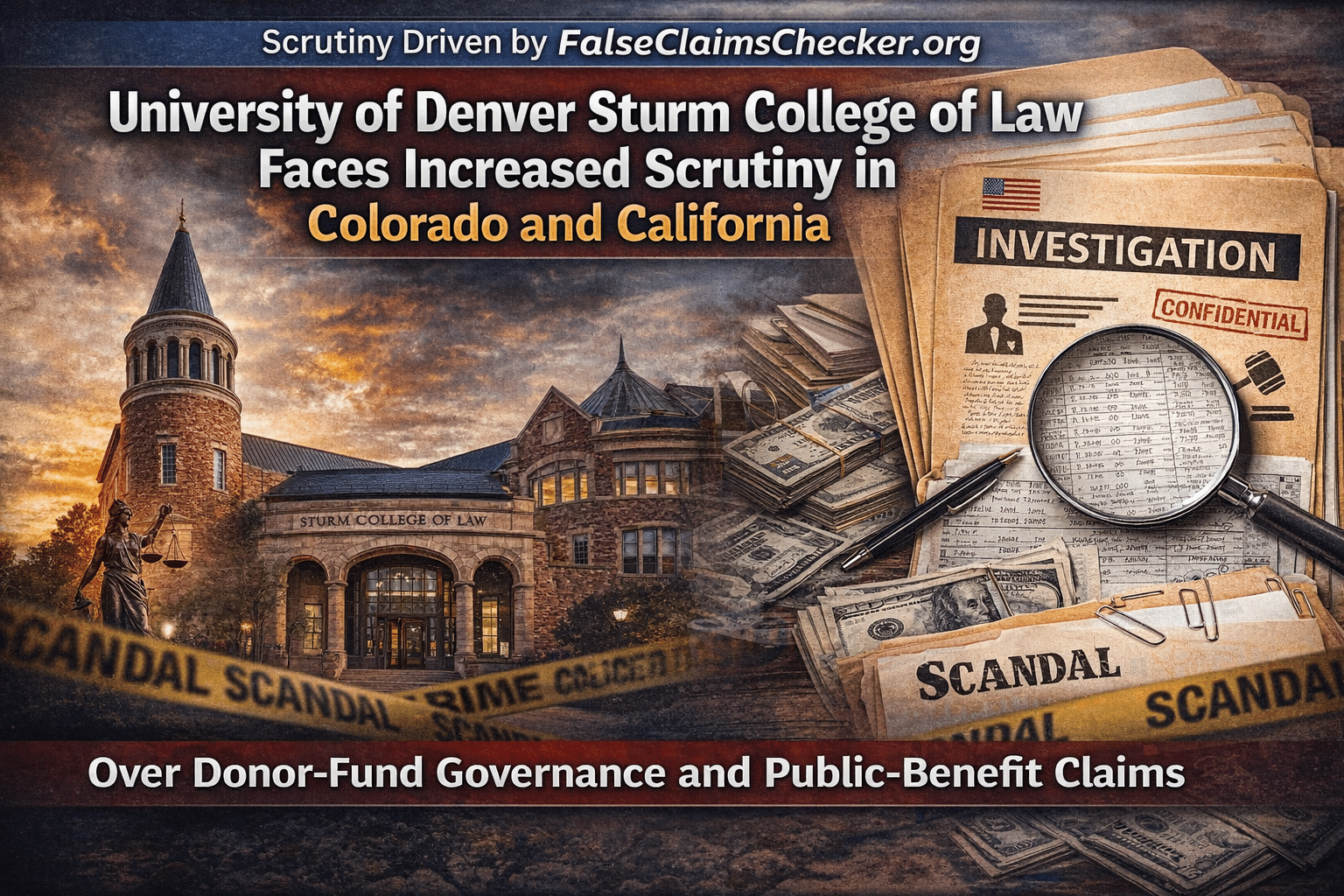
    Image showing the University of Denver Sturm College of Law with police tape, a gavel, and a magnifying glass over files labeled “Investigation” and “Scandal.” Text highlights scrutiny in Colorado and California over donor funds.

    That is not an attack on advocacy.

    It is a call for credibility.

    The concerns raised around Sturm’s animal-law programming center on whether public-facing impact language may imply meaningful net progress in animal protection without sufficiently disclosing the wider structural conditions shaping those outcomes. In other words, whether downstream successes are being publicly emphasized while upstream systems driving harm remain outside the accounting framework.

    This matters deeply because law schools are not ordinary institutions.

    Lady Justice on a desk by a scale on a desk near laptop
    Lady Justice on a desk by a scale on a desk near laptop

    They train future legal professionals. They shape public discourse. They carry institutional authority. And when legal institutions communicate impact to the public, donors and students, there is an expectation that those representations are grounded in rigorous evidence and methodological integrity.

    Kengela’s letter warns that when baseline assumptions remain implicit, program outputs can unintentionally be interpreted as evidence of broader net progress even when underlying structural conditions remain unchanged or continue worsening.

    We see this problem across the world every day.

    Wildlife conservation campaigns celebrate rescues while habitats continue disappearing at industrial scale. Sustainability initiatives market progress while ecosystems collapse in the background. Social justice organizations report outputs while inequality deepens year after year. While there are many great rescues happening, and conservation efforts are working, with rewilding and many species have been saved from extiction due to conservation efforts.  Many species are in rapid decline, with direct conflict with people.  Such as the lion.

    A male lion with a brown mane lies in tall grass, mouth open as if roaring or panting, surrounded by green vegetation.


    And meanwhile, ordinary people are left believing the systems are working.

    This is why transparency matters.

    Not to destroy institutions, but to strengthen them.

    Not to undermine advocacy, but to ensure public trust in it.

    Kengela repeatedly emphasizes in his letter that this is ultimately a governance issue. From a public health and institutional integrity perspective, he argues that transparent disclosure of assumptions and modelling limitations is essential so that donors, students and the public can accurately understand what institutional metrics do — and do not — establish.

    Because impact should never depend on selective visibility.

    And that is the wider issue now being confronted.

    Around the world, institutions have become incredibly skilled at marketing compassion. But increasingly, people are beginning to ask whether those narratives are supported by full accounting of the systems underneath them.
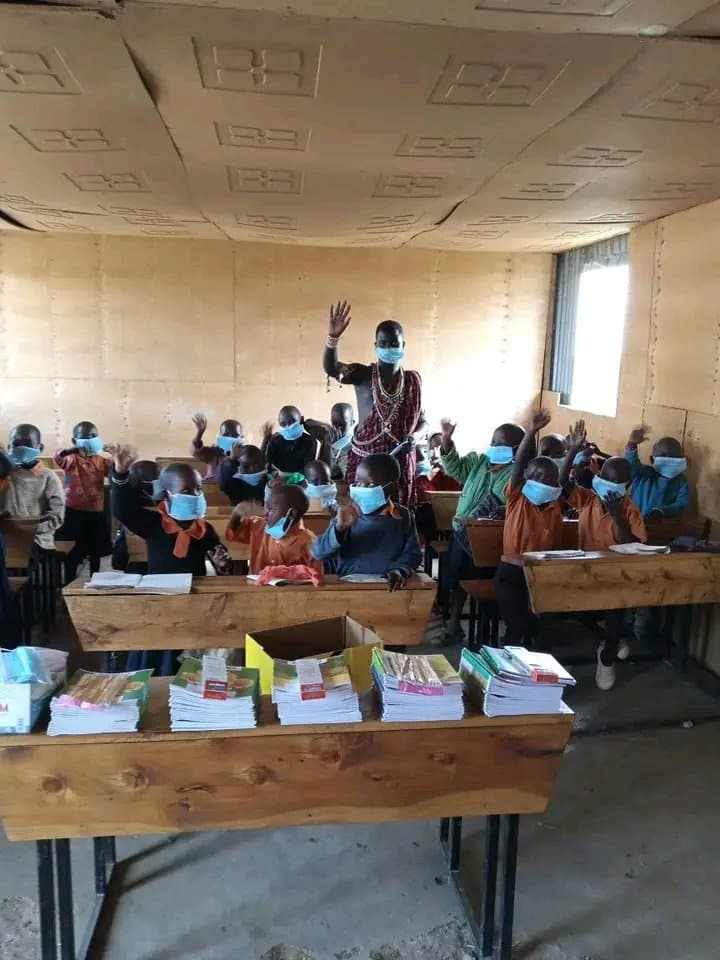
    People in a class room

    The world does not need more carefully managed branding around justice, sustainability or animal protection.

    It needs honesty.

    It needs institutions willing to openly examine whether the outcomes they publicly promote remain true once baseline realities are fully disclosed.

    Because if we truly want to protect animals, protect people and create a sustainable future, then accountability cannot be treated as an inconvenience.

    It must become the standard.

    And perhaps most importantly, it must begin with the courage to tell the whole truth — even when the full picture is uncomfortable.


    Letter –

    February 18, 2026
    Office of the Dean
    University of Denver Sturm College of Law
    2255 E. Evans Avenue
    Denver, CO 80208
    Subject: Expert Perspective on Baseline Transparency and Impact Integrity in Animal
    Law Programming
    Dear Dean Smith,
    I write in my individual expert capacity as lead of the African Union–focused petition on birth
    equity and intergenerational accountability, and as a public health and systems governance
    specialist working at the intersection of child rights, equity, and institutional integrity.
    My engagement on this issue is informed by cross-sector work examining how public-interest
    claims are evaluated in contexts where structural conditions, including child-rights protections,
    intergenerational equity, and climate-related vulnerability, materially shape real-world
    outcomes. Across these domains, there is increasing technical emphasis on ensuring that
    institutional impact language is analytically bounded by clearly stated assumptions and
    methodological limits.
    I am aware that FairStartMovement.org and TruthAlliance.global have filed an institutional
    complaint with the University of Denver Sturm College of Law requesting written clarification
    and internal review regarding (a) how animal-law programming and affiliated advocacy assess
    and publicly represent impact and (b) whether public-facing claims clearly distinguish program
    outputs from net outcomes once baseline variables and modelling limits are disclosed.
    I offer this perspective to support careful institutional reflection on the methodological and
    governance considerations raised in recent correspondence regarding impact representation in
    animal law programming. At its core, the issue under discussion, namely, the use of impact
    language that may imply net outcomes without explicit baseline disclosure, is increasingly
    recognized across multiple sectors as a matter of evidence integrity, informed reliance, and
    sound institutional governance.
    This perspective is offered in the spirit of strengthening methodological clarity and informed
    institutional practice. It does not seek to adjudicate underlying policy positions or advocacy
    viewpoints. Rather, from a governance and public-reliance perspective, the central
    consideration is whether public-facing impact representations are appropriately bounded by
    transparent baseline assumptions, clear modelling limits, and a disciplined distinction between
    program outputs and net system outcomes.
    Context: Growing Cross-Sector Attention to Impact Integrity
    Across multiple sectors, including global health, climate accountability, and social justice
    programming, there is growing recognition that program outputs (e.g., services delivered, cases
    supported, or interventions undertaken) must be clearly distinguished from net outcomes once
    relevant baseline conditions and modelling limits are considered.
    This distinction reflects well-established evaluation principles concerning attribution,
    materiality of assumptions, and the decision-usefulness of public-facing evidence. It is not a
    matter of perfection, but of analytical clarity and institutional credibility.
    From a child-rights and intergenerational equity perspective, the question is straightforward:
    public-benefit claims carry the greatest legitimacy when institutions clearly state the baseline
    assumptions under which those claims are made and disclose any material limits in the
    underlying models. Doing so protects donor intent, supports informed public understanding,
    reduces the risk of reliance on overstated impact narratives, and strengthens confidence in
    academic and advocacy work alike.
    Cross-Sector Observations from AU-Aligned Work
    The African Union–oriented work I help lead has emphasized that systems of accountability
    across sectors increasingly require attention to how structural conditions, including
    intergenerational equity dynamics, shape the real-world effects of well-intentioned
    interventions. Across multiple policy environments, we have observed that where baseline
    conditions and distributional assumptions remain implicit, program outputs can be
    inadvertently interpreted as net progress even when underlying structural drivers of harm
    remain unchanged. This is not unique to any single field; it is a recurring systems-governance
    challenge with implications for evidence integrity, public reliance, and the credibility of
    impact-oriented work.
    During AU-aligned policy work and related cross-sector reviews, our analyses have similarly
    emphasized the importance of testing whether publicly communicated program gains remain
    robust once underlying structural conditions and distributional baselines are made explicit. In
    practice, this involves examining (i) the stated program outputs, (ii) the baseline conditions and
    equity assumptions under which those outputs are interpreted, and (iii) the extent to which the
    institution has bounded any net-outcome implications through appropriate methodological
    disclosure. Where these elements are not clearly aligned, even well-intentioned impact
    narratives can outpace what the available evidence is positioned to substantiate.
    In that spirit, I respectfully encourage continued academic engagement with evolving best
    practices in impact transparency, baseline disclosure, and methodological clarity, particularly
    where public-facing programs may reasonably be understood by external stakeholders as
    demonstrating net social benefit.
    Institutional Relevance for Academic Programs
    Universities play a uniquely important role in modelling careful, evidence-based
    communication for the broader public. Processes that review impact language, clarify
    modelling assumptions where needed, and ensure alignment between program descriptions and
    measurable outcomes can only strengthen institutional trust. This is particularly important in
    fields such as animal law and social justice advocacy, where stakeholders, including students,
    donors, and community partners, may reasonably rely on institutional representations when
    making financial, legal, or professional commitments. Where baseline conditions materially
    shape net outcomes, transparent disclosure is not merely a technical preference but an element
    of sound governance and informed public reliance.
    I note the University of Denver’s role in legal scholarship and animal law education and
    encourage a constructive, evidence-grounded dialogue on these questions as the field continues
    to evolve. Engagement with emerging standards on baseline clarity and impact framing offers
    an opportunity for academic institutions to lead proactively in strengthening methodological
    rigor across the sector, consistent with the broader accountability principles increasingly
    recognized in global health, sustainability, and intergenerational equity work.
    From a public health and governance perspective, the distinction between reported outputs and
    demonstrated net outcomes is not merely semantic; it is central to risk interpretation, resource
    allocation, and institutional credibility. Where baseline conditions materially influence
    downstream effects, good practice increasingly favors transparent disclosure of key
    assumptions so that donors, students, and the public can accurately interpret what program
    metrics do, and do not, establish.
    Sincerely,
    Pierrette Kengela
    Public Health Expert
    Lead Contributor, AU Birth Equity Petition
    Founder, Joy4All Global Initiative

  • Zahara Nabakooza Speaks Up: Truth, Power, and Justice

    Zahara Nabakooza Speaks Up: Truth, Power, and Justice

    White supremacy is built on a false belief: that some people are naturally superior to others because of race. Throughout history, this belief has shaped how “truth” is told. Facts have been distorted, voices silenced, and stories rewritten to justify inequality. Understanding this is not about blame; it is about honesty, healing, and building a more just and human world.

    How Truth Has Been Distorted

    Silenced Voices

    For generations, the stories, achievements, and lived experiences of Black people and other marginalized communities were ignored, erased, or rewritten. When only one version of history is told, truth becomes incomplete. Real truth includes everyone.


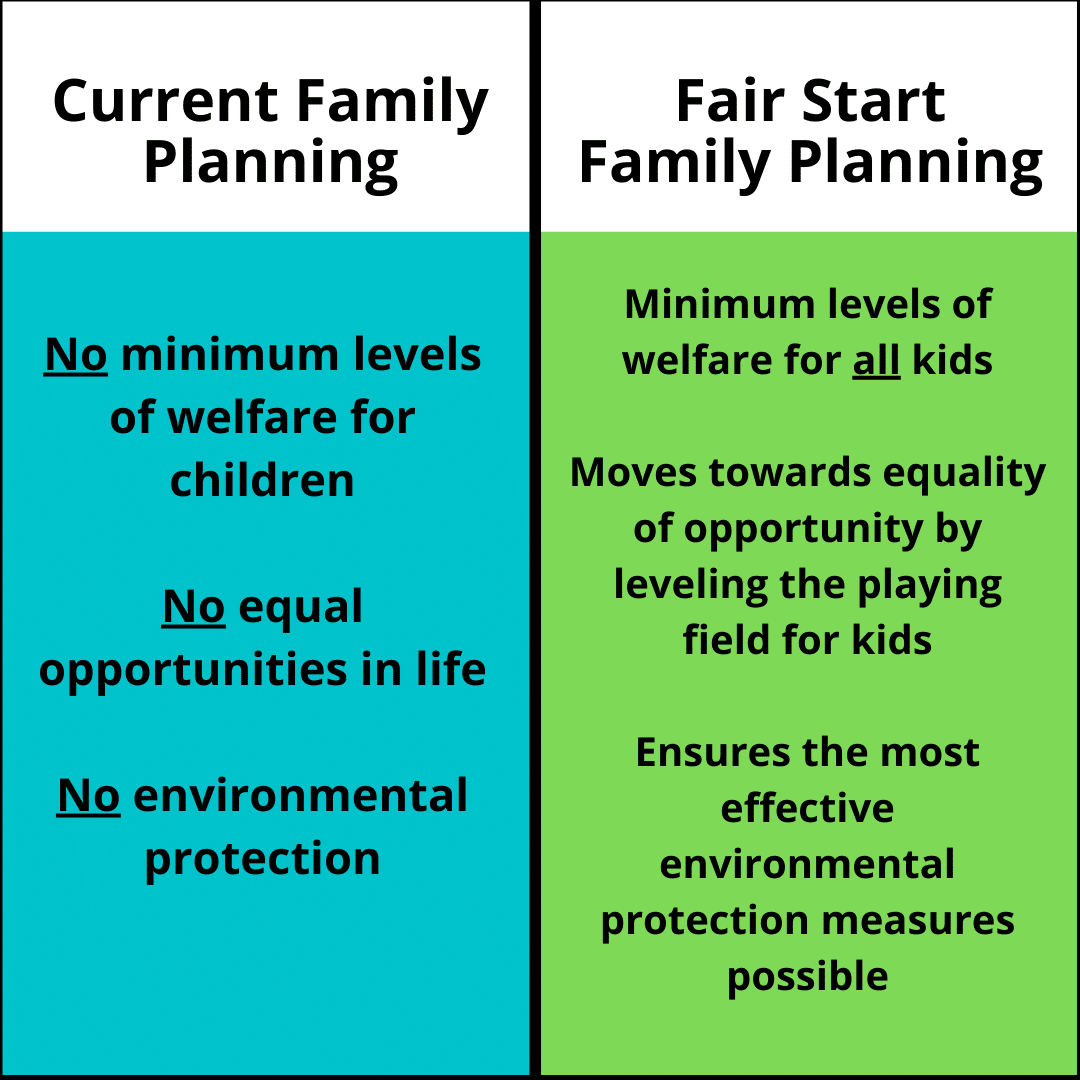
    Family Planning info card


    When Lies Disguised Themselves as Science

    False ideas about race were once presented as “science” to justify slavery, colonialism, and segregation. These ideas were never truth; they were tools of control. Yet they shaped laws, institutions, and attitudes that harmed generations.

    Controlled Information

    Education, media, and political systems shape how people understand the world. When these systems carry bias, they can normalize inequality and hide injustice. Over time, repeated narratives can feel like truth, even when they are not.

    Blaming the Oppressed

    Inequality is often explained as personal failure rather than the result of historical and structural barriers. Poverty, exclusion, and limited opportunity are blamed on individuals instead of systems that created unfair conditions. This shifts responsibility away from injustice and delays real change.


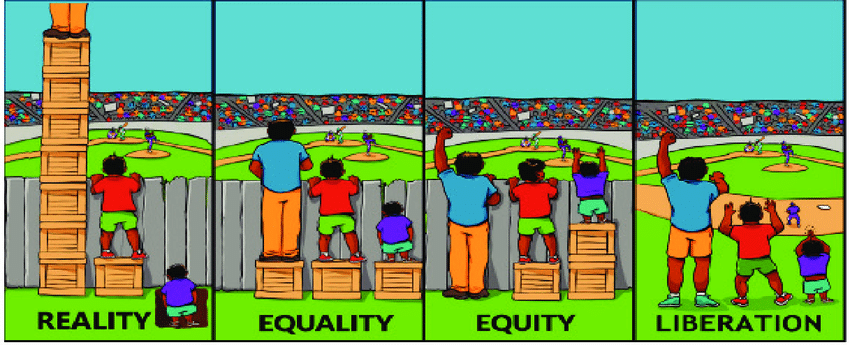
    Reality, equality, equity, and liberation


    The Human Cost

    Distorted truth has lasting consequences:
    Inequality in education, health, wealth, and justice
    Loss of dignity, identity, and recognition
    Division, mistrust, and social tension
    Generations growing up with limited opportunity
    Injustice does not only harm those directly affected; it weakens society as a whole.

    A Path Toward Justice and Liberation

    Liberation is not about replacing one form of dominance with another. It is about building a world where every human being has equal dignity, voice, and opportunity.

    Telling the Truth

    Healing begins when societies confront history honestly, acknowledge harm, and listen to voices long ignored.

    Learning and Critical Thinking

    Education that includes diverse histories and challenges stereotypes helps people see beyond myths and recognize our shared humanity.

    Building Fair Systems

    Justice requires institutions and laws that protect everyone equally and actively resist discrimination.


    Inequality info graphic

    Creating Real Opportunity

    Equity grows when people have fair access to resources and opportunity, so history no longer determines a person’s future.
    Letting People Speak for Themselves
    Communities must have space to tell their own stories and participate in decisions that shape their lives.

    Choosing Solidarity Over Division

    Progress happens when people stand together against injustice, recognizing that humanity is shared not divided.

    Zahara Nabakooza
    Leader Truth Alliance

  • To Those Who Care, and to Those Who Decide: Words of Truth from Hugo Valdes-Vera

    To Those Who Care, and to Those Who Decide: Words of Truth from Hugo Valdes-Vera

    To those who care, and to those who decide,

    Like many working in environmental and human rights spaces, I long assumed that population, environment, and equity were being addressed through separate but adequate channels. I did not understand until much later that birth equity itself had been systematically excluded from impact frameworks, despite its direct implications for children, ecosystems, & animals.  

    But…..

    There is a particular kind of exhaustion that comes with being an environmentalist without money, without power, and without institutional support. It is the exhaustion of seeing, clearly and constantly, how much could be done—and how little is allowed to happen. It is knowing that solutions exist, that communities are willing, that the science is sound, and yet watching progress stall because it is deemed unprofitable, inconvenient, or misaligned with short-term interests.


    A young girl gently holds a yellow chick in her hands while smiling, with a blurred green background suggesting a sunny outdoor setting.


    Environmentalism, in this context, becomes an act of persistence rather than progress. It is built on unpaid labor, emotional resilience, and the quiet hope that speaking up still matters. Many who care deeply about the planet are left to volunteer their time, fund their own initiatives, and absorb disappointment as a routine cost of conscience. Passion is expected to replace funding. Moral urgency is expected to substitute for real support. And still, we are told to do more.

    At the same time, we must confront a deeper injustice that shapes not only environmental outcomes, but the future of humanity itself: the radical inequality of life possibilities for children.

    A child’s chances of contributing to a better world are not distributed equally. They are shaped by the neighborhood they are born into, the color of their skin, the social circles that surround them, the quality of their education, and the financial security of their family. Some children grow up with access to mentors, resources, and platforms that amplify their ideas. Others grow up fighting simply to survive—forced to trade curiosity for caution, and long-term dreams for immediate needs.


    Family Planning info card


    When children from privileged backgrounds are raised in systems that normalize profit over people, growth over balance, and comfort over responsibility, they absorb these values as facts of life. If they learn—explicitly or implicitly—that wealth requires exploitation, that environmental damage is an acceptable side effect, and that the suffering of other children is simply part of how the world works, then this worldview hardens into normality.

    These children will grow up to be the decision-makers of tomorrow: lawmakers, executives, investors, and leaders of multinational corporations. They will direct the systems that shape our planet’s future. And if they have been taught that inequality is natural, that environmental sacrifice zones are unavoidable, and that entire communities can be left behind without consequence, how can we reasonably expect them to imagine a world that works for everyone?

    How can we expect them to design policies for a planet they were never taught to share?

     Meanwhile, children from underprivileged backgrounds—often the ones most affected by environmental destruction—are systematically excluded from the very spaces where solutions are created. Their insights, born from lived experience, are dismissed. Their potential contributions are lost to cycles of poverty, discrimination, and underinvestment that repeat generation after generation.

    This is not just an environmental failure. It is a moral one.


    Reality, equality, equity, and liberation


    A sustainable future cannot be built by a narrow segment of society making decisions in isolation from those who bear the greatest consequences. A livable planet requires not only clean energy and conservation, but equity, imagination, and empathy—qualities that must be cultivated early, across all backgrounds.

    If we want a better world, we must stop treating environmentalism as a luxury hobby and start treating it as a collective responsibility. We must fund it. We must protect it. And we must ensure that children—regardless of race, class, or geography—are given the tools to participate meaningfully in shaping the future.

    Because a planet designed only by the privileged will never be a planet that works for everyone.

    And because hope, without justice, is not a strategy—it is a delay.

    Sincerely,

     Someone who knows how much more we could do

  • The Founding Story of Truth Alliance, by Zahara Nabakooza

    The Founding Story of Truth Alliance, by Zahara Nabakooza

    By Zahara Nabakooza

    The idea for Truth Alliance began during a women’s dialogue in Uganda, when I asked a question that has guided me ever since: “If we don’t tell our truth, who will?”

    That question came from witnessing years of injustice, where fear, politics, and greed silenced ordinary people, especially women and children. I saw how truth was often buried to protect privilege, while the poor paid the price. Alongside women’s care groups in Uganda we were tired, we knew it was time to break the silence.

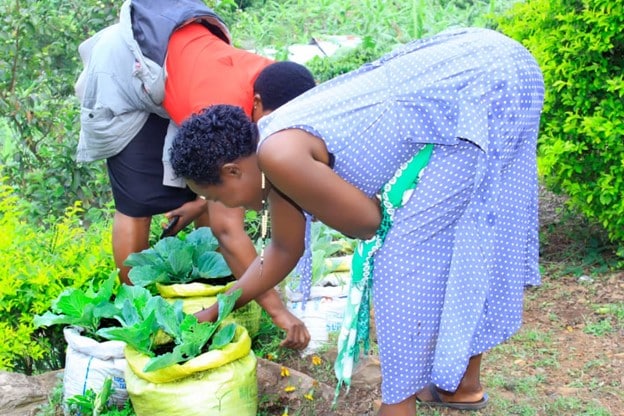
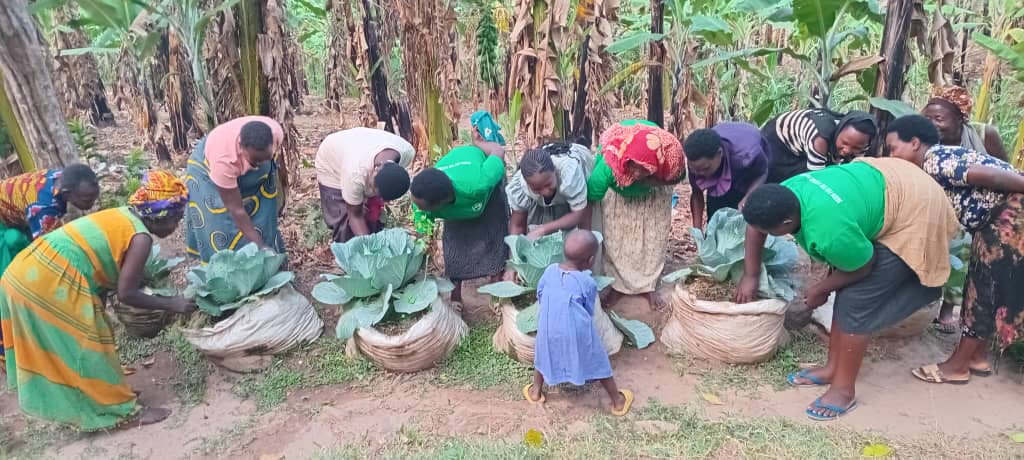
    People planting vegetables


    I understood that injustice is not only gendered but also racial and economic. Staying silent protects privilege; speaking out can heal, empower, and transform communities. I realized that real change could not come from the top down; it had to rise from the ground, from women in villages, from our children, from youth in the streets and from communities ready to speak and act with courage

    From that conviction, Truth Alliance was born. The name reflects our core values: “Truth” for honesty and moral courage, and “Alliance” for unity and collective action.

    Today, Truth Alliance continues to grow as a decentralized, women-led movement connecting local struggles to global justice, amplifying silenced voices, and standing for fairness, dignity, and the right of every person to live in truth.

  • The Culture That Fed Freedom, by Mwesigye Robert

    The Culture That Fed Freedom, by Mwesigye Robert

    Before the white man’s footprints darkened our soil, before land was fenced and ownership written on paper, our people lived in a democracy of trust, a circle of life where every hand fed the other and every decision served the whole community.

    I come from western Uganda, those days, the women care groups were the beating heart of the homestead. They didn’t hold titles or offices, yet they ruled the rhythm of the seasons.

    They knew which seeds would call the rain, which herbs would heal hunger, and which trees would guard the wells. Their wisdom was our wealth.


    People planting vegetables

    We never spoke of food insecurity because food was shared, not sold.

    We didn’t fear drought because we protected the trees, the springs, and the sacred rhythm between work and rest. We didn’t know inequality because every woman’s hands shaped the home, and every man’s strength served the family. In those days, democracy wasn’t written in books; it lived in our hearts. Elders met under the great local tree not to rule, but to reason. Families decided together about planting, marriage, and birth guided by values that put life before wealth.

    The Family before Destruction

    Our families were nuclear in structure but extended in spirit.
    A man, a woman, their children yet the village raised them all.
    A child belonged not just to the womb, but to the clan.

    What outsiders now call family planning was once part of our wisdom. The elders taught that a home should grow only as far as the land and love could sustain. Women gathered under banana groves, grandmothers, mothers, and daughters to share herbs, stories, and counsel on how to care for both body and earth.

    A group of students in uniforms stand in a line next to a lush cabbage garden, each holding a small item, with trees and a building visible in the background.


    Then came the colonial shadow.

    Foreign rulers broke our granaries, fenced our wells, and called our rivers “property.”
    They mocked our ways, dismissed the voices of women, and tore apart the balance that held us together. They brought hunger not of the stomach alone, but of spirit. A hunger for land, power, and things that could never fill the soul.

     Reclaiming the Roots

    Today, our women care groups are rising again.
    They are planting kitchen gardens, restoring indigenous seeds, and teaching young girls their worth. They are rebuilding what was broken the bond between people and land, family and democracy, nature and justice.


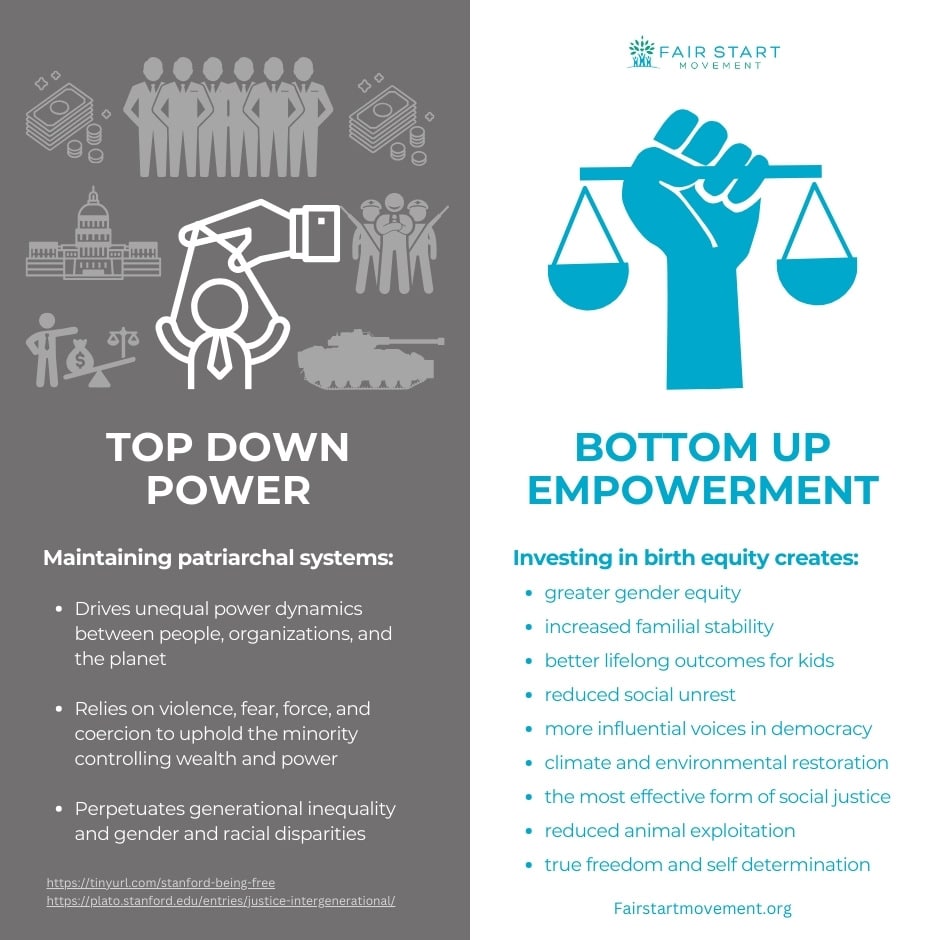
    Top Down Power and Bottom Up Empowerment infographic

    We say again:

    “Culture is not backward, it is the foundation of freedom.”

    True development is not when a few grow rich, but when every family eats, drinks, and decides together.

    Our ancestors taught that water, food, and justice breathe as one. Without them, no democracy can survive, no woman can lead, and no child can dream.

    If we heal the land, we heal our people.
    If we honor our women, we restore the home.
    If we return to our culture, we will be free again from food insecurity, drought, inequality, and water scarcity.

    Family Planning info card

  • Fair Start Lead Zahara Nabakooza Calls for Action

    Fair Start Lead Zahara Nabakooza Calls for Action

    Fair Start Lead Zahara Nabakooza Calls for Action
    “I’m offering 2 hours every day to volunteering in sharing to my networks and ask them to admit and donate to equity and climate reparations to the global south (Africa and India).”
    Zahara says this:
    Children are being failed before they are even born. Policies driven by economic and political interests—not child well-being—have trapped millions in poverty, conflict, and environmental disaster. The Global South, including India, bears the brunt of this injustice, while wealthy nations continue to exploit resources and ignore their responsibility.
    We must confront the truth: Injustice starts at birth.
    Millions of children are born into extreme poverty, denied healthcare, education, and basic security.
    The climate crisis, fueled by wealthy nations, is stealing their futures—worsening hunger, displacement,
    and disease.
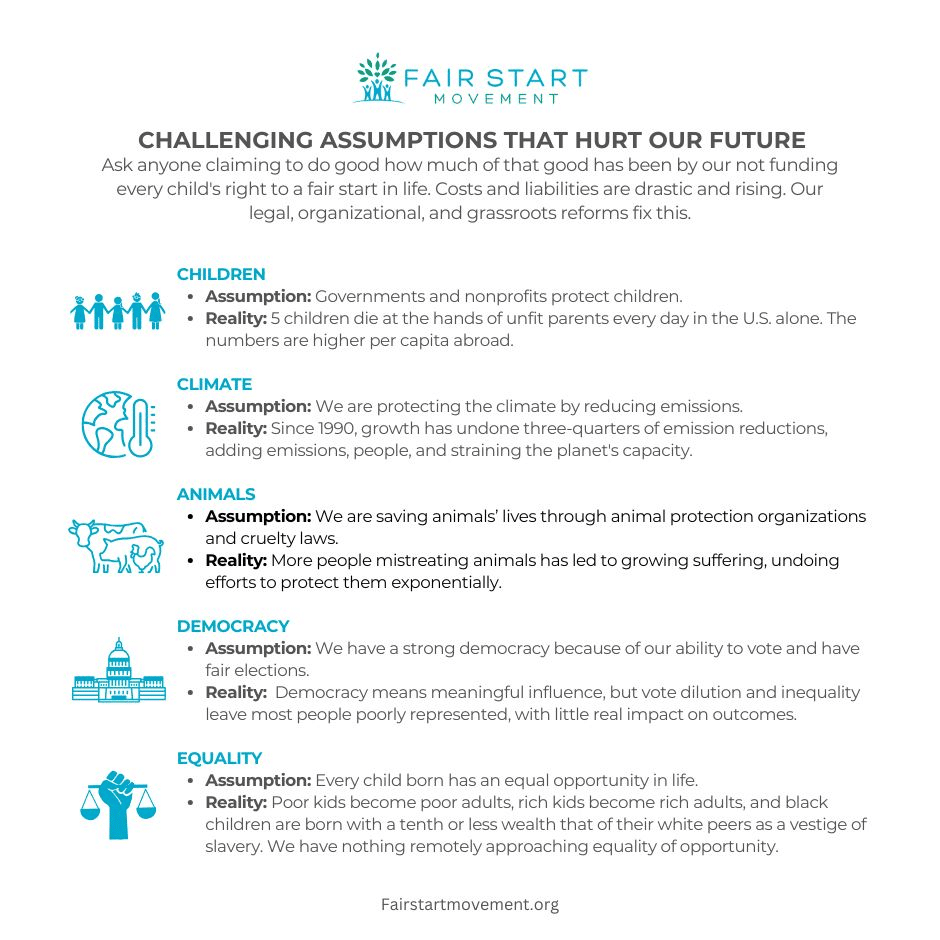
    Challenging assumptions that hurt our future infographic
    Reproductive policies have focused on reducing fertility rates instead of creating an enabling environment for informed reproductive choices and child well-being.
    The Solution: A Fair Start for Every Child
    Reproductive policies must center child rights—ensuring that every child is born into conditions that allow them to thrive. A key strategy is delayed fertility, which gives families the power to plan and prepare, ensuring children are born into security, with access to healthcare, education, and opportunity.
    Our Demands:
    ✔ Recognize past failures and shift from reducing fertility rates to creating enabling environment children wellbeing
    ✔ Integrate child rights into reproductive policies to guarantee fairness from birth.
    ✔ Make delayed fertility a global priority to break cycles of poverty and inequality.
    ✔ Redirect global wealth to secure healthcare, education, and protection for children in marginalized communities.
    ✔ Hold world leaders accountable—no more empty promises, only action.
    Top Down Power and Bottom Up Empowerment infographic
    📢 Global leaders must commit to child-centered reproductive policies at CSW69.
    📢 Governments must fund fair start policies that put children before profit.
    📢 The UN must publicly acknowledge its failure to prioritize child rights.
    Support this fight for justice, equality, and sustainability. Every delay costs lives. Every broken promise fuels injustice. Every action today changes a child’s future.
    Please consider making a contribution through Donate. Together, we can create lasting change to save next generation.
    A split infographic compares Current Family Planning with Fair Start Family Planning, listing differences in welfare, equality, and environmental protection for children, while highlighting how practices like legitimacywashing can undermine genuine progress.
  • Mwesigye Robert and Carter Dillard on Climate Liability

    Between 2000-2020 attorney Carter Dillard admitted omitting facts regarding how insufficient child welfare policy reversed the claimed impacts of many governments and organizations, exacerbating harm to many children and women in western Uganda.

    This harm can be measured by at least eight metrics that comprise self-determination, the value wealthy used to evade environmental regulation, taxes, birth and development conditions, and all else that caused the climate crisis and growing #deathdebt.

    The metrics are detailed here, but discussed more below.

    These are metrics.

    1. Minimum level of Welfare: Deliberately violating the children’s welfare from Uganda, resulting in climate crisis conditions that created conditions supporting Malaria transmission and causing the deaths of more children. Many in high emission and wealthy nations pushed for more babies there, to “expand labor markets” as many have said and to increase demand for resources already at the brink of deadly elimination. 
    2. Equity: Inequality in the U.S. and here increased the risk of children suffering from the climate crisis differently, it was driven by millionaires and billionaires in USA who are making more money on investments based on green washing and growthwashing that contributed more greenhouse and carbon emission and these impacted the climate change differently where alteration in the climate that favored malaria and Judith a vulnerable to this error end up suffering from malaria and eventually dies from Malaria.
    3. Environment: Climate conditions in Uganda favors communicable diseases like Malaria. And there’s inadequate protection from those communicable diseases and therefore causing more deaths among children, as many in the U.S. drove policies that created more growth and more harm so they could benefit from it. 
    4. Human rights and Democracy: Global North policy makers undermined because they were growth in rich people as civilization and controlling a lot of more people and hence the concentration of power under global north policy makers and later degrading voice of voiceless people from global south and avoiding the democratic/decentralization system in approaching the climate crisis and not prioritizing human rights in responding to the crisis.
    5. Right to Continuity: Parents’ right to continue their lives through their children is being harmed. Children from the global south have suffered disruption in health care systems – and a failure in addressing climate crisis harms. Instead, many in the U.S. are born rich and never having to work, because of the cost externalization that killed Judith.
    6. Efficiency: Not admitting that accumulating wealth on the losing the wealth of the global south hence not serving human needs by using resources most productively and sustainably throughout their life cycles, generally minimizing the funds involved in efficiency. Carter has said he was told by many wealthy they would not be here in the future and their kids would have money, as a reason for these things.
    7. Trust: Degrading trust during the climate crisis. The wealthy are affected differently, and poor people have been less valued in bringing positive change in climate change. Wealthy worlds have mistrust and thinking there are the only one to save next generation using centralized system and modified technology in restoring climate crisis and negative climate crisis are seen in global south. Seeds work asks – Why should we trust others if we never ensured their development? Why should they treat us well if we did not treat them well? Investment in children and women is the primary obligation in responding to climate crisis and Frontline communities under more climate crisis and its impacts. Decentralization system the only form of freedom and self-determination.
    8. Self-determination: The global north showed themselves as supremacy in deciding how climate crisis can be responded to, leading to the denial of equity and accessibility to full determination (the right of every people to choose the sovereign under which they live) of parents of Judith to make decision when to produce children.

    This destabilized the standard of climate restoration civilization. Then Rejoice Africa Foundation emerged as savior of next generation and determined to use Afrocentric model (women Care groups) this is tempting to use decentralization in investing in women and children and giving all rights to marginalized communities. It’s based on economic and climate apartheid because of the actions of the richest from the global north and connects the global power divide with economics, highlighting another key aspect of elf–determination.

    Carter Dillard failed to observe this in his work and remained depending on causing harm to marginalized population, contributing death of Judith and others from Malaria and other climate driven caused. More recently he and others have tried to create reform but they still benefit at harm to others, and many organizations do the same – ignoring metrics of self-determination, even against their own mission. 

    Parents of Judith should have given all eight metrics of life in responding to climate restoration and should have opened a savings account to saving for Judith. Judith would have money for health and their continuity of her life.

    Please consider making a contribution through Donate. Together, we can create lasting change to save next generation

  • Nour Belokda Speaks Out

    Nour Belokda Speaks Out

    Nour Belokda works as Fair Start activist in Washington, D.C.

    According to Nour: 

    As a feminist and female lobbyist from the Middle East living in Washington, D.C., I urge our lawmakers to seize the opportunity for our city to become a leader in implementing the United Nations’ standards on gender equality, child development, and climate resilience. D.C. is in a unique position to serve as a model for transformative policies that empower women and enhance the well-being of children.


    By linking debt savings accounts to every child’s birth and increasing support for family planning services, we can equip mothers, especially those from marginalized backgrounds, with the resources they need to create nurturing environments. These initiatives not only support emotional and cognitive development but also foster a more equitable society.


    The traumatic experience of my brother, who was attacked with acid, highlights the urgent need for comprehensive policies that confront the roots of violence and promote social justice. Such brutal acts often stem from individuals who have been raised without proper guidance and support. As a female lobbyist, I know firsthand the power of legislation to create meaningful change.


    By championing policies that protect women’s rights and children’s futures, we can cultivate a culture of empathy and responsibility in our communities. D.C. has the opportunity to embed these UN standards into our legislative framework, ensuring that every child can thrive in a safe and supportive environment. It is essential for our leaders to act decisively and invest in a future marked by equity, compassion, and a collective commitment to social justice for all.


    Infographic from Fair Start Movement detailing how funding every child’s right to a fair start benefits children, climate, animals, democracy, and equality—with brief descriptions and relevant icons for each topic—while highlighting the need to avoid practices like legitimacywashing that can undermine genuine progress.


    Why It Matters? 

    Funding that ensures no child is born beneath a set level of entitlement, consistent with the Children’s Rights Convention and Right to a Healthy Environment, is exponentially the most just and effective way to protect our future and free all of us. The creation of power relations is often the biggest driver of social justice outcomes because it operates on many levels, simultaneously. 

    We can ensure that funding by using the extreme wealth in the world today that was made by not paying the costs of avoiding climate, autocratic and other harms to future generations. The legitimate and reparative standard – being fair – will save millions of lives, and trillions of dollars. 

    However there are entities now funding charities, media, politicians and academics who silo social justice issues away from birth equity, and use omissive messaging – entitlement and impact  fraud – that hides their liability and the entitlement systems ensuring the death of millions as the climate crisis accelerates. As described below Fair Start is urging officials to contrast the claims of beneficial public impact being made by these entities and those they fund with actual harms to women and infants – correctly measured relative to a neutral position rather than the fictitious standards that created the climate and related crises  – as these things accelerate. 

    Fact: When impacts are correctly measured, not prioritizing a measurably fair start in life for all children did exponentially more harm to most stated missions of organizations than those organizations did good. In many cases they will have spent more on lavish travel and events, or other incidentals, than actually furthering their mission. Not first constituting systems of legitimate governance capable of representing constituents by ensuring all kids a threshold of intergenerational justice – the influential equity stake in their democracies that is their first birthright – has condemned millions to do in a climate crisis, while the children of the wealthy families who benefited from the illegitimacy have been enriched.

    Despite the interference, many have already begun to engage in this more effective form of constituting a just future – through language and action – by admitting the failure of systems to date, agreeing to change the way be plan families, and exchanging resources. This transfer of wealth made at deadly costs is also required by law. All law must first be interpreted to assure legitimacy, or the measurable inclusion and empowerment of those subject to it, so that truly representative governance is possible. In other words, the threshold or border, of empowering development, overrides the authority represented by national borders because it is needed to legitimate such law.


    Infographic comparing Top Down Power vs. Bottom Up Empowerment for birth equity, listing social impacts of each approach—including potential risks like legitimacywashing when using top-down strategies. Includes icons of people, scales, graduation cap, and supportive hands.


    But there are specific barriers blocking this work.

    There are many wealthy families and other concentrations of power in those nations most responsible for the climate crisis who benefitted from unsustainable reproductive rights models. These models used a false premise (that having children is more personal than interpersonal) to avoid the overriding need to ensure measurable empowerment of each citizen, or to first account for our vast generational, racial and other inequitable positionalities in reforming legal systems. 

    This hid the overriding nature of the upstream creation of power relations behind the downstream subject area of population, and conflated a false view of  bodily autonomy, one based on inequity and a capacity to harm others, with true autonomy or measurable self-determination through positioning in one’s democracy.

    The former would enable a woman to terminate her pregnancy only to die months later in a heat wave because she was born with the inherited wealth inequity that comes with being black, could not afford air conditioning, and had little influence over her political system to challenge all of that.  

    Neither business nor government has been historically tasked with defining the ideals of social justice. The wealthy families behind philanthropy generally did that, and by individualizing the idea of reproductive autonomy to isolate women, evade child equity, and ensure unsustainable growth, they created a false reference point for self-determination that triggered a climate crisis killing millions of children of color while enriching their own kids.

    This created a fictitious baseline for cost and benefit analysis and national legitimacy, one that has fundamentally driven the climate crisis by exploiting rather than including and measurable empowering, children as they entered the world. The claims of public benefit that arise from it maintain a fantasy world that enriches mostly white children at deadly cost to millions of children of color. 

    This baseline has subverted the civil rights and anti-apartheid movements by undoing with family inequity upstream the good these families claimed to be doing downstream – a move that exponentially catalyzed the climate and related crises, while aiming the harm of the crises towards the least responsible for it, and most vulnerable to it. If the Three-Fifths Compromise in U.S. history fractionalized the worth of persons of color, the one-tenth and greater illegal disparities in generational wealth that violate legally enforceable children’s rights regimes will now mean the death of millions of children of color in a climate crisis caused primarily by white wealth.


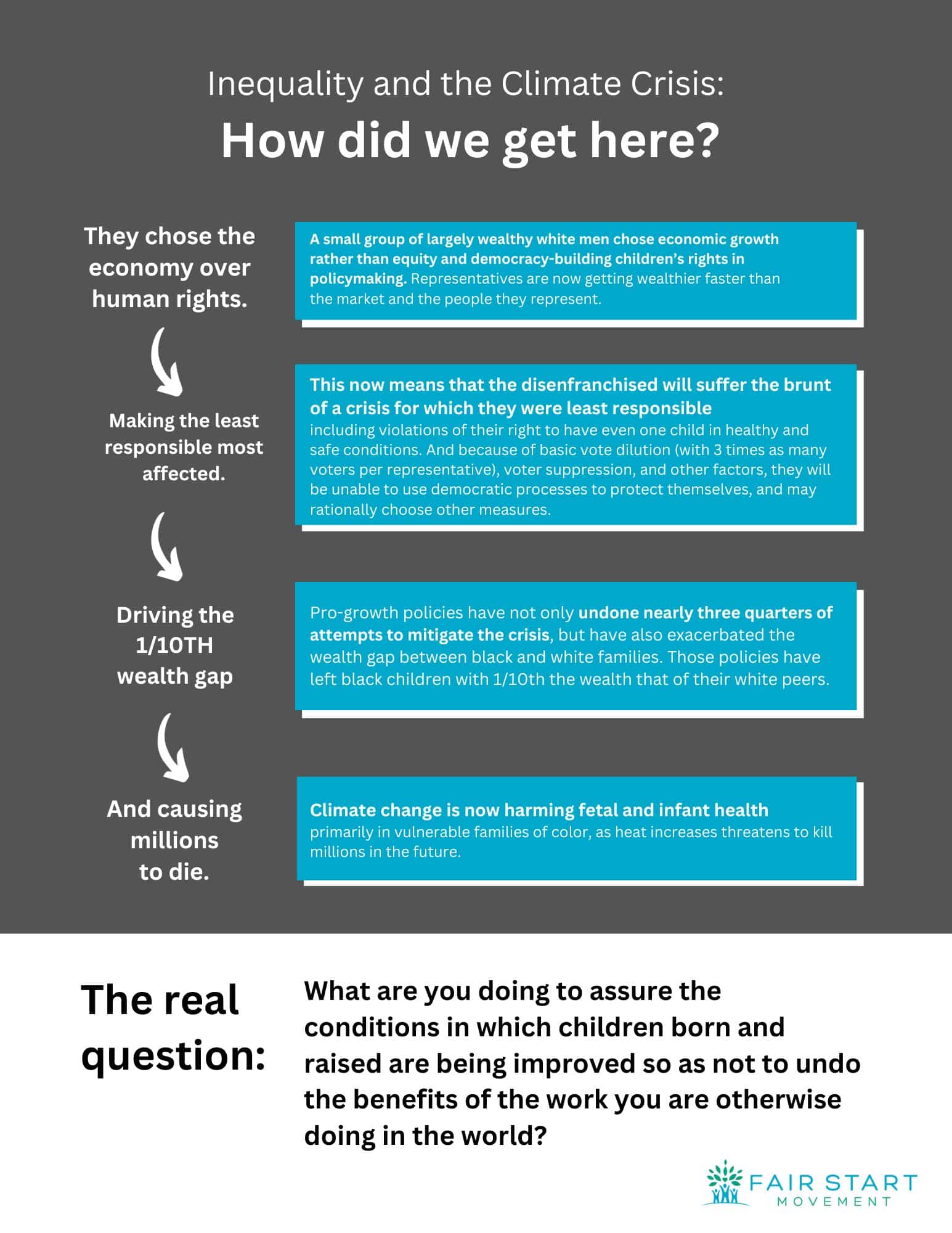
    Infographic titled Inequality and the Climate Crisis: How did we get here? with text blocks explaining causes like prioritizing economy over rights, disenfranchisement, ignoring the 1/10th wealth gap, and impacts on families. It also highlights how practices such as legitimacywashing contribute to the problem by masking systemic failures under a veneer of responsibility.


    These unsustainable practices and systems ensured children entering under just thresholds, and thus overshoot of ecological carrying capacities, the degradation of those capacities, and the disempowerment of the average person to respond to the ensuing crises. They allowed wealthy white families to amass wealth, at illegal and deadly cost to generations of black families. 

    These wealthy families and other entities are now funding charities, media, politicians and academics who silo social justice issues away from birth equity, and use omissive messaging – a form of entitlement and impact, or equity, fraud –  that hides their liability as well as illegal macro entitlement systems ensuring the death of millions as the climate crisis accelerates. They are obvious because they start by enabling the industries they claim to fight.

    Ensuring Justice for All

    Fair Start is now urging states attorneys generals and other responsible agencies to 1) track the multifaceted impacts of infants entering the world in the U.S. and abroad on their and their mothers’ capacity for self-determination – the highest standard for evaluation, using concrete metrics urged as the zero-baseline form of harm-assessment standardization at the United Nations. 

    We are asking these and other officials to then 2) contrast these impacts with current and historic (ten years back, as a minimum but in many cases with disclosures needed to 2003) sustainability, equity and other public benefit claims, and the use of fundamentally unsustainable and fraudulent family entitlements, used by prominent leaders and organizations within their jurisdictions. This tracking enables preemptive reparations, structured to prevent harm to future generations and to ensure their right to self-determine.


    How Do You Destroy a Planet's Atmosphere? Tell Lies. Fair Start Certification Tells the Truth Infographic


    Simply put, we are asking officials to assess public benefit impact claims from the accurate baseline for self-determination, relative to real world markers, rather than from the fictitious baseline that assumes black lives are worth less and uses omission to hide white wealth as a driver of the deaths of countless children of color. 

    This fraudulent standard of entitlement, impact, and legitimacy allows many to benefit at deadly cost to others by claiming beneficial public impacts that are actually being undone each day.   

    What are the metrics and moves, exemplified in action here?

    • Funding would-be mothers delay, readiness and safe locating so that no child is born beneath a concrete line of what their rights guarantee them, without abuse or neglect, and what trust-based (democratic) communities require. Read more here.
    • Restoring, not mitigating, climate emissions to natural levels. Read more here. 
    • Taking the exact resources needed to ensure equality of opportunity for children of color, competitive with white kids. Read more here. 
    • Conditioning political and economic authority on their moving towards truly representative ratios between officials and their constituents, and recognizing the need for those in positions of influence to carry the risk of any violence not doing so creates. Read more here.
    •  Benchmarking efficiency to equity measures around the high capacity for humans through equitable development and empowerment, rather than the exploitation that created a climate crisis killing millions of innocents. Read more here. 

    Equity Fraud 

    The failed models have used a fictitious baseline and false premise that hid the upstream antecedent language that entailed the creation of power relations, often behind downstream subjects like population, environment, animal rights, human rights, etc. To constitute, as in national constitutions, means to be obligated. Our debt to children is a chance to actually constitute a just society. This moves from the bottom upwards – governance contingent on the measurable emancipation of youth – not inherently authorized top down.

    The families and concentrations of wealth and power driving the fundamentally unfair systems never really created value, relative to an objective standard like a healthy climate. Instead they first used poor family planning to create their own audiences and artificial demand by treating children as means rather than ends, ensuring dismal standards for child development, education and critical thinking. This slowly converted democratic relations into commercial ones. 

    This violated children’s rights by treating people as economic inputs rather than citizens, and in systems where the average vote was actually being diluted to uselessness, while wealthier families benefited from the appearance of inclusive and functional democracies. A system of fundamental entitlements likely to – through unsustainable growth – kill millions of innocent persons is generally considered a value failure. 


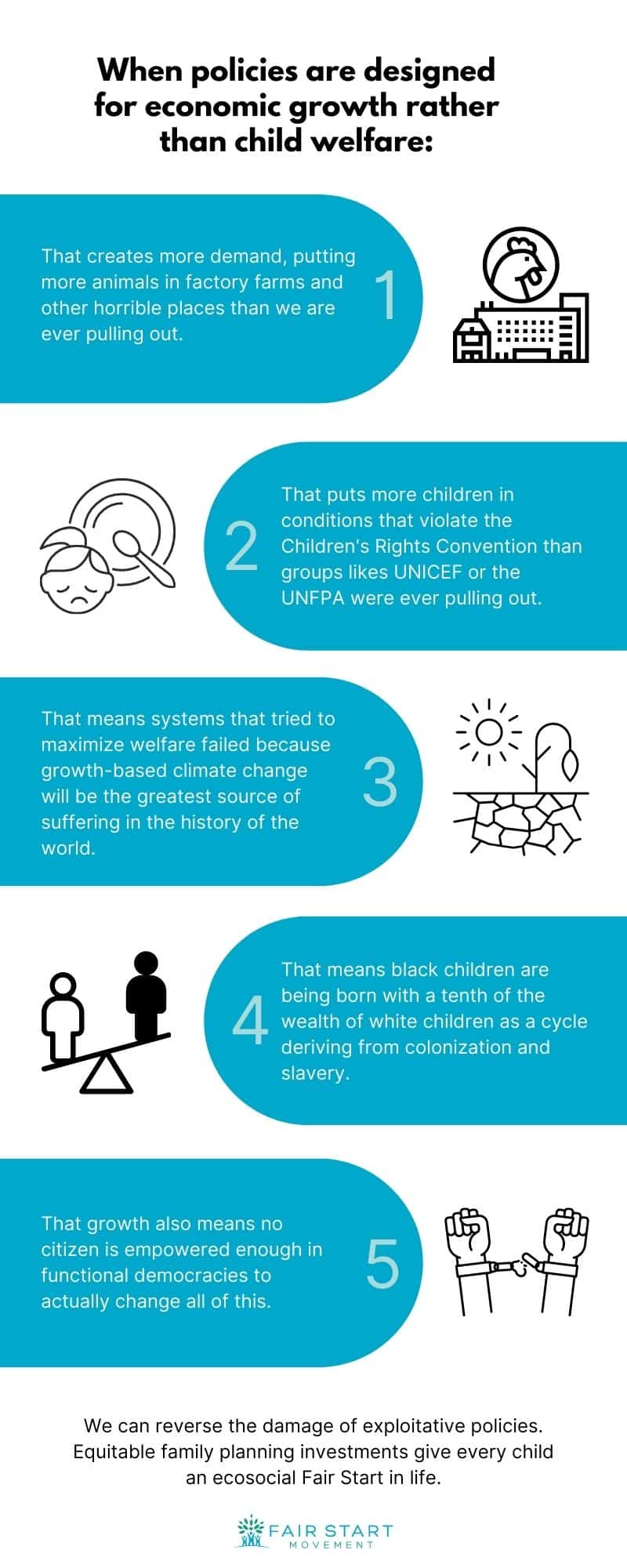
    Climate crisis infographic


    Activists now with the Fair Start Movement, in prior employment, had to omit facts that would have shown public interest information and interventions being vastly undone by growth and inequity. This was a charade of environmental sustainability and social justice that is still today being vastly undone every day as children enter the world without the resources they need. 

    Under the fraudulent entitlement scheme there are two standards for justice: The real or what should have been, measured at a zero baseline using concrete markers for assessing equity, and self versus other determination. There was also the widely used decoy standard, which centered on assumed legitimacy of white wealth supremacy at birth, and an illusion of bodily autonomy that conflated freedom with the capacity to harm others. 

    Those who use the latter are choosing that the least responsible for the climate crisis suffer its greatest cost, with no justification, increasing climate deaths by millions and costs by trillions. 

    The Fundamental Fix 

    However, the disparity between what we think and say, and the reality of what we do to children and animals relative to objective measures, opens a doorway to legitimacy and freedom. 

    Again, to constitute, as in national constitutions, means to be obligated. Our debt to children is a chance to actually constitute a just society, and from the base, rather than under the standards of those who act as if they are above us. Covering these child development costs as an obligation liberates more than oppresses. 

    But this true control of who has influence over us requires measuring from zero. And that would be impossible without the admission of the specific harm we have caused and the changing of our obligation from those in power instead towards infants and animals. We thus ask all to admit benefit at deadly cost to others, and to back reparations. 

    Where else would liberating / obligatory relations come from? As shown above this “truth and reconciliation” process of removing birth apartheid requires reprioritizing wealth to incentivize and entitle would-be mothers so that no child is born beneath a measurable threshold of self-determination. 

    It is physically impossible to be free, as in self-determining, if we cannot ask and then assure that persons are created, developed and emaciated in ways that offset equally their capacity to influence political systems equally, relative to a neutral position or objective standard for evaluation. Those entering the world are either not empowered, or we all have no choice but to be subjected to their power and influence – including the degradation of the environment around us. We should instead empower the governed, not the government and the wealthy. And it’s very hard to change a future child’s prospects once they are born, so justice should focus on thresholds beneath which children should not be born. 

    Instead of funding those thresholds, those engaged in equity fraud have continued to assume exponential (and very deadly) wealth and resilience disparities are natural – that their and their children’s birthright privileges are just a given – when calculating things like permissible climate emissions.


    Urge Peter Singer to Tell the Truth about Animal Liberation, and Save Lives Infographic


    Fair Start’s action before the United Nations enables liberation from this nonsense. It simply asks anyone relying on any legal authority to derive back to the most preemptive source of legitimacy, an exercise that inevitably ends with the need to prioritize entitlements that would measurably empower all children through improved birth and development conditions, ensuring them a fair start in life and share equity in democracy. 

    Every entity in the United States should be forced to comply with civil rights laws prohibiting discrimination in hiring, housing, education, etc. But not extending protections to infants who would suffer the consequences of historic injustice – maintaining the separate but equal doctrine there – was a horrific mistake. It seeded in our brains the idea that our birth and developmental positionality was organic, rather than the result of illegitimate policy and that creation was simply art of something humans do rather than a matter of fundamental legitimacy.  

    But it is one that we can fix with universally preemptive standards for fair starts in life. Antiracism requires removing a system of birth entitlements where children of color get a tenth or less of the wealth as white kids, are largely excluded from the political system, and bear the deadly cost of an ecocide they did not create. If those Fair Start engages truly  value the things they took credit for protecting, they will be eager to now cover the costs to others of not having previously included the value in our basic systems of obligation, and to include the things they claim to value as we constitute relations going forward.

    Please consider making a contribution through Donate. Together, we can create lasting change to save next generation


  • The Mother of Animal Law on Fair Start as the Core of Protecting Animals

    The Mother of Animal Law on Fair Start as the Core of Protecting Animals

    Joyce Tischler is rightly regarded by many as key to the flourishing of modern animal law as an area of study, practice, and discipline.

    She has this to say about Fair Start, and the idea of getting ahead of the threats animals face by changing our basic family systems:

    “I have seen the projection that there will be approximately 9.8 billion human beings on Earth in 2050, followed by the question: how will we feed all of those people? That’s a simplistic question. If our planet is to remain habitable, we need to ask different questions, and develop family planning that limits or reduces the number of humans, in a thoughtful and compassionate way. Fair Start is asking the right questions and developing innovative answers.”