Category: Animal Rights

  • Save The Animals, Save The World

    Save The Animals, Save The World

    Save the Animals Save The World, was set up by Ryan Parker, a wildlife conservationist, wildlife presenter, safari guide and animal rescuer. With a love of the natural world, and being in the wild making more sense. My idea is that restoring wild areas, letting nature take its course, an ecological balance of evolutionary grand design.  But with a growing human population, fighting for resources, human population pushing the climate, more people pushed into poverty.  A person wearing a backpack and cap stands on a dirt path in a wooded area, holding out their hand to feed a young giraffe that is leaning forward to sniff or eat from their palm.

    More and more wildlife is coming into conflict with humans. Animals are not only fighting for wild areas, but also urban areas. We cannot blame the people who are trying to survive, and we cannot blame the animals. They are both the result of social inequalities. And why is this bad? 

    Once you start removing nature, a species, whether it be plant, fungi, or animal, from birds, to insects, spiders, to large mammals. Every species has an important role to play. Take that away, the ecosystem starts to fail, and this affects us humans. It affects crop growth, flooding, human health, disease control, and even climate, and so much. You just need to check out the benefits of rewilding wolves to Yellowstone national park, or Humpbacks returning in numbers, or the benefits of beavers returning to the U.K. The importance of parrots, or the importance of song birds, to the importance of elephants, or sharks. The list is endless. 

    A baby orca swims closely beside an adult orca in the ocean, with gentle waves surrounding them and sunlight reflecting off the water.

    So we need to teach people how to live alongside these amazing animals. How to coexistence. As most of the time, the funding from governments, large companies do not reach, the local people.  For me conservation is about uniting people. For conservation to work, to help the planet, we need to work together without discrimination. A brotherhood of man. 

    Two men stand side by side outdoors on a dirt area, both giving thumbs-up gestures. They are wearing hats and casual outdoor clothing. Green trees and clear blue sky are visible in the background.

    And me personally how do I do this? Through love! To give hope. My passion and excitement for the natural world! I love it with my heart, and I can get people excited about wildlife. As a safari guide, as wildlife presenter. If I can show what beauty we have on this planet, from wildlife to landscapes. I can make people fall in love with it and fight to save it.  This is why I make wildlife films, and take people on safari. I am a conservationist sales man here to save the world.  But also prove that people do not have to be a conservationist, know the difference between an alligator or crocodile, or be part of a rich organization. That everyone can make a difference, by simple things, that do not cost money, or spending in the right place if they do. By being kind! This is how! Myself I align myself to work with small grassroots NGO companies working for little money, that is dangerous, hard, with little support. Just like me, I struggle to pay my rent and pay to rescue animals. So I understand them.  These are the people that are making a difference! An inspiration. And any company that supports that same ethos, I will be happy to work with them, like I do supporting the Fair Start Movement! 

    Because if we can work together, to save animals, they will save the world!


    https://www.instagram.com/savetheanimalssavetheworld/

  • Is This About Animal Welfare or More?

    Is This About Animal Welfare or More?

    Child holding a duckWhat is becoming increasingly clear across the world is that this conversation is no longer limited to animal welfare alone.

    The questions now being raised around institutional transparency, impact representation and public accountability are appearing across public health, climate policy, child rights, sustainability and international governance. The deeper we look, the more we find the same structural issue repeating itself: institutions presenting outputs as evidence of meaningful progress, while failing to fully disclose the baseline conditions that continue driving harm underneath the surface.

    These concerns were further reinforced through an independent expert letter submitted by Pierrette, a public health and systems governance specialist whose work focuses on child rights, intergenerational accountability, equity policy and institutional integrity, including African Union–aligned work examining long-term social and structural outcomes.

    In his letter, Pierrette explains that across multiple sectors there is increasing concern around how institutions communicate public-benefit impact. In particular, the distinction between “program outputs” and genuine “net outcomes” is becoming central to modern standards of accountability and evidence integrity.

    And that distinction matters enormously.

    Because there is a major difference between reporting actions taken, campaigns launched or services delivered — versus proving that overall conditions genuinely improved once wider structural realities are taken into account.

    Pierrette’s letter does not seek to attack advocacy itself, nor undermine the importance of animal protection, social justice or public-interest work. Instead, it raises broader governance questions that institutions across the world are increasingly being forced to confront:

    Are public-facing impact claims being communicated with sufficient transparency?

    Are baseline assumptions clearly disclosed?

    Are modelling limitations openly acknowledged?

    And are institutions carefully distinguishing between measurable outputs and actual system-wide outcomes?

    These questions sit directly at the center of the current concerns surrounding the University of Denver’s animal law programming and associated public-facing advocacy efforts.

    At issue is whether institutional impact language may have implied meaningful net progress in animal protection without sufficiently disclosing the wider structural realities surrounding inequitable growth, systemic harm and the limitations of the underlying models being relied upon.

    The concern is not necessarily that individuals involved lacked good intentions. Many people working within these institutions genuinely want to create positive change. But intention alone cannot replace transparency.

    Because if suffering expands faster than interventions reduce it, then institutions have a responsibility to communicate those realities honestly.

    In his letter, Pierrette explains that across global health, sustainability and governance sectors, there is increasing emphasis on what is known as “evidence integrity” — ensuring that publicly communicated impact claims are analytically grounded, methodologically transparent and properly bounded by clear assumptions.

    This is becoming one of the defining issues of institutional trust in the modern world.

    From climate policy to child-rights work, systems experts are increasingly warning that when baseline conditions remain hidden or poorly disclosed, even well-intentioned advocacy can unintentionally create overstated narratives of progress. Programs may highlight outputs — cases supported, services delivered, campaigns launched — while larger structural conditions continue worsening overall outcomes in the background.

    We see this happening globally every day.

    Wildlife disappears while conservation campaigns raise millions. Forests shrink while sustainability reports celebrate incremental targets. Children continue suffering under systems that publicly market themselves as advancing social equity. Communities face hunger and instability while institutions produce carefully managed narratives designed to reassure stakeholders that progress is being made.

    Meanwhile, the planet itself continues absorbing the consequences.

    That is why this issue matters beyond any one university, campaign or organization.

    The deeper question is whether institutions operating in the public-interest space are willing to hold themselves to the same standard of transparency they often demand from governments and corporations.

    Because accountability cannot only exist outwardly.

    It must also exist inwardly.

    Pierrette’s letter ultimately calls for stronger methodological clarity, transparent baseline disclosure and more disciplined communication around institutional impact claims. Not to weaken advocacy, but to strengthen public trust in it.

    Because a world facing ecological collapse, inequality and growing social instability cannot afford narratives that outpace reality.

    People deserve clarity.

    Donors deserve informed understanding.

    Students deserve truthful institutional representations.

    And the public deserves confidence that organizations claiming to create change are willing to openly disclose both the successes and the limitations of what their programs are actually achieving.

    That is not anti-progress.

    That is the foundation of credible progress.

  • Fact Check: Harvard’s  Animal Law Professor Kristin Stilt Does More to Privilege Her Kids Than Benefit Animals.

    Fact Check: Harvard’s Animal Law Professor Kristin Stilt Does More to Privilege Her Kids Than Benefit Animals.

    Professors are influential, and when they make public benefit claims, they should do some from clear baselines, and in a way that does not hide inequitable and disenfranchising growth. Not dealing with baselines is evidence to support the Fair Start thesis: That wealth obtained by violating the rights of future children now drives public interest narratives and outcomes to hide and violate those rights.  

    *This critique is intentionally done outside of customary back and forth academic discourse. A constitutive discourse is more public, and rather than treating values like animal protection as abstract, it assesses the value and impact claims influential people make that fundamentally benefit them, through a system of illegitimate and disentrancing growth and birth positionality, at deadly cost to others and in contravention of academic neutrality. 

    Professor Kristin Stilt is Faculty Director of the Animal Law & Policy Program, Harvard Law School, and in leadership at the Brooks Institute for Animal Rights Law and Policy. 

    The Program’s website states it is: “Committed to analyzing and improving the treatment of animals through the legal system.”

    That statement is inaccurate. Stilt and the program use an illegal baselining and equity fraud standard that creates a fantasy world of benefit for animals that is undone, upstream, by inequitable and disenfranchising growth.

    Stilt’s work on the illusory concept of “rights of nature,” the benefits of which are undone by growth every day, is exemplary of her approach. Claims of using animals benefiting animals are the worst example of the Winners Take All phenomenon because animals are the most numerous category of vulnerable entities, and because claiming our current political inequity-based system of growth can benefit them are outlandish.


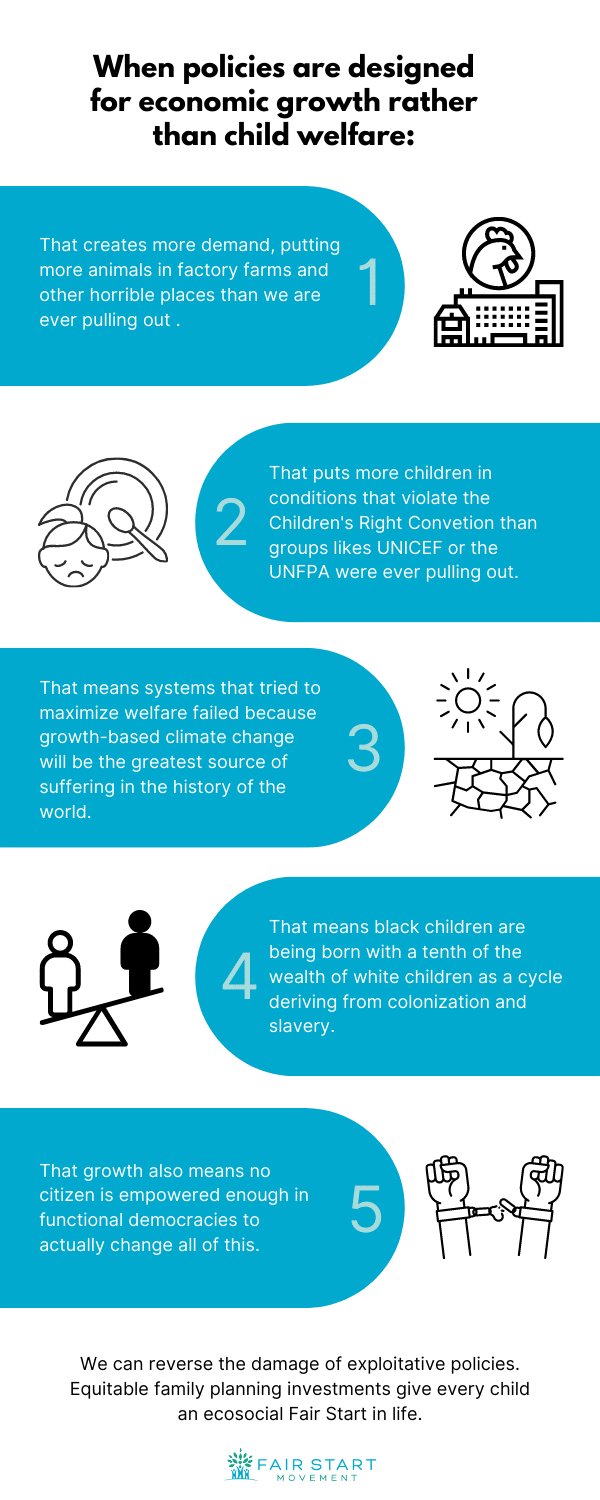
    Family Planning info card


    Fact: Inequitable growth that enriched mostly wealthy, white children at deadly cost to countless children of color did exponentially more harm to animals than the program ever did good. Use of that valuation and reporting model hides liability for the deaths of tens of millions as the climate crisis intensifies, and reflects the academic and public interest practice that ensured the polycrisis: Constantly moving goalposts away from the absolute infant-health-as-enfranchisement standard necessary for political legitimacy in order to falsely claim truth, or victories, and to thus raise funds.

    Relative to that harm, on many levels, our work was insignificant and thus performative – and in terms of the underlying business model – mimics Coca-Cola’s model of discounting future lives, especially lives of color, at exponential levels. 

    Fair Start and Truth Alliance will be taking legal action, in addition to our petition before the United Nations, to block the use of the standard by Harvard.

    Backgrounder on Equity Fraud 

    The fundamental unit of moral currency is the influence one has over the outcomes of their political system, or what is loosely understood as political equality / equity though common conceptions are incomplete. Other currencies, like welfare, cannot exist outside of systems of political and legal obligation or “oughtness” and the primacy of how people are positioned relative to others and Earth’s ecologies at birth. 

    This equity is consistent with an objective “one person, one equal and influential vote” (equal offsets of influence relative to zero) standard, empowering persons to limit the influence others have – including ecologically and socially – over them. This is also consistent with more collective systems of family planning in which no child is treated as worth more than another, an outcome ensured through a threshold or level of empowering birth and development conditions and relations outside of which no child should be born. 

    While world leaders after World War Two were obligated by the emerging human rights regime to use this standard as the fundamental baseline for governance, this was functionally blocked by use of the dominant “separate but equal” standard in universal reproductive rights regimes – in the birth and development-based creation of actual power relations. This system reversed the concept of freedom by treating the act of having children as more self-determinative of the parent than other-determinative of the children and the communities they would comprise – determining political equity for all in the process. 


    Inequality info graphic

    This physically disembedded persons from any effective role in their political systems. It also allowed those in power, both with political authority and entitlements to wealth defended by that authority, to avoid having to legitimate their power by actually, and measurably empowering those subject to it. Rather than seeing the creation of actual (relative to the legal baseline) empowering relations as the source of political authority, nations treated symbolic or representative instruments like treaties and constitutions as themselves authoritative. 

    While civil rights movements made headway in areas like housing, employment, and education, the notion of autonomy without equity amounted to the privatization of the creation of power relations, and the totally arbitrary basis for the concentration of extreme levels of generational white wealth – over the span of decades – that drives many of the outcomes we see today. That wealth never had to pay the costs of legitimacy – and the full impacts are now being revealed. 

    Within less than a few generations the regime caused unsustainable growth, vast political, social, and ecological inequity, the destruction of world ecologies, and the decline of democracy. This inequitable and disenfranchising growth breached political, ecological and social thresholds for objective values we all share like comfortable temperatures, equality of opportunity, 

    Public interest work and outcomes during these decades and into today have generally oriented from arbitrary, ever-changing and illegal (both because they disenfranchise and otherwise harm children, relative to a host of accepted legal standards usually only applied to existing rather than future children) baselines that violate the “one person, one equal and influential vote” standard. High levels of climate emissions championed by “environmental” organizations that enrich some at deadly cost to others, still permitted and defended by coercive authority of nations, are an example. 

    Use of these baselines represents an undemocratic, diluted and commercial form of freedom, rather than values consistent with political freedom, that is more akin to “free market” choice” of a shopping mall more than the political influence of a functional town hall. 

    Public interest interventions to challenge greenwashing and humanewashing have failed because they themselves did not account for the massively countervailing impacts of growth on the interventions themselves – growth that for instance has created more climate emissions than the interventions removed, while bringing children into the world without the resources or political influence to deal with them. 

    And yet accounting for growth by itself would not account for the inequity of the relations formed by that growth.cIt would not account for how some benefit at deadly cost to others based simply on their birth and developmental positionality, with benefits defended by nations on the false premise that all are empowered equally at birth. One of the false assumptions at work was that some children were magically born poor and others rich, instead of the reality of a policy choice to elevate family autonomy (and not in the sense of being free of the climate crisis, but free in a “free market” sense) over family equity and political legitimacy.

    Today women “liberated” by this reproductive rights regime, as well as their children, are dying in growth-based heat waves, living in poverty, with no way to use their political influence to save themselves or their children. They are subject to top-down abstract rules, not rules derived from the inclusive creation of power relations by those subject to them. 

    Worse yet, wealthy funders benefiting from that inequitable growth – like Tim Midura – have helped conceal this with the downstream charade interventions discussed above, and low standards for defining terms like “green,” “humane,” and “equitable” designed to enrich their own children at deadly cost to others.

    For example, Fair Start activists were funded by such funders in their work with prior organizations, and prominent activists turned business owners today benefit from having used assessment and reporting models that each year allowed them to claim progress for vulnerable entities  – like animals –  that was easily being undone on exponential levels by birth-inequity based growth. The hallmark of equity fraud involves the fraudster omitting from evaluation and reporting the largest driver of the relevant outcome – the birth-based creation of power relations – in order to exploit that process. 


    Top Down Power and Bottom Up Empowerment infographic

    The solution? 

    The FalseClaimsChecker.org accounts for this minimum necessary condition of political equity by replacing those assumptions – and the illegal baselining – with a base assumption that political authority and the entitlement to wealth it can generate must be derived from a “one person, one equal and influential vote” / “no child is worth more than another standard,” thus situating those making the value assessments and impact reporting themselves as part of, or outside of, a discourse legitimacy moving towards a just future. This accounts, at a most fundamental level – at a constitutional or basic system of obligation level, for the driver of the polycrisis. 

    This allows us to begin to see the creation of actual (relative to the legal baseline) empowering relations as the source of political authority, and treat how each person assesses value and report impacts to determine the alternative baseline from which they proceed. 

    These claims situate them in their political system, and allow us to assess how they arbitrarily benefit from, or suffer the costs, of the “separate but equal” standard. 

    When someone makes a value assessment and impact claim, we should ask: Relative to what? 

    You will find rampant use of shifting baseline – moving goalposts – that allow claimants to appear to create value and beneficial impact with no functional protections for the most vulnerable, infants and animals, as the climate crisis, autocracy, and massive inequity worsens. That means the impact is being undone relative to the minimum legally required threshold, or an illegal baseline – illegal because it does not account for legitimacy, or the need to measurably empower those subject to the legal system, including ensuring minimum levels of health-as-enfranchisement for all infants. 

    This is called growthwashing, or more accurately equitywashing. Why the latter? Because to treat humans quantitatively as numbers is less accurate than to see them as living in complex qualitative relations, and because past certain ecological, social, and political thresholds, growth has devastating nonlinear impacts – with climate emissions triggering things like ecological feedback loops. 

    We can use these claims to demonstrate the problem, that the values and impact they claimed would have been undone relative to the legal / preemptive as opposed to arbitrary baselines, and encourage reforms towards the legal baseline and their becoming part of an empowering system of truly self–determining persons by realigning fundamental authority and entitlements around a system of fair birth positionality, consistent with the values that they are signaling in their claims This is a state of autonomy through political equity by rearranging constitutional entitlements, sufficient to ensure Dasgupta’s optimality, but in the qualitative sense of empowering relations. 

    Given that few if any use the legal “one person, one equal and influential vote” standard, this exercise generally entails their having to admit benefiting from arbitrary birth and developmental positionality (national, racial, intergenerational, etc.) at deadly cost to others, and having disparate influence over others defended by unlegitimated authority, and threat of coercion, of the state. 

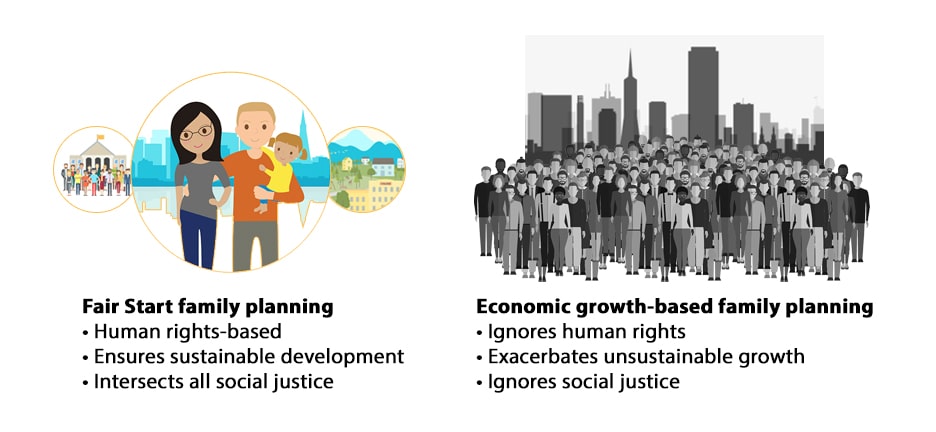
    Two illustrations compare family planning models: At left, a diverse happy family stands together with icons for community and health. At right, a monochrome crowd in a city. Text contrasts fair start (rights-based) with economic growth-based planning.

    We admit: Being part of a system of birth inequity that treats children of color as deserving fewer resources and influence, including omitting this as a countervailing factor in our value assessments and impact reporting, by overshooting ecological, political and social thresholds does more harm to our values than we do to further them.

    This “Tell the Truth” discourse creates an opportunity for permanent resistance to oppression because it protects, through the use of an intergenerational justice threshold, the most vulnerable, Infants and animals and identifies those who reject that protection, and systems of mutual self-determination with it. 

    See the fallacious claims by prominent food entrepreneur Paul Shapiro, who ironically started his work as an animal rights activist climbing to a level of national influence on a false advertising campaign against egg producers for humane washing, His claims to have saved animals while explicitly refusing to back equity reforms or qualify his claims, make them inaccurate and out of context because he omits how he chose underlying policies that did vastly more harm to animals than he did good. His omission enables him to exploit financial systems – as lead at a profitable food company with military contracts – that in turn growth exploit animals and elevate his voice above those pursuing on-balance reforms.

    Initial attempts, in other scenarios, by Fair Start Movement and Truth Alliance advocates to implement this preemption were met with sabotage by public interest entities hiding liability for decades of inaccurate claims, usually for micro interventions undone – relative to a true system of empowerment – by macro forces that enriched those involved, and their funders, at deadly cost to others. 

    As a practical matter one can challenge illegal baselining, or political equity and impact fraud, using inexpensive and widely available consumer protection and unfair competition laws to enjoin public and private business valuation, and impact reporting, that don’t comply with the minimum baseline of inclusive legitimacy.

    Given that political authority, including to entitle wealth, derives from having to empower those subject to the authority, these cases get to the ultimate question of political freedom: Are we obligated to a political system that does not empower us? And what are the limits of self-defense against such a system? 

    After 1948 and the inception of universal human rights that limited national authority, nations were obligated to derive their authority and any entitlements protected under it from the equitable empowerment of their subjects. This requirement is widely reflected in the Bill of Human Rights instruments and their references to the right to self-determination – and one person, one equal and influential vote. This requirement should have created an interpretation of the collective pronoun that premises those documents, like the reference to “we the people,” treating a level of influence in one’s political system (“oughtness” or an “influl” that precedes a “util”) as a fundamental currency that precedes utility and welfare. 


    Don't Get Scammed: Charities, Media and Big Business Use Family Policy to Quietly Undo Progress. Ask This One Question Before Giving, Believing, or Buying Infographic

    The textual basis for this interpretive rule is clear – these pronouns are the linguistic premise of the language that follows. Such a currency and universal linguistic rule of interpretation would have entailed a harsh principle: Each person in a system of law and obligation would be owed the level of public protection, or oughtness, they would account to the most vulnerable: Infants, and the animals whom the infants would impact. The value of self, versus other, determination would require it. Again, a racist system of self-determination blocked this change. 

    Regardless, the principle creates a textual basis to interpret law as requiring the inclusion and empowerment of those subject to it, consistent with standards for intergenerational justice, and ensuring equal offsets of influence relative to a zero baseline and the idea that no child is worth more than another. At a policy level this would have required a fundable, minimum threshold of empowerment beneath which no child should be born, with future children holding entitlements sufficient to create collective family planning systems based on readiness, delay, and the equitable distribution of levels of influence among children. The threshold ensures equal offsets relative to zero, or the preemptive costs of having to measurably empower all children equitably as they enter the world – and at a standard where those children could protect themselves from things like a climate crisis, autocracy, deadly inequity, etc.

    Put simply: 

    If it’s illegal to use a business model that prohibits hiring or housing persons of color, it’s illegal to structure cost/benefit business models to enrich some children at deadly cost to children of color. Use of that model hides liability for the deaths of tens of millions as the climate crisis intensifies, and reflects the academic and public interest practice that ensured the polycrisis: Constantly moving goalposts away from the infant-health-as-enfranchisement standard necessary for political legitimacy in order to falsely claim truth, or victories, and to thus raise funds.

    Unless a person or company claiming to add value to the world can show they were evaluating and reporting by accounting for the preemptive costs of having to measurably empower all children equitably as they enter the world – and at a standard where those children could protect themselves from the climate crisis, autocracy deadly inequity, etc. – the person or company making the claims has been using an illegal baseline, a Ponzi/equity-fraud standard that benefits them at deadly cost to others, and mostly children of color. 

    Those willing to pay the costs of a legitimate political system that avoids arbitrary benefits of birth positionality and conditions authority on empowerment could never compete against those willing to exploit others, and they need not given that any authority to govern or assign wealth derives from first empowering those subject to these things. The other solution to inequity-gained wealth backed by state violence – as the oppression it is – is to treat that violence as illegitimate and triggering the right to self-determinative self-defense against “trolley targets” who benefit themselves at deadly cost to others.  

    It’s this truthful and obligation-creating discourse, a Tell the Truth campaign, that is most preemptive and legally authoritative over all conflicting obligations, including treaties and constitutions. 

    Take action: Urge her here to tell the truth.

  • Factchecking Professor Justin Marceau. His Animal Advocacy Does Not On Balance Liberate Animals. It’s a Facade That Hides Liability for the Climate and Inequity-Driven Deaths of Millions.

    Factchecking Professor Justin Marceau. His Animal Advocacy Does Not On Balance Liberate Animals. It’s a Facade That Hides Liability for the Climate and Inequity-Driven Deaths of Millions.

    Did the University of Denver really spend millions of dollars to create charade of animal liberation, saving a few here and there, while embracing an underlying model of animal propertyhood, birth inequity, and unsustainable growth that kills countless more, and harms vulnerable children?  

    “Today’s animal rights movement is hindered by an unmet need: While relying heavily on activists and insiders to uncover wrongdoing and urge systemic reform, there has historically been a dearth of available legal support. The Animal Activist Legal Defense Project fundamentally alters this state of affairs, with significant and distinctive benefits for the future of the animal rights movement and for the future of animal well-being.”

    —Professor Justin Marceau, Director, Animal Activist Legal Defense Project

    That statement is not accurate.

    Relative to what standard does Marceau, or those like Paul Shapiro, benefit animals? Factor in the inequitable growth that put vastly more animals into suffering than they saved, and you find them moving the goalposts away from on-balance protecting animals in order to to appear to win, and appear so for those who use growth-based wealth to fund the efforts. That well-funded charade drowns out the voices of those who engage in fundamental reforms, and it costs lives as the climate crisis intensifies and women and children go without the resources they need to respond to it.

    I co-founded the Animal Activist Legal Defense Project with Justin, in the wake of serious misconduct at the Animal Legal Defense Fund, including illegal baselining skewing how courts evaluate harm to the environment, the Board paying a settlement to the former executive director Stephen Wells to hide this, and continued illegal baselining that hides liability for philanthropists’ and nonprofits’ role in exacerbating the climate crisis. Part of the founding of the clinic at Denver, in records now removed from the school’s website, was a commitment to total liberation that accounted for many forms of justice. That quickly changed – consistent with funders’ growing concern about what the commitments would reveal and require.

    When I mentioned to Justin the book “Winners Take All: The Elite Charade of Changing the World,” he responded: “This is a story as old as time. I admire the fact that you think you can solve it.” The work we did, if anything, exacerbated this phenomenon.

    In the years that I served with the program we never implemented that standard, but used the same illegal, racist (it starts with the assumption children of color deserve less than white children) and anthropocentric standard for evaluating the value and impact of our work that fundamentally caused the climate crisis, the standard the Animal Legal Defense Fund has used and still uses.

    In fact, leadership at the school removed me from a grant project involving a funder I had brought in to the process, one willing to address the macro issues (or what he calls the “necro”), and then repurposed the grant towards low-impact, charade-level work, keeping part of the grant even after the funder broke from the school and asked that it be returned.


    Inequality info graphic

    Justin’s statement above reflects a fantasy world that hides the liability of those who benefited from decades of anthropocentric, inequitable and disenfranchising growth – those who fund his work.

    Fact: Inequitable growth that enriched mostly wealthy, white children at deadly cost to countless children of color did exponentially more harm to animals than we, at the program, ever did good. Use of that valuation and reporting model hides liability for the deaths of tens of millions as the climate crisis intensifies, and reflects the academic and public interest practice that ensured the polycrisis: Constantly moving goalposts away from the absolute infant-health-as-enfranchisement standard necessary for political legitimacy in order to falsely claim truth, or victories, and to thus raise funds.

    Relative to that harm, on many levels, our work was insignificant and thus performative – and in terms of the underlying business model – mimics Coca-Cola’s model of discounting future lives, especially lives of color, at exponential levels. 

    Marceau’s work is a facade meant to create the impression of animal rights and law, while maintaining an illegal anthropocentric standard from which he benefits. While originally part of Animal Legal Defense Fund litigation that would have reset the baseline around the unity of interests between nonhumans and vulnerable persons, Marceau dropped out after leadership caved to Julia Olson and Our Children’s Trust – an anthropocentric environmental group – pressured the organization to drop the case. His advocacy since derives from illegal baselining that, like the advocacy of Tim Midura at the Brooks Institute for Animal Rights Law and Policy, does more to protect wealth and white privilege than on balance benefit animals.

    How could that happen? For decades reproductive rights systems built on “separate but equal” ideology enabled inequitable growth that – absolved from having to pay the costs of equitizing birthrights – created extreme concentrations of wealth. That wealth now funds downstream, micro, and charade-level interventions that hide the macro process and create a fantasy world of progress that hides liability for the polycrisis.

    That wealth, not on-balance values like the full measure of protecting animals, accounts for public interest policy and interventions.

    Animal liberation can entail the symbolic rescuing a handful of animals and doing a few show trials, while growth drives the harm of trillions of more animals than activists protect.

    To protect animals – to practice animal law actually capable of that – requires accounting for the relations they have with humans, relations that start as humans enter the world. But that entails accounting for things like racist child inequity, the countervailing impact of growth, questions of what we owe future children harmed by the climate crisis and whether that debt overrides competing interests, etc.

    We, like the Brooks Institute for Animals Rights Law and Policy that funds the animal law program Justin manages as well as his title, chose greater harm to animals than we as animal lawyers could ever do good with our downstream and micro interventions, a choice made we made in order to evade difficult questions around birth inequity, while benefitting ourselves and those funding us, at cost to animals. It was a deliberate choice of macro (human / nonhuman indivisible) animal propertyhood over macro personhood, and in contravention of the wishes of Brooks McCormick Jr. to protect animals – a fact that Fair Start will show in the years to come. 

    Following the true intent of Brooks McCormick Jr. to protect animals requires the funding of reforms at the level of the creation of power relations between humans and animals. Based on what I saw at the University of Denver, Tim Midura and his daughters – whom he hired to lead the Institute – will have spent more on lavish events than on developing and implementing a norm that could on-balance protect animals by rearranging entitlements at the most fundamental level, accounting for and reversing overshoot and the inequitable and disenfranchising growth that causes it.

    Relative to inequitable and disenfranchising growth, Midura’s use of the money had a negligible beneficial impact on animals – and he made that choice, to not even take the first necessary step of altering his conception of animal law and its basic content.

    Trump did not simply win. The public interest sector became corrupt, and they and those they fund are betting they can use their wealth to suppress these truths, and that audiences will simply not hear them nor act upon them. The programming is further evidence that public interest interventions often do more to protect the growth-based wealth that funds low-impact charades,  made at cost to children’s and animals’ rights, than to actually further those rights.


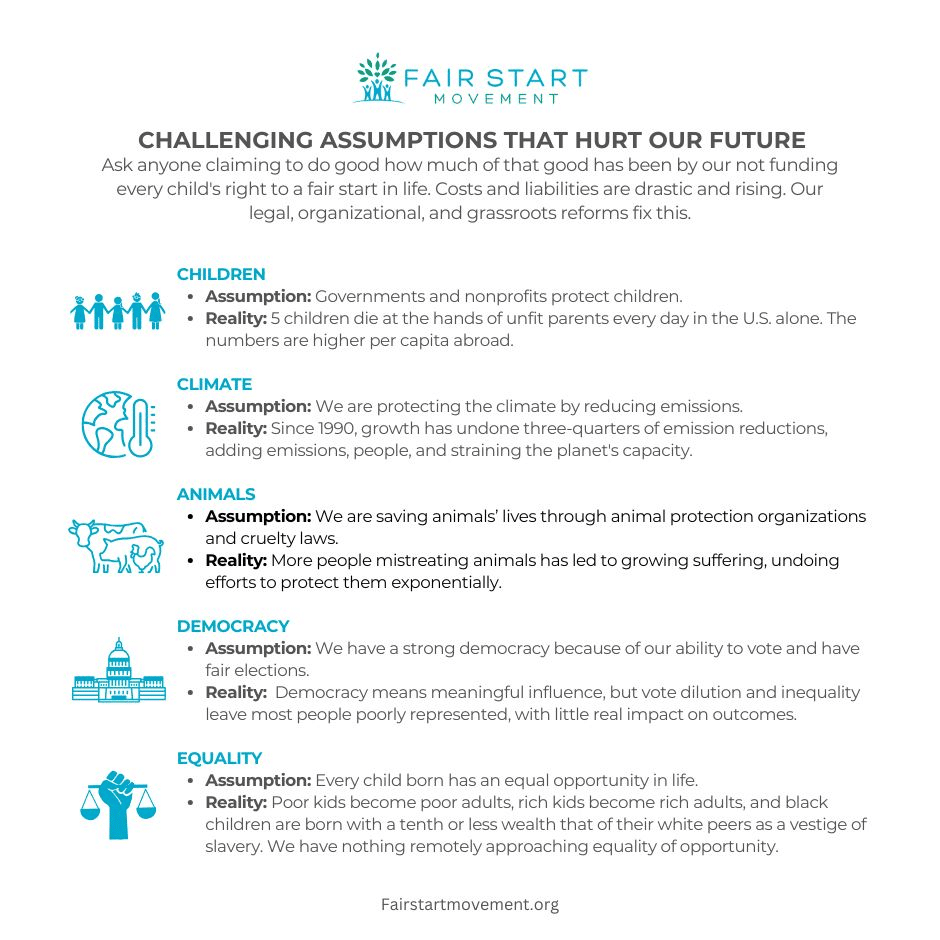
    Challenging assumptions that hurt our future infographic

    The baseline for progress in the programming, and the school in general, was set closer to growth economics based on treating children of color as deserving less that white kids, a standard that has nothing to do with animal welfare, exacerbating situations like the ejiao trade in equines and it’s projected growth. Original intent in the founding of the programming aside, that standard used is illegal because it violates a host of laws, including the fundamental rule that persons obligated to a legal system should first be empowered by it. 

    Marceau, instead of dealing with animal rights in the context of the subject-level relations of reproductive rights, intentionally chose to silo the issue away from birth equity in order to triple-dip: 1) benefit from his arbitrary but very privileged national/racial/class birth positionality, 2) benefit from growth-based wealth unimpeded by the rights of future children, and 3) pretend to be an animal savior while ensuring a comfortable life for him and his children at cost to animals. Pushed to do animal law as reforming the express or implied “we” reference that is the premise of all fundamental legal instruments like constitutions and covenants, their concern for animals fades relative to their desire to preserve their children’s unearned privileges.

    Macro animal personhood and rights, the sort that accounts for the actual lived experience of all nonhumans, marked from the birth-creation of their relations with humans, is designed to prevent this sort of charade-level work and distractivism. 

    The lives animals experience cannot be separated from the creation of the humans with whom they will interact. Justin divides the two issues to get the benefit of appearing to be a hero, while using an underlying system – and its funds – that does much more harm to animals than he does good.

    That’s a charade. And it’s illegal. 

    What Marceau did – part of a larger example of public interest advocates selling out, cost macro reforms that on-balance benefit animals substantial funding and time. And that cost the lives of mostly persons of color.

    The University of Denver, and its funders, now have an opportunity to change the way it assesses value and report impacts – to eventually be able to substantiate its claims of furthering animal rights and liberation, the highest standard of environmental protection one can imagine and something that cannot be separated from the future prospects and lives of all children.

    Fair Start and Truth Alliance activists have called upon the University to join the Tell the Truth campaign, and back preemptive standards for human rights and constitutional reforms that would truly liberate all animals. 

    The University has done the micro version of animal liberation and personhood. Now it can do the macro.

    If it’s illegal to use a business model that prohibits hiring or housing persons of color, it’s illegal to structure cost/benefit business models to enrich some children at deadly cost to children of color. Use of that model hides liability for the deaths of tens of millions as the climate crisis intensifies, and reflects the academic and public interest practice that ensured the polycrisis: Constantly moving goalposts away from the infant-health-as-enfranchisement standard necessary for political legitimacy in order to falsely claim truth, or victories, and to thus raise funds.

    Unless a person or company claiming to add value to the world can show they were evaluating and reporting by accounting for the preemptive costs of having to measurably empower all children equitably as they enter the world – and at a standard where those children could protect themselves from the climate crisis, autocracy deadly inequity, etc. – the person or company making the claims was using an illegal baseline, a Ponzi/equity-fraud standard that benefits them at deadly cost to others, and mostly children of color.

    What do we do about it?

    Use of that illegal baseline constitutes unfair and illegal (actually uniquely unconstitutional) competition. Entities willing to pay the costs of legitimacy by refusing valuation and reporting models that don’t actually empower children as they enter the world at a measurable level of “one person, one equal and influential constitutional vote” could never compete against those who refuse to do that, those who triple dip on their arbitrary birth positionality in an unsustainable system of growth to benefit from a system that quietly does more harm to their professed cause than they do to further it.

    And the just need not be subjected to unfair and unconstitutional competition: Because governments’ authority, including to entitle /incorporate private entities and assign wealth, derives uniquely from the obligation to empower those subject to that authority and those entitlements, governments are under a preemptive obligation to prioritize the elimination, through things like consumer protection actions that can enjoin the underlying business models, of illegal baselining.

    “National legitimacy is, and should have always been, contingent on measurable birth equity or
    the empowerment of each child to eventually control the outcomes of their political systems. The
    Tell the Truth campaign, which is a universal discourse in which all admit wrongly assuming
    children legally deserve with the prospects they are born with rather than what racial justice,
    their rights, and political equity require, and commit to prioritizing those things, is the best
    pathway to that legitimacy. Ensuring this change, especially in post-reconstruction scenarios, is
    the first order of business for everyone, and a discourse of our birth-equity obligations – in which
    it takes a village to plan for a child – is preemptive.”

    – Pierrette Kengela


    Family Planning info card

  • Dr. Michael Greger Helped Turn Animal Protection Into a Ponzi Scheme for Food Investors. Urge Him to Tell the Truth.

    Dr. Michael Greger Helped Turn Animal Protection Into a Ponzi Scheme for Food Investors. Urge Him to Tell the Truth.

    Dr. Michael Greger is a prominent physician promoting plant-based nutrition as a means of health.

    He was also paid a significant amount of money by the Humane Society of the United States, years ago, to further their mission of protecting animals.

    Instead, over the span of decades he used the equity fraud standard described below and key positions he held in the animal protection movement to focus investors on food choice in growth-based markets as an effective reform, monetizing animal protection into a form of consumption, benefitting himself and investors in the process.

    The growth in those markets did exponentially more harm to animals, and to vulnerable populations, than Greger did to help them.

    In the past decade, the number of animals on U.S. factory farms has increased significantly, outpacing any reduction from veganism. Factory farm animal numbers rose by 6% (roughly 97 million more animals) between 2017 and 2022, reaching 1.7 billion, while veganism remains low (under 3% of the population) and has not significantly reduced overall consumption.

    The Tell the Truth campaign simply asks him to admit that truth and factor in the negative impact of inequitable growth on humans and animals in order to dispel the illusion of his having made the world a better place.

    Greger’s version of human health as a matter of food choice – on funded platforms in which he drowns out the voices of the vulnerable – has for decades masked deadly inequity that is now killing tens of millions of persons, and mostly persons of color.

    Animal protection requires radical social change – with numbers that track total liberation. Those who have shifted it towards other ends, in the decades that proceeded Trump and the unfolding of the climate crisis, bear some responsibility for the crises we see today.  

    Contact Greger here, and urge him to Tell the Truth by describing his impacts in context, and to change standards for how he assesses and reports value.

    Don't Get Scammed: Charities, Media and Big Business Use Family Policy to Quietly Undo Progress. Ask This One Question Before Giving, Believing, or Buying Infographic

    Background:  

    Why Equity Fraud? Why Tell the Truth?

    Fair Start Movement and TruthAlliance.global offer the most just and effective social justice reforms possible today, but one has to ask the right question to understand why. You have to ask, when someone makes a value assessment and/or impact claim, what it’s relative to, or the fundamental baseline the claimant is using. They may be using the same illegal baseline that caused the climate crisis, one that undoes the value they claim by illegally discounting future lives, treating children of color as worth a fraction of the benefits white children enjoy.

    If someone claims a beneficial public impact, they should be able to account for how they factor in the variable of children entering the world, relative to what children’s rights and equity require. If they cannot, their assessment of value and reporting of impacts may do more harm than good.

    Anyone can identify what’s called illegal baselining, or equity fraud: how is anyone claiming to create public value and impact accounting for children entering the world during the contemporaneous period of time? How were they accounting for a system of empowering children enough so they have a “one person, one influential vote,” enough to stop the harms of the climate crisis? If there was no such accounting or reporting to this standard, the claimant will have benefited at illegal and deadly cost to others and undone their claimed value. The Tell the Truth campaign identifies such people.

    Family Planning info card


    History

    Fair Start was established by advocates who saw the corrupt use of a fraudulent Ponzi standard in their prior public-interest work. This standard stems from a twentieth-century power grab by wealthy families privatizing family planning to safeguard entitlements and maintain power, in a coercive political system never empowering its subjects. These families, along with political leaders, were legally bound to adhere to an objective, child-rights and equity standard, which asserts that no child is worth more than another, as outlined in the International Covenant on Civil and Political Rights. The fundamental measure of value? Infant health and wellness as self-determination, or the ensuring of equal political influence for each individual.

    Instead, they used the prevailing “separate but equal” standard to base reproductive rights on a subjective framework with no functional protection for future generations—a move that disenfranchised others, leading to the exclusion of birth equity from valuation and reporting systems and a commercialized version of freedom missing the necessary condition of empowerment.

    The twentieth-century power grab used the “separate but equal” standard to treat the act of having children as a matter of parental bodily autonomy, rather than political equity. This assumed existing entitlements and blocked the empowerment of each child—the measurable political equity that is a necessary condition of freedom—and ensured unsustainable and inequitable growth that created extreme concentration of wealth, disenfranchised citizens, and irreparable harm to the environment.

    Today, women “liberated” by this reproductive-rights regime, as well as their children, are dying in growth-based heat waves, with no way to use their political influence to save themselves or their children. Worse yet, wealthy funders benefiting from that inequitable growth masked it for decades with downstream charade interventions and low standards for defining terms like “green,” “humane,” and “equitable,” designed to enrich their own children at deadly cost to others.

    The power grab also created a false premise in our legal systems, because there is no protective obligation limiting the birth-creation of power relations. Why should we be obligated to protect the lives of those with great influence if they show no obligation to protect and empower those with the least influence so that political systems are legitimate?


    Performative Babble Signaling Value While Benefiting From a System That Undoes It

    The illegal standard uses manufactured numbers (using an XYZ analysis, where out-of-context statements about value and impact (X) are assessed against the variable of children entering the world during the relevant timeframe (Y) in a way that overshot and degraded children’s birthright conditions, showing a different outcome (Z) than claimed). The standard encouraged inaccurate claims of micro-level progress that benefited the claimant in order to hide larger losses based on macro-level factors like growth. One can’t benefit from a system that brings children into conditions and relations that violate a host of accepted legal standards, including treating infants of color as entities deserving political equity. Use of the standard means many public interventions did more to subjugate persons of color than further their missions.

    These actors engage in hypocritical value signaling and performative babble, doing many seemingly useful things while “triple-dipping”: benefiting from inequitable birth positionality, growth-based wealth, and charade micro- and downstream public-interest work that hides the upstream macro-level harms from which they benefit at deadly cost to others.

    Communications without the underlying obligation are hypocritical babble, with the communicator signaling values to others in the hope of improving their position in an illegitimate system, while refusing to legitimate the system by elevating a protective obligation to infants and animals in the formation of power relations above any other obligation, including deference to the state that purports to represent those infants.

    For example, Paul Shapiro—a well-known animal-protection advocate—used the equity-fraud standard and a constant flow of inaccurate claims over the span of decades to help shift the movement from on-balance animal protection toward a system of vegan Ponzi-scheme food investments, and then founded his own company in order to cash in.

    The power grab thus ensured a public-interest industry built on equity fraud, one that did more to enrich some children (like Barron Trump) at deadly cost to others (infants in the Sahel) than it did to long-run protect animals, the environment, children, and political systems. In this system, the wealth bubble created over decades of never having to pay the cost of children’s birthrights—not values—controls public-interest outcomes. Philanthropists assume entitlements unencumbered by both their professed and object values, when in reality they owe more than they could give as charity or invest.

    Top Down Power and Bottom Up Empowerment infographic


    The Solution: Tell the Truth and Be Part of a System of Protective Obligation—or Not

    All Fair Start is is the research conclusion that all facts are relative to values, and value and impact claims either constitute or deconstitute legitimate political systems relative to a legally required ideal of measurable empowerment. It is physically impossible to be free without a preemptive, obligatory, collective discourse that ensures a system of family planning aligning measurable birth and political equity as the preemptive obligation with the coercive authority of the state, bringing all children above a threshold of empowerment.

    The Tell the Truth campaign is the closest thing to that discourse because it requires admitting the use of an illegally commissive standard and communicatively reorienting the person in the political system to a preemptive obligation to future children. Like efforts to use non-binary pronouns or land-occupation declarations to change mindsets fixed around binary genders or colonial control of Indigenous land, the Tell the Truth campaign uses admission of benefiting at deadly cost to future generations—especially persons of color—to change how we think about obligation.

    The campaign demands admission that we all used a system with an embedded baseline error that dilutes votes and commercializes democratic relations by overshooting and degrading political, social, and ecological thresholds, rather than applying an empowerment and resourcing threshold beneath which no child should be born.

    The campaign acts as a “legitimacy lever,” taking the death debt from the use of the “separate but equal” reproductive-rights standard rather than the “no child is worth more than another” standard, and using it to leverage a legal, corporate, and grassroots effort in the United States and Europe to identify and preemptively enjoin key targets using equity fraud. This would, by 2028, not just remove Trump, but the fundamental cause of Trump: the power grab that assumed entitlements rather than legitimating them, and disembedded freedom from empowerment and isolated humans from one another, rather than having them measurably empowered and embedded via birth equity as the overriding human right.

    How? Anyone can require their governments to block the use of the equity-fraud standard (usually through an illegal or unfair-competition-law injunction) because governments’ authority—including the authority to entitle wealth and property—derives from a preemptive obligation to measurably empower those subject to that authority. It’s illegal not to hire persons because of their color. It’s also illegal to use a standard in one’s work that enriches some—mostly white children—at deadly climatological and birth-inequity costs to millions of children of color.

    Legitimate organizations that empower others cannot compete against those who exploit them. They can’t compete with those who omit facts that would show more harm done through a system that quietly turned claimed values into wealth. They can’t compete with those who want to improve their position in an illegitimate system rather than legitimate it. The Tell the Truth campaign is backed by grassroots, corporate-certification, and legal efforts to block equity fraud through state attorneys general who are obligated to legitimate their governance by actually empowering those subject to it.

    Inequality info graphic


    Conclusion

    To avoid equity fraud—which is an essentially racist Ponzi scheme with moving goalposts for what constitutes social justice in order to allow economic growth that enriches some and kills others—we all must assess value and report impact by accounting for the requirement on all of us to pay the costs of empowering children as they enter the world. The standard for doing so is sufficient entitlements and incentives to bring every child into the world in conditions, and with relations, that ensure one person, one equal and influential vote relative to political-equity metrics.

    If one cannot show that—accounting for the costs of future children being empowered enough to use their political system to protect themselves from things like the climate crisis (equal offsets relative to zero, or one person, one equal and influential vote)—those assessing and reporting were using the equity-fraud standard. The Tell the Truth campaign divides the just—who back legal injunctions blocking equity fraud—from the unjust, who exploit birth inequity to triple-dip on their arbitrary benefits at deadly cost to others. The unjust hold wealth and entitlements that they refuse to legitimate with children’s rights, using violence to defend it while women and infants—unaware of their rights, including their rights to self-defense—die.

  • Urge Peter Singer to Tell the Truth. His Work for Animals Failed Because It Was Based on the Equity Fraud Standard.

    Urge Peter Singer to Tell the Truth. His Work for Animals Failed Because It Was Based on the Equity Fraud Standard.

    Urge Peter Singer to Tell the Truth

    Fair Start is Working to End the Corrupt Public Interest Charade That Created Trump With a Yes-or-No Campaign on How We Measure Impact.

    Micro, Downstream Interventions Are Being Undone by Macro, Upstream Growth and Birth-Based Political Inequity, Illegally Discounting Future Lives and Creating Liability for the Deaths of Millions.

    Fair Start Movement and TruthAlliance.global offer the most just and effective social justice reforms possible today—but only if we ask the right question to understand why. When someone makes a value assessment or impact claim, we must ask: relative to what? What is the baseline?

    If someone claims a beneficial public impact, they should be able to account for how they factor in the variable of children entering the world, relative to what children’s rights and equity require. If they cannot, their value assessments and impact reporting may do more harm than good.

    Fair Start was established by advocates who recognized a fraudulent Ponzi standard embedded in prior public-interest work.


    Family Planning info card

    Animal law provides a key starting point. It is both aspirational and a stark example of winner-take-all philanthropy. In the 1970s, Peter Singer advanced an illegal and fraudulent standard at the Animal Legal Defense Fund that narrowly defined animal liberation. Over five decades, that standard facilitated wealth concentration that now underwrites his Effective Altruism movement.

    Singer continues today with a charade version of animal liberation, working with groups like Direct Action Everywhere while obscuring the political-equity and impact fraud that produced the current polycrisis. Claimed impacts collapse when assessed against an objective, preemptive standard.

    This standard stems from a twentieth-century power grab by wealthy families who privatized family planning to safeguard entitlements and maintain power within a coercive political system that never empowered its subjects.

    These families, along with political leaders, were legally bound to adhere to a child-rights and equity standard asserting that no child is worth more than another, as outlined in the International Covenant on Civil and Political Rights. The fundamental measure of value is infant health, wellness, and self-determination—ensuring equal political influence for each individual.

    Instead, they relied on a prevailing “separate but equal” standard to disenfranchise others, excluding birth equity from valuation and reporting systems.

    This twentieth-century power grab treated the act of having children as a matter of parental bodily autonomy rather than political equity. In doing so, it blocked the empowerment of each child—the measurable political equity that is a necessary condition of freedom—and ensured unsustainable, inequitable growth. The result has been extreme concentration of wealth, mass disenfranchisement, and irreparable environmental harm.

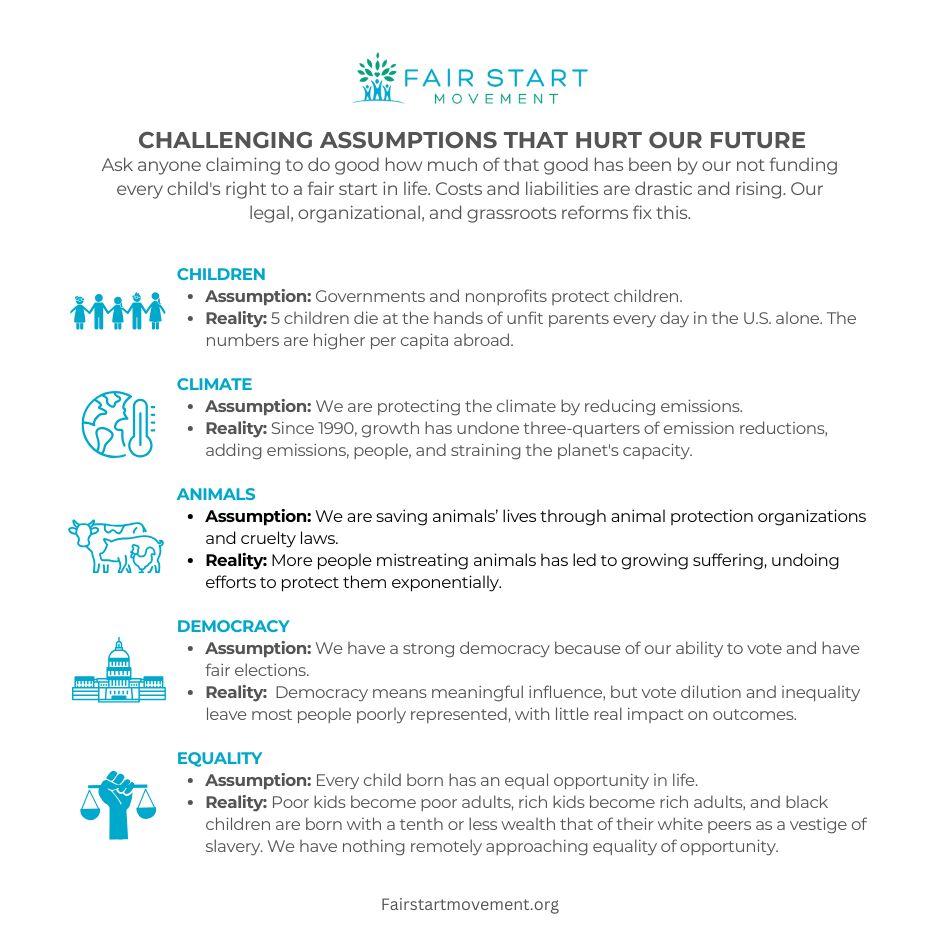
    Challenging assumptions that hurt our future infographic

    Growth is not neutral.

    Growth produces political inequity and ultimately illegitimacy. World leaders pushed public interest and social justice into the object position of the sentence, enabling triple extraction—through birth positionality, growth-based profits, and charade-level philanthropy—from a system built on birth inequity.

    This has forced us into a position where we benefit at deadly cost to others through increasingly diluted and commercialized versions of our values, making those values inaccessible to future generations. There is no way to prevent this harm other than preventing children from being brought into the world without sufficient resources and political equity. The system ensures children arrive without what they need, and in numbers and power relations that degrade the very conditions required for their survival and freedom.

    Today, women “liberated” by this reproductive-rights regime—and their children—are dying in growth-driven heat waves, with no meaningful political influence to protect themselves. Meanwhile, wealthy funders who benefit from inequitable growth masked these harms for decades through downstream, performative interventions and weak standards for terms like “green,” “humane,” and “equitable,” enriching their own children at deadly cost to others.

    This is about equity as empowerment—one’s influential share in one’s democracy. It is the political analogue of equity in a firm. What we have instead is a diluted, growth-and-inequity-commercialized version of freedom: a vote in a shopping mall rather than a town hall. The principle of one person, one equal and influential vote is the basis of national legitimacy. Today, legitimacy would require enough empowerment for future generations to block the climate and political harms we now face—and to reverse their root causes.

    The most fundamental obligation is to position future generations, and ourselves with them, in this way. The only means is a constitutional discourse that accounts for these obligations and brings every child into the world above a measurable threshold of empowerment—within conditions and relations that make that empowerment real. Our words situate us in constitutional discourse. There is no such thing as a “private” equity entitlement outside it.

    A broad professional class sustains the white-wealth bubble: lawyers who refuse to derive authority from empowerment because they benefit from not doing so; academics who ignore birth positionality and thereby forfeit neutrality; reporters and editors incentivized to produce ad-friendly sensationalism that omits birth-equity facts; campaigners and fundraisers who profit from downstream work rather than structural solutions. Together, they manufacture a fantasy of legitimacy and progress built on micro-level interventions that are easily undone by upstream growth and disenfranchisement.

    They profit by blocking the threshold that would protect infants and animals, while pretending their downstream additions are meaningful. In doing so, they convert freedom into wealth through child abuse, disenfranchisement, ecocide, and deadly inequity. They take objective values meant for all and hoard them for themselves.

    Fair Start activists watched these groups take extreme measures to hide liability, including reframing the issue as “population” in order to evade equity-based overrides.

    The remedy is to confront those using this fraud—beginning with the Tell the Truth campaign—and to pursue state attorneys general complaints to prohibit the hidden, illegal, and highly harmful practices treated as permissible despite violating objective human-rights and democratic limits on power. Legal instruments alone do not constitute obligations. Bringing children into the world in a way that genuinely empowers them does.

    There is also a preemptive cause of action for fraud, because governments can redefine what it means to omit information necessary for legitimate political obligation.

    The Fair Start Tell the Truth (TTT) campaign is one way to do this.

    Long-time animal-liberation advocate Zane McNeill recently highlighted the urgency of resisting current administration efforts to coerce higher birth rates—moves that would undo the benefits of nearly all contemporary social-justice efforts:

    Funders Must Support Advocates Fighting Back Against Pronatalism

    While opposing pronatalism is essential, it does not by itself address the power imbalance that enables such coercion. Fair Start reforms—including the Tell the Truth campaign, which prioritizes measurable #birthequity as a basis for national legitimacy—are the most just and effective path forward. This includes actions such as suing Coke/Fairlife to enjoin equity fraud.

    To understand why, we must ask one question of anyone making public-interest impact claims: How are you accounting for children entering the world? What level of democratic empowerment do you require? Are children and animals being discounted and exploited at birth?

    The campaign demands a simple admission: we all relied on a system with an embedded baseline error—one that dilutes votes, commercializes democratic relations, and overshoots political, social, and ecological thresholds, rather than enforcing a resourcing threshold beneath which no child should be born. Freedom and self-determination—and national legitimacy—are physically impossible without a shared language that creates measurable empowerment through equitable power relations.

    The illegal standard relies on manufactured numbers, often via an XYZ analysis: out-of-context impact claims (X) are assessed against the variable of children entering the world (Y) in ways that degrade birthright conditions, producing outcomes (Z) that contradict the claims. This standard rewards micro-level “progress” that benefits the claimant while concealing macro-level losses driven by growth. Interventions conducted under such a system often did more to subjugate people of color than to advance their stated missions.

    Our work uses the Tell the Truth campaign to preemptively establish legitimate obligations and to examine why some actors refuse to participate.

    Leaders such as Suriya Khan, Gabby Mora, and Breeze Harper are telling the truth. Others, including Paul Shapiro, are not.

    This all begins by challenging value and impact claims rooted in an illegal UN-developed standard (1948–1968) that caused the deaths of tens of millions through a colonial system of privatized reproductive rights designed to protect entitlements rather than measurably empower women and children.

    This was political-equity fraud. It triggered multi-threshold overshoot and self-reinforcing feedback loops.

    Our thesis is that admitting use of this system—and changing course through language itself—reorients obligation from governance toward future generations. The TTT campaign is supported by legal, certification, and grassroots efforts within Fair Start and Truth Alliance. Legitimacy is about obligation, and all our work reflects that value.

    TTT is a constitutive discourse, not a document. It rests on individual choices about which models to use within institutions, recognizing that we all benefit at others’ expense. The campaign identifies non-constitutive language and impact reporting that ignores harm to infants and animals, demonstrating the need for systemic change.

    To tell the truth is to admit participation in a system of unsustainable growth and inequitable birth positionality—one that has harmed our professed values more than it has advanced them.

    There is no conception of freedom that does not require measurable political equity—enough influence to protect oneself from the climate crisis. At this stage of overshoot, liability outweighs charity or investment.

    The TTT “legitimacy lever,” as our lead Suriya Khan describes it, redirects responsibility for the global death debt created by the “separate but equal” standard toward concrete demands—beginning in Africa and India—and leverages them through failed UN mechanisms into coordinated legal, corporate, and grassroots action in the U.S. and Europe. The goal is not merely to remove Trump by 2028, but to remove the conditions that produced him: a disembedded, isolated conception of freedom.

    Omitting information required for zero-baseline legitimacy in public-impact reporting constitutes illegal unfair competition. Using illegitimate entitlements to oppress infants and animals—backed by state violence—is morally equivalent to violence itself.

    Peter Singer and the Obligation to Tell the Truth

    Animal law provides a key starting point. It is both aspirational and a stark example of winner-take-all philanthropy. In the 1970s, Peter Singer advanced an illegal and fraudulent standard at the Animal Legal Defense Fund that narrowly defined animal liberation. Over five decades, that standard facilitated wealth concentration that now underwrites Effective Altruism.

    Singer continues today with a charade version of animal liberation, working with groups like Direct Action Everywhere while obscuring the political-equity and impact fraud that produced the current polycrisis. Claimed impacts collapse when assessed against an objective, preemptive standard.

    True animal protection—subject-level reform—requires accounting for the human-animal relations formed at birth. Instead, animal advocacy focused for decades on downstream spectacle after macro-level property relations were already entrenched. Ending exploitation requires ending those relations, but doing so demands confronting racist birth inequity—the same power imbalance imposed on animals at birth.

    Fair Start’s core conclusion is simple: facts are relative to values, and value claims either constitute or deconstitute legitimate political systems. Freedom is impossible without a collective, preemptive discourse that ensures every child is born above an empowerment threshold. The Tell the Truth campaign comes closest to such a discourse. Misrepresentation is equity fraud and subject to preemptive injunction because authority derives from constituting—from telling the truth.

    Behavior is driven by fear of ostracism and coercion. The wealthy rely on diluted representation and state power to preserve growth economies. Leaders act as if votes are equal when they are not. In that context, preemptive self-defense—and defense of others—is justified.

    Fair Start represents a permanent form of resistance to fundamental oppression, using language to define obligation, legitimacy, and protection. The first laws are those that account for our creation relative to one another and the environment. No one is above the law.

    All Fair Start is, is the research conclusion that all facts are relative to values, and value and impact claims either constitute or deconstitute legitimate political systems relative to a legally required ideal of measurable empowerment. It is physically impossible to be free without a preemptive, obligatory, collective discourse of family planning ensuring all children are born above a threshold of empowerment. The Tell the Truth campaign is the closest thing to that discourse. Deconstituting legitimacy through inaccurate statements is equity fraud and subject to preemptive equity injunctions, because authority derives from constituting—from telling the truth.

    What really drives behavior? Fear of ostracism and coercion. The wealthy use state violence and the threat of prosecution to control people, but few know the state operates on diluted representation necessary for growth economies that benefit the top. Leaders act as if votes are equal. We have a right to preemptive self-defense, and defense of others, in that context. 

    Fair Start represents a permanent, ubiquitous, and indefatigable form of resistance to fundamental oppression, using language to identify perpetrators and obligations. It clarifies who belongs in the legitimate linguistic community of obligation,entitlements-to-ensure actual or on-balance values, and protection, and who does not. All laws should be fair.The first laws are laws that account for our creation relative to others and our environment. And no one is above the law


  • An Open Letter to Mercy for Animals: Ensuring On Balance Public Interest Assessment and Reporting

    An Open Letter to Mercy for Animals: Ensuring On Balance Public Interest Assessment and Reporting

    Fair Start Movement

    A PDF version of the following letter is attached here.

    December 30, 2025

    Board of Directors, Mercy For Animals, 8033 Sunset Boulevard #864, Los Angeles, CA 90046

    Dear Ms. Colizzi, Mr. Pellman Rowland, Ms. Akinci, and Ms. Mindrum,

    I write on behalf of Fair Start Movement, which is a charitable organization that analyzes the systemic harms and threats to the sustainability and viability of our planet, with a particular focus on the most vulnerable populations globally, including children and future generations, animals, and the environment. It seeks solutions through law, policy, and education.

    I’m also writing in my personal capacity as an attorney and leader in the animal protection movement and the human rights movement, including in various roles protecting the interests of humans, nonhuman animals, and the environment throughout my career. I started as a human rights attorney with the U.S. Departments of Justice and Homeland Security to remove human rights abusers and then spent over twenty years in our movement building and leading legal and strategic animal protection initiatives and creating scholarship on how our work can truly advance the rights and protections of all of us – human and nonhuman – and fight exploitative systems to build a sustainable world. 

    Admittedly in this process I have developed critiques of what I see as counterproductive work in the animal protection movement and crucial errors and omissions in the way we evaluate and approach the work we do. In a nutshell, I believe we have to take into account the impact of growth and inequities in the human population as we fight against exploitative systems, understanding the plight of vulnerable populations and future generations, as well as the dire ecological crisis we are facing, and the role of factory farming in that. I think by incorporating these concepts and a more accurate calculus of present and future harm, the potential impact of our work will be immeasurably improved. Likewise, I have been outspoken in critiquing particular players in the animal protection movement because I believe the implication of not including appropriate growth and equity considerations into our work is catastrophic and undermines our objective of protecting animals in factory farms. I now have shifted to the process of building and guiding the grassroots Fair Start Movement, largely in the U.S. and Sub-Saharan Africa. As part of this, I have honed and refined our campaigns and asks in a way I think will be beneficial for all of us, and ultimately for the animals. It’s in this spirit of building a better movement that I come to you with this ask to begin to incorporate and account for these growth and equity issues in your work.

    This is a moment of opportunity for Mercy For Animals. MFA has a history of innovation and thought leadership in this movement, and has weathered internal and external changes before. On the occasion of looking back over the organization’s accomplishments under Leah and what the next stage of MFA should be, I invite you to recognize and begin to incorporate the central tenets of the Fair Start Movement into the formulas and metrics by which you design and measure the impact of your work, and into your campaigns. We believe it’s exactly this thinking that can enhance the goals you set forth in your FAST post of “clarity, collaboration, and meaningful change for farmed animals.”

    The Fair Start Movement is on the brink of launching its largest campaign yet, which is tailored primarily to organizations, funders, and leaders in the animal protection movement, and which will form the intersectional movement-building basis of incorporating growth and equity considerations within the animal protection movement and across other movements around the world. This campaign is called the Tell the Truth Campaign (TTT). It has a 4 point ask:

    • Assess all public interest work from an accurate baseline, like assessing how climate and political crises impact the health and freedom of women and infants disproportionately around the world. Take into account inequitable growth. Ask: how does the value and impact of your work change once you factor in children entering the world relative to what their rights and equity require?
    • Work toward the universal human right to birth and political equity as the most basic norm which means a minimum or floor of empowering and equitable resources beneath which no child should be born. Ask: are we and/or others claiming to do good while treating children of color and/or poor people as worth fewer resources and more risk than the average white or wealthy child?
    • Address – and require government and the industry to address – the fundamental authority any government has, including to protect the legitimacy of economic rights and capital, is contingent on measurably empowering those people subject to it, in the creation of power relations and in birth and development. Defrauding people about inequity disenfranchises people. It’s not about population, it’s measurable political equity. In other words, ending equity fraud is about being free to choose who has power over you.
    • Use discourse and a standard to assess impact that accounts for the full impact of the system that inequitable birth and development, and one’s position within it. In other words, set goals that account for and are ambitious enough to cover the full nature and scope of the harms industry causes.

    We invite you to join the TTT campaign by beginning to incorporate its asks within your campaign design and metrics. 

    Mercy For Animals is a particular fit for this work given its core identity in two distinct respects. First, MFA is an organization that truly engages intersectionally across movements, supports the fight for racial justice, and elevates the factory farming issue in multiple spaces. Second, MFA has been dedicated to quantifiable impact-based metrics, particularly in its corporate and outreach campaigning. The TTT campaign and the Fair Start Movement’s core principles are central to improving upon both of these areas. Properly accounting for the harm to vulnerable populations, people of color – especially children and future generations – is the crux of true intersectionality and a bridge for more and better work across movements. The TTT campaign also offers a more complete accounting for harm and the impact of campaigns because it takes into account not just the number of animals affected today, but what impact on growth will mean for future suffering saved over a multigenerational timeline. 

    What we are offering here is an opportunity to incorporate a better and more complete formula for calculating harm and impact. As we know, factory farms operate on an illegal business model, externalizing the harms to animals, the environment, workers, consumers, and communities. Our campaigns and advocacy – outreach, corporate, legal, and otherwise — have been weak relative to the level of harm inflicted by these factory farms. Calculation of harm has been based on an incomplete and ineffective use of existing legal tools and inaccurate economic modeling which has actually further enabled such harm rather than curtailing it. Animal advocates must change our legal and economic systems to require them to catch up to recognition and remediation of the true scope of harm, across systems and even for future generations in order to address the existential threat that mega-corporations present to the rule of law and even to life on this planet.

    The Problem: Improper Prioritization of Short-Term Profits and Growth Due to Future Discounting and Errors in Calculating Baseline Harms

    Core to all of the harms of factory farming is the improper prioritization of short-term profits and growth without accounting for the negative externalities. Two closely related economic principles compound the harms. First, future discounting (i.e. valuation of short-term profits and growth over preservation for future health, animal life, animal welfare, and sustainability) and measuring things like amount of suffering and number of animals killed from the starting point of current production levels and demand, rather than from a baseline that reflects an ethical and sustainable amount of suffering and animal killing (which I think we’d all agree is zero or at least a negligible amount that is unavoidable through the use of sustainable plant based agriculture). This applies also to greenhouse gas emissions. That is, we must look at what the healthy and sustainable CO2 levels would be and hold factory farming polluters accountable to meet that goal. The end result is that short-term profits and growth are valued and enabled by the law and its enforcement, and the negative externalities are borne by the animals and the public. Vulnerable populations are hardest hit, including people of color, people in poverty and developing countries, children, and future generations. Mass species extinction, exploitation, and killing of trillions of animals each year, public health crises, and the risk of total ecosystem collapse are the result. If we remain on this trajectory, things will only get worse in the coming decades.

    Second, omission of the disparate impact of harm to vulnerable populations – including animals and the natural environment, children, and the effect of this trend on future generations as population grows – has caused significant under-assessment of harm. This omission has led to the application of a standard for assessing such harm that is so inadequate it threatens the efficacy of all sorts of campaigns and other advocacy in the movement, and even the legitimacy of the law that continues to justify the existence and growth of factory farming. This inadequate assessment has been employed by stakeholders across all categories, including governments, corporations, and even nonprofit organizations working on these issues.

    This has resulted in widespread discounting of lives and rights, and systematic political disenfranchisement.  Without correction, significant portions of the population will become functionally incapable of getting their basic human rights met and will be irredeemably politically disenfranchised. The advocates for those who don’t have those voices – including animals and the environment – are weakened in their political power and efficacy as well, which will only continue to get worse over time. 

    Mercy For Animals’ Work is Hindered by this Problem and Uniquely Positioned to Incorporate Accurate and Impactful Metrics

    MFA has a long history of leadership and impact in the animal protection movement, and has been at the forefront of a holistic and intersectional view of the factory farming problem and of its work. Its mission is “to construct a compassionate food system that is not just kind to animals but essential for the future of our planet and all who share it. Our vision of a world where animals are respected, protected, and free drives the work we do every day.” This globalistic and future-focused view of MFA’s mission makes it crucial to account for the problem accurately, and to apply its innovative skill set to its work incorporating an understanding of growth and sustainability. 

    Programmatically, according to its 2024 990, MFA’s impact and focus is on “expos[ing] factory farming… [and] educating millions through social media on the benefits of plant-based eating… helping to raise awareness and inspire action for animal welfare globally.” It also “supported significant corporate and legislative wins, ensuring ongoing progress for farmed animals. Our corporate engagement team helped advance campaigns to improve protections for farmed animals and promote plant-based eating.”

    MFA’s Transfarmation program’s “mission is to build collective power sufficient to realize a just and sustainable food system… by helping farmers transition from industrial animal agriculture operations to raising crops for human consumption. By creating models of  alternative economic opportunities, building solidarity with other movements, and shifting societal narratives to chang culture, we will realize a just and sustainable food system.” This is another future-focused and systemic strategy. 

    “Investigations show the harsh realities of the treatment of farmed animals… and can help lead to major changes in the animal agricultural system and public perception to further action for animal welfare and protection of farmed animals.”

    Each of these programs presents an opportunity and an imperative to incorporate an accurate assessment of harm and evaluation of impact into MFA’s strategy and work. A throughline of each of these programs is the commitment to changing things now for a cumulative and lasting effect on the future plight of animals, people, and the environment. All of these programs also rely essentially upon the agency and effectiveness of activists and political power. These are the central principles of TTT and the Fair Start Movement’s solutions for effecting real change.

    Taking a few of the specific programs, corporate and legislative campaigning has a significant blind spot here that causes it to be potentially weak to the point of counterproductivity. If we do not take into account the growth – in profits, in demand, in market share, and in total production of animal products – that welfare-based corporate and legislative campaigns may be contributing to, these campaigns may have the effect of actually increasing suffering over the course of time in a significant way. An additive component here is the halo effect these campaigns may bring to these companies, further promoting consumerism and growth as a virtue rather than the root of the problem.

    Educational and exposure-based campaigns including investigations could and should be incorporating an accurate calculus of harm, accounting for growth and the impact of the harms of industrial animal agriculture on vulnerable populations and future sustainability, as well as emphasizing the importance of reducing the overall demand and production of animal products. Vegan campaigning has heretofore not taken into account the projected growth of demand in animal products. Movement leaders have privately conceded for years that even the most optimistic projections on the success of vegan campaigning can only hope to slow the growth of demand for animal products over time, rather than reducing existing levels or reversing the trend to reducing the overall number of animals in the system or overall suffering. This issue needs to be reckoned with and inform strategy and assessment. 

    Perhaps the easiest program to upgrade under the Fair Start Movement’s principles is Transfarmation. With its objective to create a holistically just and sustainable food system, any impact it can have on shifting the paradigm and transforming the system now will have an amplified effect in the future, shifting away from the highly consolidated corporate animal-based model that is centered on and slated to grow dramatically over time. If Transfarmation succeeds today, its effects will be much greater than if it were to try to correct the problem in 10, 20, or 50 years’ time.

    The Solution; Incorporate Growth-Based Standards for Calculating Harms into Your Campaigns and Metrics

    As MFA and other organizations that work with the TTT campaign design their strategies, you can correct the basis for which you are calculating harms and impact by taking into account the impact on animals, vulnerable populations, and future generations using an objective measure. This objective measure accurately assesses damages and should be used in evaluating what kinds of interventions and campaigns can be used in your strategy against factory farming, how effective your campaigns are as they progress, and incorporated into your outreach and education and bridge-building between social justice movements. Two types of actions can and should underly a variety of campaigns and strategies:

    1. Reduce or eliminate future discounting in cases where there is harm that will continue. Instead, take into account the projected growth of the exploitation and growth of harm over time. The most important situations to apply this principle to are cases where animals and ecosystem health and survivability, young people, vulnerable populations, and future generations face disproportionate harm. 
    2. Use a zero-baseline calculus of harm. Fair Start Movement advocates for the recognition of harms to all, including animals and the environment, young people, and future generations. By considering the welfare of life holistically, and on a longer timeline, we can account more accurately for the level and type of harm factory farming is inflicting and upon whom.

    Impacts on farmed animals, poor people, people of color, children, and future generations, are disproportionately high now and those divides will continue to grow. The current campaign, educational, and legal approach also does not take into account the acceleration of production of animal products, suffering, demand, and ecological devastation and system collapse corporate bad actors are creating for short-term gains. In particular, any legitimate advocacy work must include an understanding of future animals, children’s welfare, and future generations in light of the existential threats to our environment and geopolitical future. 

    Harms to young, the vulnerable – including people, animals, and the environment, and future generations – and the likelihood of acceleration of those harms if current trends are allowed to continue – should be taken into account in any campaigning against factory farming. In addition, in the case of factory farming, where the underlying harm is a driver of growth of the corporation or sector – by competitive advantage, simple externalizing of costs to increase profits, and/or by false representations to consumers, investors, or regulators – campaign objectives that account for this should be incorporated to take into account the disparate, ongoing, and growing harms caused by factory farming. Breaking away from the pack by reliance on illegal and damaging practices now sets into motion growth and acceleration which increases damage as a whole. 

    Factory Farming’s current and projected harms also pose a fundamental threat to the legitimacy of law and our power as political citizens in a representative democracy. Factory farming corporations have been allowed unfettered – and in fact highly assisted – growth, which has put children and future generations in a position of inheriting a world that is both ecologically worse off than ever and where they have no functional opportunity to reverse course due to the relative political disempowerment that the exploitative industries have created.

    The scope of this problem is so large that it poses a fundamental threat to our democratic system of government. Ecological collapse due to climate change, deforestation, and a litany of similar existential harms have robbed massive numbers of people the meaningful right to participate in the political process, let alone enjoy the exercise of their legal rights. Their ability to advocate for animals and other politically disenfranchised groups is further weakened. Corporate growth and profitability does not necessarily support even baseline human rights. In fact, at some point enabling such corporate growth and profitability to the exclusion of other things reduces humans to mere instruments of corporate objectives. For some populations now – and certainly for many future generations – that balance has tipped, such that corporate profits have subsumed even the basic ability for people to participate in and consent to their own governance. Their access to basic needs such as clean water and a livable environment has been or will be denied. Corporate bad actors – especially factory farm corporations – are undoubtedly the major cause of such existential harms. 

    The representation of the governed is the basis of the authority to govern, and is the preemptive standard from which all other legal authority derives. The situation we are facing as a result of corporate harms poses such an existential threat that it has either passed now or will soon pass the threshold of disenfranchisement if these kinds of harms persist unabated.  At some point, the threat becomes so dire, the very basis of law is threatened. Large swaths of people have no meaningful representative rights and access, and it will only continue to get worse. This threat to equity and political representation necessitates the accurate and objective harm standards set forth in this letter. 

    All legal systems, political entities, constitutions, courts, precedents, statutes, and the like are predicated on the simple premise of citizen representation. All legal authority derives from such representation.  The cornerstone of political representation is the “one person, one vote” standard for equal protection. The environmental harms caused largely by multinational factory farming and other corporations impact the population in such a disparate way, and that disparate impact is set to accelerate in our children’s lifetime and for future generations, that the very concept of political legitimacy through representation is undermined. We stand to leave our children and future generations with an irredeemable ecological, legal, and geopolitical mess. It is only through the objectivity and accuracy of the preemptive standard we propose here that we may find remedies to reverse course. Any remedies applied after-the-fact in an attempt to right this will fall far short of the mark unless a standard is used that takes children and future generations’ right to a sustainable environment and functional democracy into account.

    Failing this, vulnerable populations, children, and future generations must live in a society where they are in ecological crisis, have no meaningful political power to shape reforms, and are required to follow the law without actually being empowered by it.  The preemptive standard takes these interests into account, incorporating constitutive political equity and self-determination into its metric. As compared with the current standard which was derived from commercialized standards of welfare that prioritized profit and growth, there are massive differences in terms of things like permissible emissions, levels of democratic representation, minimal birth and development conditions for children, and many others. The current commercially based standards are not based on legitimate legal principles, are killing millions, will continue to do so, and pose and existential risk to life on earth over time.

    Fair Start’s full justice standard to preserve freedom and self-determination

    The Fair Start Movement seeks what we call a full justice standard, which requires no child is born beneath a threshold of resources necessary for freedom and self-determination. In other words, we do not want to see any life brought into a planet that is irredeemable. That may already be happening to some in this generation, and with the trajectory we are currently on, it is only a matter of time before the next generation or the one after that is handed a planet and political system that they have no power to fix. We face an unsolvable ecological and geopolitical crisis with no meaningful access to the tools – political, economic, educational, and otherwise – to give any hope of redemption. Corporate harms and the disparate impacts of these corporate harms directly cause this powerlessness. Factory farming corporations are at the center of this problem. 

    • Measurement of harms accurately, from zero baseline standards and without future discounting, is necessary to preserve democracy and the government’s own right to govern
    • Protecting political legitimacy requires prioritization and inclusion of children and future generations 

    In order to have any meaningful attempt at a “one person, one vote” democratic institution, from which all legal authority derives, a certain baseline requirement must be met: children need minimum thresholds of well-being and empowerment, or they simply do not have access to political representation of any kind. Infants possess a constitutionally protected right to life, bodily integrity, and health. 

    As explored by Nobel Laureate Steven Chu in Forbes, “The World Economy Is a Pyramid Scheme,” this systemic exploitation continues to enrich the few at the expense of millions, perpetuating cycles of inequity and environmental degradation. The omission of children’s rights not only weakens the chain of legitimacy but also allows performative fraud to undo the “object in the subject,” thus undermining justice. No valuation system outside of zero remains for the omitted, who are those left without recognition or investment in their future. The inequitable growth this ensured was sustained for less than a handful of generations before it caused catastrophic economic, ecological and political outcomes, creating unsustainable demand, cheap labor, and diluted political equity – all enabled by discounting future children’s rights – and in fact the rights of all future life. The standard has allowed benchmarking of terms like green, humane, eco, sustainable, net-zero, equitable, etc. that in ways that have no connection to the actual birth and development conditions children need to survive, and benchmarking process that has been driven by a first-order lack of equity standards in value assessments and claims.

    The preemptive standard argued for here has a number of campaign, legal, and policy implications and potential applications, including incentivized parenting delay, equity reparations, and a resource measure below which no child should be born.

    MFA is a leader and a pathbreaker in the animal protection movement. This is a moment of unique opportunity to level up the impact of its work and its leadership across our movement and others. I invite you to reach out to me and to the Fair Start Movement to engage in a dialogue around how to improve the course of progress for today and generations to come. 

    Sincerely,

    Carter Dillard, and The Team at Fair Start Movement

  • Fair Start Fundamental FactCheck: Paul Shapiro and His Claims Regarding Impact on Animals

    Fair Start Fundamental FactCheck: Paul Shapiro and His Claims Regarding Impact on Animals

    The following is an AI simplification of a longer draft, in progress, below it regarding one example of Fair Start’s Tell the Truth campaign, which urges constitutional discourse to target the fundamental driver of the political, ecological, and social crises we see in the world today: Birth-based political equity. 

    All facts, and the claims that use them, are relative to values. Ensuring the right set of values when assessing the accuracy of claims, and contrasting what we find when we use the wrong set of values, let’s us see problems in the world today at a deeper level, as well as how to fix them.


    Fair Start reforms offer the most just and effective way to address many of today’s overlapping crises—but only if public-interest claims are evaluated using the right standard. Anyone claiming positive impact should be asked a basic question: How did your cost-benefit model account for children entering the world, and did it meet what those children’s legal rights, political equity, and national legitimacy require?

    In most cases, the answer is that it did not. Children are typically treated as economic inputs driving growth, while the ecological, political, and human costs of that growth are ignored or illegally discounted. This produces “free” wealth that depends on worsening conditions—especially for children of color—and contradicts the values advocates claim to hold, such as safety, equality, and sustainability. The result is continued overshoot of ecological and social thresholds that both humans and nonhumans need to survive.

    If a business or nonprofit used a valuation model that counted racial exclusion as a benefit, it would be subject to civil-rights enforcement. A model that enriches mostly white children while imposing deadly climate, political, and ecological costs on mostly children of color—often through disenfranchisement—is worse, not better, and is also illegal. Yet this model is widespread.

    The model uses a sliding baseline that gives future children fewer resources and less political power as conditions worsen. This is the same growth-based Ponzi scheme—identified by a Nobel laureate—that shifts costs onto those least responsible while violating children’s legal rights. Impact claims made under this model are therefore inaccurate because they omit a decisive factor: the harms caused by inequitable and unsustainable growth itself.

    The remedy is straightforward: call such claims in, and require advocates to change how they assess and report impact.

    Paul Shapiro as an Example

    Paul Shapiro, founder of a major alternative-protein company, recently claimed in a Medium essay that he has helped animals over more than two decades. That claim is misleading.

    Since the early 2000s, factory farming has expanded dramatically, with hundreds of billions more animals suffering today than when Paul began his work—far exceeding any animals “saved” through food reforms. This outcome was driven by a factor Paul and many others relied on and benefited from: unsustainable, birth-inequitable growth paired with valuation models that illegally discount future human and nonhuman lives. Instead of focusing on fundamental justice, Paul and other activists used a focus on farmed animals as a vector to focus on food, monetizing animal rights in a way that benefited Paul and alternative protein food investors more than animals, and at cost to our ecologies, democracies, and the most vulnerable humans. Had they actually moved to liberate animals, they would have had to account for the fundamental creation of power relations between humans and animals – a costly move that would require dealing with racial justice, political equity, and other issues that cannot be reduced to an investment strategy masquerading as charity. 

    Activists working alongside Paul at Compassion Over Killing and later at the Humane Society consistently used this same flawed standard. It created the appearance of progress through narrow, downstream interventions while upstream growth quietly overwhelmed those gains. The model violated legal protections for children and animals, undermined racial justice, and entrenched political inequity by ignoring the impact of children entering the world without guaranteed birth or political rights.

    The question is not whether Paul did better than worse actors. The question is relative to what standard he claims to have helped animals. Using a floating baseline—rather than a legally required threshold of empowerment—allows one to claim success even as conditions worsen overall. That is how animal suffering could increase dramatically while advocates claim victory.

    Much of the funding for these efforts came from wealth produced by the same inequitable growth system—wealth that carries a “death debt” as climate harms accelerate. Charity distributed from this system does not outweigh the damage it causes.

    The Core Failure

    The standard Paul and others used treats harm as relative and adjustable rather than absolute. As ecological and political conditions degrade, the baseline simply shifts downward, normalizing injustice. This allows advocates to appear to help animals while benefiting from a system that does far more harm than good.

    True animal protection cannot be separated from human political equity. Humans are animals, and any serious attempt to reduce nonhuman suffering must account for how children enter the world, how power is distributed at birth, and whether governance is legitimate. Ignoring these relationships turns animal protection into a charade.

    Laws protecting animals have negligible impact compared to the effects of unchecked, inequitable human growth over generations. Food reforms and similar interventions are minor and often self-serving when measured against these macro forces—and they frequently obscure growing political illegitimacy.

    The Alternative: Fair Start

    A legitimate model begins with birth and political equity. Government authority—and the wealth it entitles—must be derived from the measurable empowerment of those subject to it. This is a yes-or-no condition, not a matter of ideology.

    Fair Start treats caring for children as the foundation of freedom and democracy, not as a private matter divorced from political legitimacy. It replaces growth-based exploitation with a standard that ensures no child is born below a threshold of empowerment and preparation. This approach aligns with ecological limits, racial justice, democratic self-determination, and genuine animal protection.

    Call to Action

    Paul should tell the full truth about the context of his impact, including how growth undermined it. He should abandon models that exploit infants and animals and instead support a Fair Start standard that prioritizes birth and political equity as prerequisites for legitimate impact.

    Specifically, he should support efforts—such as forthcoming FTC action—to prohibit the use of deceptive “equity fraud” valuation models in public-interest claims. This is a collective action problem, but it will not be solved unless those with influence lead.

    This is not a personal attack. The personal is political, and Paul has the opportunity to help correct a systemic failure. Telling the truth about how we failed future generations—and committing to a just standard going forward—is the first step toward real accountability and real change.


    Paul Shapiro Can Do More to Help Animals, at an Exponential Level

    Fair Start reforms are the most just and effective way to end many of the crises we see in the world today, but you have to ask the right question of anyone making a public interest impact claim to understand why.  Ask the person making the claim to explain how their value assessment (cost/benefit) model, and impact reporting, accounted for the factor of children entering the world, and entering in conditions that satisfy what those kids’ legal rights, right to political equity, and right to national legitimacy, require? Most likely they were not accurately accounting for those rights, but were instead treating children as economic inputs who are simply driving growth, and the “free” money that magically comes from unsustainable growth. Most likely the person making the claim was using a standard that contradicts their own values (like being made safe rather than put into a vulnerable position), and ensures the ongoing overshoot and degradation of multiple ecological/social thresholds that infants and animals need to survive.

    Lots of inputs go into the outcome of more animals suffering despite the efforts critiqued below, but everyone has to choose the lens through which they weigh values and report impacts, and everyone can choose a model that requires a threshold of empowerment for all children. We are all responsible for that choice, because we benefit from the system that impacts them. 

    If anyone used in their business or nonprofit work a valuation model premised on valuing as a benefit not hiring persons of color, they would be subject to civil rights injunction by state government, as described below. Using a model that generally enriches mostly white children at deadly climatological and other costs to mostly children of color, doing so in part by disenfranchising them, is worse than a discriminatory hiring model, and is also illegal. 

    If the person making the claim was using this model/standard, they were mostly likely doing so in order to personally benefit, and using a sliding scale baseline that gives children (and mostly children of color) less and less as things worsen ecologically and politically in the world, heaping costs on those least responsible. This is the same scale that ensures the ongoing and illegal Ponzi scheme (as noted by one Nobel laureate) that fundamentally drives outcomes in the world today, and is designed to enrich some children at deadly cost to others, all in violations of children’s legal rights. And that means the claims the person is making are inaccurate – usually because they are omissive of a key factor, e.g. an animal advocate omitting the largest driver of animal suffering, as discussed below. The fix? Call the claimant in, and ask them to change how they assess and claim impact.

    I have done this. Paul can too. 

    Paul Shapiro is an influential person and can use that influence to make a massive shift that does not disproportionally elevate his own prospects, and by  embracing a macro or total liberation of not just nonhumans but humans as well. 


    Paul Shapiro and his recent claims to have helped animals over the span of more than two decades 

    Recently Paul Shapiro, founder of a highly valued alternative protein company, wrote a piece for Medium about his work at the animal protection organization Compassion Over Killing (now Animal Outlook) going back to the early 2000s. Paul is well respected and liked by many, including at Fair Start, but the subject below involves a system that causes unimaginable suffering. And while his work has inspired some to take up animal protection and leave lucrative careers, their goal was always to help animals on balance and as Paul pushed for in the early days, to liberate them.

    Paul is better off than when he and other activists there started their work. Animals, and the most vulnerable humans, are much worse off, with horrific prospects for the future.

    What went wrong? In his Medium piece Paul refers to helping animals in various ways over his career. For example, Paul says:

    I’m grateful to the numerous animal advocates who helped build COK during my decade there. I’m also grateful to the animal advocates around the world who came both before and after us and are still today working to effectuate a better world for animals.

    Those statements are inaccurate, and out of context.

    Paul is trying to rewrite history. Factors of growth, impact, and damage to equity – and the cumulative and accelerating effect of all of these – should be and should have been taken into account by anyone doing public interest work when designing strategy and tactics.

    There are hundreds of billions of more animals suffering in factory farming since 2001, exponentially more than Paul saved, and all from a factor Paul spent decades benefitting from while shuffling the costs of onto others: Unsustainable, and birth inequity-based growth, and the use of manufactured numbers in value assessments and impact reporting that illegally discount future human and nonhuman lives, rather than measuring harm from a zero baseline, as described below.

    Activists today working with Fair Start also worked with Paul and others at the Compassion Over Killing, since roughly 2001, and after that at the Humane Society of the United States. During their entire experience, the activists and Paul all consistently used a fraudulent equity and impact standard – #equityfraud – that created a fantasy world of impacts on a micro and downstream level that were quietly being undone on a macro, and upstream level by a Ponzi scheme of inequitable growth.

    Using the wrong standard – clouding the world with misinformation and skewing the baseline – threatens ongoing efforts to ensure accurate and life-saving climate reparations. 

    The model the activists used was based on a decades old and illegal growth arc that violated a variety of legal protections for infants and animals, and effectively subverted racial justice movements of the Twentieth Century by ensuring unsustainable and inequitable growth and massive political inequity. Ask Paul how he was factoring in children entering the world relative to what their rights require, 2001 to date, and you will find him assuming and benefiting the current reproductive rights system – the system most responsible for factory farming itself. He started his work, and starts today, with a growth model that contradicts his own claims. The lives of animals lost to growth are of no less value than the lives Paul saved in his food reform work.
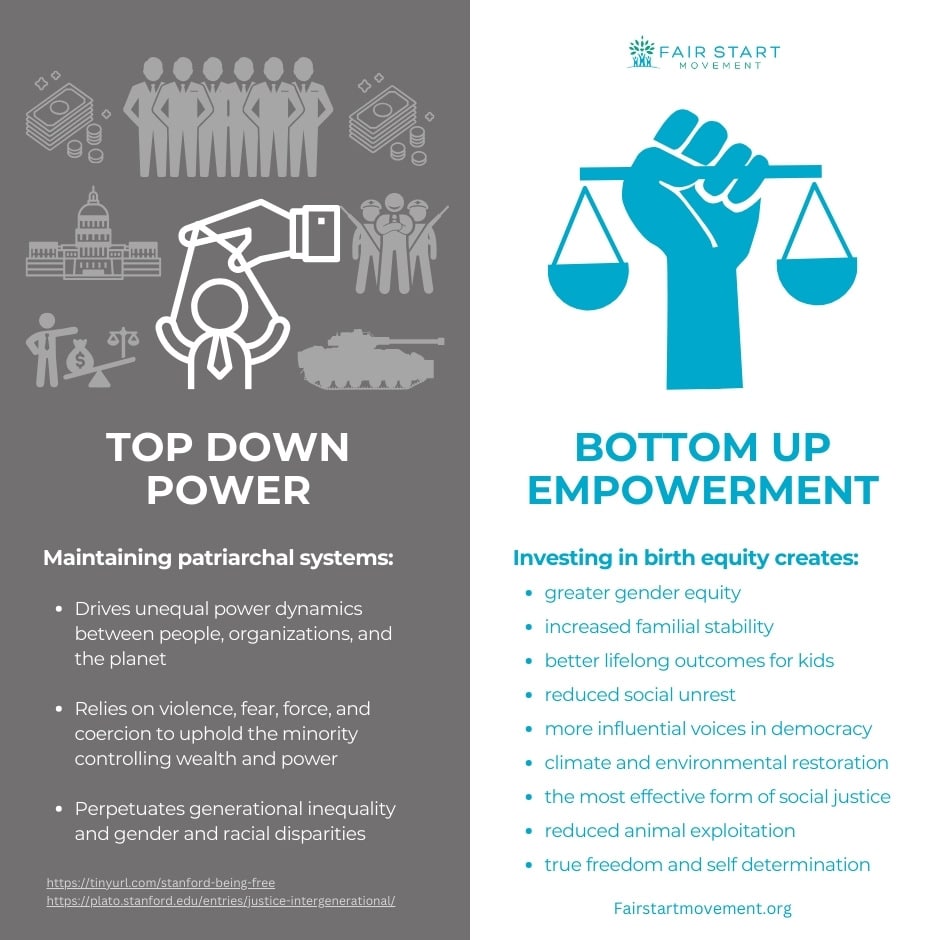
     

    Top Down Power and Bottom Up Empowerment infographic


    The standard Paul and many others used treats the baseline for harm as floating rather than fixed, and as things get worse in the world ecologically and politically, it does more harm. Why talk about Paul, and not big companies like Coke, for example? Fair Start does talk about Coke, but Coke never claimed to be saving animals. By doing so, Paul sets a standard.

    This is the question truly just people will ask: If Paul helped animals, he did so relative to what standard? Yes, he did better than Donald Trump, but using a floating scale, rather than the legally required threshold, leads to the situation we all face today: How could he be helping animals, while things have gotten worse for them on balance?

    The animal protection efforts of Paul and the activists were funded by the wealth illegally produced by that growth. That wealth (much of it intergenerational and derived from the arbitrary birth lottery – where and with what you are born determining your benefits and burdens – we see in the world today) drives much of the public interest work one sees today, and the death debt it owes as the climate crisis accelerates outweighs the charity it doles out.
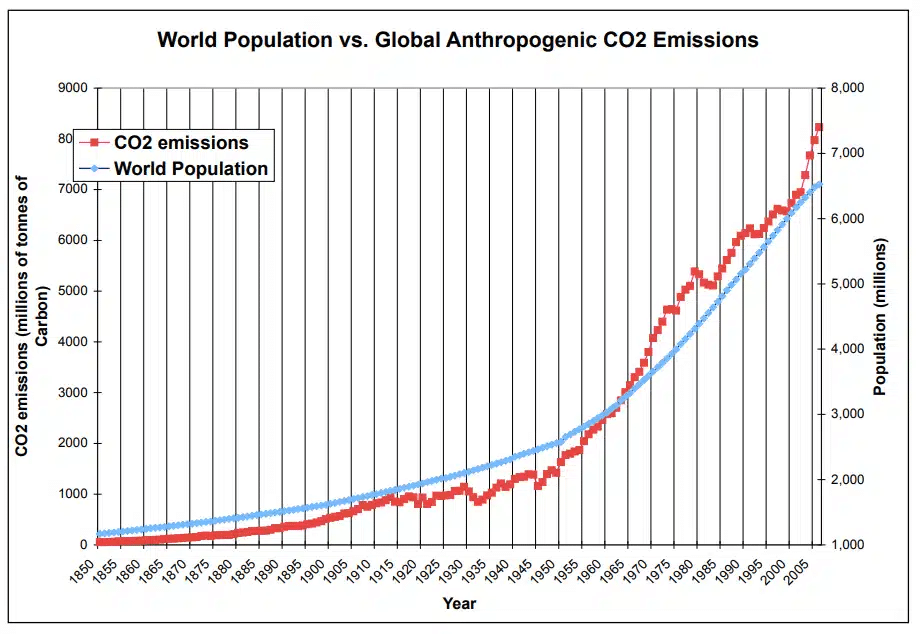
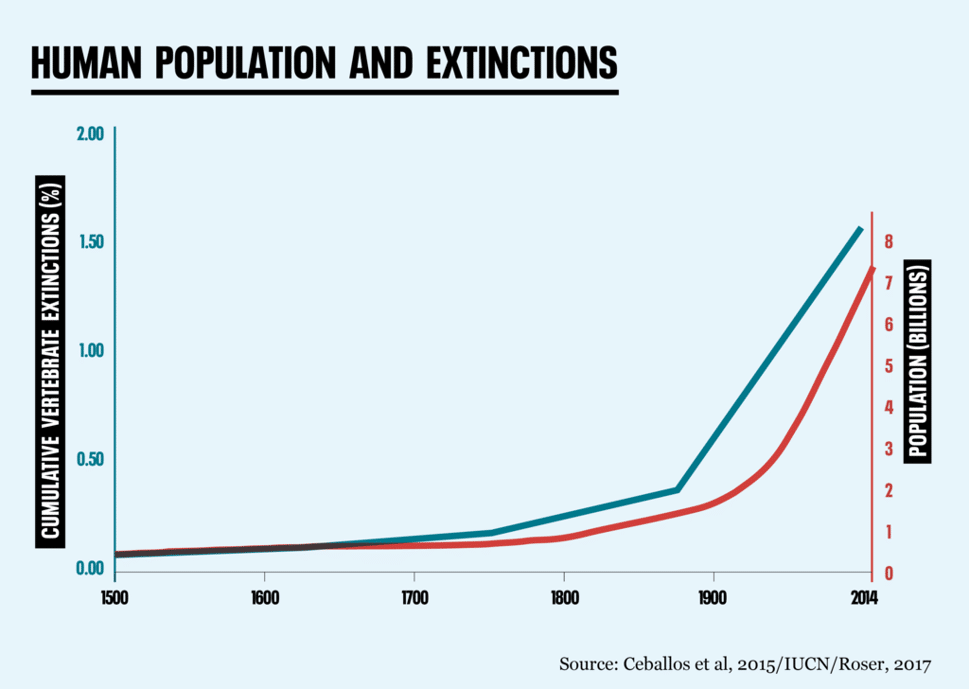
     

    World Population vs. Global Anthropogenic CO2 Emissions

    Human Population and extinctions infographic


    That growth arc has caused the death of millions as the climate crisis accelerates, and it is driving wealth – made at growth-driven cost to objective values like safe temperatures, participatory democracy, and equal opportunities in life – into the hands of a few.

    Use of that standard means Paul was and is part of a well-documented and illegitimate system of disenfranchising growth that did much more harm to animals, to say nothing of children, political equity, and legitimate and inclusive democracy, than he did good. But he benefited from that system, and does today. That standard uses manufactured numbers in assessing and reporting value – and fundamental justice means not using it. Yes, this constitutes fraud – benefitting at deadly cost to others based on the omission of material information – in terms of the most fundamental or constitutive sources of law: the norms that empower those subject to legal systems. 

    Paul values those norms too – things like safe temperatures, being heard and valued, a future with exponentially less animal suffering, having some control over the governments that have control over him, etc. That’s the nature of objectivity. But as things get worse with greater emissions, each person having less of an effective voice in their democracy, wealthy white children living at deadly cost to children of color, Paul’s business model accepts that degraded conditions as the new normal, as an acceptable baseline. If Paul were part of a system of mutual obligation and value, he would assess and report in a way that entitled all to the good things he values, and move towards Dasgupta’s optimality as discussed below.

    Paul continues to use that standard of illegally discounting future lives, with his public interest work having acted ass a decoy to enable his private success. He does so despite several written conversations with Fair Start activists urging him to change course, and join the Tell the Truth process of legitimating macro systems by elevating in his for-profit and non-profit modeling birth/political equity as the measure of political legitimacy, and accurate cost/benefit analysis. His position reflects a phenomenon we see time and time again. Persons, like Paul, back the idea of Fair Start in the abstract because they get something from that, but pushed to apply the standard in their lives and they will refuse, or in some cases go out of there way to hide liability. 

    But the truth is, there is no such thing as an anthropocentric animal protectionist. If one care about nonhumans, they will choose a future and limitations on the powerful to minimize animal suffering. Using a growth arc is the opposite. It would be physically impossible to protect animals without accounting for the relations they will form with humans, which means one has to invert the entire power structure to actually protect them.

    Part of the failure involved the organizational structures Paul and the other activists used – salary-based organizations designed to scale, but which simultaneously became reliant on the problems they claimed to want to solve.
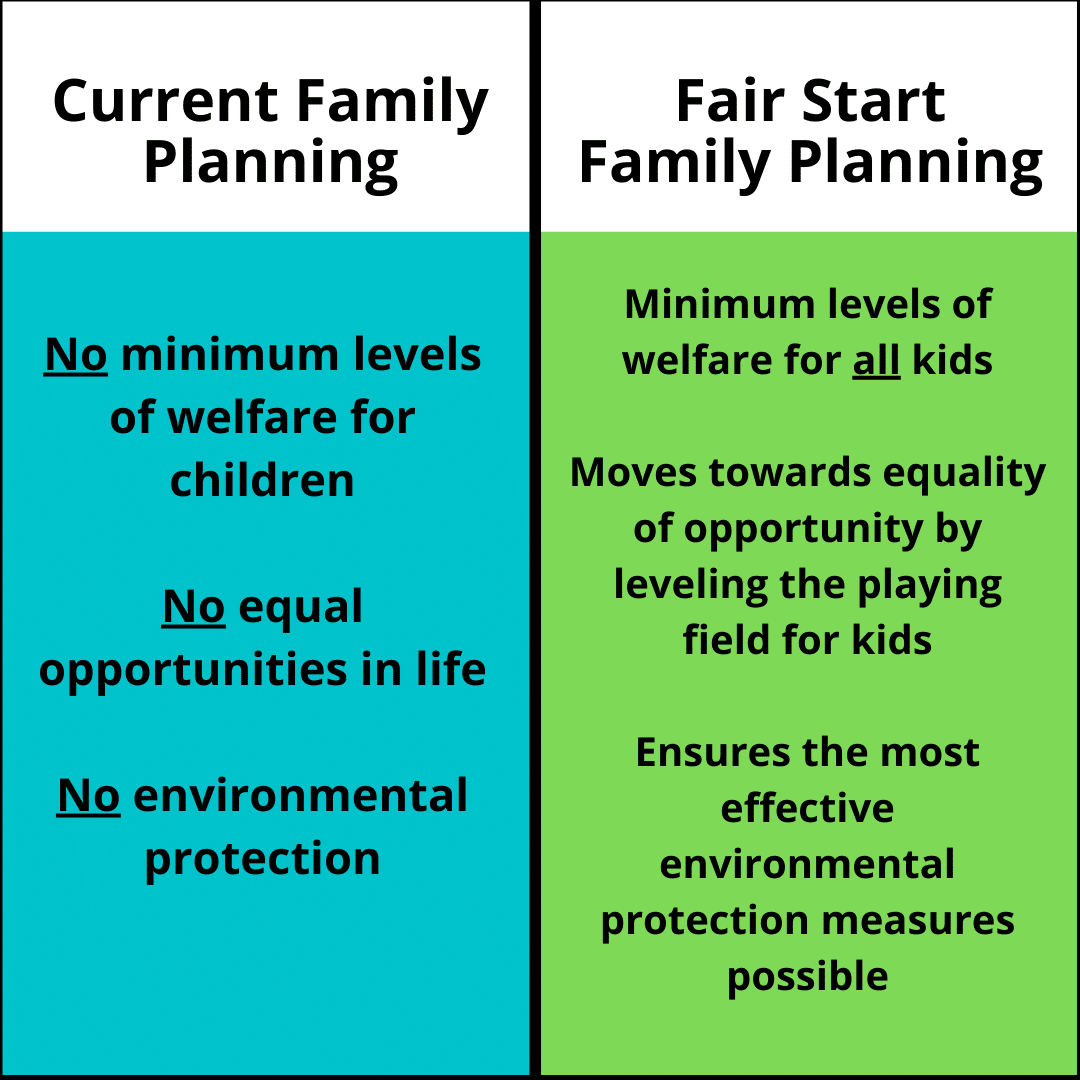
     

    Family Planning info card


    Run an AI query on how inequitable growth, on many levels, impacted animals relative to vegan and other food-based interventions over the last few decades. It will show the latter are relatively insignificant. Then run the query on how inequitable growth impacts political equity. Not only were food interventions ineffective and usually self-serving for those promoting them – they hid growing political illegitimacy. Self-determination has as a requirement each person being an influential part of a political system, holding political equity, a necessary condition blocked by the legal fiction of reproductive autonomy, which functionally reduced autonomy to the body – now disconnected – not needing to be part of an effective system of self-governance.

    There is a difference between using one’s privileged birth positionality in an illegitimate birth lottery to appear to make the world a better place, and actually making it a better place by legitimating the system itself through birthright empowering those subject to it. In particular, a key funder of the activists’ work at Compassion Over Killing used that same fraudulent standard to simultaneously limit the scope of animal law’s development through selective funding at key leading law schools, and in a way that exploited inequitable growth, benefitting him and others at deadly cost to animals, and vulnerable persons.

    Laws meant to protect animals have a negligible effect on their lives relative to the effect of humans having children, children that grow and interact with those animals, generation after generation, creating broader ecological and other outcomes. The former, by comparison, are charade version of impact.


    Don't Get Scammed: Charities, Media and Big Business Use Family Policy to Quietly Undo Progress. Ask This One Question Before Giving, Believing, or Buying Infographic


    Paul used his influential positioning in the animal protection movement to focus efforts on farmed animals as a vector to engage in relatively low-impact food reforms, premised on and omissive in reporting of, growth and an absence of children’s birthrights, and then positioned himself to benefit from that move at deadly cost to others absorbing the ecological, social and political costs of that growth. Farmed animals are not the most numerous category of existing animals exploited by humans, and future animals outnumber existing animals by far, but a farmed animal focus allows animal rights to be monetized around food reforms, and it was. 

    In many ways this move is the greatest example of the Winners Take All phenomena, because that original assessment of how social justice becomes a charade did not account for animal-inclusive liberation, the highest form of social justice. 

    The children of the funders Paul aided over decades are rich, and made so through a system of growth and birth inequity that is killing millions of other children. Many of those same funders pushed Fair Start activists to treat this injustice as a matter of downstream “population” framing, rather than upstream preemptive political equity, and to go to other funders for charity-based resources rather than birth equity entitlements and reparations. It’s more about disempowerment, given the overshoot of multiple thresholds including reasonable levels of representatives to voters and other measures of political equity, than overpopulation.

    They did so knowing that Fair Start and the vulnerable entities we represent would not be able to compete against the fraudulent modeling, and the wealth it creates.
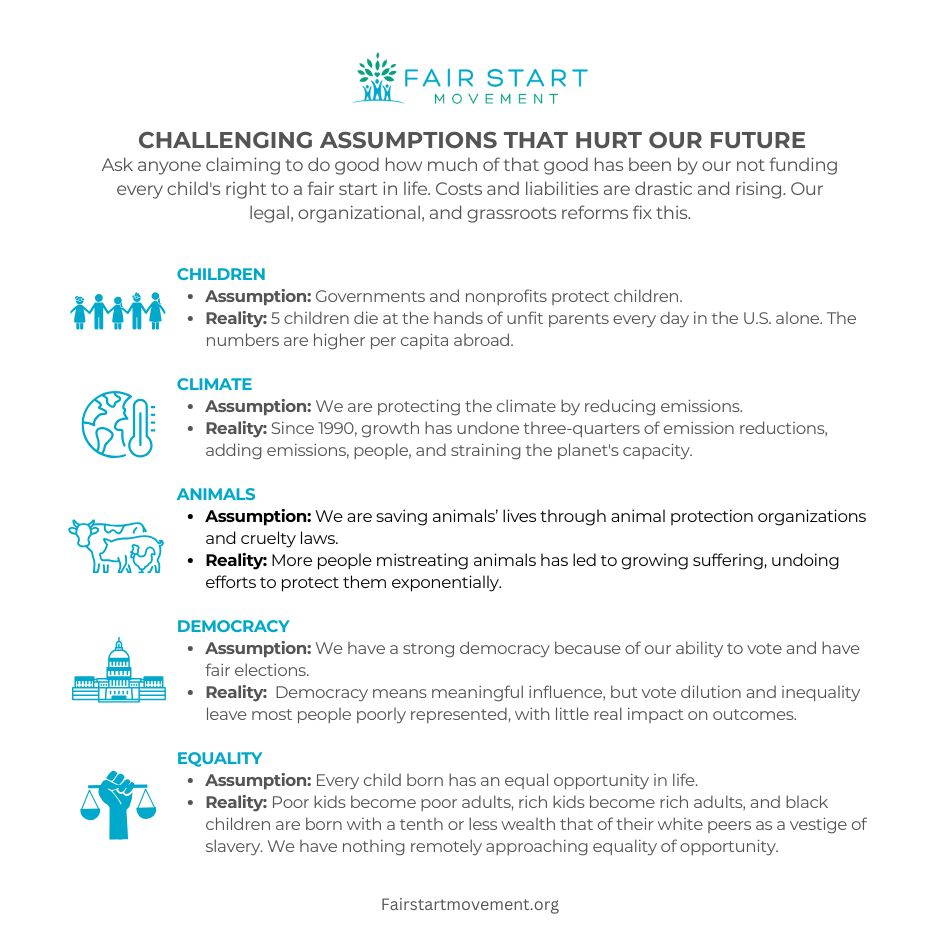
    Challenging assumptions that hurt our future infographic


    Facts:

    • Paul’s model exploits growth that treats children of color as worth significantly fewer resources and more risk. No child is worth more than another, but the model Paul and other activists used was premised on the opposite, and illegitimate, assumption. Humans are animals, and any attempt to protect nonhumans starts by accounting for the actual relations that form between them and children as they enter the world. Paul’s model skips this step and assumes total animal propertyhood, (and future person propertyhood as well) dividing nonhumans off into the object rather than subject and relational phase of the sentence, which allows him to appear to benefit them while benefitting from a system that fundamentally exploits them. Paul is then able to appear to benefit animals  – selling vegan products – but not pay the costs of a growth-based system that does more harm than he does good. 


    • The model ignores the fact that government’s authority, including to entitle wealth, has to be derived from the measurable empowerment or birth/political equity of those subject to it. Measurable birth equity as the overriding basis of legitimate governance is a yes or no proposition. This is not about liberals versus conservatives, vegans versus meat eaters, or pro-Palestinians versus Israelis. It’s about those who believe governance requires empowering those subject to it, and those who do not believe it. One of the costs of the model Paul uses is violence, with illegitimate state violence driving violence in general in societies, a situation in which the innocent – rather than the beneficiaries of injustice – are targeted.


    • The alternative model treats caring for children as the genesis of human freedom – not resistance to the state, but inclusion in it. Instead of using the idea of reproductive autonomy to undermine freedom and then sell back to people in a “free market” economy what they are owed in a legitimate democracy – nonhuman liberation, equality of opportunity, an influential voice, etc. – it makes allegiance to a political system contingent on such things shaping the power relations formed in birth and development.


    But how does the model actually work? 

    After World War Two, nations were legally obligated to derive and condition their authority on objective limitations – called human rights – of the power humans have over one another. Instead leaders used a subjective reproductive rights system devoid of child equity standards in order to privatize the creation – at birth – of power relations, a move initiated by wealthy and white concentrations of power at the United Nations. This is the fundamental injustice and driver of all the suffering we see today, as upstream growth that benefits a few undoes downstream interventions that should be benefitting many.

    These men started reproductive rights as a system that ensured they need not share power.


    A chalkboard drawing shows a machine with tools inside, turning stick-figure people on the left into dollar bills and coins on the right, symbolizing people being converted into money.


    One way to think of it:

    Women are told in the 1960s that terminating a pregnancy and having kids are both forms of bodily autonomy – a standard devoid of child equity, and child rights-based reproductive rights. By today many of those women, their kids and certainly grandkids will die in growth-based heat waves enabled by the absence of children’s birthrights, with their voices having been drowned out by population growth and political inequity. In short, they were robbed of enough influence over their political systems to stop the horrible outcomes. Worse yet? Environmentalists and animal rights activists would have hidden the problem for decades with downstream micro interventions undone by macro growth benefitting them and their funders, and with greenwashing/humanewashing interventions that looked good, but that defined “green” and “humane” with ridiculously low standards designed to benefit the investors/philanthropists funding the environmental and animal organizations at deadly cost to women and children.

    Today the massive bubble of money made in those decades hides what happened, drowning out vulnerable voices with wealth. What happened? World leaders used a fundamental system that defined power and freedom around visions of the coercive power of the state and escape/safety from it, rather than empowering citizens through measurable birth/political equity so that one is part of a legitimate state and need not fear and run from it. Had world leaders done the latter we would have gotten Dasgupta’s optimality – but with equity. They did not, and today when Paul and others go to assess value and report impact, they do so from a completely arbitrary baseline (the same one baselining the arbitrary birth lottery / privatized creation of power relations reproductive rights system driving the Anthropocene) that has nothing to do with the real world – nothing to do with the conditions that infants and women of color need to be free. His version of saving animals and the growth arc it assumes – the money he spends on elevating his voice – these things block a reform that would allow humans to actually limit the power others have over us, and save countless lives in the process.

    Instead humans vastly overshot ecological carrying capacities, legitimate political representative ratios, levels of equality of opportunity, minimal standards of birth-based child welfare, etc., with power relations that have little to do with the actual and measurable self-determination of peoples. And when Fair Start activists showed this research to wealthy U.S. funders in 2019 along with evidence their philanthropy was doing more to enrich their kids than further their stated missions, their reaction was to retaliate and hide liability. We are now in the process of telling this story, and bringing legal actions against these funders – who would rather ensure inaccurate legacies than actually do what they claim by factoring in birth/political equity as the key driver impacting the work.
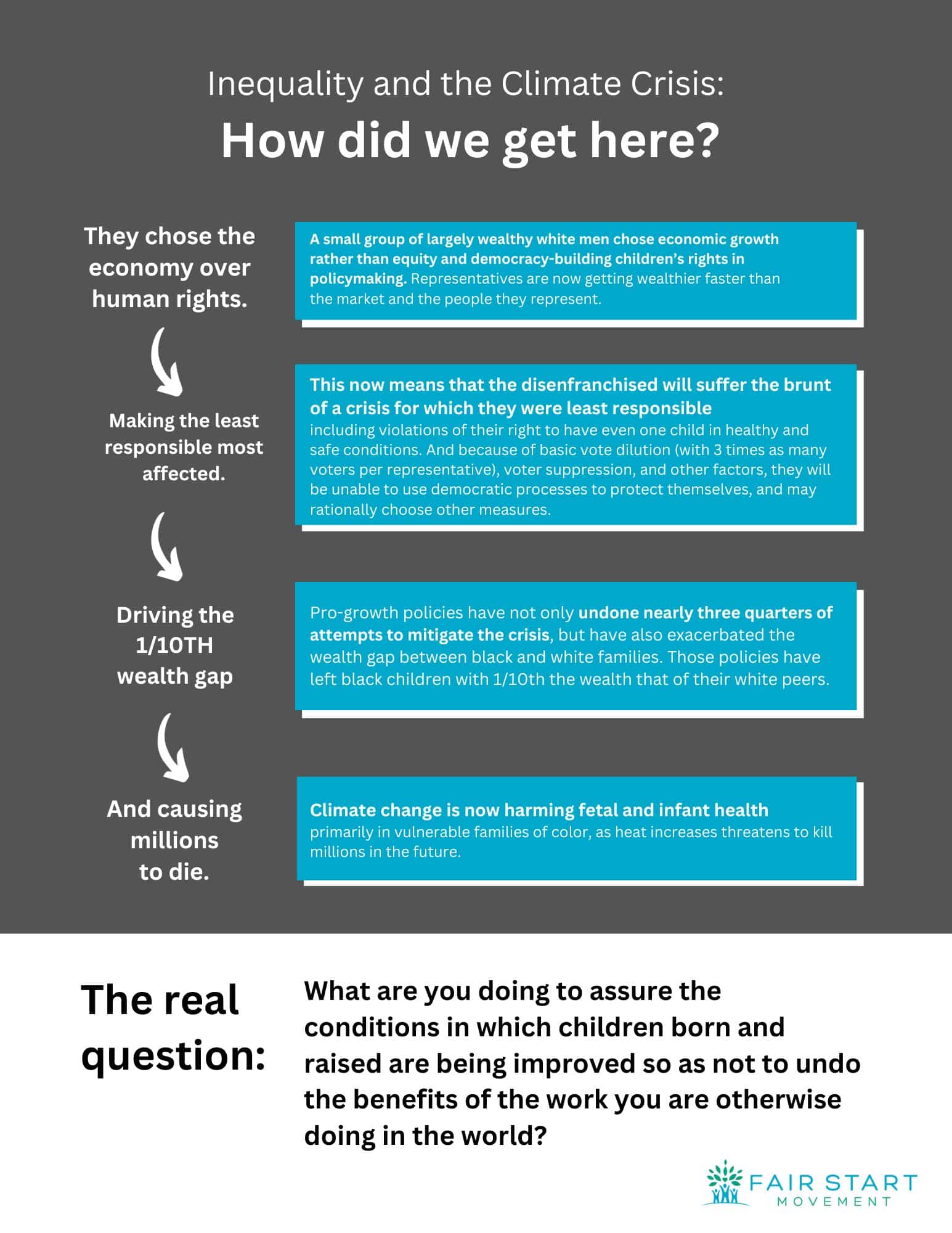
     

    Inequality info graphic

    Take Action:

    Urge Paul to Tell the Truth about the full context of his impact on animals, including use of a model that exploits macro forces like growth. Urge him to replace a growth-based model that exploits infants and animals and has no minimum threshold of empowerment for those infants as they enter the world, with a model that preemptively prioritizes a threshold of empowering/enfranchising resources, and equitable preparation, beneath which no child should be born. A fair start standard would ensure measurable self-determination for all, and specifically through a collective discourse that encourages parental delay, smaller families, parental readiness, and a collective process of birth-equity distribution inverse to wealth.

    Specifically, and especially given Paul’s work on false advertising, he should speak out in favor or a better future and embrace brith equity override, as others have done. He can also back forthcoming efforts at the Federal Trade Commission to prohibit use of the equity fraud model by both private and public entities.

    In Paul’s defense, this is a collective action problem and those first changing the model face a lot of resistance – but it will not be changed unless some come forward and animal advocates have a lot of failure to make up for. What passed as “victories” for animal protection advocates in the United States over the last several decades shows a standard that fully explains the political and ecological state of affairs we see today.

    This is not a personal attack on Paul – the personal is political, and Paul has the ability to make a great change.

    Telling the Truth about how we failed future generations, what we owe them now, and what we intend to do, is a discourse –  and unlike top-down and abstract national constitutions and even international human rights instruments – it actually obligates us in an empowering and self-determining way, situating us justly relative to others and at the most fundamental level. 

  • Animal Charities that Operate Scam Fundraising

    Animal Charities that Operate Scam Fundraising

    “Climate change doesn’t affect everyone equally, it hits the poorest children and communities hardest, deepening the inequalities they already face.”

    – Zahara Nabakooza

    The exponential growth enabled by birth and political inequity, the absence of any protective floor for children in reproductive rights regimes, did more to harm animals than any animal protection group has done to help them.

    Many animals charities assess the value they add to the world, and report beneficial impact, but relative to what standard?

    Most are using the same fraudulent standard of quietly disenchanting persons of color – and undoing value, on balance – that caused the climate and inequity crises today killing millions. This is the 20th century child-inequity standard that caused the climate crisis, and subverted racial justice movements. The standard removes political equity from reproductive rights and replaces it with manufactured numbers, like high pollution thresholds and diluted representative ratios that undermine democracy. This assessment and reporting standard is fundamentally designed to illegally enrich some children at disenfranchising and deadly cost to others –  mostly children of color, in violation of a long list of human and animal rights.

    Challenging assumptions that hurt our future infographic


    This is not theory. Fair Start and Truth Alliance activists have experienced organizations intentionally omitting information that would show their impacts being undone in order to avoid liability – exacerbating the risk to millions. 


    Family Planning info card


    Under this cost/benefit standard, some get the benefits of a coercive legal system without having to pay the costs of actually empowering those subject to it. Use of this #equifraud standard hides the fact that value and impact claims and micro-level interventions taken of context, were being undone everyday by the more macro forces that have destroyed our ecologies, democracies, and freedoms. Use of that standard shifted the true costs of wealth onto infants and animals did exponentially more harm – resulting in the deaths of millions as the climate crisis accelerates, measured by values we all share – than any of us did good. There is no set of values that doesn’t begin with infant health/equity, and no legal system could actually protects animals without first accounting for the creation of their disparate power relations with humans. 

    The solution to the equifraud?

    No one should start their work with injustice – start with empowerment-based obligation. The solution involves treating political equity and empowerment of all as the preemptive standard for legal systems including corporate civil rights obligations, and use fact-checking, whistleblower platforms, and legal injunctions to prohibit use of the political inequity standard. There are many other tactics as well.

    Free people will always need to legitimize the power – ecological, social, and economic – others have over them, power that starts as children enter the world, and avoid a fraudulent and illegal standard that exploits children as they enter the world by removing any minimum threshold of empowerment and protection rather than paying legitimations that offset the costs of wealth.

    Take Action: Before you give to any charity claiming to help animals, ask how they account for child inequity and the growth in enables. 

    Take Action: Join and back charities that are part of the Truth Alliance, and entity designed to block equity and impact fraud. 

    Take Action: Organize Truth Alliance work in your state, and urge state officials to do their job and recognize measurable political equity as the correct standard for legitimacy, and to derive and condition their authority on empowering their constituents.