“As we mark World Cities Day, let us celebrate the power of youth to build green, resilient and inclusive cities that meet the needs and aspirations of future generations.”
Fact: Neither the United Nations nor Guterres is ensuring such power. The statement is false.
How does Guterres actually account for children entering the world on what he claims to value and the good work he claims to do? How he is delaying children entering the world to create great conditions for them? Is he taking any action to constitute just nations, and ensure the good he claims to do is not being undone as children enter the world without what their rights promise them – things like equity, and health with reparations and debt/savings accounting for children as they enter the world?
No he is not.
And it is impossible to choose who has influence over you, to be truly free, without this reform. Those entering the world are either not empowered, or we all have no choice but to be subjected to their power and influence – including the degradation of the environment around us. We should instead empower the governed, not government and the wealthy.
What do we really owe to those who exploit children for economic growth rather than legitimately protecting and including infants as they enter the world?
By asking these questions you are looking for something called entitlement and impact fraud, originating in the formation of human rights regimes in the middle of the Twentieth Century. The fraud entailed assuming entitlements in violation of the constitutive self-determination of peoples through birth, developmental and emancipatory share equity in democracy, and – for decades – hiding those entitlements in a way that ensure the crisis.
Humans are animals. What we refer to as animal rights and law focus on nonhumans not because of their species. but because of their unique vulnerability. Why then not focus on infants and animals, and – at a macro level of inclusive animal personhood – the creation of fundamental power relations between the two? Those like animal rights theorist Peter Singer, and others, do not do so because that level of comprehensive vision involves equity, race, democracy, and other factors that require true tradeoffs against one’s positionality. Effective animal rights in this sense is personally expensive, not profitable.
It’s easier to ignore all of that and let the macro undo good for animals at the micro level.
True animal rights and law focuses on the creation of power relations, and limiting capacity to harm others – the capacity that is the core of the Anthropocene and the antithesis of animal rights. Guterres and the United Nations will have to eventually move away from anthrocentric systems, towards seeing humans as the animals that they are, and situating them in equity before there is any sense that they can be free.
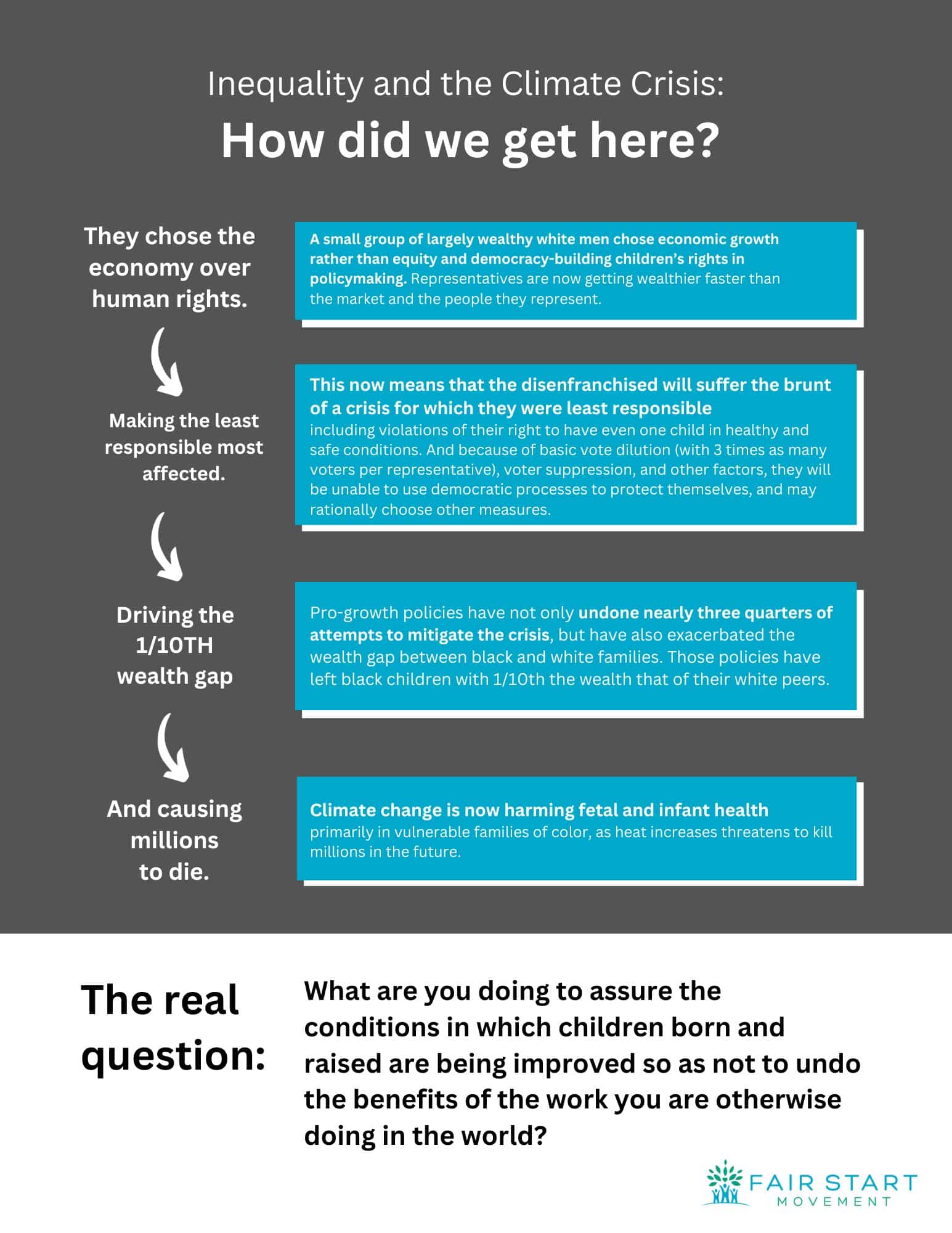
Concentrations of wealth and power, especially philanthropic funders, in those nations most responsible for the climate crisis often use institutions and individuals – media, nonprofits, governments, universities, agencies, think tanks, celebrities, etc. – to continue the entitlement scam, hiding behind a fantasy world of social justice impact that hides liability. The fantasy world ensures wealthy whites benefit at deadly cost to mostly persons of color.
This fantasy world, created mostly by entities that were operating without accountability or genuine constituents, have cost businesses trillions of dollars long run. A lot of environmental and other social justice agenda-setting over the last several decades came from institutions driven by philanthropy and familial wealth, entities – rife with nepotism – that are unaccountable to market and electorate forces. The climate/inequity crisis is going to cost business and government more than any other factor in the years to come.
Many businesses and governments now have claims against philanthropy and their low impact corporate campaigns that magically enriched some foundations and families at deadly cost to millions. Violence is one of the costs. Much of the violence we see in the world today derives from this failure, with disempowered persons acting out in systems of government incapable of truly representing them. Instead of those who benefit from this process carrying the risk of violence, innocents are usually targeted.
As early as 2003, activists now involved with Fair Start were urged by the nonprofits in which they worked to promote food reforms as a means to benefit animals, reforms they and their employers knew were being undone by growth and inequity which enriched only a few and create the chaos we all see in the world today.
Not addressing birth inequity allows some to treat inherited wealth and other privileges as somehow magically outside of the democratic process, and to use it, their positionality, and growth to slowly disenfranchise the average voter. We are now at a place where these families and their concentrations of wealth and power can use the wealth they made through the sustainability scam to attack the democratic process itself.
How is it not racist to refuse children of color a fair start in life? How should we handle those that refuse such fairness, even when it will kill millions as they are born without resources and in the path of danger? Why would anyone have to follow the rules in a system where they are not measurably empowered?
Most claiming to do good work in the world should be eager to ensure the fertility delay and readiness reparations discussed below because they compensate for the absence of the values of self-determination in current human reproductive rights regimes and evade harm to those values in the future. This avoids public interest work that is essentially performative, addressed to audiences that then undo the impact.
Fair Start reforms and debt/savings birth accounts mean no child’s life will be made worth more than the life of another. This reform targets the fraud wealthy white families and fake charities in polluting nations have been using for decades to hide liability for the climate crisis.
The concentrations of wealth and power you see in the world today have not created value. Instead they first illegally used their wealth to create their own audiences and artificial demand by ensuring dismal standards for child development and education, treating people as economic inputs rather than citizens whose influence offsets one another. In other words, to properly assess costs and benefits we have to first become groups of people capable of doing so in a way that is actually inclusive and reflective of the group constituents.
We can identify – on a binary spectrum – those who believe in linking children to debt/savings accounting to move towards self-determination, and those who do not. The rights of those who stand in the way are contingent on their supporting the rights of others, and their children will inherit their death debt if they do not pay it. Knowing the truth – that the default for what is fundamentally permissible depends on how we include and empower others – lets us overcome the most influential barriers to justice, and ensure a better future for all.
Please consider making a contribution through Donate. Together, we can create lasting change to save next generation
Today the Fair Start Movement has updated a legal action at the United Nations, originally filed November, 2021, as detailed here.
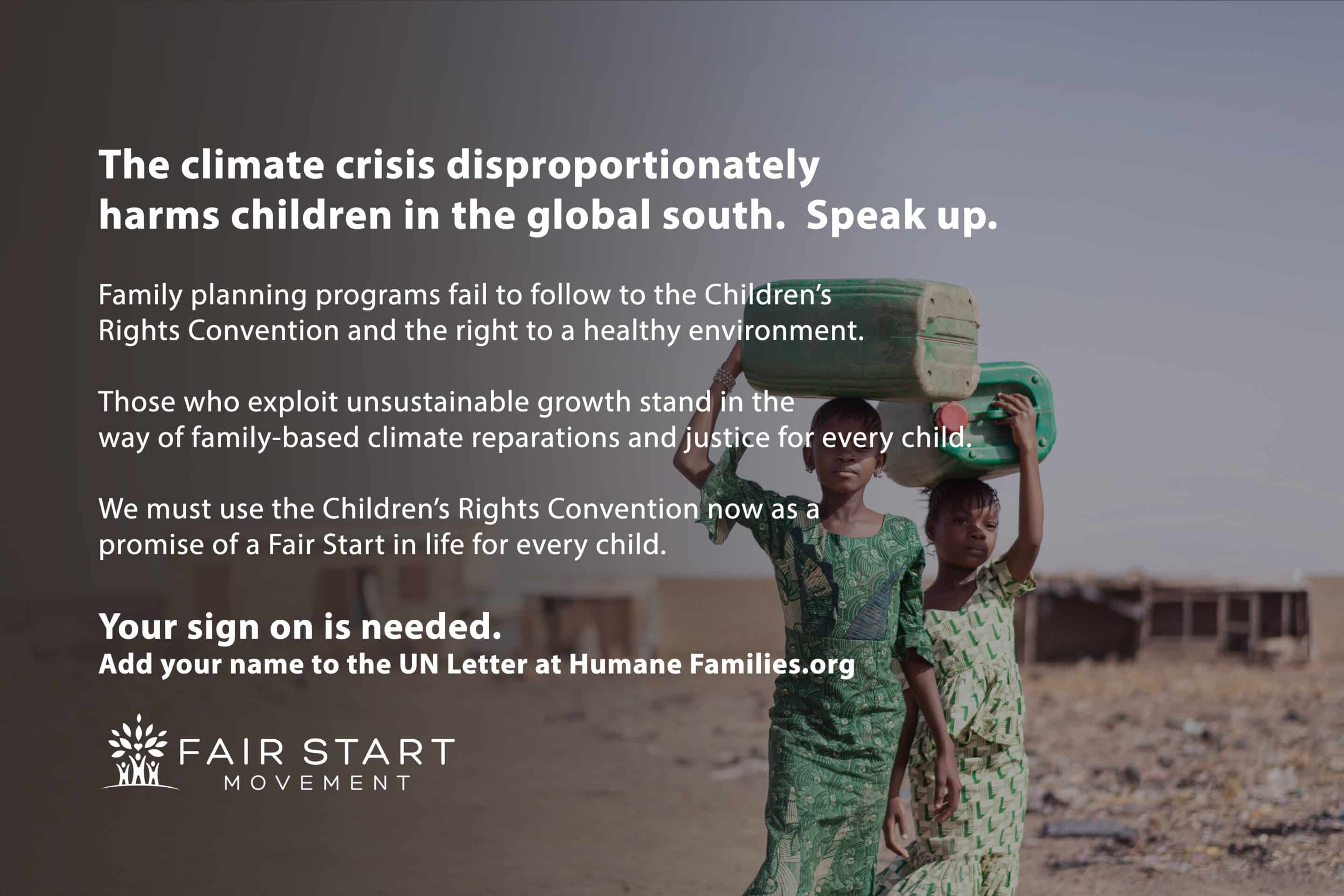
The filing today adds many new parties from Africa, India and elsewhere – and argues the current common formula for climate reparations and their priority use is based on the same fundamental false assumptions that created the crisis, and sets the awards too low – devaluing harms by trillions of dollars and ensuring millions of deaths of mostly black persons.
The filing solves what is the greatest collective action problem humans have every faced: Bringing children into the world in a way that ensures their measurable self-determination, rather than the massive inequity and ecocide we see today. The authority to govern derives from and is conditional on this, so the update urges action now even short of a formal statement.
The model the filing shows as overriding the current reproductive rights regime need not be ideal. It only has to be be better than than the current system, which is not hard to do given that it offers little in any protection for the values we all share.
This devaluation derives from a system of fundamental entitlement and impact fraud – a charade to protect illegitimate concentrations of wealth and power – begun at the United Nations between 1948 and 1968 that circumvented democratic processes, protecting concentrations of familial and church wealth that should have been directed to women and children. That move – at the most fundamental level – ensured the climate crisis and millions of deaths.
Esther Afolaranmi, the lead attorney on the filing, said this: “Do we all admit we benefitted at horrific cost to others, and saw the good we did set back by inequity? The evidence is overwhelming. If we can admit that we can move forward with mandatory reparations that override the United States and European states authority to protect wealth gathered illegally – in violation of the Children’s Convention – and at deadly cost to others.”
Read our cover letter, and general engagement form, below – and act.
COVER LETTER TO PETITION TO THE UNITED NATIONS: ADDRESSING ENVIRONMENTAL AND SOCIAL DEGRADATION AND ITS IMPACT ON FUTURE GENERATIONS
To:
The Secretary-General of the United Nations
United Nations Headquarters, New York, NY 10017 USA
I. Introduction
We, the Fair Start Movement (FSM), together with our global partners from Africa, China, South America, India, and women’s advocacy groups, present this petition to the United Nations Human Rights Council (UNHRC). We submit this as a continuation of our ongoing efforts to address fundamental legal oversights that allow environmental and social degradation to threaten the rights of future generations. We highlight the inadequacy of current international frameworks in recognizing and protecting these rights.
II. The Problem: Structural Flaws in Human Rights Regimes
Since 2008, FSM has consistently raised concerns about the failure of international human rights regimes to adequately ensure democratic equity and a “fair start” for all children. This failure is rooted in the absence of a standardized approach to public benefit claims and climate-related damage evaluations, allowing for rampant entitlement mismanagement that disproportionately affects the poorest and most vulnerable, particularly people of color.
The wealth amassed by a few, especially in developed nations, was acquired without paying the true social and environmental costs. The rich have amassed wealth at the cost of others’ well-being, including future generations who bear the brunt of environmental destruction. This ongoing crisis is exacerbated by the inequitable allocation of resources, as wealth is concentrated in the hands of a few, while millions are left to suffer the consequences of environmental degradation.
III. The Core Issues: Legal Authority for Fairness
Public Benefit Claims: Current legal frameworks lack standardized mechanisms to prevent fraudulent or inflated claims related to environmental and public benefit initiatives. This results in mismanagement of resources that should be directed toward addressing climate-related damage.
Climate Crisis Loss and Damage Evaluations: The failure to establish proper baselines for evaluating the harm caused by climate change prevents a clear assessment of the true impact on communities. This has allowed for continued environmental harm without adequate legal accountability or compensation mechanisms.
Equity for Future Generations: The right to self-determination for future generations is fundamental to national legitimacy. Governments cannot claim legitimacy if they continue to ignore the rights of children to equal participation in democratic processes. There is an urgent need for legal recognition of these rights, especially as it pertains to their environmental inheritance.
IV. Historical Oversight in International Law
The international human rights regime, established between 1948 and 1968, failed to prioritize democratic equity for future generations. Instead, it embraced a flawed framework that prioritized procreative autonomy—a value that benefited wealthy, often white families, while failing to ensure adequate investment in vulnerable populations. This oversight allowed unsustainable growth models to flourish, exacerbating global inequality and environmental collapse.
The lack of focus on equitable birthrights within the human rights framework has led to a crisis where marginalized populations, particularly in the Global South, suffer the most from a climate crisis they did not create. The legal frameworks of many nations and international bodies must be realigned to prioritize ecological and democratic equity for future generations, as the current systems continue to exacerbate inequality.
V. The Legal Basis for Reform
Under existing international law, including the International Covenant on Civil and Political Rights (ICCPR) and the Convention on the Rights of the Child (CRC), there is already a recognized obligation to protect the rights of children and the environment. However, these rights must be extended and strengthened to include a legally enforceable “Fair Start” principle that mandates equitable birth conditions and development opportunities for all children.
Article 24 of the ICCPR emphasizes the protection of children without discrimination. This must be expanded to ensure that all children are given equal access to resources, education, and a healthy environment, starting from birth.
Article 6 of the ICCPR guarantees the right to life, which must be interpreted to include protection from environmental degradation. This protection is not merely a moral obligation but a legal one, requiring the reallocation of resources from wealthy nations to support vulnerable communities disproportionately affected by climate change.
VI. A Fair Start for All Children
To address the climate crisis effectively, we propose integrating the “Fair Start for All Children” model into international legal frameworks. This model emphasizes:
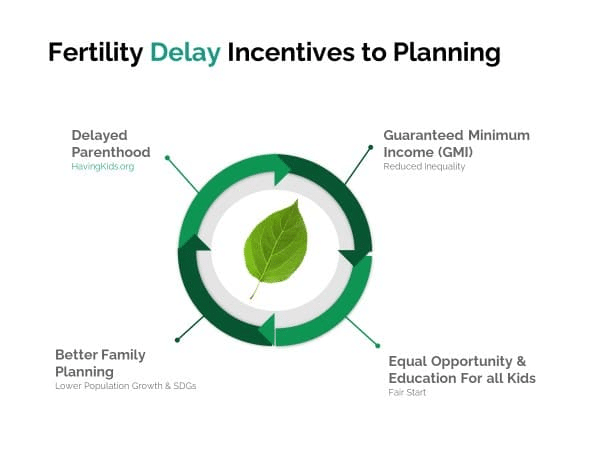
Family Planning and Delayed Parenthood: Encouraging sustainable family planning practices that align with environmental and social equity goals. This includes ensuring that children are born into conditions that support their full development and capacity for self-determination.
Redistributive Justice: Redirecting wealth from those who have accumulated it through unsustainable practices to fund environmental reparations and support vulnerable populations. This can be achieved through the establishment of planning accounts for young parents, ensuring they have the resources necessary to raise children in safe and equitable environments.
Recognition of Collective Rights: Encouraging collective models of family planning and care that move away from individualistic approaches, which have historically benefited the wealthy at the expense of the vulnerable. Such collective efforts would ensure that all communities share the burden and benefits of environmental and social reform.
VII. Holding Wealthy Nations Accountable
The climate crisis has exposed the deep inequalities embedded in international economic and social systems. Wealthy nations, particularly in the Global North, are primarily responsible for the environmental harm that now disproportionately affects poorer countries. It is imperative that:
Reparations for Climate Damage: Wealthy nations must be held legally accountable for their role in exacerbating climate change. This includes providing financial and technical assistance to developing countries to help mitigate and adapt to the effects of climate change.
Redistribution of Wealth: Wealth accumulated through unsustainable practices must be redirected to support initiatives aimed at reversing the damage caused by climate change. This includes funding sustainable development projects, renewable energy initiatives, and ecological restoration programs in the most affected regions.
Legal Accountability: International and national legal systems must evolve to hold individuals, corporations, and nations accountable for their role in environmental degradation. This includes establishing mechanisms for litigating and compensating for climate-related harms, as well as enforcing stronger environmental regulations.
VIII. The Urgency of Action
The time to act is now. The failure to address these issues threatens not only the survival of future generations but also the legitimacy of political and legal systems worldwide. We urge the United Nations and its member states to:
Implement legal reforms that standardize public benefit and climate damage claims to prevent further fraud and mismanagement.
Prioritize the rights of future generations by incorporating the “Fair Start” principle into international human rights frameworks.
Hold wealthy nations accountable for their disproportionate role in causing the climate crisis and ensure that resources are equitably distributed to mitigate its effects.
IX. Conclusion
This petition calls upon the United Nations to take immediate and decisive action to address the root causes of environmental degradation and social inequity. The rights of future generations must be protected through legal reforms that ensure democratic equity, fair distribution of resources, and accountability for those responsible for climate damage. Only by enacting these changes can we hope to secure a just and sustainable future for all.
USE OUR ENGAGEMENT FORM BELOW TO JOIN THE FAIR START MOVEMENT
[Fill in the name of a person or organization] is doing great work, but to avoid them undoing it they should admit that children entering the world without what their rights promise them is cancelling the benefits of the work for most, driving up the costs of race and climate reparations – the death debt, reversing sustainable development, and ensuring violence as temperatures rise.
[Fact / Value Check: If the person or organization does not back overriding current systems to measurable empower and repay children for climate harms as they enter the world, are they doing more harm than good?]
Many have admitted the undoing – vegans, for example, who know inequity/growth does more harm than dietary change does good and have started to fix the problem by admitting the undoing and instead backing fair starts in life for all children as the preemptive standard for national legitimacy.
This inversion of power systems offsets our positionality, and any false claims we might have made (as many now working with Fair Start previously did), to allow unifying self-determination for all. Rights to wealth are not inherent but contingent on each child in the nation being empowered with equity and thus emancipated in particular ways.
At bottom, if we can’t admit we failed and reorient ourselves, we will be saying that mostly children of color who had nothing to do with climate and related crises should suffer and die, while mostly white families who benefited and, in many cases, perpetuated the crisis by exploiting children rather than creating value should live and profit. These entities generally did not create value so much as create their own audiences and demand by preventing sufficient investments in children to make them self-determining in quantity and civic quality, enough to evade growth-based catastrophe.
Grist is a nonprofit media organization that makes this claim:
Grist is a nonprofit, independent media organization dedicated to highlighting climate solutions and uncovering environmental injustices.
Facts:
On any given day Grist made claims about someone or some action creating benefits in terms of ecological protection, those claims were being undone as children entered the world under without entitlements to minimum levels of welfare, share equity in their democracies (equity, like equity in a company, where you have a measurably equal and influential role in outcomes) or entitlements to the legitimate political systems that derive from the share equity of their members.
To further values like ecological protection, entities like Grist would need to include those values in the first premise of who humans should be and become in terms of the creation of basic power relations, and entities undo the values if they do not include them. While including those values in the premise is not popular with funders or seemingly progressive media whose wealth derives from inequity, that does not change the reality of the impacts – including suffering and death – and the justice owed for those impacts.
An entity either starts with a measurably inclusive and thus liberating system that accounts for the birth, developmental and emancipatory positionality of its members, and relative costs and benefits, or they do not.
There is no evidence Grist factors in equity in its coverage, and much evidence that they omit the impacts of inequity.
Many involved in the Fair Start movement had to, in prior employments at nonprofits, governments, media corporations, and universities, omit crucial facts about inequitable growth impacts that were actually undoing the public benefits the organizations claimed to create, and as such helped illegally enrich mostly white children at deadly cost to millions of children of color – hiding massive liability and skewing the baseline for crucial climate reparations.
In one case a member of a prominent and wealthy family funding animal law projects insisted on omitting the role inequity and growth on their charitable impacts claims, knowing these omissions were hiding drivers doing more harm to animals than the funder’s work has done good. They feared how full-spectrum evaluations of claims, costs and benefits, around the climate and related crises, would impact the family’s wealth.
Not orienting from equity risks millions of lives as well as trillions of dollars in climate reparations, and illegitimates political systems by treating subjects as means bound in inequity, rather than empowered ends from whom governance derives. If one wanted to decolonize wealth and the future, one would have to start from a position of not punching down on children and animals – and that requires a constitutive threshold.
Many involved in the Fair Start movement had to, in prior employments at nonprofits, governments, media corporations, and universities, omit crucial facts about inequitable growth impacts that were actually undoing the public benefits the organizations claimed to create, and as such helped illegally enrich mostly white children at deadly cost to millions of children of color – hiding massive liability and skewing the baseline for crucial climate reparations.
In one case a member of a prominent and wealthy family funding animal rights projects insisted on omitting the role inequity and growth on their charitable impacts claims, knowing these omissions were hiding drivers doing more harm to animals than the funder’s work has done good. They feared how full-spectrum evaluations of claims, costs and benefits, around the climate and related crises, would impact the family’s wealth.
TAKE ACTION: URGE THE LEAD AT GRIST TO COVER ISSUES AND STORIES IN A WAY THAT INCLUDES EQUITY AND ITS ROLE IN DETERMINING OUTCOMES.
The National Park Foundation has announced great news:
The National Park Foundation (NPF) today announced a historic $100 million grant from Lilly Endowment Inc. This transformative grant — the largest ever received by NPF and the largest grant benefitting national parks — celebrates a pivotal moment in safeguarding the future of America’s treasured national parks.
We can’t really become ourselves, and live authentic lives where we self-determine rather than determine the lives of others, without ensuring all children a fair start in life as the first human right.
Without this right in place, we have been able to exploit race/wealth based birth positionality and growth to benefit ourselves at deadly climatological other costs to others.
The current systems of family entitlements allows us to benefit while impacting the future majority in a way that will kill millions because each of us is not forced to account for the birth, developmental, and emancipatory positionality that gives some – mostly whites – a massive head start in life, and everyone living today the ability to make choices for others in the future instead of similarly making choices for themselves.
If we want to run life as a race, we should try doing it without a head start. We should do it with rules that are based on the values we all live, and rules that don’t immediately position some over others, that don’t exclude most from rulemaking and access to accurate criteria for assessing truth and value, or that ruin the track for future runners such that they die by the millions.
We should be runners, and not choosing for others in ways that don’t allow them to run.
We should understand that there is a difference between being popular, and being right. Millions dying from a climate crisis suggests we were not right, and should start all we do assessing why. Growth creating demand at cost to freedom, and even access to the criteria to accurately asses truth and value, suggest culprits.
By the numbers, most least lives that are anything but self-determining, or free. Why? Because this most basic rules was never in place: Young would-be parents have a first and overriding claim to societal resources if used to parent us into a better future, using metrics that combine to create a threshold above which children may be born, but beneath which no child should be born.
Without this it would be physically impossible to be free because we could not limit who has authority, power and influence over us. We could only try to limit who represents us – not who actually has – day to day – influence and power over us.
Free persons will see themselves as first obligated to persons who will parent and empower their children into emancipation, rather than first ruled by those at the top of the influence pyramid, e.g. officials, the wealthy, CEOs, celebs, etc., because all entitlement to influence derives from the governed and their primary and equitable positioning to self-determine, rather than government and current influencers, which have no inherent authority.
Would-be mothers who will physically constitute the future have the first right to use the most effective means to obtain the resources they need, to ensure freedom for all, and more of a right than the men with guns in government who masquerade as their representatives because there is no coherent, and necessarily primary, “we” without this override function. Those who wish to die orienting their lives from a position of freedom should consider this.
Here are eight metrics, and how then can be used to assured share equity entitlements, including reparations for climate harms. We cannot evade impacting all these values when we have children, hence
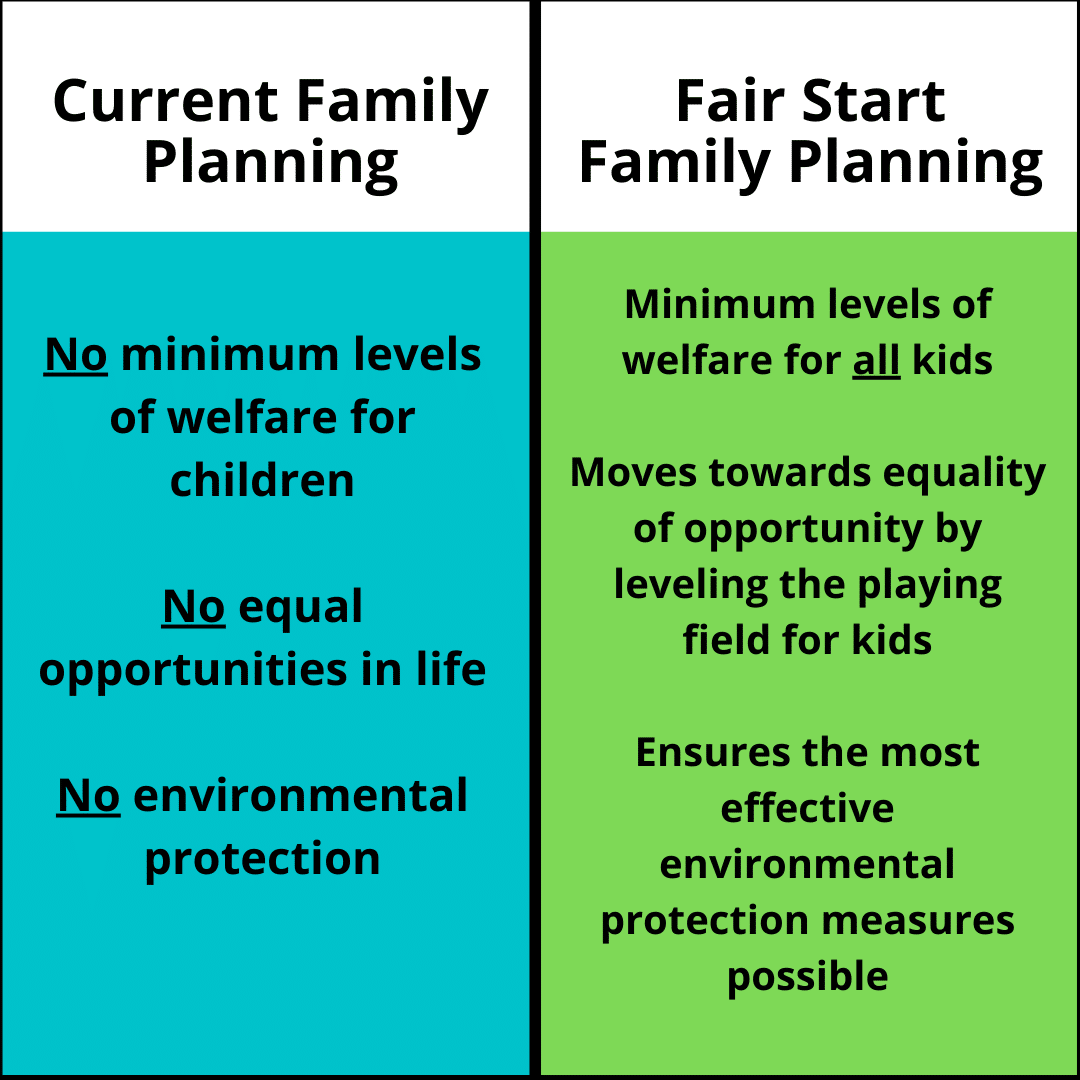
Welfare standards for birth, development, and emancipation – ensuring things like health, nutritional and educational outcomes that are measured based on the world as it would have been had the United Nations in1948 actually used self-determination – rather than the right to determine the lives of others with the entitlements they assumed – as the standard for who we should be. An example might be flexible savings accounts containing ten thousand dollars, in place before any child is born, to ensure everyone can have at least one child safely if they choose to.
Nature/environment (e.g., measurable emissions) – limiting emissions to levels that would not have caused the crisis, generally less than 280 ppm, and requiring the restoration of full biodiversity towards optimal ranges consistent with low-end UN growth projections.
Successful parenting – ensuring that parents do no regret having children, including eliminating cases of neglect of abuse, through successful planning. Would-be parents contributing twenty-five percent to the savings and debt accounts, including through credit earned by parental readiness training, would further this goal.
Having an equal and influential share to determine all laws, including constitutional provisions – limiting representative ratios to those fitting with low-end UN growth projections.
Democratic, not economic, levels of trust – Metrics for trust among citizens must show their willingness to trust each other with legislation, and all lesser included forms of trust that implies.
Self-determination, or share equity, to limit the influence others have over you – Whether you are free requires an amalgamation of the other metrics above.
They helped ensure rules for the game, and most importantly the first rule of who we should be in terms of the creation of power relations, to move the key costs on to others, and to create deadly criteria for truth and value (like demand created by not investing in birth and development conditions) by ensuring the average person could not patriciate in the rulemaking. Their wealth is owed back, and the demand overrides any government’s right to block it because the process of investing in equitable birth and development positionality is what makes governance inclusive, capable of representation, and hence legitimate.
National legitimacy, and the ability of nations to assign entitlements to wealth and to protect the lives and property of the wealthy, is contingent on human rights that empower subjects as political equals. This is the first human right, the right to share equity – or an equal and influential role in self-determining limitation of the power and influence others have over you.
Whether nations are assuring the right can be measured with discrete metrics – metrics that were hidden by those structuring human rights in favor of using arbitrary standards, like market demand manufactured through low standards for child welfare and development. The sovereignty and legitimacy of nations derives from the sovereignty – or self-determination – of its subjects, and an easy measure is whether each new child born into the world is seen as capable of offsetting or countermanding the vote and voice of existing persons, relative to a neutral threshold.
That would show they are truly empowered as political equals, and we would invest heavily in them – starting with a reproductive rights model actually based on children’s rights to conditions of birth and development that ensured inclusion – to ensure they used that power responsibly.
Between 1948 and 1968 in the wake of World War II, the United Nations and member states were obligated to use objective values and human rights to limit the power of nations over their citizens, in order for those nations to remain legitimate, sovereign and authorized to make laws and enforce them, as well as to entitle wealth and property. Underlying this process was the assumption that sovereign governments have no inherent authority, but derive it from the sovereignty / self-determination of their citizens.
This defined freedom as the powerful determining the vulnerable, for current over future generations and rich over the poor. It made liberty doing whatever you want to do, and autonomy as somehow existing outside of collective equity or democracy where each person eventually can offset the influence of others in a measurable way, and control through rulemaking who has influence or power over them.
Yes, a woman could choose to terminate her pregnancy or not as an act of bodily autonomy, but not be free from dying (with or without a child) in a growth-exacerbated heat wave because she could not afford air conditioning. That sense of bodily autonomy was not freedom after all. This gave the average person enough room to harm their own progeny, and it defined our criteria for assessing truth and value, our language, our capacities to influence the world around us.
It limited what it meant for us to “be who we should be.”
As many theorists have seen, this is the fundamental paradigm to overcome, this corruption of freedom, to do the most good.
All policy starts with who we should be, or children’s rights and the line or threshold of true self-determination below which children should not be born, and above which children may be born.
You either agree to that line as a primary obligation or not. That line is set to a threshold of zero based on hard metrics linked to physical conditions in the world, and it is much is easier to see and achieve in a collective setting like care modeling than a nuclear family.
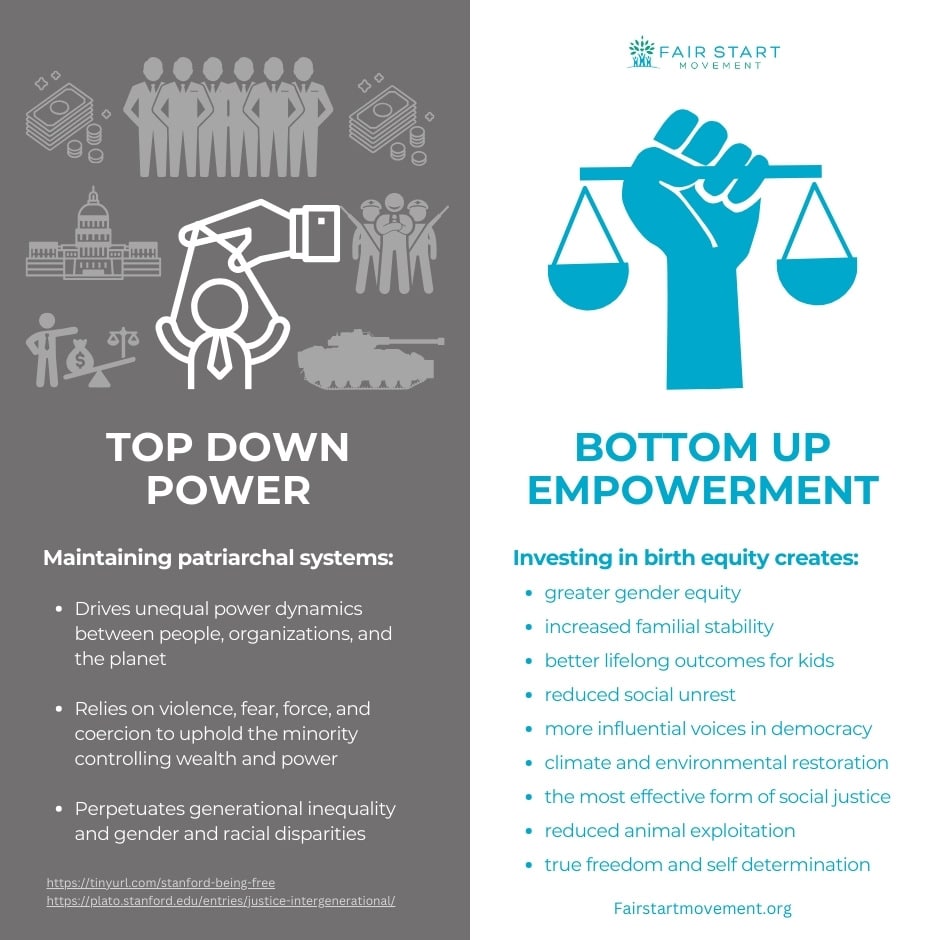
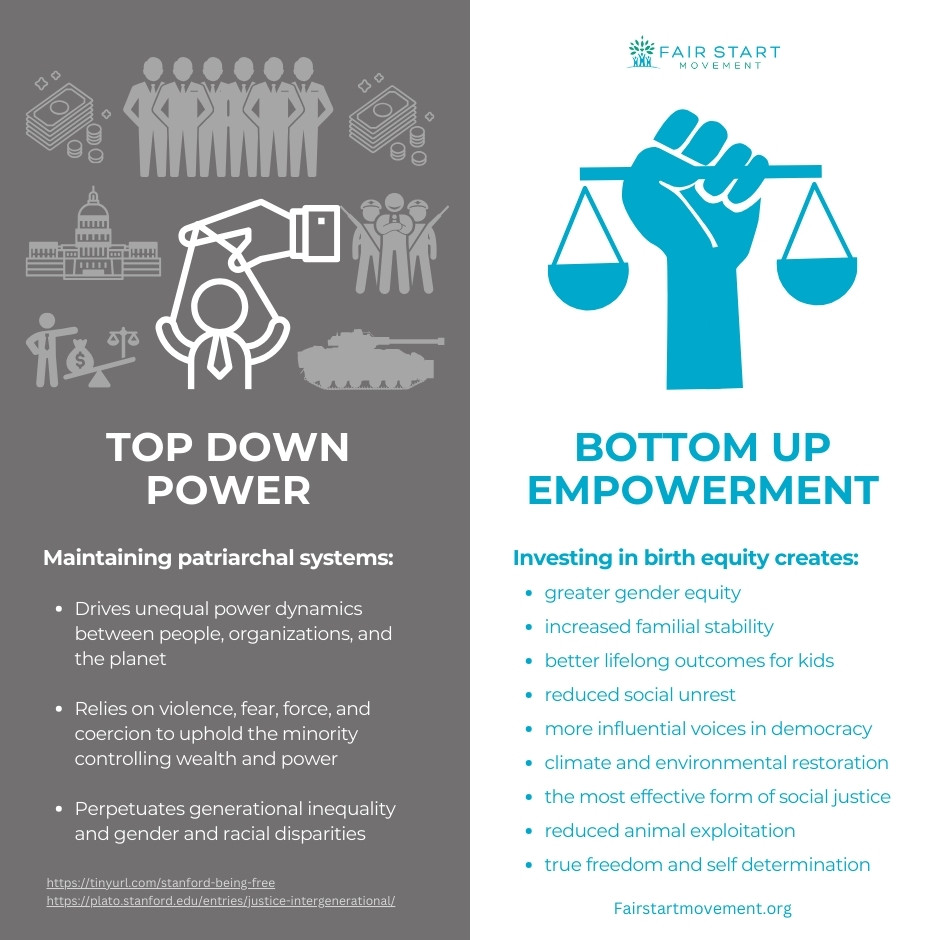
This is a binary choice between acting obligated towards bottom-up systems of investment and inclusion, or top-down systems of governmental violence that exploit low levels of child welfare to create growth that kills animals and destroys nature.
We can test anyone for which side of the binary they fall on by asking them regarding claims they have made about values and impacts, relative to the facts of children entering the world on the day the claims were made. Ask them about the horror stories – the abuse, the ecocide, the disenfranchisement, the power differentials – arising from the zero entitlements and functional protections for children and animals as children entered the world.
Ranking those who make that choice to find the most influential, and targeting those who matter the most in terms of the harm they do is one tactic to ensure change. Among those most problematic are actually those decoys from social justice funded by wealthy investors, those that seem to do good but are meant to hide how creation drives inequity.
They will define values like “green, :”mercy,” or “inclusive” to benefit the rich children of investors, not the truly vulnerable. This clouds the criteria for assessing truth and value. We can’t legitimately create economic demand by violating children’s rights, including the rights to sufficient levels of education to understand how power works. We can’t fill shopping malls that drive animal suffering and extinction by cutting citizens off from being born and raised into town halls. Those who do, and pretend to further animal rights, do more harm than good.
Consider that understanding self-determination in this way changes the legitimacy of nations to use violence under the guise of being representative. How could they legitimately uses it to halt would-be parents who would need resources in order to meet the line, and thus be truly inclusive, legitimate and authoritative?
Focusing in the vulnerable in this way also makes permissible registering the children of wealthy families and engaging them directly when they reach the age of majority because family transfers of privilege can be seen as primary and be openly discussed rather than hidden behind the veil of privacy. Many concentrations of wealth and power have shown themselves to be impervious to moral persuasion, and will continue to hold and use illegal entitlements until they think their children will not benefit but lose from their doing so.
This last change is crucial – many will justify to themselves choosing fundamental injustice if they believe they are doing it for their family, especially their children. Many in the Fair Start Movement have known law professors that lied about the impacts of their work, and the liability they were creating, to ensure more wealth for their kids. To smash the illusion of continuing to see family as somehow outside of the social contract, and to instead ensure truth and justice, mean disincentivizing this sort of excuse.
The New York Times Co. is an American mass-media company that publishes The New York Times, its associated publications, and other media properties. Its headquarters are in Manhattan, New York City.
Claim: “The Times publishes hundreds of pieces of journalism every day. We apply ethical standards and rigorous reporting to every article, video, podcast, newsletter and interactive we produce.”
Facts:
For years the Times published articles and essays omitting crucial facts, facts that would have shown that the beneficial impacts of the environmental, antiracist, human rights, child welfare, and many other policies and processes being covered were being undone by inequity and growth. Those omissions benefitted Times leadership, at deadly cost to others.
And saying that is not controversial, or controvertible. Google “New York Times” and things like “children’s rights” or “child welfare.” On any given day an essay or article was published lauding such things, the Times omitted that more children that day were being born into conditions that violate their rights than were being protected. Look for actual, functional protections in terms of limits on the conditions in which children could be born, and hence their environment protected.
You won’t find them. Why? Because of the need for growth, growth – having already exceed atmospheric carrying capacities – that would ensure the violation of countless children’s rights in the future. This went well beyond the Ponzi scheme Nobel laureate Steven Chu saw, and into a multi-faceted and deadly thing.
The Times routinely uses and has used terms like sustainable, green, eco, humane, democratic, inclusive or similar value terms to describe policies, states of affairs, and /or objective values/measures which rigorous research and reporting would have shown were being vastly undone by unsustainable and inherently racist policies (like inherited economic inequity) accelerating the climate crisis and deadly inequity. The Times routinely framed environmental issues as liberal, and under an ethos of top down protection, which according to research has divided audiences over the issue, instead of correctly covering the more antecedent, unifying and accurate issue of democratic share equity as a driver of environmental outcomes.
The Times routinely covered issues of animal rights without ever including the driver of animal oppression, the creation – in the birth and development of humans – of our relations with them. The reporting, around things like veganism, treated animal rights as consistent with growth-based consumerism, and dietary change as an on-balance benefit for animals. That is inaccurate, hid the main drivers of climate change and the extraction of wealth ensuring inequitable outcomes, and in many cases was accompanied by stealth advertising.
The Times also routinely covered political institutions and those claiming to represent constituents, while omitting how easily measurable growth and inequity were undermining any possibility of any accurate representation. Times editors and reporters benefited from these omissions, forestalling things like expensive liability in the United States for birth equity reparations that would have moved towards representability. While the Times is critical of symptoms of growth and inequity, like the rise of Donald Trump, its reporting has stymied attempts to change the cause, the fundamental allotment of entitlements that created him. In similar form, the Times routinely covered affirmative action and other more cosmetic fixes to racism, even though that framing is divisive of the vulnerable on both sides of the political spectrum.
A assessment of recent coverage shows more reporting by the Times that would qualify as advertising, including advertising to children, than of violence around the nation and world that is at least partially driven by correctable incentive structures and entitlements that also benefit the Times and its leadership. When it does report, the coverage avoids drivers like economic and other caste-class based motivation, or political disempowerment, in favor other more topical explanations.
While the Times may feel it has been reducing the likelihood of violence of a political nature by not covering that side of violent events, it may be doing the opposite, concealing a backgrounded but fundamentally relevant system driving violence. This driver will become more salient as temperatures rise and growth-based inequity disempowers the average person, crowding them out of town halls where they can self-determine and into shopping malls where they are determined by others.
The coverage above ignored the overriding nature of child development entitlements in favor of downstream concentrations of wealth and power that were exploiting those children. This is not about freedom of speech, or journalistic autonomy, but a powerful entity misreporting facts and values to benefit itself at deadly cost to the vulnerable.
How inaccurate was the reporting, given the omissions?
All facts and values are relative to the thresholds and baselines discussed above, and any reasonable editor would reorient assessments of any story when it became clear that basic assumptions about relative positioning were likely to kill a billion innocent persons.
Failure to account for these crucial facts makes the reporting and essays inaccurate.
Are these omissions racist?
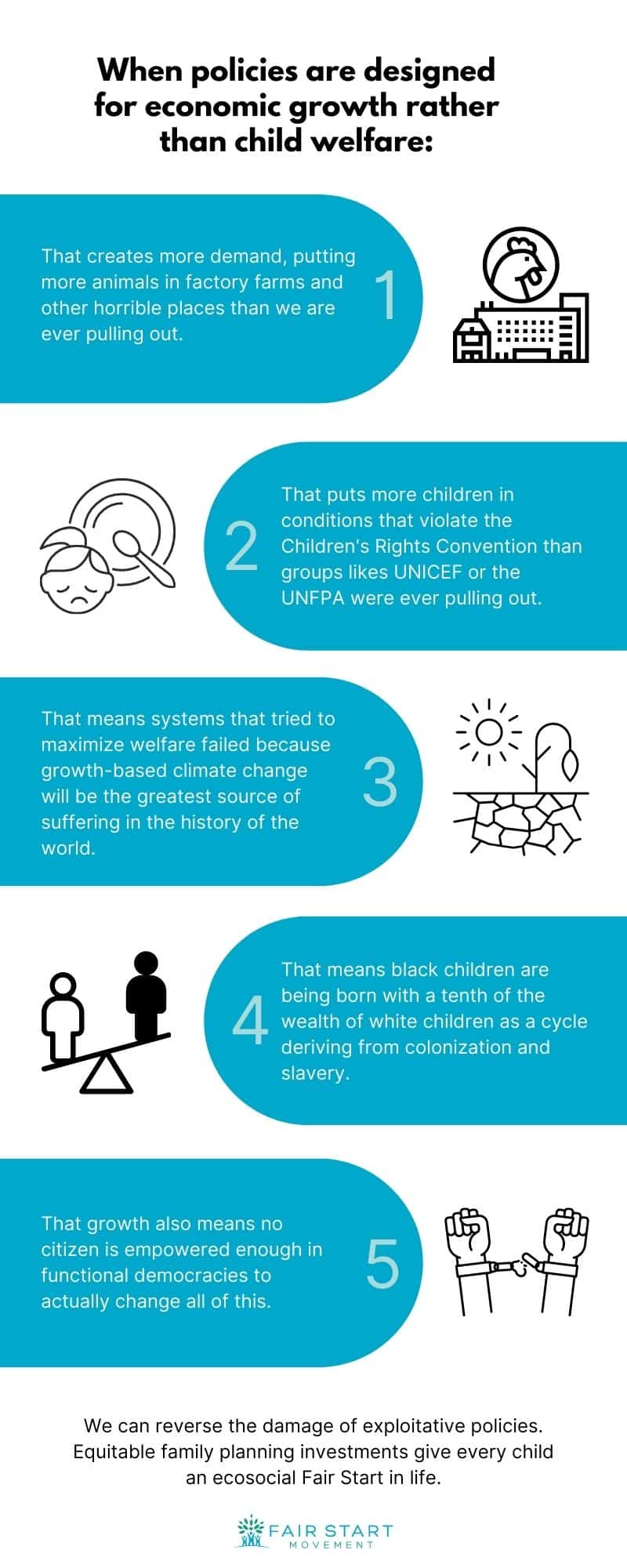
How is it not racist omit as a driver (and also omit research showing the right to override racist entitlements by all means effective) of many stories a system of birth entitlements where children of color get a tenth or less of the wealth as white kids, are largely excluded from the political system, and bear the deadly cost of an ecocide they did not create?
We would and should ostracize anyone who refused to hire black people. Why not identify, reform or if they cannot be reformed, ostracize anyone backing largely old white make billionaires whose wealth is being made at deadly cost to millions of black children, wealth that could be moved to still save lives? There is a bright line test for this sort of racist, based on whether one supports universal birth equity or not, now pending before the United Nations.
The omissions hid – as many in the Fair Start Movement did in former work – a process that would lead to largely white and wealthy children being enriched from growth-based investments, at deadly cost to mostly black children. Instead, they reported from arbitrary baselines – the same thing that conservative Exxon, and liberal Cass Sunstein for that matter, did.
An analogy: The Times reporting on all of these matters of basic justice and political legitimacy/obligation, which impact the future majority in a way that will kill millions, would be like reporting on events in historic South Africa while omitting mention of the apartheid policy in place, and that policy benefitted those controlling the reporting. But in this case, the intergenerational and racial apartheid of assuming birth, developmental, and emancipatory benefits will kill countless more people.
Concentrations of wealth and power like the Times – like those in white South Africa – did not create value. They helped ensure rules for the game, and most importantly the first rule of who we should be in terms of the creation of power relations, to move the key costs on to others, and to create deadly criteria for truth (academic hierarchies based on birth inequity, for example) and value (like market demand created by not investing in birth and development conditions for all children, but rather exploiting their needs) by ensuring the average person could not patriciate in the rulemaking and was born more as a worker and consumer, than an empowered constituent. Their wealth is owed back, and the demand overrides any government’s right to block the taking of the wealth because the process of investing in equitable birth and development positionality is what makes governance inclusive, capable of representation, and hence legitimate.
TAKE ACTION
The New York Times leadership, including Joseph Kahn, is personally liable (as many in leadership elsewhere are) for the costs and benefits of a deadly but fixable systems of birth, developmental, and emancipatory positionality. We are all liable for the costs and benefits of our birth, developmental, and emancipatory positionality, and can choose to offset them and be obligated to legitimate systems, coming under their protection, or not.
He and others are liable for making choices and living lives that contradicted their own demonstrated values, like enjoying the absence of heat waves, while ensuring others could not do the same. He and others made choices for the vulnerable, robbing them of their freedom.
Right now most nations treat their constituents as economic inputs, consumers and workers designed for growth, rather than citizens with an equal and effective voice in their political systems. But it’s unclear why those created as economic means would ever have to follow the law, including the entitlements driving the loss of freedom.
If we are in quantity and civic quality created as workers for factories, and consumers for shopping malls, and not created as empowered and influential citizens in town halls where we make the rules, what democratically made laws protect the entitlement of the mall owners? This is not socialism or capitalism but basic constitutionality.
Nonviolence in engagement is crucial, but what seems clear is that the state also cannot use violence to halt constituting an equitable future – via things like care modeling reforms – because it would have no authority to do so.
Background reading:
Between 1948 and 1968, when the United Nations and member states should have been shifting their power from the top down systems of coercion protecting existing entitlements to bottom up systems of inclusion and empowerment. They should have begun the process of inversion. They did the opposite.
Controlled by a handful of mostly white and wealthy men whose criteria for evaluating truth and value came from the castes in which they were born and saw the world, through various mechanisms they avoided the shift from to down power to button up inclusion by conflating the act of having children and not having children under a veil of personal autonomy or privacy, failing to include share equity and children’s rights. They used a mangled version of freedom – freedom from taxes, from governance and regulations, from obligation to animals and the environment, freedom from duties to others, etc. to benefit at cost to others, causing the current state of world affairs. It was an immediate, narrow version of freedom, with one’s true freedom – based on our personal histories and positionality relative to others, veiled behind privacy.
What good is the right to terminate a pregnancy if you die in heat waves driven by others, because you could not afford air conditioning.
More specifically, they treated having children as an act of autonomy, bundled up with the act of not having kids, because that form of autonomy would define the concept of power in a way that avoided questioning certain entitlements. The dangerous and powerful were the men with guns in government, and the castle of the home was an autonomous zone to be protected from it. That’s not the definition of conception of power that makes democracy work – it was used to make listeners assume the status quo for certain entitlements, like generational wealth, that should have been examined.
Power is any form of human influence, the mass aggregate of human activities that is killing millions in the climate crisis, and it begins as we – and our relations to others – are created fundamentally through birth and development. Watch for others entering the world, not the leaders with money and guns they will become. This was power over others, not self-determination for all, and the misconception operated mostly by taking the element of time out of the equation, and assuming certain relations rather than requiring birth and developmental self-determination. But families are not just in the social contract; they are constitutive of it.
Young would-be parents have a first and overriding claim to societal resources if used to parent us into a better future, using metrics that combine to create a threshold above which children may be born, but beneath which no child should be born.
Kahn fails this binary, threshold test, because his editing decisions omitted it – for their own benefit and at cost to others.
Why does the baseline matter?
Without this it would be physically impossible to be free because we could not limit who has authority, power and influence over us. We could only try to limit who represents us – not who actually has – day to day – influence and power over us. Free persons will see themselves as first obligated to persons who will parent and empower their children into emancipation, rather than first ruled by those at the top of the influence pyramid, e.g. officials, the wealthy, CEOs, celebs, etc., because all entitlement to influence derives from the governed and their primary and equitable positioning to self-determine, rather than government and current influencers, which have no inherent authority.
Would-be mothers who will physically constitute the future have the first right to use the most effective means to obtain the resources they need, to ensure freedom for all, and more of a right than the men with guns in government who masquerade as their representatives because there is no coherent, and necessarily primary, “we” without this override function.
The United States prides itself on being a free nation, but it uses a conception of freedom that starts by exploiting the most vulnerable, at the nexus of our creation. Look for a minimum threshold of wellbeing for future children and animals, and you won’t find one because they are both already earmarked for use in growth.
Had Micah Johnson, instead of filling five police officers, turned his attention to fossil fuel executives in demanding reparations for would-be black mothers harmed by the crisis and inequitable positioning in responding to it, the state would have not been able to legitimately block any nonviolent efforts by Micah to get the funds.
It should be the beneficiaries of a set of rules premised on inclusion for their legitimacy, but which instead fundamentally exploit and exclude, should carry the risk of violence in any confrontation over entitlements (which will mostly be reactionary) it creates. Justice, at base, will mean their not being allowed to benefit from an illusion of including and empowering others.
Many over the years had said that Fair Start Movement was true in its assessment, but that the goals were unrealistic. In a world where a few like Kahn have massive influence, targeting them to admit liability and transfer wealth in a way that would save countless lives – so that we may orient from truly self-determining baselines and die free or self rather than other-determining – is totally realistic, and underway. Who else will be held accountable for the deaths?
Wikipediais a free online encyclopedia, created and edited by volunteers around the world and hosted by the Wikimedia Foundation. There is evidence that many of the articles contain claims that do not account for a key factor that alters their veracity. For example, this article leads with the claim:
The Center for Biological Diversity is a nonprofit membership organization known for its work protecting endangered species through legal action, scientific petitions, creative media and grassroots activism.
It is now widely accepted that individualized attempts to protect endangered species were undone, and are being undone, by insufficient neonatal and child welfare policies designed to enable growth and which drive climate and other macro changes in our ecologies. The Center accepted and benefitted from these policies, as does the Wikimedia Foundation.
To further values like biological diversity, or mercy for individual animals, entities would need to include those values in the first premise of who humans should be and become in terms of the creation of basic power relations, and entities undo the values if they do not include them. While including those values in the premise is not popular with funders or seemingly progressive media whose wealth derives from inequity, that does not change the reality of the impacts – including suffering and death – and the justice owed for those impacts.
An entity either starts with a measurably inclusive and thus liberating system that accounts for the birth, developmental and emancipatory positionality of its members, and relative costs and benefits, or they do not. There is no evidence the Center or Wikimedia Foundation do.
Not doing so risks millions of lives as well as trillions of dollars in climate reparations, and illegitimates political systems by treating subjects as means bound in inequity, rather than empowered ends from whom governance derives. If one wanted to decolonize wealth and the future, one would have to start from a position of not punching down on children and animals – and that requires a constitutive threshold.
Many involved in the Fair Start movement had to, in prior employments at nonprofits, governments, media corporations, and universities, omit crucial facts about inequitable growth impacts that were actually undoing the public benefits the organizations claimed to create, and as such helped illegally enrich mostly white children at deadly cost to millions of children of color – hiding massive liability and skewing the baseline for crucial climate reparations.
In one case a member of a prominent and wealthy family funding animal law projects insisted on omitting the role inequity and growth on their charitable impacts claims, knowing these omissions were hiding drivers doing more harm to animals than the funder’s work has done good. They feared how full-spectrum evaluations of claims, costs and benefits, around the climate and related crises, would impact the family’s wealth.
The Center and Wikimedia are hardly alone. Media, like the New York Times Co., routinely misreported the climate crisis in a way that exacerbated it, urging along with many animal protection organizations the sale of vegan products in growth-based economies that were doing more harm than the dietary change was doing good. They are accountable, and if reparations are not paid, the children of their leadership will inherit the debt for the deaths they enabled, when those children become adults.
Many supporters of the Fair Start Movement were urged by funders in their work with other nonprofits to ignore equity as a base value, and to focus downstream, creating false silos like environmentalism, animal protection, human rights and democracy, racial justice, etc. They left out crucial facts while claiming to create public benefit they knew was being undone by inequity in creation under a system liberals, conservatives and almost all shades of political affiliation use. This helped illegally enrich mostly white kids, the children of funders. at deadly cost to millions of black children. There is a way to mitigate the harm – prioritizing the self-determination of all future children, by all means effective.
For all the good progressives’ think Klein did, by the numbers his pronatalism – urging women to have kids to grow the economy – did more harm. Klein is especially known for his promotion of veganism as a form of social justice, especially beneficial to animals. Like Vox, Klein misleads about the impact of food reforms.
Many involved in the Fair Start movement had to, in prior employments at nonprofits, governments, media corporations, and universities, omit crucial facts about inequitable growth impacts that were actually undoing the public benefits the organizations claimed to create, and as such helped illegally enrich mostly white children at deadly cost to millions of children of color – hiding massive liability and skewing the baseline for crucial climate reparations.
Fair Start supporters have interacted with funders and plant-based food investors who wanted to make money on inequity and growth, even when it harmed animals and future generations on balance, and interacted with former animal rights activists who were now invested in or otherwise benefitting from inequitable growth-based markets.
They were willing to greenwash to further veganism, even at cost to animals. They were herding the well intentioned towards buying their products, in the middle of a climate catastrophe.
Here are eight metrics, and how then can be used to assured share equity entitlements, including reparations for climate harms. We cannot evade impacting all these values when we have children, hence Singer’s focus on animal liberation as an abstract concept accomplished neither liberation for humans or nonhumans.
Welfare – ensuring things like health, nutritional and educational outcomes that are measured based on the world as it would have been had the United Nations in1948 actually used self-determination – rather than reproductive isolation of families – as the standard for who we should be.
Nature/environment (e.g., measurable emissions) – limiting emissions to levels that would not have caused the crisis, generally less than 280 ppm, and requiring the restoration of full biodiversity towards optimal ranges consistent with low-end UN growth projections.
Having an equal and influential share to determine all laws, including constitutional provisions – limiting representative ratios to those fitting with low-end UN growth projections.
Democratic, not economic, levels of trust – Metrics for trust among citizens must show their willingness to trust each other with legislation, and all lesser included forms of trust that implies.
Real efficiency – Ensuring outcomes, like gross domestic product, are based on the inclusion of others as equals, not exploiting others in disregard of the capacity of all to contribute highly.
Self-determination, or share equity, to limit the influence others have over you – Whether you are free requires an amalgamation of the other metrics above.